Australian parliament to apologise to ‘Black Power’ sprinter

Tommie Smith (centre) and John Carlos (right) showing the Black Power salute in the 1968 Summer Olympics while Silver medalist Peter Norman (left) wears an OPHR badge to show his support for the two Americans. Photo: Wikipedia

An Australian athlete who supported the famous Black Power salute of two black Americans at the 1968 Mexico Olympics was Monday to be the subject of a parliamentary motion that he be given an apology for how he was treated.

Peter Norman was the silver medallist in the 200m at Mexico City, and stood on the dais alongside United States athletes Tommie Smith and John Carlos, who both put a black-gloved fist in the air in a civil rights protest.

Norman, who died of a heart attack in 2006, backed their gesture and wore an Olympic Project for Human Rights badge in support.

Lawmaker Andrew Leigh said on his website that parliament would debate his motion to apologise posthumously to Norman “whose courageous stance for racial equality got him blocked from competing in subsequent Olympics”.

The motion apologises “for the wrong done by Australia in failing to send him to the 1972 Munich Olympics, despite repeatedly qualifying; and belatedly recognises the powerful role that Peter Norman played in furthering racial equality”.

Leigh, who has the support of Norman’s family, said while the selectors for the 1972 Games had passed away, he did not think Australia “did the right thing by him”.

“I don’t think we gave recognition to somebody who’d done so much to stand for racial equality,” he told the Australian Broadcasting Corporation.

Norman ran a time of 20.06 seconds in Mexico, and afterwards when the two American athletes said they were going to give the Black Power salute on the podium, said: “I’ll stand with you.”

The Australian Olympic Committee rejected the suggestion that Norman was “punished” for his role in the powerful gesture.

“He was not shunned by the AOC,” a spokesman said.

“As to his non-selection in the 1972 Olympics, it had nothing to do with the incident in Mexico City four years earlier.”

Australian Olympic historian Harry Gordon, who was present during the Mexico medals presentation, described Norman as “a sincere young man whose favourite tracksuit was adorned with the words ‘God is love'”.

He wrote that Norman was cautioned by Australia’s chef de mission at the time to be careful about his public statements but there was no punishment or reprimand. – AFP
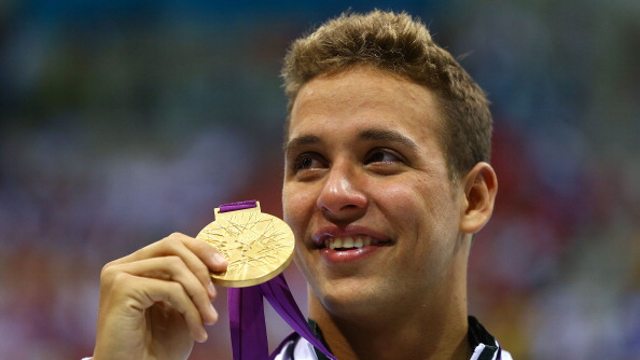
Race an issue while white South African swimmers win gold

Chad le Clos with his gold medal, not good for South Africa's image as a "black" country

While white South African swimmers, Cameron van den Burgh and Chad Le Clos, have won  gold medals at the Olympic games in London, complaints that  “Team SA” is “too white” have surfaced. In a country where affirmative action requires black majorities everywhere, even racial quotas for sports teams, the sight of two young white men winning gold medals have jarred local sensibilities.

On Twitter, one member of the black elite tweeted “Whites will be hugged by the likes of @Sentletse @Mabine_Seabe @khayadlanga because of that Gold. #2012London I’ll wait for Caster’s Bronze”. Caster refers to Caster Semenya, the black female 800m athlete whose career has been marred by a controversy about her gender.

Whereas white faces are almost never shown in leadership positions on state TV, many of the black presenters for the Olympic games have enthused about “our gold medals” won by the the two white swimmers.

Sapa reports that former ANC Youth League president Julius Malema has defended the racial make-up of the SA Olympic team after suggestions that it was too white.

Malema was asked about the team during an interview with British Sky News on Tuesday.

The Sky News interviewer said: “It did strike me that there weren’t many black faces in the group for a black majority country.”

Malema said the team members were chosen because they were qualified.

“We think that we’re a non-racial country and all South Africans who have qualified to make Team SA should carry the flag proudly, and we support them,” he said.

“It’s not [any] more about the issue of colour.”

Malema said there was still a problem with poor communities not having access to sport. Sport Minister Fikile Mbalula was working to resolve this.

“It’s quite a serious challenge, but we’re still very proud of our Team SA,” Malema said.