Nelson Mandela welcomed Bantustans

The NP under FW de Klerk started the negotiations with Nelson Mandela “well”, but abandoned most white demands in September 1992, leading to the current growing assault on property rights, says Hermann Giliomee. He recently gave a lecture in honour of Richard Elphick at Wesleyan University, Middletown, Conn, USA.

In 1960 Mandela along with mostly white communists decided to form an armed body, later called Umkhonto we Sizwe, to embark on a campaign of sabotage and terror against whites and black moderates, now euphemistically called the “armed struggle”.

Albert Luthuli, the incumbent ANC president was firmly opposed the ANC embarking on a terror campaign.

Two Russian historians, Irina Filatova and Apollon Davidson, in The Hidden Thread; Russia and South Africa in the Soviet Era (Jonathan Ball), write that Mandela was present as a member of the SACP’s central committee:

Using the ANC’s distinction between members of the SACP, i.e. communists, and members of the ANC proper, or nationalists, the two [Russian] historians conclude there was no nationalist present when the SACP decided to embark on an armed struggle.

The controversy intensified when the Mandela Foundation released the 627 page original manuscript of Mandela’s account of his life, which was smuggled out of jail. It now appears that some very interesting passages was expurgated from the prison manuscript in producing the printed version of Mandela’s autobiography A Long Walk to Freedom (1994).

The unexpurgated prison manuscript include detail particularly on how Mandela wanted to deal with the Bantustans.

From the mid-1970s the tide turned against the white regimes in Southern Africa. The economy became bogged down by the sudden jump in oil prices together with a slump in commodity prices and growing demands from a much more assertive black work force.

The collapse of the dictatorship of Portugal in 1974 was the start of rapid withdrawal of Portugal from its Southern African colonies. Soviet-aligned regimes came to power in Mozambique and Angola. A South African attempt to intervene in Angola misfired badly. The Soviet government airlifted some 30 000 Cuban troops to the country. Secretary of State Henry Kissinger warned Vorster that due to opposition in the American Congress the Ford administration would not be able to counter further Soviet intervention in southern Africa.

In June 1976 a major uprising erupted in Soweto, near Johannesburg, and quickly spread to townships across the country. The political isolation of the white community was starkly exposed. The situation was so serious that on 8 August 1976 the Vorster cabinet had on its agenda the issue of the release of Nelson Mandela, which was by then twelve years in jail. There is no record of the decision.

What would have happened if Mandela were indeed released in 1976? Neville Alexander records that in 1971 he and Mandela debated using the apartheid channels, flawed as they were. Two years earlier, in 1974, Mandela had written a secret memorandum, entitled “Clear the obstacles and confront the enemy”, that was smuggled out.

In this document Mandela confronted the fact that the government of the Transkei, which was the putative homeland of most Xhosa, had opted to take the apartheid style independence in 1976. In terms of a 1971 law, Mandela who was born in the Transkei, would lose his South African citizenship.

Undeterred, Mandela wrote in his 1974 memorandum that the ANC faced an entirely new development: the independence of the Transkei, which was sure to be followed by other Bantustans. Mandela wrote: “The Transkei will have an independent legislature, judiciary and executive and may control its foreign relations” and then added:
“For the first time since conquest the people will run their own affairs. Now Africans will be able to be judges, magistrates, attorneys-general, inspectors of education, postmasters, army and police officers, and they will occupy other top positions in the civil service. Would it not be far better to consider independence as an accomplished fact and then call upon the people in these so-called free territories to help in the fight for a democratic South Africa?”

If a free Mandela had pushed for this policy of recognising the Transkei’s independence the strains in the ANC may well have become too great to contain. A major split may well have occurred in the movement, putting South Africa on a quite different course than one it took between 1976 and 1990.

Apartheid South Africa: Reality vs. libertarian fantasy

mercer_ilanaby Ilana Mercer

[followbutton username=’IlanaMercer’ count=’true’ lang=’en’ theme=’light’]

Like Ilana Mercer’s Facebook page

One needn’t propagate lies about the state-enforced segregation that was Apartheid in order to condemn it.

Yet in defiance of fact, one prominent libertarian economist has gone so far as to assert that apartheid was “a version of Castroite socialism.”

How can one credibly say that about a country that in its heyday had a gold-backed currency, enjoyed the confidence of investors the world over, sported low to no government debt and similar rates of inflation, the most opulent and spectacular shopping malls, the freest, finest medicine I’ve experience in life on three continents, near-unfettered legal access to handguns (for whites) and relatively secure property rights for the same minority? You can’t. Not if you wish to retain intellectual credibility.

Racial segregation, inequality under the law, injustice: yes, yes, and yes. But “Castroite socialism”?

Not quite as embarrassing, another wag asserted the following: “Apartheid was a system of government control and regulation to artificially keep South African blacks from competing against whites in the marketplace.”

This is only partly true. The problem with half-truths is that the conclusions that flow from their premises will likewise be deficient.

Dogma without data

Distorting the facts about Apartheid’s raison d’être does nothing to promote the truth.

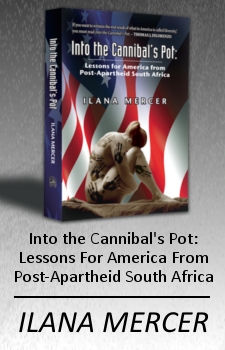
“Hermann Giliomee – whose grand historical synthesis and primary source exegesis (“The Afrikaners: Biography of a People”) is referenced extensively in “Into the Cannibal’s Pot: Lessons For America From Post-Apartheid South Africa” – has concluded that Afrikaner anxieties were overwhelmingly existential, rather than racial. Leading thinkers at Stellenbosch University devised a system for the National Party to ensure “the security of the Afrikaners as a dominant minority.” (More about Apartheid as “A Strategy for Survival,” in “Into the Cannibal’s Pot,” pp. 67-70.)

As noted in the same book:

Anybody who lived … among Afrikaners during the apartheid era can testify that crime and communism were foremost on their minds. To rationalize the cruel, Kafkaesque laws of Apartheid, Afrikaners spoke of the Swart Gevaar (which meant the “Black Threat”), and of the Rooi Gevaar (the “Red Threat”). My Afrikaner neighbor would regularly admonish me for my incipient liberalism: “You want black rule so badly, look around you at the rest of Africa! Anglos like you simply don’t understand what’s at stake.” (P. 70)

The sweeping non sequitur that follows from the partial truth aforementioned has it that “black poverty” and misery stemmed solely from Apartheid’s “suppression of free market forces.” This is economic reductionism, typical of the impoverished analysis of South Africa, offered so authoritatively by libertarian economists stateside.

Apartheid is a necessary explanatory variable in the “black poverty” equation, but never a sufficient one.

As expounded in “Into the Cannibal’s Pot,” “the maze of racial laws that formed the edifice of Apartheid” had been dismantled by the offending National Party almost a decade before the transition to democracy; by 1986, the party had already brought down Apartheid’s pillars, the “pernicious influx control laws,” for example.

In all, South Africa has now been racially desegregated for almost 28 years.

Documented in the same book are these immutable facts: “Twelve years into the Nationalist government’s rule, the rate of literacy among the Bantu of South Africa was already higher than that of any other state in Africa, or that of India. From the 8.6 million recorded in the 1946 census, the black population rose to 17.4 million in 1974 and 28.3 million by 1991. [In-migration from the north was just about non-existent.] From the 1940s to the 1990s, life expectancy for blacks soared from thirty-eight to sixty-one years!” (P. 178.)

“Since the dawn of democracy in 1994, life expectancy has plummeted by nine years. Crime has reached crippling levels … and is certainly much higher than in the Old South Africa. … unemployment had jumped from 19 percent in 1994 (before ‘freedom’) to 31 percent in 2003 (after ‘freedom’), steadily rising until, in 2005, it stood at 38.8 percent. The trend is consistent and persistent.” (P. 178)

These stubborn facts collapse the politically pleasing but reductive theory, promulgated by libertarian know-nothings, that holds Apartheid to be the sole cause of black South Africa’s dysfunction, economic and other.

As the pesky facts attest, black dysfunction in racially desegregated South Africa is way worse than it was during state-enforced segregation. In fact, it now resembles that of the rest of Africa.

Apartheid was reprehensible. But dogma denuded of data does nothing to bolster this uncontested, incontrovertible position.

Lite libertarianism vs. the right kind

Herein lies the difference between the paleolibertarian analysis and what this column has termed the lite libertarian one, philosopher Hans-Hermann Hoppe being the finest example of the former. The rest fall into the latter, lite category.

A crucial difference between lite libertarians and the right kind is that to the former, the idea of liberty is propositional – a deracinated principle, unmoored from the realities of history, hierarchy, biology, tradition, culture, values.

Conversely, the paleolibertarian grasps that ordered liberty has a civilizational dimension, stripped of which the libertarian non-aggression axiom, by which we all must live, cannot endure. “The pursuit of the … paleolibertarian ideal,” explained Catholic philosopher Jack Kerwick, Ph.D., “is the pursuit of an ideal of liberty brought down from the clouds to the nit and the grit of the history and culture from which it emerged.”

Into the Cannibal's Pot

‘The color of money’

Indeed, the truth about the Old South Africa is far more nuanced. As this writer tried mightily to explain during an RT broadcast (embedded), “The color of money” did speak loud and clear to enlightened self-interest in Apartheid South Africa.

“‘The market is color-blind,’ said Milton Friedman. ‘No one who goes to the market to buy bread knows or cares whether the wheat was grown by a Jew, Catholic, Protestant, Muslim or atheist; by whites or blacks.’ As Thomas Sowell put it so well, ‘prejudice is free, but discrimination has costs.’ Added South African academic, Steven Farron: ‘[P]eople demand that their governments restrict the economic and occupational success of specific ethnic or racial groups. However, when the same people act as individuals or business owners, they actively resist and/or circumvent these restrictions.’” (P. 127)

All people do this. Apartheid South Africa was no different.

During Apartheid, white industrialists – miners especially – “put continual pressure on the South African government to allow them to use more black labor.” Afrikaner farmers also chose overwhelmingly to ignore racial job quotas, despite their own racist predilections, and also despite high unemployment among rural Afrikaners. Well before the official dismantling of Apartheid laws (carried out, as mentioned, by the white minority government), the agricultural sector, skilled and managerial jobs included, came to be dominated by blacks. As was the semi-skilled labor market – clothing, furniture, millinery, sheet metal, construction, mining, baking. Clearly, whites, acting as individuals, chose to subordinate ethnic advancement to optimize their livelihood. (P. 126)

Those half-truths again

“Free market economists (the only kind worth consulting) have long since insisted that the rational, self-interest of individuals in private enterprise is always not to discriminate. Arguably, however, the good economists, while certainly not wholesale liars as are their Keynesian counterparts, are still offering up a half-truth. Rational self-interest does indeed propel people, however prejudiced, to set aside bias and put their scarce resources to the best use. But to state simply that ‘discrimination is bad for business’ is to present an incomplete picture of reality. This solecism stems from the taint the word ‘discriminate’ has acquired. The market, by which we mean the trillions of capitalist acts between consenting adults, is discriminating as in discerning – it is biased toward productivity. Hiring people on the basis of criteria other than productivity hurts the proprietor’s pocket.” (P. 127)

Thus, we can be fairly certain that, absent racist affirmative-action laws, the market would reflect a bias toward productivity. In other words, what the good economists are loath to let on is that a free market is a market in which groups and individuals are differently represented. Parity in prosperity and performance between differently able individuals and groups can be achieved only by playing socialist leveler.” (P. 128.)

Freedom vs. egalitarianism

Contra the economic reductionism of the lite libertarian, free-market capitalism is a necessary but insufficient condition to sustain freedom in a country of South Africa’s complexion.

The truth absent from the phantasmagorical formulations critiqued is this: Economic freedom does not necessarily reduce so-called wealth inequality. Inegalitarainism is a feature of a free economy. If history is anything to go by, certain minorities will achieve prosperity from poverty, no matter how gravely the state and society impede them. Jews did it in Europe. Levantines and Indians in Africa and the Middle East. Chinese in southeast Asia and everywhere else they go. Europeans in South Africa.

Moreover, “While all people want safety and sustenance for themselves, not everyone is prepared to allow those whom they dislike and envy to peacefully pursue the same.” (P. 4) Free-market capitalism is not enough to safeguard ordered liberty in racially riven societies like South Africa, where the majority will always covet the possessions of immensely wealthier minorities and associate these riches with racial privilege.

Ultimately, the rights to life, liberty and private property will forever be imperiled in a country whose constitution has a clause devoted to “Limitation of Rights,” and where redistributive “justice” is a constitutional article of faith. (P. 101)

This, paleolibertarians (all three of us) know too well.

In “The Cannibal” chapter entitled “Saving South Africans S.O.S.,” secession is explored as one solution, it being a species of the private-law society delineated by Hans-Hermann Hoppe. Hoppe, of course, has never been afraid to speak to the “unequal civilizing potential” (in James Burnham’s coinage) of different people and peoples.

Against dog-ate-my-homework argumentation

For the sins of man, hard leftists blame society, and the lite libertarian saddles the state.

In its social determinism, the lite libertarian’s “the-state-made-me-do-it” argumentation apes that of the left’s “society-made-me-do-it” argumentation. Both philosophical factions implicate forces outside the individual for individual and aggregate group dysfunction.

In the New South Africa, the left’s “argument” has been taken to a new level of abstraction: “The legacy of Apartheid” is said to explain the unparalleled depravity of Nelson Mandela’s dominant-party mobocracy.

While the state is a worthier culprit than society, both are analytical equals in as much as they absolve the individual of responsibility for his actions. For the philosophy of freedom is predicated on individual responsibility.

“Societies are only as good as the individuals of whom they are comprised; individuals only as good as their actions.” (P. 4) If the sanctity of life is the highest value in a civilized society – then Mandela’s South Africa is uncivilized in every way possible.

The unvarnished truth about democratic South Africa is that it is “now preponderantly overrun by elements, both within and without government, which make a safe and thriving civil society impossible to sustain.” (P. 4)

Although absolutely essential, free-market capitalism is insufficient to the task of tackling this tide of sinecured criminals.

[followbutton username=’IlanaMercer’ count=’true’ lang=’en’ theme=’light’]

Like Ilana Mercer’s Facebook page

Britain likes anarchy, especially in South Africa

by Dan Roodt

Over the past week or two, I have been embroiled in a polemic in Business Day and elsewhere about South African and Afrikaner history. First of all, I challenged the ubiquitous assumption that apartheid visited some form of genocide upon South African blacks. Neither did apartheid “withhold education from blacks” as historian Hermann Giliomee has so amply demonstrated in a few recent articles.

I got some irate replies from Mrs. Louise Asmal, wife of the destructive former minister of education Kader Asmal. Mrs. Asmal is Irish, therefore a foreigner enthralled by the stereotyped views of our history proliferating abroad. Dr. Wilmot James of the Democratic Alliance also responded to my “apartheid revisionism” by regaling us on the apparent injustices suffered by his family under the previous South African government.

However, any injustices from 1948 to 1994 must pale into insignificance next to the injustices, nay, atrocities suffered by Afrikaners since 1994, not to mention much of the nineteenth century and especially the Anglo-Boer. One letter writer to Business Day had the temerity to suggest that 34 000 Boer women in the British concentration camps had died as a result of “cultural factors” such as a lack of hygiene.

If only the Germans had thought of that one: the Jews died at Auschwitz and Dachau “because they were dirty”. Take that, you dirty Jew! There you have it, you vile Afrikaner miscreant!

I have often wondered at the source of British arrogance. When I worked in Johannesburg dealing rooms, we were often visited by high-flying financiers out of the City of London with dirty collars and cuffs. In the Johannesburg heat you also became aware that these people, although living in five-star hotels, did not make the morning shower one of their regular habits.

More often than not they were nothing short of uncouth, lacked any form of culture and were given to getting drunk ever so often. Yet these British yobs in dirty shirts with double cuffs sporting flashy cuff links radiated a sense of know-it-all superiority that was a wonder to behold.

The presenter of Top Gear, Jeremy Clarkson, recently fulminated against his own countrymen, saying about Britain: “We are the country that invented the concentration camp.” Notwithstanding Tony Blair’s lies about Iraq’s weapons of mass destruction, the British sense of moral superiority has never been stirred, let alone shaken.

Talking of James Bond, that great hero of fiction and film, it reminds me of something else: Britons are, like African warlords, “licensed to kill”. That is why it is almost futile to mention any past or present British war crimes and human-rights violations. It will only elicit boredom or the impression that one has broken some rule of etiquette merely by mentioning it.

Currently I am reading a book by one Willem Steenkamp, who is apparently the former military correspondent of the Cape Times. Entitled, Assegais, drums and dragoons: a military and social history of the Cape, it is irritating in parts, because one senses that the author is trying to offer a politically correct re-reading of early Cape history. For example, he spends a whole chapter arguing that the seventeenth and eighteenth centuries were marvels of racial integration and intermarriage so that we are all in fact “Coloureds”. If so, then it must be a genetic miracle that Afrikaners from the oldest families still manage to produce offspring that appear even more European in features and in skin colour than the children of many European nations. Every time I drive past an Afrikaans high school, I am simply amazed at the incongruous sight of all these beautiful, gamboling white children in the African sun. On my mother’s side I have a lot of Botha blood, Botha being one of the oldest and most common Afrikaner surnames, going back to the early Cape. Yet a Dutch TV team, with an American geneticist in tow, replete with Harvard Ph.D., gave me a DNA test. To their utter disappointment, I was found to be of 100% European ancestry, or if you prefer, white, that dreaded concept.

However, if one disregards Steenkamp’s attempts at political correctness, the book contains some interesting material on the building of the Castle at the Cape of Good Hope in the seventeenth century. He quotes an author, Mentzel, who described life at the Castle thus:

“…for a man who loves method it is a veritable joy to observe the excellent order maintained in the Castle. The whole work of the day is mapped out by the clock and is performed with the utmost punctuality.”

To some extent, those two sentences describe much of the Afrikaner ideal for South Africa, one we had lived up to for most of the time when he had any say in government. On a recent visit to the Pretoria archives, I was astonished to see the meticulous way in which the early pioneers had immediately set about recording the meting out of the first farms in the Transvaal in the 1840s. I twice saw another of South Africa’s surfeit of Bothas, PW, at his home in the Wilderness near George, and on both occasions he repeated the words to me:  “I believe in orderly government.”

The Castle at the Cape of Good Hope is something of a symbol of that order which we have vainly tried to maintain in South Africa, and not only because the Castle was used as an emblem for the old South African Defence Force, prior to the ANC’s takeover.

Whence the need for such a fortress in the seventeenth century? From the very moment that Jan van Riebeeck and his fellow pioneers set foot in the Cape on 6 April 1652, they had to protect themselves from two constant enemies: the cantankerous, often violent Khoikhoi or “Koina” as Steenkamp calls them,  as well as, of course, belligerent Britain or England as it was known then.

During the seventeenth and eighteenth centuries, England was nothing less than a pirate nation, attacking merchant ships from other nations at will, much like Somalian pirates do today in the Indian ocean off the horn of Africa. Again and again the Netherlands had to fend off the English pirates and troublemakers, until the courageous Dutch Admiral Michiel de Ruyter sailed up the Thames and all but destroyed the English fleet. That gave us a few decades of respite.

Unfortunately, the treacherous British who changed alliances as it suited them, eventually got the upper hand and since then our misery here in South Africa has not ceased. Instead of “privateers” holding a commission from Queen Elizabeth I or some other monarch, a licence to rob and kill like James Bond, we are now faced with a motley collection of NGOs, churches, propagandists and rapacious mining magnates who would gladly see South Africa reduced to rubble if only they could make a quick buck in the process.

In the City of London the current anarchy and mining strikes must be a boon to traders who would be long gold and platinum, but short the rand and South African government bonds. They also propagate “land reform” in the hope of destroying our agriculture so that we would ultimately be completely at the mercy of British NGOs like Oxfam or Save the Children. Except, it is not our children that they will be saving.

In this way, there is a strange synergy between the British privateer, his profit motive that does not balk at bribery of the odious ANC officials, and the strange breed of histrionic, publicity-seeking “do-gooder” that also abounds in the British Isles. The latter have wrought almost more evil than the looting privateer or “businessman”. One such individual was Father Trevor Huddleston of the Anglican Church. Without Huddleston and his various public and private stratagems, the ANC terrorist regime would never have come to power in South Africa and we would have been spared the current descent into anarchy.

From my reading of the facts since Huddleston’s fateful arrival in South Africa in 1945, the ANC would long have fallen by the wayside as just another failed, penniless black organisation with megalomaniac dreams. Huddleston more or less “created” – trained, indoctrinated and groomed – subsequently world-famous black heroes such as Nelson Mandela and Desmond Tutu.

The culture of licence, criminality, violence, prostitution and gangsterish “glamour” that characterised Huddleston’s Sophiatown, would eventually overwhelm the entire country. Of course, Sophiatown has been lionised by English authors such as Nadine Gordimer and Anthony Sampson, the first editor of the black Drum magazine. Gordimer even wrote a roman à clef, A world of strangers, with an ill-disguised Anthony Sampson as the main character, boozing in shebeens and chasing after township whores.

After 1948, Britain or at least Labourite Britain, launched a total propaganda onslaught against South Africa, aided and abetted by much of the local English media who have never shaken off their colonial, jingoist origins during nineteenth-century British rule. They have maintained their fawning, sycophantic dependence upon English so-called “liberal” ideas, together with their often irrational and pathetic sense of “being superior” to Afrikaners.

Recently , the ideal of Sophiatown during the 1940s and 1950s, that “multiracial” demi-monde, has triumphed over that of the Castle. Thanks to the English menace, we have come full circle since 1652. The “excellent order” that we have created by being disciplined and law-abiding, together with the prosperity resulting from that order, have been swept away.

Those periods of South African history when Britain and its callous officials dominated us, notwithstanding its hysterical clergy, inciting blacks or Khoikhoi against the indigenous white population, have always been characterised by the kind of lawlessness and mayhem that we are currently experiencing.

But we must also blame ourselves, in having allowed – despite the historical evidence – this catastrophe. Our forefathers could withstand Britain, for decades and even centuries. They fortified themselves against all those English ships out there and formed commandos of citizens to defend themselves and to maintain order. In fact, the commando system that the ANC abolished had been more than three centuries old!

Why have we been found wanting?

Apartheid evil is hype

by Dan Roodt

South Africa is listed in Samuel Huntington’s book as a country prone to a “clash of civilisations”. Hence the acrimonious exchanges that characterise South African discussions of politics and history.

The South African left scored a major propaganda victory some time in the 1980s when reformist National Party policies were vilified as the “apartheid crime against humanity”. The Truth and Reconciliation Commission compared us to the Nazis. Hyperbole reigned supreme.

How many death camps did John Vorster open up and how many mass graves have the BBC shown to the world? The BBC would surely have loved to find even one mass grave as testimony to Afrikaner evil, yet it could only report on rugby player Geo Cronjé’s supposed refusal to share a room with a non-white player a few years ago.

Further investigation of Mr Cronjé’s “crime against humanity” revealed it to be a red herring.

On Wednesday, I reminded listeners of 702 that all history, including apartheid, was open to interpretation. One black SABC journalist responded by saying that I was “revising history and her pain”. However, there is far more pain to come as we witness the shambles our country is turning into. Inevitably, unflattering comparisons are being drawn between the old and the new SA, unflattering to the post-1994 dispensation.

Apartheid revisionism is in the air. Historian Hermann Giliomee recently delivered a hammer blow to the truism that “apartheid withheld education from blacks” by pointing out that “syllabi of schools in the higher standard were the same as those in white schools”.

It is also completely false that Hendrik Verwoerd discouraged the study of science and mathematics in black schools; the main problem was the lack of qualified teachers, as it remains to this day. According to an insider within the Gauteng education department, the maths average among black matriculants is currently a hopeless 20%.

A refined and cultured man like Dr Verwoerd would have been highly shocked by the Limpopo schoolbook affair. No doubt he is “spinning in his grave” as that educational buffoon, Kader Asmal, once put it, but for entirely different reasons. The tragic demise of his educational legacy should fill us all with sadness.

Within an Orwellian climate of hysteria and cries of “racism!” whenever the anti-apartheid myths are exposed, historians and commentators will need great courage to rehabilitate our history to anything resembling the truth.

This piece also appeared as a letter in the Johannesburg Business Day.

‘Apartheid made maths difficult for blacks’ and other myths – historian Hermann Giliomee defends Bantu Education

By Hermann Giliomee

Bantu Education: Destructive intervention or part reform?

As the crisis of education in black schools has worsened, or rather become more evident, so the tendency to “Blame Verwoerd” has intensified.

Senzo Mchunu, MEC for Education in Kwazulu-Natal, declared in late July: “One of the points we found was a problem in Maths and Science. It was Verwoerd who made the subjects difficult because he thought blacks would be a threat to him’.[1]

Addressing the Limpopo textbook crisis on Talk Radio 702, President Jacob Zuma said: “What is happening today is what Verwoerd did, where the black majority were historically not given education. We are dealing with a system that had put black people back for centuries.” According to Zuma, Verwoerd created the textbook crisis in Limpopo. [2]

Redi Tlhabi, who interviewed Zuma on Talk Radio 702, expressed outrage over the president’s remark that he did not know who was to blame for the textbook scandal, but agreed with him about Verwoerd. “The president was right in that Verwoerd worked to create a system that was intent on stifling the black child and making sure that she or he did not thrive.” She added: ‘Today, in 2012, I did not expect that the ‘liberation party [the ANC] would want to further Verwoerd’s goals: to keep the black child poor, uneducated and deprived.” [3]

President Zuma’s comments attracted a retort from Mamphela Ramphele, a product of Bantu education and a previous UCT Vice-Chancellor. Speaking at an education conference she commented on the current state of black education: “The monumental failure in South Africa was not Hendrik Verwoerd’s fault but that of the current government”. She continued: “Children under apartheid’s ‘gutter education’ were better educated than children are today.”[4]

Hendrik Verwoerd, National Party Minister of Native Affairs from 1950 to 1958 and Prime Minister from 1958 to his assassination in 1966, remains one of the most complex figures in South African history. In the contemporary debate, he is, however, little more than a demonic figure, denounced and excoriated as the architect of all our misfortunes.

Equally, while his policy of Bantu Education looms large in the popular imagination it is very poorly understood. Despite the significant work that has recently been done by historians in this area, many opinion-formers’ knowledge of this policy does not stretch much beyond a notorious single quote by Verwoerd in a 1953 speech.

Although the Bantustans and Bantu education were inextricably linked, Bantu education could, to a considerable degree, also be considered on its own merits. This article attempts to focus only on some of the aspects of this system, such as funding and the relative value of mother tongue education, and not on the more ideological aspects like the attempt to use the schools to foster distinctive ethnic identities.

Verwoerd’s Bantu education signalled the introduction of mass education in South Africa. After 1994 a new regime has removed all forms of racial privilege, but black public schools remained in a state of crisis. It is important to go back to the founding years of the system to establish to what extent the roots of the crisis could be traced back to these years.

The indictment

The indictment of the education system Hendrik Verwoerd, Minister of Native Affairs, introduced in 1954 consists of several charges. The most important are:

  • He closed down a functioning system of black education that included some good mission schools like Lovedale and Healdtown
  • His policy based on ‘the assumption of an inferior potential of African minds’ was ‘explicitly designed to prepare blacks for a subordinate place in society.’[5]
  • He discouraged the teaching of Mathematics and Science
  • The policy deliberately starved black education of funds

Closing down a functioning system?

Missionary societies dominated the provision of black and coloured education before the accession of the National Party to power in 1948. In 1939 the Minister of Education in the United Party government admitted that two-thirds of black children were without any school experience whatsoever.[6] During the war years the government improved the provision of education to blacks considerably, but by 1950 less than half of black children between the ages of 7 and 16 were attending school, and only 2.6% of black pupils were enrolled in post-primary standards. The average black child spent only four years in school.

Among the mission schools there were a few excellent high schools, but, as a historian commented, the renowned reputation of these schools ‘should not obscure the fact that most mission schools were poor primary schools with large dropout rates’ and that the ‘mission system was breaking down at all levels.’[7] With the demand for education growing rapidly, schools had to take in far more children than they could teach effectively.

The state helped by providing salaries for approved teaching posts, but overall state aid was insufficient in a modernising economy. School buildings were dilapidated and classes overcrowded. Most schools were understaffed and there was a severe shortage of competent teachers.

In the mid-1940s both the United Party government and the Natives Representative Council, the main body for articulating black opinion, sensed that the system of black education was in need of drastic overhaul. The main sticking points lay elsewhere. There was firstly the question of funding.

ZK Matthews, the leading black authority on education and a prominent member of the ANC, demanded the modernisation in terms that, implicitly at least, meant apportioning resources for equal educational opportunities. But whites baulked at the expense. RFA Hoernlé, a leading liberal, observed that while a large number of the white voters do not mind  ‘native education’ as such, it would be suicide in most constituencies for a Member of Parliament ‘to advocate, let alone vote for, the proposal that whites should be taxed in order that natives could be educated.’[8]

Another major point of conflict was over the extent to which traditional black culture had to be made part of the school syllabus. Matthews argued for the ‘preservation of the African heritage and for using the powers of the vernacular languages to effect social rejuvenation.[9] Some ANC leaders, however, rejected any ‘Bantuization of native education’. Blacks had to be educated ‘to live side by side with Europeans’.[10] Developing proficiency in English was generally regarded as much more desirable than using the Bantu languages as media for instruction.

In 1954 the government took over the coloured and black schools that the state partly funded and moved control of black and coloured education from the provinces to central government. As part of his ambitious plan to overhaul black education Verwoerd insisted that black education had to be rooted in the ‘native community’. ‘It is in the interest of the Bantu that he be educated in his own circle. He must not become a black Englishman in order to be used against the Afrikaner.’[11]

To the extent that the policy tried to foster different ethnic identities in the black community it was a dismal failure, but that was not the sole rationale of the policy.[12] In , the decades that followed, however, the issues of promoting the Bantustan policy through the education policy and mother tongue education became hopelessly confused.

Both Werner Eiselen who headed the commission that laid the groundwork for Verwoerd’s policy, and Verwoerd himself, firmly believed in mother tongue education as the best form of education  A Professor of Anthropology before he became a chief inspector of native education in the Transavaal, Eiselen had a great respect for the particularity of blacks and genuine concern for the preservation of Bantu language and culture.[13] To him there was little doubt that blacks would learn better through their own languages.

Verwoerd received his secondary school education in the medium of English in Milton Boys School in Bulawayo before enrolling at the University of Stellenbosch. He became the first student in the country to write his doctoral dissertation in Afrikaans. In 1924 he received his doctoral degree, a year before Afrikaans was proclaimed an official language. Afrikaans quickly developed from a low-status language to one that could be used in all walks of life. Afrikaans-speakers, along with English speakers, now began to experience the benefits of what language expert Neville Alexander called “mother-tongue education from cradle to university.”[14]

Bantu education, as introduced by Verwoerd in 1954, entailed the provision of eight years of mother tongue medium education (MTE). In addition well-trained teachers and competent speakers of English and Afrikaans taught these languages as second languages. In the ninth year of school, students were expected to switch to learning through the two second languages, Afrikaans and English.

The department laid down the principle that it would not use African languages as media of instruction in secondary school until the black community requested it. An education advisory council, which was established in terms of the policy, polled the boards of control of black school all over the country to asses their support for different options: It provided the following result[15]:

1 Afrikaans and English 64%
2 Only Afrikaans 5%
3 Only English 31%
4 Mother tongue 1%

The scant support for mother tongue as medium of instruction in the two highest school standards is an important indication the black population – unlike the Afrikaans one – were not convinced of the merits of mother tongue instruction.

Yet Bantu education was not out of line with what many Western scholars regard the best educational practice. Developed countries teach their children in the mother tongue because they are convinced that such a policy is pedagogically much sounder. They also believe that it improves people’s ability to make a contribution to the economy than those taught in a second or third language. Many developing countries, by contrast, tend to use the colonial language of instruction because they believe, incorrectly as it happens, that it is a short cut to a good education and job opportunities.

In South Africa the results of Bantu education between the mid-1950s and mid-1970s was positive, measured by pass rates. Kathleen Heugh, an acknowledged authority on language use in education, writes: “Between 1955 and 1975, there was a steady improvement in the achievement in literacy and numeracy… Eight years of MTE resourced with terminological development, text-book production, competent teacher education and competent teaching of English, resulted in a school-leaving pass rate of 83.7% for African students in 1976. This is the highest pass rate to date.”[16]

One of the reasons for the disastrous downturn in black education after 1976 is the introduction of a policy that limited mother tongue education to the first three years, which is generally accepted as quite inadequate. Heugh concludes: apartheid’s education policy consisted of two phases. The first part, up to 1976, worked to the educational advantage of black students; the second part, from 1976 on, to their disadvantage, with mother tongue education limited to three or four years.[17]

Based on racist assumptions?

Those who charge Verwoerd with implementing a policy with racist assumptions usually base it on a reading of his speech in parliament in 1953 when he introduced the policy. Here Verwoerd attacked the existing policy, which, in his words, showed the black man ‘the green pastures of the European but still did not allow him to graze there’. By that he meant pupils were provided with skills that employers did not want from black workers.

He criticised the existing policy as uneconomic, because money was spent on education with no clear aim. This frustrated educated blacks, who were unable to find the jobs they wanted. He said: ‘Education should have its roots entirely in the Native areas and in the Native environment and the Native community … The Bantu must be guided to serve his own community in all respects. There is no place for him in the European community above the level of certain forms of labour. Within his own community, however, all doors are open.’

This comment is quoted in virtually every article on the subject. It is often distorted by quoting only the first part – ‘There is no place for him in the European community above certain forms of labour’ – and by omitting the qualifier that Verwoerd added: ‘Within his own community, however, all doors are open.’ [18]

Today the first part of the quote sounds very harsh, but it was not out of line with existing policy. A study states: ‘The overwhelming demand among urban employers was for workers with basic literacy, who could be employed as unskilled labour. In most cases “tribal labour” was preferred.’[19] There was little demand for blacks who had completed the more advanced standards.

The previous United Party government had also seen little need for the training of large numbers of black artisans for employment in the common area. The policy emphasised the training of whites for skilled labour in the so-called “white areas”. Blacks could only expect to do skilled work in the reserves. In terms very similar to those Verwoerd would use later, the secretary of the Department of Native Affairs told the De Villiers Commission on Technical and Vocational Training in 1947 that ‘the unfolding of extensive government development schemes’ in the reserves would produce a large number of skilled posts.[20]

White supremacy was clearly incompatible with a steadily rising, better educated, urbanized black population moving up to strategic levels of the economy. Recognizing this, J.G. Strijdom, Transvaal NP leader, warned D.F Malan in 1946 that it would be impossible to maintain racial discrimination if the quality of education of the subordinate people was steadily improved. ‘Our church ministers,’ he added, ‘were far too eager to compete with other missionary societies in trying to provide the most education to blacks.’ If the state in the future tried to withhold equal rights from educated people it would lead to ‘bloody clashes and revolutions.’[21]

To put it in non-racist terms, by modernizing the provision of education to the subordinates, however incompletely, the apartheid state ran the risk of sowing the seeds of its own destruction. An opinion survey conducted in 1981 showed that black children’s rejection of segregation steadily increased with higher education levels. About half of the children with only 4 years of schooling said whites could keep their own housing areas and schools, against only a third of those in Standards 7 to 9, and only one tenth of those in Std 10 and higher. See Table 1.[22]

Table 1: Black political responses (%) according to level of education – 1981

Whites can have their own… Std 2 or below Std 3-6 Std 7-9 Std 10 and above
Laws against mixed marriages

70

65

45

18

Own housing areas

62

52

32

15

Own schools

53

34

26

13

Farmlands

47

38

29

11

Recreation facilities

41

27

13

9

Transport and Buses

36

26

18

2

Note: Only percentages accepting segregation are given

Source: Hermann Giliomee and Lawrence Schlemmer, From Apartheid to Nation-building, p.119

Read the whole article here.

Apartheid revisionism needed

About two weeks ago, Hermann Giliomee, the well-known liberal Afrikaner historian, wrote a scandalous piece in the Afrikaans Sunday newspaper, Rapport. The title was, “Apartheid: was it only evil?” (Afrikaans link)

I have since responded with two articles of my own to his, and we are more or less in agreement that there has been a colossal misrepresentation of what the apartheid system of racial segregation in South Africa was. However, at least one academic from the University of Stellenbosch, Anton van Niekerk, has already attacked Giliomee, describing his piece as “immoral” and “unjustifiable”.

But for decades white South Africans have spent an ever-increasing portion of their taxes on black education, health and welfare, something which the rest of the world has characterised as a “crime against humanity”.

The other day I was speaking to a friend and she told me that Afrikaans was such a nice language because one could still express how one felt, whereas “everything in English had to be so politically correct”. At least that is the way it is in South Africa. Probably in the USA and other countries, it is different. Although I have been astounded to see how intolerant American liberals can get about views on race that differ from their own.

To appreciate what a major step Giliomee took in coming out with the view that some alternatives to apartheid would have been worse, one has to live in South Africa where every day we are inundated with propaganda about our “evil past”. I grew up in the 1960’s and 1970’s, rode a bicycle in our crime-free streets, saw happily dancing black mineworkers and generally was completely unaware that anybody in South Africa was desperately unhappy. As opposed to today when acrimonious exchanges fly almost continuously between black, white, coloured and Indian, race relations in those days were cordial and uncomplicated. We each lived in our own compartments and did not feel threatened by others. That too, in juxtaposition with contemporary South Africa where whites constantly worry whether they are going to be attacked en masse, chased into the sea by angry, frustrated blacks or fall victim to the daily criminal incidents such as rape, murder, robbery and theft. Whereas South African whites go out of their way to be civil to blacks, even calling them “sir”, which would have been unheard of in the old South Africa, blacks do not seem to return the compliment. Instead they behave absolutely abominably, whether in the extreme form of violent crime or in the imperious arrogance of their politics.

However, that almost idyllic South African past before we adopted the American model of affirmative action, white guilt and forced integration, is nowadays equated with Nazism. In 1939 large numbers of white South African men volunteered to fight Germany together with Britain and the rest of the Commonwealth, yet at some point we became the Nazis. Even Germans look upon us as Nazis. Not only do the Germans feel morally superior to us, but they would rather sell their sleek Mercedes-Benzes and BMW’s to corrupt black politicians than to us. These days, being impoverished, lower middle-class victims of affirmative action, “black economic empowerment” and all the other race-preference measures, we cannot afford German cars anymore and are driving second-hand Korean cars.

After all, the Germans only gassed a few million Jews. We Afrikaners or white South Africans oppressed blacks, which is far worse. We provided them with separate toilets. The fact that they did not have toilets at all before and somehow did it behind bushes or even in full view (as many still do next to our decaying roads), is besides the point, but next to whites-only toilets, Auschwitz and Dachau pale into insignificance.

Many South African liberals have already told me that denying that “apartheid was a crime against humanity” was tantamount to holocaust denial. In fact, two billionaire Jews, the twin brothers Krok, have given us their version of a South African holocaust museum, the so-called Apartheid Museum. That part of the deal was getting a casino licence from the new black government so they could make even more money, is never mentioned. Suffice it to say that we now have a tourist attraction where people can come and participate in the re-imagining of the South African past as a quasi-Nazi nightmare, replete with our own holocaust museum.

Except six million did not die. At least not in South Africa. It was more a case of: six million were born, grew up and proliferated and out of that population explosion and “youth bulge” all the chaotic urbanisation and familiar riots ensued.

Today there are as many, if not more, black riots in South Africa, than ever before. Yet the BBC, ABC, France 2, Reuters and whoever are not filming it. It seems that for blacks to riot under a black government is considered normal whereas every stone thrown or building set alight “under apartheid” was seen as pregnant with meaning, the expression of an entire political philosophy, a deep yearning for democracy. Just today I read in a report from the SA Institute of Race Relations that the most signifcant shift in the South African voting pattern is not that a lower percentage of people want to vote for this well-nigh useless and incompetent ANC government, but that fewer blacks express the desire to vote at all.

But I digress. The fact is that for Hermann Giliomee to have set off his apartheid revisionism, took a lot of courage. In a private letter, he told me that to his great relief he had severed all ties with universities. No-one wishing to keep his post at a university or even get published in academic circles would dare write a piece with such a heretical title: “Apartheid: was it only evil?”

To most sane people, his is a rhetorical question. One only needs to drive around South Africa and see all the overweight, contented blacks walking around in brand-name clothes, driving cars and chatting away on expensive cellphones to appreciate that, contrary to popular belief, our “evil past” had not affected them in any negative way.

Whenever I hear the litany of complaints by blacks about how they have been “disadvantaged” by apartheid – that is another shibboleth of the new South Africa, the “previously disadvantaged” – I feel like asking them: But what would South Africa have looked like without apartheid? Would our GDP have rivalled America’s? Would you have sent rockets to the moon from Soweto? If, despite affirmative action, only a thousand blacks could so far manage to pass the board examination to become a chartered accountant, how on earth would this economy ever have performed better than it actually has under mostly white management and entrepreneurship?

However, the issue goes further. Again, contradicting received wisdom, apartheid, at least the kind of policy espoused by the successive Afrikaner governments after 1948, was not only about providing separate amenities to black and white, so-called “petty apartheid”. It was also a colossal attempt at kick-starting black development. In today’s money, billions were poured into black education, healthcare, training, agricultural development, social services and so on. That was so-called “grand apartheid”, something which few of the hysterical liberals screaming “boycott South Africa” at the time wanted to talk about.

If we are to be heretics, after Hermann Giliomee’s example, we might as well start talking about grand apartheid  now.

By the way, I firmly believe that what a few of us “dissident Afrikaner intellectuals” are doing at present, questioning the racial orthodoxies of South Africa, is of great significance to us, to this country and perhaps even to the wider world that is grappling with similar problems.  For a long time now, we have been labouring under a type of censorhip. Whenever we dared to question our abject guilt, the Luciferian malevolence of our forebears, we would immediately be silenced, ostracised or vilified, so as to suppress those facts or aspects of our past that do not fit in with the “Nazi model”.

What we are really dealing with, and that was the starting point of my recent piece in Afrikaans, published on www.praag.co.za on Sunday, is yet another confrontation between dogma and reason. To Van Niekerk, Leop0ld Scholtz and many of the Media24 or Naspers commentators, it is about maintaining the apartheid dogma as it was established by the foreigners and by the South African Marxists.

Anton van Niekerk feels that it is “immoral” to question the apartheid dogma by simply referring to the facts of National Party policy between 1948 and 1994. At the very least it represents an argumentum ad populum or appeal to the “accepted wisdom” created in the past by left-wing historians and British newspapers.

Therefore, to be an apartheid rationalist today, requires a great deal of courage! A year or two ago at the offices of the South African Human Rights Commission, when I questioned the assertion by an Indian academic from Wits University that “apartheid had killed millions of people”, I was seen as some sort of lunatic. The Wits professor concerned promptly burst into tears and in general I was deemed a heretic.

The point about apartheid is that just about any lie or misrepresentation of if is acceptable today, simply because so many Afrikaners no longer have the courage to speak the truth about our past. Many of the National Party cabinet members are still alive and would easily be able to rectify the falsifications and half-truths by means of a few statistics and statements to the media, but they are simply too lily-livered for that.

Mr. Flip Buys too, of the mighty Soliforum group, says in almost every one of his radio interviews: “I am fighting for a better future, not a better past.” Buys knows very well on which side his bread is buttered and that the questioning of the apartheid dogma would quickly cost him the support of Media24.

But like George Orwell said: ” He who controls the present, controls the past. He who controls the past, controls the future.”

Actually, it is quite ironic that someone like Hermann Giliomee, who has a reputation as a liberal thinker and who spent some time at the University of Cape Town, should defend the current reputation of mostly conservative Afrikaners from the past. But I think part of Giliomee’s feeling that he has to do it, stems precisely from the classic nineteenth-century liberal idea that “there is more than one truth” or that every issue has at least two sides. Of course, that is also a principle of our Roman-Dutch law in South Africa, that every party to a suit has at least the right to put his case.

After my first response to Giliomee on Sunday a week ago, a reader sent me a clipping from The Citizen newspaper. It was made up of a letter that Jaap Marais wrote sometime in the nineties to the newspaper in which he pointed out a few interesting facts and figures, for the benefit of one W.J. Sachs who wrote that “the apartheid government withheld basic education from the black majority”. Naturally, it has become a generally accepted part of the apartheid dogma that blacks had received no education before the ANC took over in 1994. The fact that members of the ANC government are able to read and write at all, will no doubt soon by declared an official miracle by the Pope.

Among other things, Marais shows how only 20% of black children went to school under the United Party government prior to 1948. However, by 1967 the historian C.J. Scheepers Strydom wrote: “one of the changes with most far-reaching effect is undoubtedly the advancement of Bantu in education. Today 85% of the Republic’s Bantu of school-going age are literate – an increase of 600% since 1925. 32 000 teachers are employed in 8 500 schools with 2 million pupils”.

Jaap Marais adds: “In 1948 there were 8 000 Bantu teachers and 336 437 pupils in 3 310 schools. So it is evident that the so-called ‘apartheid regime’ did more for black education than its predecessor.”

While white taxes today are being spent largely on blacks, this was already the case during South Africa’s previous political system. Jaap Marais shows in his letter that the contribution per individual taxpayer according to race in 1970 was the following:

Whites R126

Indians R10

Coloureds R3

Blacks R0,85

In other words, blacks paid only 1/130th of the taxes paid by whites, but received far more from the state treasury!

Marais points out further that the total contributions of the different race groups in the 1980/81 fiscal year were still the following:

Whites R2 053 million

Indians R43 million

Coloureds R39 million

Blacks R100 million

In fiscal 1982/83 whites continued to pay 92,5% of all personal income tax.

After giving these figures, Marais emphasises the stupendous fact denied by today’s dogmatists, namely that in the same decade from 1973 to 1983 we again saw a tremendous rise in expenditure on black education: from R27 million per annum to R475 million per annum. From 1981 to 1985 the increase was equally rapid and shot up from R225 million per annum to R950 million per annum.

Referring to fiscal 1983/84, Marais says: “The government took from the 1,5 million taxpayers a total of R1 733 million for non-white education, averaging R1 107 per white taxpayer. This is how the former government practised affirmative action.”

In 1971 blacks had received 16 percent of the total education budget, but by 1991 it was already 58%, which indicates to what extent the apartheid dogma that “whites withheld education from blacks” rests on a myth.

But Anton van Niekerk and other dogmatists will respond to this by saying that they are not interested in the numbers and hard reality, but in the “moral” aspects of apartheid and segregation to which they refer as “an assault on human dignity” and “dehumanising”.

Van Niekerk writes in Rapport:

“We can therefore not judge apartheid in terms of a sinical, semi-Machiavellian estimation, merely what would have happened to the economy if there were no apartheid. Apartheid is gnawing at our conscience as whites because we have wounded the basic humanity of our fellow South Africans in its essence.”

The question is: why is apartheid “gnawing at our conscience as whites” when all the leaders and inhabitants of the formerly independent black homelands, as well as the Indians and Coloureds who also enjoyed certain privileges above blacks, may walk around with “clean consciences”?

And one wonders why Anton van Niekerk’s version of white guilt only applies to white South Africans or whether he also subscribes to Susan Sontag’s slogan: “The white race is the cancer of history.” Are all whites guilty? At any rate, most Western countries practised some or other form of colonialism or segregation. Until the seventies some of the southern states of the USA, as well as Britain, still applied forms of apartheid or segregation. Why should we be singled out as the scapegoats of the Western world?

Evidently, Afrikaners and SA whites do not need to take moral lessons from Americans, Britons or former National Party supporters like Anton van Niekerk. Today we have the opposite problem: in South Africa and to a lesser extent in the USA and other countries, there exists a system of reverse discrimination and permanent affirmative action by which we are reduced to permanently second-class citizens. Blacks also commit violence against us on a scale which may, at the very least, be called a violation of our human rights and at worst may be seen as a form of genocide.

In the recent past, the silence on black-on-white violence by the media in the USA has been coming under the magnifying glass. It is a disconcerting tendency that black violence, also in our country, is not being examined with the same “moral” spectacles as those used to stare at the South African past. During the conflict between the ANC and the National Party, newspapers regularly published statistics about deaths in police detention, but these days it is not being done anymore. In his book Trou tot die dood toe, gen. Johan van der Merwe mentions that nowadays approximately 700 deaths in police detention occur per annum, which is far higher than at any time during so-called “apartheid”. When are Prof. Anton van Niekerk and other politically correct academics going to start looking at that?

Those who prefer to make use of “moral criteria” should apply the same criteria to the methods used by the ANC to come to power. That is another issue raised by Van der Merwe: The ANC simply ignored the Geneva Convention and committed terror against civilians, both black and white. How are we supposed to feel guilty about the apartheid past when we are being governed by a group of monsters that exploded the Church Street Bomb on 20 May 1983 and committed over 400 necklace murders. (The method of execution by which a tyre is place around someone’s neck, filled with petrol and set alight, the person literally burnt alive.)

It will also be an interesting exercise to compare the human rights record of “Apartheid South Africa” with those of the group of countries that declared apartheid a “crime against humanity” at the United Nations.

Two years ago I visited Sweden. At times I had to stop myself from feeling morally superior to the Swedes, those supporters of the ANC and the anti-apartheid movement. Because our people have done so much more for blacks than Swedes or Norwegians – with all their development programmes in Africa. We only have to look at the extraordinary affluence of South African blacks, against the abject poverty pertaining elsewhere in Africa.

Where apartheid was wrong in my view, was in the burden and responsibility we took upon ourselves to look after other nations and racial groups, administer them, train them and in general assume responsibility for their well-being. In this way, the economic and political failure of the black homelands also became our failure. To this day, the dogmatists are trying to place the blame for deficient black performance on us.

While paternalism in many Western countries is still fashionable and aid money is being handed out in Africa by the billions, we Afrikaners must never again assume Kipling’s “white man’s burden”. The paradox of apartheid is: We are today damned, not so much because we oppressed blacks, but because we demonstrated compassion for blacks, as well as their education, health and welfare.

At present many people want to continue with this, in the name of so-called “reconciliation between the races”. It would be a grave mistake and would only lead to further misery and recriminations. Currently the black man prefers to stand on his own two feet and certainly does not need our help, assistance or even taxes anymore.