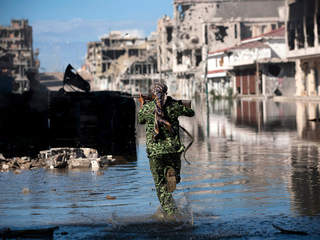
Libya on the verge of total collapse

libyaviolenceA little under two years ago, Philip Hammond, the Defence Secretary, urged British businessmen to share in the reconstruction of Libya and exploit an anticipated boom in natural resources.

Yet now Libya has almost entirely stopped producing oil as the government has lost control of much of the country.

Mutineers have taken over oil ports on the Mediterranean and are seeking to sell crude oil on the black market.

As world attention focused on the coup in Egypt and the poison gas attack in Syria over the past two months, Libya has plunged into its worst political and economic crisis since the defeat of Gaddafi two years ago.

Government authority is disintegrating in all parts of the country putting in doubt claims by American, British and French politicians that Nato’s military action in Libya in 2011 was an outstanding example of a successful foreign military intervention which should be repeated in Syria.

Libya’s prized high-quality crude oil has plunged from 1.4 million barrels a day earlier this year to just 160,000 barrels a day.

Libyans are increasingly at the mercy of militias which act outside the law.

The international community has ignored the escalating violence. The foreign media, which once filled the hotels of Benghazi and Tripoli, have likewise paid little attention to the near collapse of the central government.

Foreigners have fled Benghazi since the American ambassador, Chris Stevens, was murdered in the US consulate by jihadi militiamen last September.

Anarchy has spread around the capital. The government called on the Supreme Security Committee, made up of former anti-Gaddafi militiamen nominally under the control of the interior ministry, to restore order.

Diplomats have come under attack in Tripoli with the EU ambassador’s convoy ambushed outside the Corinthia hotel on the waterfront. A bomb also wrecked the French embassy.

One of the many failings of the post-Gaddafi government is its inability to revive the moribund economy. Libya is wholly dependent on its oil and gas revenues and without these may not be able to pay its civil servants.

A member of the parliamentary energy committee, told Bloomberg that “the government is running on its reserves. If the situation doesn’t improve, it won’t be able to pay salaries by the end of the year”.

Zille warns of ‘anarchy’ in Western Cape

Striking workers in the Western Cape

Western Cape premier Helen Zille warned on Wednesday that the province was “heading towards anarchy” as farmworker protests continued.

The Democratic Alliance leader said in statement she had sent ANC provincial leader Marius Fransman an SMS detailing her concerns.

The SMS read: “We are heading towards anarchy. 1000s of jobs will be lost and an industry potentially destroyed.

“I am receiving horrific reports of farmworker intimidation. [Labour Minister Mildred] Oliphant must be recalled from abroad and begin negotiations on the national minimum wage with all stakeholders.

“It is essential that we remove politics from this matter and stabilise the situation. That is the call you must make. I am extremely worried that lives are in danger and that people will retaliate.”

Zille said later in a statement that Fransman had to distance himself from alleged incitement in the province by the Congress of SA Trade Unions (Cosatu).

Last Wednesday, Cosatu Western Cape secretary Tony Ehrenreich said talks about the protest had to find a way for workers to get decent wages.

“The ill treatment and under-payment of workers by some farmers must stop, otherwise we will see a Marikana in De Doorns,” he said.

Freedom Front Plus spokesman Pieter Groenewald said on Tuesday the party would ask the SA Human Rights Commission to investigate the “correctness” of statements attributed to Ehrenreich.

According to Groenewald, Ehrenreich allegedly told farmers: “There is already blood on the farmworkers, and unless it stops there will be blood on the farmers of these farms.”

On Tuesday Zille said she asked President Jacob Zuma to intervene in the De Doorns farmworkers’ wage dispute, and had called for the defence force to get involved.

Farmworkers continued protests in the Western Cape and burned tyres on Wednesday morning while police fired rubber bullets to disperse a crowd.

Police spokeswoman Constable Lybey Swartz could not confirm this, saying no reports had reached the Western Cape media centre.

Farmworkers in the area started protesting last week in demand of R150-a- day wage and better working conditions.

Last Thursday, Zille was heckled by supporters of expelled ANC Youth League president Julius Malema while visiting the area.

She had to be escorted away by police when her entourage was pelted with stones by the striking farmworkers.

Agriculture Minister Tina Joemat-Pettersson was expected to meet Zuma on Wednesday to obtain his support for higher wages for farmworkers. – Sapa

Chaos and violence on the rise in UK

British police in Croydon, South London on August 8, 2011

Chaos and violence are on the rise in the UK a year after the PM declared a war on gang culture, a study revealed. Police aggression and a refusal to tackle the root causes of delinquency are reportedly the main issues hindering the initiative.

On Monday, the Center for Social Justice (CSJ) released a damning report titled ‘Time to Wake Up.’ The study criticized the steps taken by the UK’s coalition government over the last year to curb the problem of rising social unrest and delinquency.

The investigation roundly condemned the government’s heavy-handed approach as exacerbating the problem, citing a perception in the government of the riots as a “random one-off” that can be managed by an elevated police presence.

“They could not be more wrong. The alarming fact is that many streets across the country are besieged by anarchy and violence. There is no control in such neighborhoods,” the report said. It also notes an increase in violence among younger gang members, and in the number of women joining gangs.

In the wake of the mass rioting that swept the UK last summer, PM David Cameron launched an “all-out war on gang culture,” maintaining that gangs were at the root of the social unrest. The CSJ report cited statistics showing that “individuals who have links to gangs are believed to be responsible for 16 percent of London’s total drug supply, nearly a fifth of stabbings, half of all shootings and 14 percent of all rapes.”

The CSJ argued that the 10 million pounds the Home Office allotted last year to combating gang culture had been poorly distributed. Some organizations designated for funding did not receive money due to a lack of awareness, which the report describes as indicative of a “complete disconnect between what goes on at the policy level to what goes on on the ground.”

The CSJ said that aggressive policing could be one of the main drivers of the increase in gang crime over the past year.

“Negative, discriminatory and aggressive police behavior, if not perpetuating gang culture, actively hinders attempts to tackle it,” the study said, adding that according to a CSJ survey, 57.7 percent of respondents believed the police’s relationship with young people had not changed since the riots, while 13.5 percent said it had worsened.

The organization expressed particular concern with the police policy of targeting gang leaders. Referencing the arrest of over 200 ringleaders in London over the past year, CSJ said their removal had led to the creation of volatile power vacuums, potentially paving the way for chaotic power struggles between younger gang members.

The UK government’s attitude towards gang violence will only yield short-term results, the CSJ argued, adding that the underlying issues need to be addressed if there is to be any long-term resolution of the issue.

The study described the current strategy as ignoring the root causes of the violence, such as family breakdown and dysfunction, drug addiction and unemployment: “It takes years to work with gang nominal. Preventative work to discourage young people from joining gangs has ‘fallen off the radar.’

The growing gang culture in the UK hit the headlines last year when thousands of young people took part in riots across the country, looting shops and damaging property.

Mass riots in London were triggered by the police shooting of suspected criminal Mark Duggan, The circumstances surrounding the incident are highly controversial: Some claim Duggan was unarmed when he was gunned down by an officer. The government attributed the ensuing violence and social unrest to a degraded youth culture.

Britain likes anarchy, especially in South Africa

by Dan Roodt

Over the past week or two, I have been embroiled in a polemic in Business Day and elsewhere about South African and Afrikaner history. First of all, I challenged the ubiquitous assumption that apartheid visited some form of genocide upon South African blacks. Neither did apartheid “withhold education from blacks” as historian Hermann Giliomee has so amply demonstrated in a few recent articles.

I got some irate replies from Mrs. Louise Asmal, wife of the destructive former minister of education Kader Asmal. Mrs. Asmal is Irish, therefore a foreigner enthralled by the stereotyped views of our history proliferating abroad. Dr. Wilmot James of the Democratic Alliance also responded to my “apartheid revisionism” by regaling us on the apparent injustices suffered by his family under the previous South African government.

However, any injustices from 1948 to 1994 must pale into insignificance next to the injustices, nay, atrocities suffered by Afrikaners since 1994, not to mention much of the nineteenth century and especially the Anglo-Boer. One letter writer to Business Day had the temerity to suggest that 34 000 Boer women in the British concentration camps had died as a result of “cultural factors” such as a lack of hygiene.

If only the Germans had thought of that one: the Jews died at Auschwitz and Dachau “because they were dirty”. Take that, you dirty Jew! There you have it, you vile Afrikaner miscreant!

I have often wondered at the source of British arrogance. When I worked in Johannesburg dealing rooms, we were often visited by high-flying financiers out of the City of London with dirty collars and cuffs. In the Johannesburg heat you also became aware that these people, although living in five-star hotels, did not make the morning shower one of their regular habits.

More often than not they were nothing short of uncouth, lacked any form of culture and were given to getting drunk ever so often. Yet these British yobs in dirty shirts with double cuffs sporting flashy cuff links radiated a sense of know-it-all superiority that was a wonder to behold.

The presenter of Top Gear, Jeremy Clarkson, recently fulminated against his own countrymen, saying about Britain: “We are the country that invented the concentration camp.” Notwithstanding Tony Blair’s lies about Iraq’s weapons of mass destruction, the British sense of moral superiority has never been stirred, let alone shaken.

Talking of James Bond, that great hero of fiction and film, it reminds me of something else: Britons are, like African warlords, “licensed to kill”. That is why it is almost futile to mention any past or present British war crimes and human-rights violations. It will only elicit boredom or the impression that one has broken some rule of etiquette merely by mentioning it.

Currently I am reading a book by one Willem Steenkamp, who is apparently the former military correspondent of the Cape Times. Entitled, Assegais, drums and dragoons: a military and social history of the Cape, it is irritating in parts, because one senses that the author is trying to offer a politically correct re-reading of early Cape history. For example, he spends a whole chapter arguing that the seventeenth and eighteenth centuries were marvels of racial integration and intermarriage so that we are all in fact “Coloureds”. If so, then it must be a genetic miracle that Afrikaners from the oldest families still manage to produce offspring that appear even more European in features and in skin colour than the children of many European nations. Every time I drive past an Afrikaans high school, I am simply amazed at the incongruous sight of all these beautiful, gamboling white children in the African sun. On my mother’s side I have a lot of Botha blood, Botha being one of the oldest and most common Afrikaner surnames, going back to the early Cape. Yet a Dutch TV team, with an American geneticist in tow, replete with Harvard Ph.D., gave me a DNA test. To their utter disappointment, I was found to be of 100% European ancestry, or if you prefer, white, that dreaded concept.

However, if one disregards Steenkamp’s attempts at political correctness, the book contains some interesting material on the building of the Castle at the Cape of Good Hope in the seventeenth century. He quotes an author, Mentzel, who described life at the Castle thus:

“…for a man who loves method it is a veritable joy to observe the excellent order maintained in the Castle. The whole work of the day is mapped out by the clock and is performed with the utmost punctuality.”

To some extent, those two sentences describe much of the Afrikaner ideal for South Africa, one we had lived up to for most of the time when he had any say in government. On a recent visit to the Pretoria archives, I was astonished to see the meticulous way in which the early pioneers had immediately set about recording the meting out of the first farms in the Transvaal in the 1840s. I twice saw another of South Africa’s surfeit of Bothas, PW, at his home in the Wilderness near George, and on both occasions he repeated the words to me:  “I believe in orderly government.”

The Castle at the Cape of Good Hope is something of a symbol of that order which we have vainly tried to maintain in South Africa, and not only because the Castle was used as an emblem for the old South African Defence Force, prior to the ANC’s takeover.

Whence the need for such a fortress in the seventeenth century? From the very moment that Jan van Riebeeck and his fellow pioneers set foot in the Cape on 6 April 1652, they had to protect themselves from two constant enemies: the cantankerous, often violent Khoikhoi or “Koina” as Steenkamp calls them,  as well as, of course, belligerent Britain or England as it was known then.

During the seventeenth and eighteenth centuries, England was nothing less than a pirate nation, attacking merchant ships from other nations at will, much like Somalian pirates do today in the Indian ocean off the horn of Africa. Again and again the Netherlands had to fend off the English pirates and troublemakers, until the courageous Dutch Admiral Michiel de Ruyter sailed up the Thames and all but destroyed the English fleet. That gave us a few decades of respite.

Unfortunately, the treacherous British who changed alliances as it suited them, eventually got the upper hand and since then our misery here in South Africa has not ceased. Instead of “privateers” holding a commission from Queen Elizabeth I or some other monarch, a licence to rob and kill like James Bond, we are now faced with a motley collection of NGOs, churches, propagandists and rapacious mining magnates who would gladly see South Africa reduced to rubble if only they could make a quick buck in the process.

In the City of London the current anarchy and mining strikes must be a boon to traders who would be long gold and platinum, but short the rand and South African government bonds. They also propagate “land reform” in the hope of destroying our agriculture so that we would ultimately be completely at the mercy of British NGOs like Oxfam or Save the Children. Except, it is not our children that they will be saving.

In this way, there is a strange synergy between the British privateer, his profit motive that does not balk at bribery of the odious ANC officials, and the strange breed of histrionic, publicity-seeking “do-gooder” that also abounds in the British Isles. The latter have wrought almost more evil than the looting privateer or “businessman”. One such individual was Father Trevor Huddleston of the Anglican Church. Without Huddleston and his various public and private stratagems, the ANC terrorist regime would never have come to power in South Africa and we would have been spared the current descent into anarchy.

From my reading of the facts since Huddleston’s fateful arrival in South Africa in 1945, the ANC would long have fallen by the wayside as just another failed, penniless black organisation with megalomaniac dreams. Huddleston more or less “created” – trained, indoctrinated and groomed – subsequently world-famous black heroes such as Nelson Mandela and Desmond Tutu.

The culture of licence, criminality, violence, prostitution and gangsterish “glamour” that characterised Huddleston’s Sophiatown, would eventually overwhelm the entire country. Of course, Sophiatown has been lionised by English authors such as Nadine Gordimer and Anthony Sampson, the first editor of the black Drum magazine. Gordimer even wrote a roman à clef, A world of strangers, with an ill-disguised Anthony Sampson as the main character, boozing in shebeens and chasing after township whores.

After 1948, Britain or at least Labourite Britain, launched a total propaganda onslaught against South Africa, aided and abetted by much of the local English media who have never shaken off their colonial, jingoist origins during nineteenth-century British rule. They have maintained their fawning, sycophantic dependence upon English so-called “liberal” ideas, together with their often irrational and pathetic sense of “being superior” to Afrikaners.

Recently , the ideal of Sophiatown during the 1940s and 1950s, that “multiracial” demi-monde, has triumphed over that of the Castle. Thanks to the English menace, we have come full circle since 1652. The “excellent order” that we have created by being disciplined and law-abiding, together with the prosperity resulting from that order, have been swept away.

Those periods of South African history when Britain and its callous officials dominated us, notwithstanding its hysterical clergy, inciting blacks or Khoikhoi against the indigenous white population, have always been characterised by the kind of lawlessness and mayhem that we are currently experiencing.

But we must also blame ourselves, in having allowed – despite the historical evidence – this catastrophe. Our forefathers could withstand Britain, for decades and even centuries. They fortified themselves against all those English ships out there and formed commandos of citizens to defend themselves and to maintain order. In fact, the commando system that the ANC abolished had been more than three centuries old!

Why have we been found wanting?

Julius Malema’s supporters threaten anarchy if he is arrested

Julius Malema

With a warrant out for Julius Malema’s arrest, it seems that both President Zuma and Helen Zille were right on cue in deploying the army. After Malema’s imminent arrest was leaked to City Prees, the South African National Defence Force may be necessary to keep the peace upon Malema’s supporters getting unruly.

The Friends of Malema and the ANCYL leadership suspended earlier this year, as well as current leaders of the League’s National Executive Committe have warned that the country’s youth would rebel and engage in mass action if the suspended former League President had to be arrested.

These warnings were issued in a week during which Malema spoke openly about alleged threats to have him killed or arrested.

Malema’s closest ally, Floyd Shivambu, the League’s former spokesman who had also been suspended, told the Mail & Guardian newspaper this week that both Malema and the Youth League’s secretary-general Sindiso Magaqa no longer slept at home because they feared being attacked.

Shivamabu said that State Security sources had told him that there was a plan to neutralise them, concocted at the highest levels of government and that options had been narrowed down to “arrest or kill”. But he did add that Malema had no fear of arrest as he knew that he had committed no crime.

Two members of the Youth League’s National Executive Committee told the M&G anonymously that the youth will go on the rampage if the state had to “abuse” resources to arrest Julius Malema.

“On what basis would he be arrested? What has he done wrong with tenders in Limpopo? When there are limitations in society you can’t stop people from addressing any section of society,” said one of the members.

“Julius has lots of support from youth who don’t rely on patronage from the ANC. They are not MECs, mayor or ministers. The youth are angry and they will go out in numbers. Young people will lead the mass action and they have lots of energy. And young people will not be peaceful …

“We know that the security cluster has allocated five people to follow him wherever he goes and this surveillance has not even been approved by a judge,” one of the members said.

The President of the Congress of the People, COPE’s youth movement, Ncaba Bhanga, promised that the organisation would defend Malema if hy had to be arrested.

“This is not about Malema,” said Bhanga. “It is about the ruling party using state resources to suppress dissenting views [in the build-up to] its Mangaung conference. Malema has done nothing wrong.”

A warrant of arrest for Julius Malema was issued this morning, City Press reported. He is expected to appear in court next week.

Eyewitness News reported earlier in the week that Malema might be arrested after conclusion of the Hawks’ investigation of him. He was being investigated for alleged corruption.


South African lawlessness on the rise

Left-wing lawyer George Bizos

South Africa is in the grip of increasing lawlessness, according to a senior researcher at the Institute for Security Studies (ISS), Beeld reported on Monday.

According to an essay written by Dr Johan Burger more than a week before the Marikana mine shootings, blame for anarchy cannot simply be attributed to contempt for the law or the absence of law enforcement, but should include the failure of government, and its absence.

“It looks like vigilante attacks are also on the increase, and these are becoming more violent and deadly,” he was quoted as saying by the newspaper.

Academics and Wits University students took part in a march last week, to protest against the social inequalities they blame for tragedies like Marikana.

“This is what we did in 1948, 1949, 1950 when we protested against the apartheid laws,” weeping struggle veteran and advocate George Bizos told Beeld during the march.

“I never thought it would ever be necessary to take part in a march again,” he said.

When he was asked if he thought South Africa was becoming more violent, he said “I don’t just think so, it’s a fact.”

According to Burger, violent protests also make it necessary for the police to divert limited resources away from the battle against crime. – SAPA