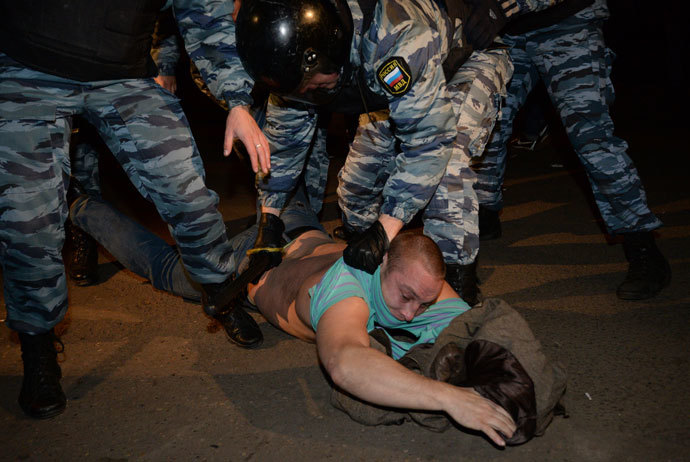
Anti-immigrant mass riot rocks Moscow

moscowriotMoscow police detained some 380 people during the mass rioting in a southern district of the city. A mixed crowd of nationalists and locals attacked a warehouse run by natives of the Caucasus, blaming a migrant for the fatal stabbing of a local.

Authorities lifted the emergency plan codenamed “Volcano” after midnight, several hours after public order had been restored. The plan, put into effect in the afternoon, involved sending scores of riot police to the scene of the clashes, and placing police officers across the city on high alert.

By midnight the streets were practically deserted, except for police officers and a couple of bystanders discussing the day’s events. Meanwhile the 380 detained during the unrest were being interrogated in a criminal case over hooliganism – thus far as witnesses, police said.

Residents of the Biryulyovo district in southern Moscow took to the streets following the fatal stabbing of Egor Shcherbakov, a Muscovite, earlier in the week. Late on Thursday evening, when Shcherbakov and his girlfriend were on their way home, the young couple were attacked by an unidentified man who stabbed Shcherbakov with a knife.

Shcherbakov’s girlfriend described the attacker as a male native of the Caucasus and said that he had assaulted her boyfriend after trying to harass her.

On Saturday a group of about 40 people gathered for a protest in the area, urging the police to find and punish the attacker. They demanded that the district’s police chief resign, and that a local vegetable warehouse, where many migrants work, be closed.

The locals also lashed at the the authorities, accusing them of covering the wave of migrant crime and the illegal immigration in the area. The protest was followed by an unsanctioned rally on Sunday, which turned violent as hundreds of angry protesters attacked a shopping mall – attempting to set it on fire and breaking windows. A group of people among the crowd reportedly broke into stores, ransacking them and looting goods.

Ethnic tensions in Moscow have been high on politicians’ agenda in recent months, with the issue of illegal migration a key theme in the city’s mayoral election last month. Some 3 million migrants from former Soviet republics in Central Asia and the Caucasus are estimated to live in the city, many working in low-paid jobs in food markets without legal residency permits.

The city’s ethnic dividing lines are also overlaid with religious ones, as the Russian Orthodox majority is challenged in many neighborhoods by a growing Muslim population – both from Russia’s North Caucasus and from outside Russia’s borders.

Meanwhile, authorities in Moscow’s Southern Administrative district have decided to set up an operation headquarters to counter illegal migration. The body – comprised of police, federal migration service representatives and voluntary people’s guard – will gather daily.  The new foundation will focus on identifying flats rented to illegal migrants, patrolling streets and organizing sweeps on reports from citizens, the prefecture’s press service told Interfax.

Egor’s girlfriend said she was against such protests, since she did not want “interethnic conflicts” to be inflamed. “I know this crime won’t remain unpunished,” she told Moskva 24 TV channel.

According to statistics announced in spring by the Federal Migration Service, there are over 3 million illegal immigrants in Russia and 11 million legal visitors. However, unofficial estimates put the number of illegal immigrants at 10-12 million.  – RT

Chaos and violence on the rise in UK

British police in Croydon, South London on August 8, 2011

Chaos and violence are on the rise in the UK a year after the PM declared a war on gang culture, a study revealed. Police aggression and a refusal to tackle the root causes of delinquency are reportedly the main issues hindering the initiative.

On Monday, the Center for Social Justice (CSJ) released a damning report titled ‘Time to Wake Up.’ The study criticized the steps taken by the UK’s coalition government over the last year to curb the problem of rising social unrest and delinquency.

The investigation roundly condemned the government’s heavy-handed approach as exacerbating the problem, citing a perception in the government of the riots as a “random one-off” that can be managed by an elevated police presence.

“They could not be more wrong. The alarming fact is that many streets across the country are besieged by anarchy and violence. There is no control in such neighborhoods,” the report said. It also notes an increase in violence among younger gang members, and in the number of women joining gangs.

In the wake of the mass rioting that swept the UK last summer, PM David Cameron launched an “all-out war on gang culture,” maintaining that gangs were at the root of the social unrest. The CSJ report cited statistics showing that “individuals who have links to gangs are believed to be responsible for 16 percent of London’s total drug supply, nearly a fifth of stabbings, half of all shootings and 14 percent of all rapes.”

The CSJ argued that the 10 million pounds the Home Office allotted last year to combating gang culture had been poorly distributed. Some organizations designated for funding did not receive money due to a lack of awareness, which the report describes as indicative of a “complete disconnect between what goes on at the policy level to what goes on on the ground.”

The CSJ said that aggressive policing could be one of the main drivers of the increase in gang crime over the past year.

“Negative, discriminatory and aggressive police behavior, if not perpetuating gang culture, actively hinders attempts to tackle it,” the study said, adding that according to a CSJ survey, 57.7 percent of respondents believed the police’s relationship with young people had not changed since the riots, while 13.5 percent said it had worsened.

The organization expressed particular concern with the police policy of targeting gang leaders. Referencing the arrest of over 200 ringleaders in London over the past year, CSJ said their removal had led to the creation of volatile power vacuums, potentially paving the way for chaotic power struggles between younger gang members.

The UK government’s attitude towards gang violence will only yield short-term results, the CSJ argued, adding that the underlying issues need to be addressed if there is to be any long-term resolution of the issue.

The study described the current strategy as ignoring the root causes of the violence, such as family breakdown and dysfunction, drug addiction and unemployment: “It takes years to work with gang nominal. Preventative work to discourage young people from joining gangs has ‘fallen off the radar.’

The growing gang culture in the UK hit the headlines last year when thousands of young people took part in riots across the country, looting shops and damaging property.

Mass riots in London were triggered by the police shooting of suspected criminal Mark Duggan, The circumstances surrounding the incident are highly controversial: Some claim Duggan was unarmed when he was gunned down by an officer. The government attributed the ensuing violence and social unrest to a degraded youth culture.