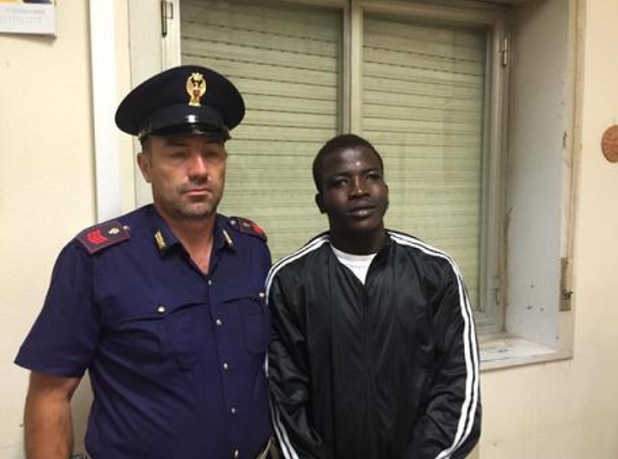
Italy’s taste of violence: black migrant murders 2, causing public outrage

Italy’s simmering anti-immigrant sentiment has been stoked by the murder of an elderly couple in their home in Sicily, allegedly by an African asylum seeker.

Mamadou Kamara, an 18-year-old from the Ivory Coast, allegedly slit the throat of Vincenzo Solano, 68, and then attacked his Spanish-born wife, Mercedes Ibanez, 70.

Ms Ibanez fell to her death from a second-floor balcony, during a robbery that turned violent.

Mr Kamara is one of thousands of migrants and refugees living at a vast reception centre at nearby Mineo, in south-eastern Sicily.

They are accommodated there after arriving by boat from Libya, and wait sometimes for months to have their asylum applications assessed.

The migrants are allowed to come and go freely from the facility, a former US military base where prostitution, links with organised crime and the trade in illicit goods is said to be rife.

Mr Kamara, who was rescued in the Mediterranean on June 8 and brought with other migrants to the port of Catania in Sicily, allegedly broke into the pensioners’ flat in the village of Palagonia, six miles away, and slit the throat of Mr Solano.

The elderly man’s wife was found dead in the courtyard of their three-storey apartment block. Investigators believe she may have fallen over the balcony in panic after trying to flee the attacker.

Mr Kamara was arrested after police searched his bag on Sunday as he returned to the migrant centre.
Inside they found a mobile telephone, a laptop computer, a video camera and a pair of trousers, allegedly belonging to Mr Solano, that were covered in blood.

The young African man claimed to have “found” the items, but police arrested him and are expected to charge him with two counts of murder.

Sebastian Maccarrone, the director of the Mineo migrant centre, said: “If it was him, it is a tragedy within a tragedy – for the people killed, and for integration. We are all shocked… For each small step we have taken forward in terms of integration, this has put us 10 steps backwards.”

More than 100,000 refugees have arrived by boat in Italy this year, making the crossing from Libya in overcrowded rubber dinghies and leaky fishing boats. Last year, a record 170,000 arrived on Italian shores.

“Italians fear for their lives inside their own homes,” said Gianluca Buonanno, an MEP with the Northern League, a staunchly anti-immigrant party of the Right.

“This is Renzi’s national security strategy. What kind of country are we living in?”

Giorgia Meloni, another centre-Right politician and a close ally of Silvio Berlusconi, the former prime minister, said: “The instigator of the murder of these two innocents is the Italian state, which is responsible for having kept open a facility … which we said should be closed down.”

“The murdered couple had returned from living in Germany to enjoy their retirement in Sicily,” a relative told La Stampa newspaper. “They shouldn’t have died like this, slaughtered like goats.” – London Daily Telegraph
G4S guards accused of migrant’s death found innocent

Three security guards from the controversial security firm G4S have been cleared of manslaughter, despite accusations they killed a 46-year-old man by forcibly restraining him on a charter airline flight.

Jimnmy Mubenga, from Angola, died on the 12 October 2010 after being restrained by guards at Heathrow Airport while on a British Airways flight. He was due to be deported to Angola from the UK.

The guards, Terrence Hughes, 53, Colin Kaler, 52, and Stuart Tribelnig, 39, were accused of killing Mubenga by forcibly pushing his head down and restricting his breathing.

The court heard fellow passengers said Mubenga told the guards he couldn’t breathe. Mubenga was already handcuffed and held down with a seatbelt during the restraining.

In a statement issued on the guards behalf, Alex Preston from Olliers Solicitors said: “Terrence Hughes, Colin Kaler and Stuart Tribelnig are delighted to have been found not guilty so quickly. They bitterly regret the death of Mr Mubenga but have always said they were trying to do a very difficult job in difficult circumstances to the best of their ability.”

“They are grateful to the judge and jury for the care they have taken resolving these sad events,” the statement added.

The hearing comes weeks after the death of Eric Garner in New York, an African-American who also suffocated despite telling police that he couldn’t breathe whilst being restrained.

Mubenga came to the UK with his wife Adrienne Makenda Kambana in 1996, but faced extradition after being involved in a violent nightclub brawl in 2006.

Mubenga’s lawyer, Mark Dennis QC, also told the court he was co-operative before boarding the extradition flight, but became upset after he spoke on the phone in the plane’s toilet cubicle.

“Each officer would have known from their training and from common sense that keeping someone in such a position was likely to cause a person harm yet they did so over a prolonged period and did so ignoring shouts from Mr Mubenga that he was in trouble,” Dennis said.

“‘I can’t breathe’ shouts were heard by many a passenger seated further away.”

Following the court hearing, a number of human rights organizations expressed their disappointment, including Amnesty International UK, who said the outcome ignored the ‘multiple failings’ that led to Mubenga’s death.

The Migrants Rights Network also said the outcome would not provide comfort to immigrants facing deportation from the UK.

“Once again a migrant has lost their life in detention, and once again no one will ultimately be held to account,” said MRN’s action director Jerome Phelps.

“There needs to be a fundamental review of the detention and deportation system, to ensure that the UK does not needlessly jeopardize the lives of people who have come here in search of a better future.”

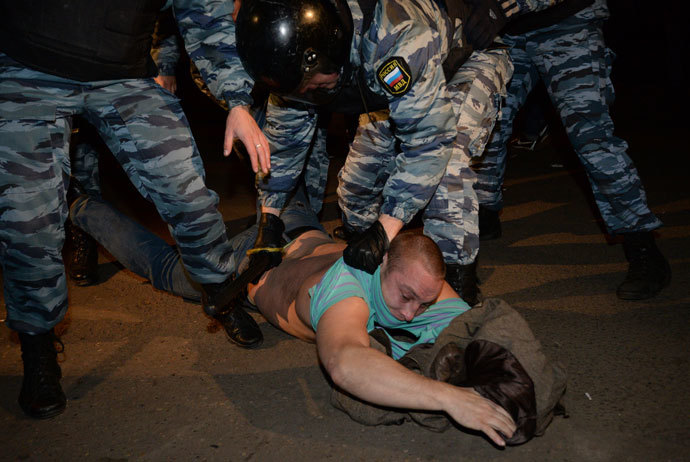
Anti-immigrant mass riot rocks Moscow

moscowriotMoscow police detained some 380 people during the mass rioting in a southern district of the city. A mixed crowd of nationalists and locals attacked a warehouse run by natives of the Caucasus, blaming a migrant for the fatal stabbing of a local.

Authorities lifted the emergency plan codenamed “Volcano” after midnight, several hours after public order had been restored. The plan, put into effect in the afternoon, involved sending scores of riot police to the scene of the clashes, and placing police officers across the city on high alert.

By midnight the streets were practically deserted, except for police officers and a couple of bystanders discussing the day’s events. Meanwhile the 380 detained during the unrest were being interrogated in a criminal case over hooliganism – thus far as witnesses, police said.

Residents of the Biryulyovo district in southern Moscow took to the streets following the fatal stabbing of Egor Shcherbakov, a Muscovite, earlier in the week. Late on Thursday evening, when Shcherbakov and his girlfriend were on their way home, the young couple were attacked by an unidentified man who stabbed Shcherbakov with a knife.

Shcherbakov’s girlfriend described the attacker as a male native of the Caucasus and said that he had assaulted her boyfriend after trying to harass her.

On Saturday a group of about 40 people gathered for a protest in the area, urging the police to find and punish the attacker. They demanded that the district’s police chief resign, and that a local vegetable warehouse, where many migrants work, be closed.

The locals also lashed at the the authorities, accusing them of covering the wave of migrant crime and the illegal immigration in the area. The protest was followed by an unsanctioned rally on Sunday, which turned violent as hundreds of angry protesters attacked a shopping mall – attempting to set it on fire and breaking windows. A group of people among the crowd reportedly broke into stores, ransacking them and looting goods.

Ethnic tensions in Moscow have been high on politicians’ agenda in recent months, with the issue of illegal migration a key theme in the city’s mayoral election last month. Some 3 million migrants from former Soviet republics in Central Asia and the Caucasus are estimated to live in the city, many working in low-paid jobs in food markets without legal residency permits.

The city’s ethnic dividing lines are also overlaid with religious ones, as the Russian Orthodox majority is challenged in many neighborhoods by a growing Muslim population – both from Russia’s North Caucasus and from outside Russia’s borders.

Meanwhile, authorities in Moscow’s Southern Administrative district have decided to set up an operation headquarters to counter illegal migration. The body – comprised of police, federal migration service representatives and voluntary people’s guard – will gather daily.  The new foundation will focus on identifying flats rented to illegal migrants, patrolling streets and organizing sweeps on reports from citizens, the prefecture’s press service told Interfax.

Egor’s girlfriend said she was against such protests, since she did not want “interethnic conflicts” to be inflamed. “I know this crime won’t remain unpunished,” she told Moskva 24 TV channel.

According to statistics announced in spring by the Federal Migration Service, there are over 3 million illegal immigrants in Russia and 11 million legal visitors. However, unofficial estimates put the number of illegal immigrants at 10-12 million.  – RT