Venda parent rips into Afrikaners at Curro

A black Venda parent who filmed the excursion that has landed Curro Roodeplaat Private School in another racial segregation scandal, described the footage as disturbing and said he would take his child out of the school.

Dr Christopher Madumi Ramalingela said, “Initially, we just wanted to document our little girl’s trip and were shocked at what we saw.

“My wife was very disturbed by what she saw on the field trip. She had no idea the children were loaded onto the buses in that fashion.”

Ramalinga said he tried to put what he had seen out of his mind and convince himself it was no big deal, but it kept worrying him.

“The video was taken on June 3. It’s only in the last week that I showed it to friends after I just could not get the images of the children separated like that out of my head.

“I needed to hear other people’s opinion on the matter to assess how justified my concern was,” Ramalinga said.

He said, “It is a horrible situation and I can’t let my child continue to be subjected to such an environment.”

Ramalinga is looking for a new school for his daughter.

He said he is not satisfied by the school’s excuse that the children were merely separated by language.

Ramalinga was also not happy that there were no black teachers at the school, despite 66 percent of children at Curro schools being black.

“It’s ridiculous to think that they can’t find any qualified black teachers,” Ramalinga said.

When asked what he thought of Afrikaans and English-speaking classes being separated, Ramalinga said this is a separation parents had begrudgingly accepted in the past, but he did not believe it was necessary.

“Afrikaans-speaking people have always been very keen to have their own schools and universities,” he said.

“Maybe they know better, but I’m Venda and I think if I had just stuck to knowing only Venda and doing all my subjects in Venda, it would not have gotten me anywhere.”

Source:eNCA

Whites asked to stay away from rallies for Brown in Canada

Organizers of pro-Ferguson events in Ottawa and Toronto, asked white people not to appropriate vigils for Michael Brown, sparking intense debate on social media.

White people were told by organizers to not appropriate a recent vigil for Michael Brown and Ferguson in Canada, sparking intense debate on social media.

Hundreds of protesters chanted and carried signs through the streets of Washington, DC, Tuesday night to show solidarity with Michael Brown, a black teen offender shot dead by a police officer in Ferguson in August and other victims of police violence.

In a post, published on the Facebook page of the Ottawa vigil, she stressed that fair-skinned people “are there in support of black folks, so should never be at the centre of anything,” adding that “black voices are crucial” to the movement at the moment.

The same suggestion was posted on the Facebook page of a similar event in Toronto.

Arte’s post attracted nearly 300 comments, prompting one user, Hamdi Loukoum, to ask: “Wow, is this an anti-racist rally or a pro-segregation one?”

In response to the appeal Darian Parsons, stated: “I’m not sure why white people would have to refrain from taking up space…. won’t that push them away from coming to support and won’t it help to have support from the whole world, not just the black community…? I think it would be a terrible idea to ask non-black people to not talk to the media.”

Other participants were sympathetic with Arte’s message. “For us, it’s really important to come up and show our solidarity and make sure black voices are leading this — that their feelings and opinions are front and centre for everything happening here. We’re just here to show support and be allies,” Paige Jackson and Rebecca Macintyre, both white, told CBC News. “It’s not about us. It’s about showing solidarity with people whose lives are affected by Ferguson — and that’s not really us. That’s not really white people,” Macintyre added.

The peaceful rallies were held in Ottawa and Toronto under the banner “BlackLivesMatter” following a night of rioting in Ferguson, sparked by the grand jury’s decision not to indict Darren Wilson, a white police officer who fatally shot the African-American teenager. Thousands have reportedly participated in the two vigils braving cold weather.

“Those folks who are here tonight don’t believe that’s OK,” said Lena Peters, the leader of the protests, as quoted by the Huffington Post. “We believe that it is part of a larger system that doesn’t value black life,” she added during the rally held outside the US Consulate in Toronto.

“Our message is that black lives matter,” said Janaya Khan, one of the organizers of the Toronto vigil, as quoted by the Global News. “Our message is that we unequivocally stand against the no indictment ruled in favour of Darren Wilson and that we completely support Mike Brown and Mike Brown’s family. We support any kind of actions against state sanctioned violence and police brutality and we want to draw parallels to what is happening here in Canada to black and African peoples.”

The grand jury’s decision came after nearly three months of deliberation over a case that has highlighted issues of race and police brutality throughout the United States, inciting massive protests around the country over the summer.

Thirty-eight US states, Washington DC and over 140 other US cities have organized demonstrations throughout the day on Tuesday under the banner of “Emergency Response Protests to Ferguson Grand Jury Decision”.

Former NBA player wants racial segregation after owner’s remarks

Don Sterling
Don Sterling

Knicks executive and former player Larry Johnson had a strong reaction to the racial remarks Clippers owner Donald Sterling is alleged to have made.

On Saturday night, Johnson tweeted: “Black people your Focusing on the wrong thing. We should be focusing on having our own, Own team own League! To For Self!!’’

The initial indication was Johnson was calling for an all-African-American league complete with black ownership. It wasn’t the first time Johnson, who is black, concerned himself with the fact the NBA’s ownership is mostly white while its players are mostly black.

During the 1999 NBA Finals between the Knicks and Spurs, Johnson caused a stir by saying: “We’ve got a lot of rebellious slaves on this [Knicks] team.”

When asked at the time why he referred to his teammates as slaves, Johnson said: “I’ve got to explain that to you? We don’t go with the mainstream.’’

Johnson was hired by the Knicks two years ago and serves many roles as a basketball and business operations representative.

When Donald Sterling’s comments surfaced this week, they caused an uproar. The basketball franchise owner is also a Jew. Sterling attempted to justify his racism by invoking Israel.

“DS: It’s the world! You go to Israel, the blacks are just treated like dogs.
V: So do you have to treat them like that too?
DS: The white Jews, there’s white Jews and black Jews, do you understand?
V: And are the black Jews less than the white Jews?
DS: A hundred percent, fifty, a hundred percent.
V: And is that right?
DS: It isn’t a question – we don’t evaluate what’s right and wrong, we live in a society. We live in a culture. We have to live within that culture.”
(via Deadspin)


Apartheid South Africa: Reality vs. libertarian fantasy

mercer_ilanaby Ilana Mercer

[followbutton username=’IlanaMercer’ count=’true’ lang=’en’ theme=’light’]

Like Ilana Mercer’s Facebook page

One needn’t propagate lies about the state-enforced segregation that was Apartheid in order to condemn it.

Yet in defiance of fact, one prominent libertarian economist has gone so far as to assert that apartheid was “a version of Castroite socialism.”

How can one credibly say that about a country that in its heyday had a gold-backed currency, enjoyed the confidence of investors the world over, sported low to no government debt and similar rates of inflation, the most opulent and spectacular shopping malls, the freest, finest medicine I’ve experience in life on three continents, near-unfettered legal access to handguns (for whites) and relatively secure property rights for the same minority? You can’t. Not if you wish to retain intellectual credibility.

Racial segregation, inequality under the law, injustice: yes, yes, and yes. But “Castroite socialism”?

Not quite as embarrassing, another wag asserted the following: “Apartheid was a system of government control and regulation to artificially keep South African blacks from competing against whites in the marketplace.”

This is only partly true. The problem with half-truths is that the conclusions that flow from their premises will likewise be deficient.

Dogma without data

Distorting the facts about Apartheid’s raison d’être does nothing to promote the truth.

“Hermann Giliomee – whose grand historical synthesis and primary source exegesis (“The Afrikaners: Biography of a People”) is referenced extensively in “Into the Cannibal’s Pot: Lessons For America From Post-Apartheid South Africa” – has concluded that Afrikaner anxieties were overwhelmingly existential, rather than racial. Leading thinkers at Stellenbosch University devised a system for the National Party to ensure “the security of the Afrikaners as a dominant minority.” (More about Apartheid as “A Strategy for Survival,” in “Into the Cannibal’s Pot,” pp. 67-70.)

As noted in the same book:

Anybody who lived … among Afrikaners during the apartheid era can testify that crime and communism were foremost on their minds. To rationalize the cruel, Kafkaesque laws of Apartheid, Afrikaners spoke of the Swart Gevaar (which meant the “Black Threat”), and of the Rooi Gevaar (the “Red Threat”). My Afrikaner neighbor would regularly admonish me for my incipient liberalism: “You want black rule so badly, look around you at the rest of Africa! Anglos like you simply don’t understand what’s at stake.” (P. 70)

The sweeping non sequitur that follows from the partial truth aforementioned has it that “black poverty” and misery stemmed solely from Apartheid’s “suppression of free market forces.” This is economic reductionism, typical of the impoverished analysis of South Africa, offered so authoritatively by libertarian economists stateside.

Apartheid is a necessary explanatory variable in the “black poverty” equation, but never a sufficient one.

As expounded in “Into the Cannibal’s Pot,” “the maze of racial laws that formed the edifice of Apartheid” had been dismantled by the offending National Party almost a decade before the transition to democracy; by 1986, the party had already brought down Apartheid’s pillars, the “pernicious influx control laws,” for example.

In all, South Africa has now been racially desegregated for almost 28 years.

Documented in the same book are these immutable facts: “Twelve years into the Nationalist government’s rule, the rate of literacy among the Bantu of South Africa was already higher than that of any other state in Africa, or that of India. From the 8.6 million recorded in the 1946 census, the black population rose to 17.4 million in 1974 and 28.3 million by 1991. [In-migration from the north was just about non-existent.] From the 1940s to the 1990s, life expectancy for blacks soared from thirty-eight to sixty-one years!” (P. 178.)

“Since the dawn of democracy in 1994, life expectancy has plummeted by nine years. Crime has reached crippling levels … and is certainly much higher than in the Old South Africa. … unemployment had jumped from 19 percent in 1994 (before ‘freedom’) to 31 percent in 2003 (after ‘freedom’), steadily rising until, in 2005, it stood at 38.8 percent. The trend is consistent and persistent.” (P. 178)

These stubborn facts collapse the politically pleasing but reductive theory, promulgated by libertarian know-nothings, that holds Apartheid to be the sole cause of black South Africa’s dysfunction, economic and other.

As the pesky facts attest, black dysfunction in racially desegregated South Africa is way worse than it was during state-enforced segregation. In fact, it now resembles that of the rest of Africa.

Apartheid was reprehensible. But dogma denuded of data does nothing to bolster this uncontested, incontrovertible position.

Lite libertarianism vs. the right kind

Herein lies the difference between the paleolibertarian analysis and what this column has termed the lite libertarian one, philosopher Hans-Hermann Hoppe being the finest example of the former. The rest fall into the latter, lite category.

A crucial difference between lite libertarians and the right kind is that to the former, the idea of liberty is propositional – a deracinated principle, unmoored from the realities of history, hierarchy, biology, tradition, culture, values.

Conversely, the paleolibertarian grasps that ordered liberty has a civilizational dimension, stripped of which the libertarian non-aggression axiom, by which we all must live, cannot endure. “The pursuit of the … paleolibertarian ideal,” explained Catholic philosopher Jack Kerwick, Ph.D., “is the pursuit of an ideal of liberty brought down from the clouds to the nit and the grit of the history and culture from which it emerged.”
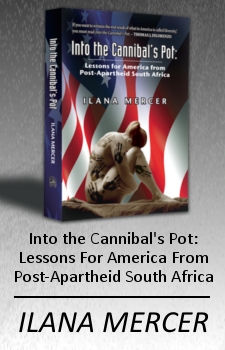
Into the Cannibal's Pot

‘The color of money’

Indeed, the truth about the Old South Africa is far more nuanced. As this writer tried mightily to explain during an RT broadcast (embedded), “The color of money” did speak loud and clear to enlightened self-interest in Apartheid South Africa.

“‘The market is color-blind,’ said Milton Friedman. ‘No one who goes to the market to buy bread knows or cares whether the wheat was grown by a Jew, Catholic, Protestant, Muslim or atheist; by whites or blacks.’ As Thomas Sowell put it so well, ‘prejudice is free, but discrimination has costs.’ Added South African academic, Steven Farron: ‘[P]eople demand that their governments restrict the economic and occupational success of specific ethnic or racial groups. However, when the same people act as individuals or business owners, they actively resist and/or circumvent these restrictions.’” (P. 127)

All people do this. Apartheid South Africa was no different.

During Apartheid, white industrialists – miners especially – “put continual pressure on the South African government to allow them to use more black labor.” Afrikaner farmers also chose overwhelmingly to ignore racial job quotas, despite their own racist predilections, and also despite high unemployment among rural Afrikaners. Well before the official dismantling of Apartheid laws (carried out, as mentioned, by the white minority government), the agricultural sector, skilled and managerial jobs included, came to be dominated by blacks. As was the semi-skilled labor market – clothing, furniture, millinery, sheet metal, construction, mining, baking. Clearly, whites, acting as individuals, chose to subordinate ethnic advancement to optimize their livelihood. (P. 126)

Those half-truths again

“Free market economists (the only kind worth consulting) have long since insisted that the rational, self-interest of individuals in private enterprise is always not to discriminate. Arguably, however, the good economists, while certainly not wholesale liars as are their Keynesian counterparts, are still offering up a half-truth. Rational self-interest does indeed propel people, however prejudiced, to set aside bias and put their scarce resources to the best use. But to state simply that ‘discrimination is bad for business’ is to present an incomplete picture of reality. This solecism stems from the taint the word ‘discriminate’ has acquired. The market, by which we mean the trillions of capitalist acts between consenting adults, is discriminating as in discerning – it is biased toward productivity. Hiring people on the basis of criteria other than productivity hurts the proprietor’s pocket.” (P. 127)

Thus, we can be fairly certain that, absent racist affirmative-action laws, the market would reflect a bias toward productivity. In other words, what the good economists are loath to let on is that a free market is a market in which groups and individuals are differently represented. Parity in prosperity and performance between differently able individuals and groups can be achieved only by playing socialist leveler.” (P. 128.)

Freedom vs. egalitarianism

Contra the economic reductionism of the lite libertarian, free-market capitalism is a necessary but insufficient condition to sustain freedom in a country of South Africa’s complexion.

The truth absent from the phantasmagorical formulations critiqued is this: Economic freedom does not necessarily reduce so-called wealth inequality. Inegalitarainism is a feature of a free economy. If history is anything to go by, certain minorities will achieve prosperity from poverty, no matter how gravely the state and society impede them. Jews did it in Europe. Levantines and Indians in Africa and the Middle East. Chinese in southeast Asia and everywhere else they go. Europeans in South Africa.

Moreover, “While all people want safety and sustenance for themselves, not everyone is prepared to allow those whom they dislike and envy to peacefully pursue the same.” (P. 4) Free-market capitalism is not enough to safeguard ordered liberty in racially riven societies like South Africa, where the majority will always covet the possessions of immensely wealthier minorities and associate these riches with racial privilege.

Ultimately, the rights to life, liberty and private property will forever be imperiled in a country whose constitution has a clause devoted to “Limitation of Rights,” and where redistributive “justice” is a constitutional article of faith. (P. 101)

This, paleolibertarians (all three of us) know too well.

In “The Cannibal” chapter entitled “Saving South Africans S.O.S.,” secession is explored as one solution, it being a species of the private-law society delineated by Hans-Hermann Hoppe. Hoppe, of course, has never been afraid to speak to the “unequal civilizing potential” (in James Burnham’s coinage) of different people and peoples.

Against dog-ate-my-homework argumentation

For the sins of man, hard leftists blame society, and the lite libertarian saddles the state.

In its social determinism, the lite libertarian’s “the-state-made-me-do-it” argumentation apes that of the left’s “society-made-me-do-it” argumentation. Both philosophical factions implicate forces outside the individual for individual and aggregate group dysfunction.

In the New South Africa, the left’s “argument” has been taken to a new level of abstraction: “The legacy of Apartheid” is said to explain the unparalleled depravity of Nelson Mandela’s dominant-party mobocracy.

While the state is a worthier culprit than society, both are analytical equals in as much as they absolve the individual of responsibility for his actions. For the philosophy of freedom is predicated on individual responsibility.

“Societies are only as good as the individuals of whom they are comprised; individuals only as good as their actions.” (P. 4) If the sanctity of life is the highest value in a civilized society – then Mandela’s South Africa is uncivilized in every way possible.

The unvarnished truth about democratic South Africa is that it is “now preponderantly overrun by elements, both within and without government, which make a safe and thriving civil society impossible to sustain.” (P. 4)

Although absolutely essential, free-market capitalism is insufficient to the task of tackling this tide of sinecured criminals.

[followbutton username=’IlanaMercer’ count=’true’ lang=’en’ theme=’light’]

Like Ilana Mercer’s Facebook page

US to ‘diversify’ white neighborhoods

HUDThe United States Department of Housing and Urban Development (HUD) is a Cabinet department in the Executive branch of the United States federal government.

To ensure that “every American is able to choose to live in a community they feel proud of,” HUD has published a new fair-housing regulation intended to give people access to better neighborhoods than the ones they currently live in.

The goal is to help communities understand “fair housing barriers” and “establish clear goals” for “improving integrated living patterns and overcoming historic patterns of segregation.”

“This proposed rule represents a 21st century approach to fair housing, a step forward to ensuring that every American is able to choose to live in a community they feel proud of–where they have a fair shot at reaching their full potential in life,” said HUD Secretary Shaun Donovan.

“For the first time ever,” Donovan added, “HUD will provide data for every neighborhood in the country, detailing the access African American, Latino, Asian, and other communities have to local assets, including schools, jobs, transportation, and other important neighborhood resources that can play a role in helping people move into the middle class.”

According to HUD, long-term solutions include “helping people gain access to different neighborhoods and channeling investments into under-served areas.” The mapping tool may guide development and zoning decisions, for example.

In a July 16 speech to the NAACP, Donovan said the American Dream still isn’t within equal reach of all communities. He lamented the lack of diversity in America’s boardrooms, schools, and the nation’s “strongest neighborhoods.”

Donovan said HUD’s new neighborhood mapping tool, which uses Census data, will “expand access to high opportunity neighborhoods and draw attention to investment possibilities in under-served communities.”

“Make no mistake, this is a big deal,” Donovan said. “With the HUD budget alone, we are talking about billions of dollars. And as you know, decades ago, these funds were used to support discrimination. Now, they will be used to expand opportunity and bring communities closer to the American Dream.”

Under the proposed rule, the neighborhood data provided by HUD will be used to evaluate patterns of integration and segregation, racial and ethnic concentrations of poverty, and access to “valuable community assets.” HUD wants to know if existing laws and policies–such as zoning, financing, infrastructure planning and transportation–create, perpetuate or alleviate segregation. – CNS News

Israel launches racially segregated buses

From Monday Palestinians travelling to day jobs into central Israel from the West Bank will be urged to board special buses at a checkpoint instead of the regular services used by Israelis.

The scheme was drawn up by the Israeli transport ministry after residents in two Jewish settlements complained that Palestinians travellers on the Trans-Samaria road – also known as Highway 5 – between the West Bank and Tel Aviv were a potential threat.

There were also reports of overcrowding and fights between Israeli and Palestinian passengers.

The transport ministry insisted the move was “designed to improve the service for Palestinians entering Israel”.

But some human rights groups called it “blatant racism” that resembled South African-style apartheid.

“They are institutionalising segregated services for Jews and non-Jews,” said Ofra Yeshua-Lyth, an activist with Women For Civil Disobedience, an Israeli-Palestinian campaign group. “Many people don’t class the Israeli situation as apartheid because for a long time, Israel refrained from the characteristics of petty apartheid, like separate roads, cafés and buses. This bus situation is a step in the direction of petty apartheid because people are being segregated in their daily activities.”

Avner Ovadia, a transport ministry spokesperson, said there was no official ban on Palestinian workers travelling on public buses.

“Furthermore, the transport ministry is not authorised to stop any passenger travelling on these bus routes,” he said.

But drivers with the Afikim bus company, which operates the Trans-Samaria route, said Palestinians attempting to use the regular services would be pointed towards a different bus.

“We are not allowed to refuse service and we will not order anyone to get off the bus, but from what we were told … there will be checks at

the checkpoint, and Palestinians will be asked to board their own buses,” one driver told Ynet, an Israeli news website.

Flyers in Arabic advertising the new service have been distributed at bus stops near Palestinian villages in the West Bank.

Yirsael Maidad, a spokesman for the Jewish Settlers Council, said Israelis felt justified in refusing to share buses with Palestinians because of Israel’s experience with suicide bombers.

“Since we ride buses with Arabs every day in Israel, it’s not a racist thing but for some strange reason, Arabs blow themselves up in buses and Israelis find that very unnerving,” he said. “If you were to ask some bright young radical, he would say forcing Arabs to ride Israeli uses would be a form of colonialism. Having their own buses should be very much welcomed as part of a state-building process.”

Campaigners say troops began ordering Palestinians with Israeli work permits off buses after settlers made complaints last November.

After witnessing one such incident, Ms Yeshua-Lyth lodged a report with Makhsom Watch, an Israeli group that monitors check point incidents. She described how soldiers herded around 30 Palestinian workers from a bus travelling from Tel Aviv to the West Bank.

“The soldier/officer roars: “Udrub!” (Move!) And then: “Sit on your butts! On your butts!,” she wrote. “They are then marched to the terminal fence and made to stand along it in a line, then to sit on the cold ground and wait.”

When the men asked why they had been taken from the bus, they were told “You’re not allowed to be on Highway 5” and “You’re not allowed to use public transportation at all”.

Palestinians say they have been forced to walk several miles to their homes or use expensive taxi services since the policy of removing them from buses began. An estimated 29,000 Palestinians travel to jobs in Israel every day, according to official figures. – http://www.telegraph.co.uk