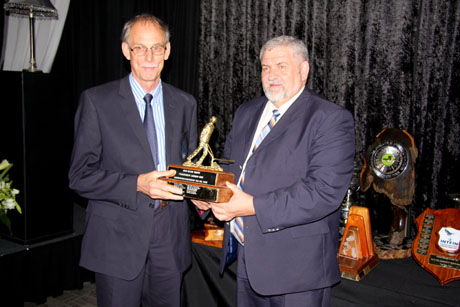
The time has come for organisations to work together to strengthen South Africa. This was the message that was confirmed by almost all role players during yesterday’s meeting of the ad hoc group for the protection of property rights.
This group decided to convene all interested groups to discuss the controversial firearms bill. These amendments amount to a form of expropriation of property, against which the group advises.
The ad hoc group for the protection of property rights is an informal grouping of organisations, organised agriculture and agricultural representatives, civil and civil rights institutions, opposition parties and academics as well as religious institutions. The group meets regularly to discuss any policy frameworks that may harm or undermine property rights and to consider mutual views, actions and initiatives.
“It was good to have a diverse group of organisations together,” said Henry Geldenhuys, the president of TAU SA. “What has become very clear from the groups that attended the event and from the comments of people who followed it through social media, is that action must now be taken to prevent this type of legislation from being implemented.”
“We are experiencing serious problems with the administration and feasibility of existing legislation. It is therefore ridiculous to think that new legislation that will require much more administration will be capable of being implemented successfully.”
TAU SA and Freedom Front Plus have confirmed that they totally disapprove of the bill and will not submit to it.
The group agrees that the bill has yet to progress through the parliamentary process, but that provision must already be made for future legal action.
“In the meantime, we urge all South Africans not to be apathetic towards important issues such as those that restrict basic freedoms like the right to choose. Get involved, make your voice heard, be aware of your safety and what you have to do.”
The group also warned that people should not act recklessly, but should become part of a controlled plan to oppose this legislation. Join the conversation and feel free to comment below!
“Could someone perhaps assist the National Police Commissioner, Riah Phiyega, with the interpretation of farm murder statistics,” says TAU SA’s Deputy President and Chairman of the Safety Committee, Mr Henry Geldenhuys. He reacted on the Commissioner’s submission to the Human Rights Commission (HRC) where she said that farm murders are declining and that there is no difference between a farm murder and any other murder.
Earlier TAU SA released its figures for farm murders for 2014 until the end of September. Accordingly it seems that this year 53 murders occurred in 210 attacks. This represents a sharp increase over 2013, when until the end of September 43 murders occurred in 164 attacks. “It is amazing that on one hand the Commissioner may assert that there is a decline in farm attacks and murders, and on the other hand showing the error factor on the police’s own statistics. Presumably, other police statistics will be wrong too,” said Mr Geldenhuys. This unacceptable situation requires the SAPS have to make their own statistics public. There is no reason other than their own inability to try to disguise it, than to announce crime statistics on a regular basis.
“The HRC hearing has learnt about enough evidence of a lack of police action, for any reason whatsoever. Where appeals to the community to assist the police are made, the SAPS structures are not in place, as the chaotic situation around police reservists indicates.
“In some of the traditionally black communities it happens nowadays more regularly that the law is taken into their own hands because the police do not act. It will be a dark day if that kind of behaviour would spread. The farmers are becoming impatient with the feeling that they are free game,” said Mr Geldenhuys.
TAU SA called on the Minister of Agriculture, Tina Joemat-Pettersen, to express her opinion on her colleague of Rural Development and Land Reform’s ideological process which will deprive white landowners of their rightful property.
TAU SA`s president, Mr. Louis Meintjes calls minister Nkwinti plans “constructive deprivation of white landowners, if not plain legalized land grabbing”.
In a letter to Minister Joemat-Petterson Mr Meintjes asked her if her colleague’s policy also is government policy, and whether she, who is also in essence the minister who has a direct interest in food security, can condone the ideological approach which has the potential of “totally destroying commercial agriculture”.
Meanwhile, Minister Nkwinti was informed in a separate letter that until he and his department display the common decency to respond to correspondence, TAU SA was not prepared to participate in the NAREG process or any of his ministerial work sessions, and that TAU SA did not regard those actions as meeting the requirements applicable to a public consultation process as it does not comply with administrative requirements.
Mr. Meintjes called on Minister Joemat-Petterson to ensure that the plans and proposals for Land Reform would not give such rights to farm workers that it would jeopardise food security, because in terms of the proposals farmers would eventually have no authority to make any decisions on their own farms without the consent of their employees.
“Those proposals effectively puts Government in charge of all agricultural properties. This is a communist approach and TAU SA will have no choice but to encourage farmers to put measures in place within the shortest time possible to ensure that they will be able to continue with their operations without labour,” said Mr Meintjes.
“Should these proposals be contained in legislation it will influence the total economy negatively, and we foresee famine in South Africa,” Meintjies concluded
A credible land audit should take place before the land claims process is reopened, farmers’ union Tau SA said.
Ownership figures released in the much-awaited land audit in February were not reliable, union president Louis Meintjies said in a statement.
“Utmost dissatisfaction was expressed about the uncertainty of the land audit, especially with regard to state-owned land, during TAU SA’s general council meeting in Pretoria.
“The process was not transparent and therefore no value could be attached to the audit.”
Meintjies claimed the figures, released by Rural Development and Land Reform Minister Gugile Nkwinti, contradicted those he announced previously.
“According to Nkwinti’s latest figures, the state owns less land than what was previously estimated.”
He said it seemed that agricultural land was being registered in the country on an almost weekly basis.
Tau SA launched its own land audit initiative several years ago, but this was halted because the state apparently refused to fund it.
Nkwinti announced in February that about 26 million hectares belonged to the state and 96m hectares were privately owned.
A break down of which nationalities and races owned the private land was still outstanding.
“There is an institutional challenge which will be resolved very soon,” Nkwinti told MPs at the time.
Tau SA’s general council recommended that a comprehensive land audit take place before the land claims process reopened.
Nkwinti recently announced an indefinite postponement of the reopening of the land claims process.
According to the draft Restitution of Land Rights Amendment Bill, published in May, the new land claims deadline would be December 31, 2018. The previous deadline was December 31, 1998.
The land claim process is aimed at providing compensation to those forcibly removed from their land by the colonial and apartheid governments between 1913 and 1994. – Sapa
During the South African Truth and Reconciliation Commission hearings in the late nineties, the Commission declared in its findings that there were four different kinds of truth. The Commission “rejected the popular assumption” that there are only two options to be considered when talking about truth – subjective and objective information – but that there were other kinds of truth – “personal or narrative” truth, “social or dialogue” truth and “healing or restorative” truth. We wonder which kind of truth is being published in our media on the history of land ownership in South Africa, and specifically why the reasons for the codification behind the South African 1913 Land Acts are being pointedly ignored.
South African history is arguably one of the world’s most controversial chronicles, but it was chronicled by those who could and did: the first Europeans who landed at the Cape, the subsequent colonial government, the missionaries, and the Europeans who made South Africa their home as did their counterparts who made other new world countries their home. The present government can only refer to the 1913 Land Act as a point of reference because their forefathers did not have the written word. They have no proof of anything other than what someone else wrote about. It is thus ironic that these complainants refer to “historical theft”, “land grabbing”, “stolen dreams”, “structural inequalities” and “infamous laws” as if they had their own factual proof that these circumstances existed.
Facts are ignored in the surfeit of hyperbole and distortions carried by the South African media which is increasingly becoming a mouthpiece of the government’s fraudulent propaganda.
A rooibos tea farm in South Africa
TAU SA’s two previous Bulletins exposed this disinformation about the history of land in South Africa and the land devastation of Zimbabwe. Nobody in the media published one word of these Bulletins. TAU SA requested the Johannesburg Sunday Times to publish the 1913 Land Act Bulletin as an advertisement. The cost of a half page is around R180 000. TAU SA was completely ignored. The paper was not prepared to publish anything other than the politically correct myths and false dissemination about the history of land in this country.
This should reveal something to readers of this Bulletin. If the facts are ignored, who is kidding whom about press freedom in South Africa?
The media
City Press, a publication within the largest Afrikaans press stable in South Africa, carried a full-page article “A century of stolen dreams” containing the opinions and historical fantasies of one Dr. Ruth Hall from the University of the Western Cape. On the adjoining page was an article by ANC national spokesman Jackson Mthembu entitled “A Call to Accelerate Restitution”. His article was entirely predictable – land is a “ticking time bomb”. At the bottom of the double page spread was a large piece on the now discredited book by three British academics called “Zimbabwe Takes Back its Land” on which we wrote in a previous Bulletin. This double-page centre spread’s ideological humbug is served up as a true picture of the land question in South Africa.
Who is Dr. Ruth Hall and why does she have a say while not one word from commercial agriculture – the people who actually produce South Africa’s food – is printed anywhere? Hall holds a Ph.D. from OxfordUniversity in the UK and is an Associate Professor at the University of the Western Cape. She joined in 2002 and has continually punted a leftist, ideological viewpoint which is a total disconnect from SA’s agricultural realities. Her SA history in the article was distorted and her sanctimony and bitter criticism of the twin plagues of colonialism and apartheid infect her pronouncements. The “erasing of history, unjust laws, cheap migrant labour, the legacies of displacement, deprivation, dispossession, inequality and poverty” are alluded to as being the fault of whites. She laments the fact that there was not a Truth and Reconciliation Commission on Land.
South Africa’s largest circulation newspaper the Sunday Times gave prime space to one Mtobeli Mxotwa , spokesman from the Ministry of Rural Development and Land Reform whose article was entitled ”Radical steps needed to right the 1913 wrong”, while leftist Gareth van Onselen’s article on the same centre page was headlined “Consequences of a cruel act linger on”.
The absolutely useless ANC Youth League was given top space in The Citizen to say that “Land reform is too slow” while a large colour picture of President Jacob Zuma and the Minister of Rural Development shows them at the opening of an exhibition entitled “Reversing the legacy of the Natives Land Act 1913” at the Cape Town Convention Centre. Some newspapers printed critiques of current legislation but not one paper printed theTAU SA bulletin or excerpts thereof containing the historical facts on the history of land in South Africa.
The Land Act bulletin was specifically sent to Business Day, asking that some of it be printed. TAU SA was ignored. To top it all, the Afrikaans Sunday newspaper Rapport(30.6.13) carried an article by “political analyst” J.P. Landman who sees the government’s land reform program is a “political requirement for community and political stability”. In other words, hand over the farms to appease the (mostly violent) mob demands. Thus we are to continually appease each time there’s a riot, or a threat of violence. Feed the crocodile until it devours you! His Zimbabwe allegory is completely wrong – agriculture was destroyed by Robert Mugabe when he lost the 2000 election and grabbed farms to placate the so-called war veterans who demanded land, not because land was not handed over earlier. is Zimbabwe allegory is completely wrong – the land(Perhaps Mr. Landman would like to hand over some of his property as an appeasement gesture!)
Media
Instead of all of the above, when will the South African media explain the truth about land in South Africa? Whose viewpoints should be exposed to the population – those who produce the food or those who talk about expropriation, who draft parliamentary laws to further curb commercial farming, who are establishing a land valuer’s office to determine the price of land according to themselves, who urge giving in to the violence of the mobs, or the British university zealots with leftist agendas?
Getting the facts to the South African public is becoming as difficult as the course taken by samizdat activists during the worst years of the old Soviet Union. From the Russian sam “self”, and izdatelstvo “publishing”, these activists’ literature was secretly written, copied and distributed during the periods of Soviet repression. We haven’t reached this point yet, but when a national newspaper refuses to print undisputable facts about land in South Africa, and even refuses a paid advertisement containing these facts, then we can’t be too far behind. TAU SA’s bulletin and other news is disseminated via the internet, but the masses who vote for the ANC only read the inflammatory nonsense propagated by government-supporting academics and ANC spokesmen. These masses clamor for land based on this disinformation. They believe Jackson Mthembu’s ticking time bomb warning, and his statement that Africans can only build from the “ruins of the past” if they have a piece of land on which to do so. This is dangerous nonsense. Forty million black people each with a piece of land?
TAU SA tries to maintain the very best relationships with the media: there is also much appreciation of how the media has handled TAU SA’s viewpoints and how they have been presented in the media. In this light it is thus strange that this important topic is met with almost absolute silence. It doesn’t make sense. TAU SA is of the opinion that the land question is of crucial importance, given the implications for food security in South Africaand the emotional way it is presented to the voting public. The other side of the story should be heard – especially when this “other side” consists of the very people who produce South Africa’s food. For the sake of justice we would like to see this happen.
What are the facts?
All the undisputable facts on the history of land in South Africa can be found in the book “Disputed Land” by Louis Changuion and Bertus Steenkamp. Almost a third of the book contains historical documentation to back up the contents of the book. (It can be bought at Kalahari.com). As far as we know, not one South African publication has reviewed this book.
Only 35 000 commercial farmers provide food for South Africa’s nearly 53 million people. If the emotive recommendations of Dr. Hall, and the ignorant demands of the ANC ever become realities, will Dr. Hall and the ANC suggest suitable food supply replacements for SA’s commercial farming sector’s production? In a 25 June press release, TAU SA asks that the government “take active steps to prevent more farmers leaving the industry to avoid South Africa relying on unsustainable food imports”. The World Bank recently warned that food demand is growing, and that “disruptive weather events are increasing in frequency and amplitude. The variables that surround agriculture are increasingly volatile. Countries will not export food if they are themselves vulnerable.” The World Bank continues: “About 50% of global grain supplies are in India and Chinaand they are not exporting them. Countries from India to Egypt to Vietnam to Indonesia banned exports of rice during the 2008 crisis, while sudden changes in trade policy also affect exports.” Will the ANC turn South Africa into a country dependent on others for food?
The government’s land restitution policy is an abject failure. Hundreds of farms have been lost to production.
Black Economic Empowerment has not left agriculture alone. The current Broad-based Black Economic Empowerment Bill is due for amendment, and comment has been called for. It is a fact that profit after tax on average assets of a working farm in South Africa is 1,7%. Farming enterprises are running on thin margins – 85% of livestock producers show a profit per annum of less than R40 000 per month, while 27% of general farmers run at a loss and 58% make a profit of between zero and R500 000. Most farmers cannot afford BEE. BEE scorecards have been presented to agriculture on which little research has been conducted. If this legislation is thrust upon commercial farmers, many will go out of business, further impinging upon food security in South Africa.
Agriculture throughout the world is increasingly less labour intensive. The US farm population today is only 1,5% of the total. Yet American farmers feed 320 million people and they export massive quantities of food around the world. Thus this “hunger for land” and “everyone must have a piece of land” punted by the ANC is clearly a sop to their electorate but a danger to food security. South Africa will simply relapse into one huge squatter camp if commercial farms are broken up and redistributed.
Indeed the agricultural warning drum has been beating but who is listening? The “free” press should ask itself whether honest information or politically correct propaganda is its mission, and whether it should be held responsible for a collapse of food security in South Africa.
TAU SA is highly upset about trade unions’ proposed public actions to expedite land transfer. “The country is still licking its wounds from the labor unrest in the mining industry, which led to the Rand experiencing near-record lows. Now there are threats of labor unrest in the agricultural sector,” said TAU SA’s General Manager, Mr Bennie Van Zyl. “It seems if the unions have the support of Pres Jacob Zuma, who stated in his reply to its budget debate that land has to be transferred faster from those who need to give land to those who want to have land. This creates a supportive climate for unions’ radical demands and sends a message that the country’s farmers must not expect any sympathy or assistance if the industrial action would turn violent. In addition, it is time that the Government sets an example by transferring the millions of hectares of unused land in its possession to those who say they need land,” said Mr Van Zyl.
“There is a political agenda behind the proposed actions of Numsa and Fawu. Numsa has nothing to do with the agricultural sector because it is the metal workers’ union. However, his president Cedric Gina is revolutionary outspoken in his unfounded, untested and untrue allegations about alleged ‘land transgressions, theft and violent land expropriations’ that would have occurred in the past “
Mr. Van Zyl notes that the unions concerned have section 25 of the Constitution in their sights. “The government needs to state urgently and in unambiguous terms where it stands in terms of the Constitution, and whether it is considering changing it in order to allow expropriation without compensation. Government will have to show whether it is willing to respect and uphold the Constitution, and whether it is going to give in to pressure from the unions,” said Mr Van Zyl.
Meanwhile, TAU SA urged farmers to intensify their security measures in the light of the impending industrial action by trade unions and to be intolerant against any act of insurrection or vandalism that would be a threat to life or property resulting from this action. “We as law-abiding citizens also have rights, and we also have the right to protect those rights,” said Mr Van Zyl.
This website uses cookies to improve your experience. We'll assume you're ok with this, but you can opt-out if you wish. Cookie settingsACCEPT
Privacy & Cookies Policy
Privacy Overview
This website uses cookies to improve your experience while you navigate through the website. Out of these cookies, the cookies that are categorized as necessary are stored on your browser as they are essential for the working of basic functionalities of the website. We also use third-party cookies that help us analyze and understand how you use this website. These cookies will be stored in your browser only with your consent. You also have the option to opt-out of these cookies. But opting out of some of these cookies may have an effect on your browsing experience.
Necessary cookies are absolutely essential for the website to function properly. This category only includes cookies that ensures basic functionalities and security features of the website. These cookies do not store any personal information.
Any cookies that may not be particularly necessary for the website to function and is used specifically to collect user personal data via analytics, ads, other embedded contents are termed as non-necessary cookies. It is mandatory to procure user consent prior to running these cookies on your website.