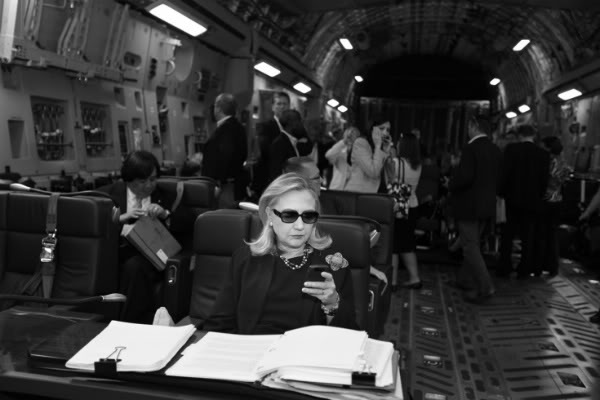
Hillary blames ‘mass incarceration’ for Baltimore

Hillary Clinton blames “mass incarceration” of blacks for the riots in Baltimore. She called for a re-evaluation of prison sentences.

Hillary Clinton called on Wednesday for broad criminal-justice reform, reflecting the former First Lady’s evolution from supporting the policies instituted by her husband two decades ago in a period of high crime rates.

Clinton called for body cameras in every police department in the country, as well as an end to an “era of mass incarceration.” Her speech came two days after the funeral in Baltimore of Freddie Gray, a 25-year-old black man who died while in police custody, and amidst ongoing civil unrest in that city.

“There is something profoundly wrong when African-American men are far more likely to be stopped by the police and charged with crimes and given longer prison terms than their white counterparts,” Clinton said. “There is something wrong when trust between law enforcement and the communities they serve breaks down … We must urgently begin to rebuild bonds of trust and respect among American between police and citizens.”

Clinton offered few specific policy plans in the speech, and didn’t explain how police forces would pay for body cameras on all officers. She spoke broadly about reducing jail sentences for low-level offenders and the effects of imprisoning millions, particular African Americans. “We don’t want to create another incarceration generation,” Clinton said.

Policing experts who reconstructed the events of the day said that Baltimore police did not send enough officers to the situation at the start, failed to quickly make arrests once trouble began and did not deploy additional officers quickly enough.

Key decisions led the situation to spiral out of control in a short 90 minutes, a lesson other police departments should heed.

Source: Time

Seattle, San Francisco, Baltimore face fresh riots

Police say black-clad May Day marchers hurled wrenches and rocks at officers and hit police with sticks as a Friday evening march through Seattle’s Capitol Hill neighborhood turned violent, injuring three officers — two seriously.

Police responded with pepper spray, pepper balls and flash bang grenades. Officers said several dozen vehicles were damaged. Windows were broken in neighborhood businesses.

Seattle Police Chief Kathleen O’Toole said one officer had a dislocated shoulder, a second had a broken wrist, and a third had a burn injury to his leg and ankle. They’re recovering at Harborview Medical Center.

“Thankfully, they’re all conscious,” O’Toole said. “We talked to them. They’re in good spirits. Just happy the situation didn’t become more serious.”

The injuries occurred at 7:30 p.m. when officers issued a dispersal order to the group and attempted to clear the street at Broadway and Howell, Seattle police said.

Protesters hurled bottles, rocks, bricks, wrenches, and other projectiles at police, who responded by utilizing pepper spray and pepper balls to break up the increasingly violent crowd, police said. They added protestors also began pushing barricades and trash cans into roadways, and raided a fenced construction site for items they later burned in the street.

A May Day protest and march through the streets of Downtown Oakland, San Francisco, also turned violent Friday evening, with some businesses and cars being vandalized.

Friday’s protest began peacefully. About 500 people protesting several issues, from police brutality to capitalism, marched from Frank Ogawa Plaza and eventually up Broadway. Later on, vandals went on a rampage. They broke windows of business and vehicles and set a car on fire on the Broadway Auto Row.

One of the marchers said she was okay with vandalism that targeted big business.
“I see it like a game of chess and if one day we can throw rocks at police, right or wrong, however you feel about it, then that’s a day we took a stand. And that, in my mind, to some extent, is a win against the system,” Melissa Crosby said.

Baltimore is bracing for fresh protests this weekend, following a tumultuous week that included looting and arson, the arrival of National Guard troops and the filing of criminal charges against six police officers in the case of Freddie Gray, a 25-year-old black man whose death in police custody set off the unrest.

Thousands of people are expected here Saturday for a march organized by Malik Shabazz, president of the Washington-based Black Lawyers for Justice and a former chairman of the New Black Panther Party. For nearly two weeks, ever since Mr. Gray died, city leaders have been warning against “outside agitators,” an oblique reference to Mr. Shabazz, who is clearly making them nervous.

“They should be nervous,” Mr. Shabazz said in an interview Friday night. “The youth went off and had a rebellion because the established leadership has not represented them well.”

Source: CBS/NYT