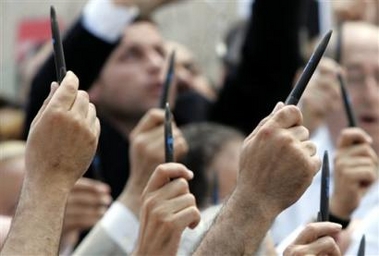
What is a journalist?

journalistThe Senate Judiciary Committee, looking to provide protections for journalists and their sources, ran into a roadblock Thursday when lawmakers couldn’t agree on the definition of “journalist.”

Under the legislation, journalists wouldn’t have to comply with subpoenas or court orders forcing them to reveal sources or confidential information unless a judge first determines there’s reason to think that a crime has occurred and government officials have exhausted all other alternatives.

It’s the third time Congress has considered a “shield law” for journalists. Similar bills have failed despite bipartisan support.

“I’m hoping the third time’s a charm,” said Sen. Patrick Leahy, D-Vt., the committee’s chairman.

The bill defines a journalist as a person who has a “primary intent to investigate events and procure material” in order to inform the public by regularly gathering information through interviews and observations. The person also must intend to report on the news at the start of obtaining any protected information and must plan to publish that news.

But senators disagreed on how to define journalists, since some thought the bill’s definition wasn’t specific enough.

Sen. Amy Klobuchar, D-Minn., wondered whether it could be used to provide protections to employees of WikiLeaks, an organization that allows anonymous sources to leak information to the public.

“I’m concerned this would provide special privilege to those who are not reporters at all,” Klobuchar said.

Sen. Dianne Feinstein, D-Calif., suggested that the definition comprise only journalists who make salaries, saying it should be applied just to “real reporters.” The sponsor of the bill, Sen. Charles Schumer, D-N.Y., was against that idea, since there are bloggers and others in the Internet age who don’t necessarily receive salaries.

“The world has changed. We’re very careful in this bill to distinguish journalists from those who shouldn’t be protected, WikiLeaks and all those, and we’ve ensured that,” Schumer said. “But there are people who write and do real journalism, in different ways than we’re used to. They should not be excluded from this bill.”

The Standing Committee of Correspondents, a group of reporters that issues congressional press passes, requires that reporters be full time and paid in order to receive passes.

The reconsideration of a shield law comes on the heels of media controversies that came to light in May. The Justice Department had seized the phone records of 20 Associated Press reporters over two months without giving them prior notice and had traced the phone calls and emails of a Fox News reporter.

The bill also would require the Justice Department to notify any reporters it chose to monitor. It allows Justice officials to delay that notice by 45 days and permits them to ask for an extension of another 45 days.

Most states have their own shield laws for journalists, but those laws don’t apply in federal court. That means any monitoring of reporters by the federal government would be covered only under a federal shield law.

The committee will continue debating the bill when it reconvenes in September, and Schumer said he hoped it would head to the Senate floor by the end of the year. – McClatchy Washington Bureau

Read more here: http://www.mcclatchydc.com/2013/08/01/198338/senators-spar-over-definition.html#storylink=cpy

Less activity at Mandela hospital

Nelson Mandela
Nelson Mandela

A few vehicles were entering and exiting the Pretoria hospital on Tuesday morning where ailing former president Nelson Mandela is in a critical condition.

Hospital security staff attended to the infrequent motorists at the facility’s entrance on Park Street.

The main entrance on Celliers Street was still closed after 3am on Tuesday.

Reporters and technical staff, camping on Celliers Street sidewalks, packed and departed after midnight.

Vehicles belonging to media personnel were left parked near the hospital’s entrance. Private security guards kept an eye on the broadcast equipment.

The usually busy Park Streets, where there is another entrance, was almost deserted. Patrolling police cars with flashing lights were seen at intervals.

Several police officers could be seen inside the hospital.

At midnight, several news crews made up of mainly international broadcasters, were doing live crossings near the Celliers Street entrance.

Several generators for back-up power were running through the night and broadcasting equipment including huge lights and cameras had been set up.

Numerous Mandela family members, politicians and government officials have been visiting the anti apartheid icon.

Public Service and Administration Minister Lindiwe Sisulu and Madiba’s daughter Makaziwe, left the hospital on Monday night.

Sisulu arrived at the hospital just after 6pm in a black Mercedes with blue flashing police lights. She and Makaziwe Mandela left just before 8pm.

Some of Mandela’s relatives left the hospital earlier in the day.

First seen leaving on Monday after a visit was grandson Ndaba Mandela, who arrived shortly after Mandela’s ex-wife Winnie Madikizela-Mandela and daughter Zindzi Mandela-Motlhajwa.

Earlier in the day, Defence and Military Veterans Minister Nosiviwe Mapisa-Nqakula and United Democratic Movement leader Bantu Holomisa arrived separately at the hospital.

On Sunday night presidential spokesman Mac Maharaj said in a statement that Mandela’s condition had turned critical.

Addressing the media in a briefing, which was initially scheduled as an off-the-record editors’ briefing, on Monday, President Jacob Zuma said Mandela’s condition had not changed.

“Mandela remains in a critical condition in hospital and doctors are doing everything possible to ensure his well-being and comfort,” Zuma said in Johannesburg.

He and deputy African National Congress president Cyril Ramaphosa visited Mandela at the hospital on Sunday night. – Sapa

Media crowd growing at Mandela’s Pretoria hospital

Journalists waiting for news during a previous Mandela hospitalisation

The number of journalists outside the Pretoria hospital where former president Nelson Mandela is in a critical condition increased significantly on Monday morning.

Reporters’ vehicles, including more than 10 broadcast vans, took up almost all the parking spots adjoining the Medi-Clinic Heart hospital.

Several police officers were manning the entrances to the hospital.

Before 6am, three police officers stood at the hospital’s entrance along the busy Park Street.

The officers searched cars entering the hospital premises. More officers were inside the facility.

The hospital’s other entrance along Celliers Street was opened before 6am. Police officers and hospital security searched all vehicles, including delivery vans.

Well-wishes adorned the hospital’s security wall with get-well cards, balloons, flowers, and paintings.

Some of the messages pasted onto the wall read: “Descendants of [former Ghana leader] Kwame Nkrumah wish u long life. Bernard [from] Ghana”.

Another message imprinted on an Ethiopian flag read: “We love you our father, Tata Madiba”.

A colourful card from a Montessori pre-school was decorated with tiny children’s palm prints and numerous pictures of Madiba holding the Fifa World Cup trophy.

Some passers-by, rushing to work on Monday morning, momentarily glanced at the huge artistic display.

Several news crews converged on the hospital on Sunday night after the presidency announced that Mandela’s condition had deteriorated. Most of them had left by 3am on Monday.

However, more than 20 vehicles, including the broadcast vans for local and international media, occupied the parking along Celliers Street on Monday morning.

A few reporters braved the biting early morning cold to chat near the hospital’s Park Street entrance. Some of them held cameras.

It was a quiet night outside Mandela’s home in Johannesburg with almost no movement on Monday morning.

Shortly after 2am, a silver Jeep arrived at the house. The driver pulled up outside the black gates, flashed the vehicle’s headlights and, when there was no response, hooted twice. The gates opened.

Two broadcasting teams arrived at the house on Sunday night, but left a short while later.

The street was otherwise quiet, with only the occasional armed response patrol.

After 6am the streets became busier as people started their daily routines. A black VW Polo parked outside the gate of the house and a woman entered.

On Sunday evening presidential spokesman Mac Maharaj said in a statement: “The condition of former president Nelson Mandela, who is still in hospital in Pretoria, has become critical.”

It was issued after a visit by President Jacob Zuma and African National Congress deputy president Cyril Ramaphosa.

“They were briefed by the medical team who informed them that the former president’s condition had become critical over the past 24-hours,” said Maharaj.

Zuma and Ramaphosa also met Mandela’s wife Graca Machel to discuss his condition.

“The doctors are doing everything possible to get his condition to improve and are ensuring that Madiba is well-looked after and is comfortable. He is in good hands,” Zuma said in the statement.

He appealed to South Africans to continue praying for Mandela and his medical team.

Mandela, 94, was admitted to hospital on June 8 for treatment of a recurring lung infection. – Sapa

Mandela vigil continues

Nelson Mandela's houe in Houghton, Johannesburg

There was little activity outside former president Nelson Mandela’s house in Houghton in northern Johannesburg on Wednesday as the ailing icon entered his fifth day in hospital.

A small contingent of media has been stationed outside his home since the news of his admission to a Pretoria hospital on Saturday.

A police officer patrolled the street in front of the residence on Wednesday morning.

At around 9.45am a black Mercedes-Benz with dark tinted windows entered the black gates to the house. A while later two cars were seen leaving.

As people drove past the house they slowed down to take a look at all the cars and the media contingent.

A woman got out of her car to read the stones with well wishes left for the former statesman outside the house.

On Saturday, the presidency announced that Mandela had been admitted to hospital in the early hours of the morning and was in a “serious but stable” condition.

His condition has remained unchanged since then.

The presidency said on Tuesday that the doctors treating Mandela had given President Jacob Zuma a thorough briefing on Monday night.

“President Zuma has full confidence in the medical team, and is satisfied that they are doing their best to make Madiba better,” spokesman Mac Maharaj said in a statement.

Mandela was still in a “serious but stable” condition.

More than 10 outside broadcast vehicles were parked close to one of the entrances at the hospital on Wednesday where Mandela was believed to be admitted.

Security remained tight at the facility, with six police officers manning each entrance. All cars entering the facility were searched.

Family members have been seen arriving at the hospital over the past two days.

On Tuesday, Mandela’s ex-wife, African National Congress MP Winnie Madikizela-Mandela, left the hospital before 6pm.

She and her daughter Zindzi were driven off in a black Audi, escorted by a white Mercedes Benz. Both cars had flashing blue police lights.

Mandela’s two other daughters, Makaziwe and Zenani, who is South Africa’s ambassador to Argentina, were also seen at the hospital on Tuesday.

His wife Graca Machel has reportedly been at his bed-side since his admission.

This is the third time this year the Nobel Peace Prize laureate has been hospitalised.

At the end of March and in April, he spent nine days in hospital receiving treatment for recurring lung problems.

Earlier in March, he was admitted to a Pretoria hospital for a scheduled check-up and was discharged the following day. – Sapa

Passers-by curious about Mandela

The throng outside the Medi-clinic Heart Hospital in Pretoria

Pedestrians passing the Pretoria hospital where ailing former president Nelson Mandela is apparently being treated, were curious about his health on Tuesday.

This was heightened by the presence of 10 police officers at the private hospital’s entrance, parameter fences, a police tape cordon, and media camping across the street.

“I do not want to just go home without knowing what is happening to Madiba. He is in our neighbourhood and even though he is unwell, I am excited to an extent,” said university student Aymee Zwane.

She stood next to local and international photographers whose lenses were focused on the hospital’s main entrance.

“I wish I knew more about his condition, but from what I’ve heard so far, Tata is unwell. My family prays for him every time. He will be fine,” she said.

Another passer-by, Simon Moereng, 57, said he felt helpless at not being able to do anything to assist Mandela.

“Here is a man who did a lot for millions of us. He is lying in hospital, sick and there is nothing we can do for him. That depresses me a lot,” he said.

“We are poor people, we don’t have much, but only our well wishes. Mandela should live long in our democracy. He is missed in our nation’s day to day running.”

Some passengers in passing taxis used their cellphones to photograph the journalists and the hospital.

Mandela’s ex-wife, ANC MP Winnie Madikizela-Mandela was seen leaving the hospital before 6pm.

She and her daughter Zindzi were driven off in a black Audi, escorted by a white Mercedes-Benz. Both cars had flashing, blue, police lights.

Earlier, the other two of Mandela’s three surviving children arrived at the hospital in separate cars.

Makaziwe Mandela’s red Range Rover was followed by that of Zenani Mandela, South Africa’s ambassador to Argentina.

Tuesday was Mandela’s fourth day in hospital.

The presidency said the doctors treating him ad given President Jacob Zuma a thorough briefing on Monday night.

“President Zuma has full confidence in the medical team, and is satisfied that they are doing their best to make Madiba better,” spokesman Mac Maharaj said in a statement.

Mandela was still in a “serious but stable” condition.

Maharaj dismissed media reports that Zuma would visit Mandela on Tuesday.

“That is incorrect. The president is in Cape Town preparing for the budget vote of the presidency,” he said.

On Saturday, the presidency announced that Mandela had been admitted to hospital in the early hours of the morning.

On Monday, the presidency said his condition was unchanged, and that he was receiving intensive care.

Security at the hospital, in Arcadia, was tightened, with police officers manning its two entrances.

Brigadier Phuti Setati said the police at the hospital were part of the presidential protection services team, whose task included protecting former presidents.

He did not specifically confirm that Mandela was in the hospital.

Local and international media have camped outside the facility, and at Mandela’s Houghton, Johannesburg, home since Saturday.

This is the third time the Nobel Peace Prize laureate has been hospitalised this year.

At the end of March and in April, he spent nine days in hospital receiving treatment for recurring lung problems.

Earlier in March, he was admitted to a Pretoria hospital for a scheduled check-up and was discharged the following day.

The West’s slippery slope to sadism

20 May 1983, Civilians killed in Church St bomb attack, with the help of Britain, The Netherlands and Sweden

by Joseph Secrève

If one were to take a bird’s eye view of the changes that took place in Western nations over the past sixty years, one could only muse at the rapid shifts that have occurred in this short time. The dust of war had hardly settled and an invisible war on the Western soul has taken its place. In small increments, we have been fed slivers of violence, less dialogue and more action through the national media and entertainment industry. A sense of higher purpose has been clouded and narcissism has taken over. Remember the Cold War spy dramas where pistol-wielding protagonists held lengthy dialogues with their enemies at gunpoint? Especially in the case of Ian Fleming’s immortal superspy, a clear shift could be seen if one compares Connery with Craig. More often the use of violence has been promoted as a means of solving disputes and debasement has become acceptable under the guise of an ‘alternative lifestyle’.

In stark contrast to today, Truman Capote’s famous non-fiction novel In Cold Blood caused a national stir when it was first released in 1966. The book recounts the killing spree of two rogues who killed a Kansas farmer and his family after it was rumoured that they had a substantial amount of cash in their home. The killers got away with only a modicum of dollars, but the carnage they left behind traumatised a large section of rural America. To quote Capote: “Of what were they frightened? It could happen again.”

The intensity of Capote’s research in today’s terms would seem slightly out of place. Such levels of violence and cruelty have become an almost everyday occurrence, and in rural South Africa there are even multiple cases of torture, often leading to murder, with on average one murder per week. This carnage has spread like an inkblot over South Africa, fuelled by the “Kill a Boer, Kill a Farmer” slogan, and there appears to be no end in sight. Every subsequent president under the ANC is less reserved in either chanting or defending this bloodcurdling invective. In Capote’s interview with the accused Perry Edward Smith, the latter revealed that he had felt a deep sense of shame as he slit the throat of Mr. Clutter. Nowadays the mutilation of people and deliberate desecration of corpses unveils a motive of a different kind: sheer hatred! The intentional destruction of human life has become a goal in itself, especially when one considers that these savages…uhm…I mean “robbers” seldom steal anything valuable. Usually no more than a cell phone gets stolen to prevent the victims from calling someone or their car gets taken as a getaway vehicle, only to be abandoned a few kilometres down the road.

Our Marxist-inspired intellectuals and ideologues are eager to help defend these offensive acts, often rationalising the chaos away with their usual outmoded Freudian frustration-aggression or deprivation theories. This is their version of ‘supporting the oppressed’. Strangely enough, many people still buy it. The more savagery the murderers cause, the more warranted their grievances are held to be, especially from people who have no knowledge or experience of these communities. Filling their knowledge gaps with presuppositions then becomes a reality.

Fortunately our understanding of human psychology could help us show the way. In many respects the Arendtian concept of the ‘banality of evil’ clears matters up a bit. The everyday nature of these acts of cruelty makes them appear normal. Hannah Arendt however faltered in believing that people were entirely nonchalant when it comes to the killing of others. Research has shown that there is always an element of ideology present in these levels of appalling behaviour. Psychologist Philip Zimbardo demonstrated this in his Stanford Prison Experiment, which was later to be elevated to the ranks of classic psychology experiments. In this experiment a makeshift prison was erected on the university premises and student participants were randomly assigned to the role of prisoner or warden. It was the intention to run this experiment for a fortnight, but after six days the severe levels of abuse from the warden participants on the prisoner participants compelled Zimbardo to pull the plug prematurely. In fact, Zimbardo himself was moderately blinded by this experiment, and only started seeing the trees from the forest when a new participant entered the experiment and pointed out how badly abusive the wardens had become.

This convinced Zimbardo how easily a fabricated reality could alter the perception and behaviour of people, regardless of their deeper understanding that this ‘reality’ is only play-acting and not for real. What was more astonishing was the level of docility of the prisoner participants. Having to go to the bathroom with a bag over their heads and their ankles in chains; or having to do push-ups with one hand behind their backs were humiliations they fairly readily accepted.

In this sense, South Africa – like many communist-run countries – is a collection of all the evil psychology experiments raked together from times past. Farmers and other whites are considered to be fundamentally to blame for all social ills that have visited South Africa. The stoic acceptance of the fate of whites is further exacerbated by calls from intellectuals, with the likes of leftist author André P. Brink who mentioned that his people deserved to disappear. The reason why is not really important. The daily reality is clouded with the notion that they are unwanted to the extent of being outlaws. One doesn’t need to control human behaviour directly, as this would likely meet up with resistance. The better option would be to control the mental climate, ie. cast a stage where the actors are told to live this reality, and then slowly turn up the heat. By letting this severe debauchery creep in slowly has the additional benefit to cause confusion and paralyse the victim even more. Had the approximately 4 000 South African farmers lost their lives in, say a week or a month instead of twenty years, this would have been a sure-fire cause for war.

Unfortunately our powerful leaders, our presses and public intellectuals have the habit of denying certain aspects of daily life such as the abominable state of cruelty we have fallen into. Harvard psychologist Stephen Pinker claims that we are living in a higher state of peace in the West than ever before. The impending genocide on white South Africans is primarily expounded by a small group of bloggers who are constantly facing a wall of denial or ridicule. Especially regarding South Africa, they are having a tough time in dealing with this frustrating Cassandra Complex.

As for communism, there were always the frontrunners who were obsessed with their brave new world ideology and who were capable of turning a blind eye to all the evils they personally witnessed. The Romanian communist leader Ana Pauker is a prime example, as she saw to the deportation of her own husband who later died in the gulags under Stalin’s orders, but did not shed a tear. Not to mention how cannibalism was justified and even rewarded with top jobs under chairman Mao’s command in certain Chinese provinces. Yet, all the while, the promised utopia did not materialise. The only real change that took place was to turn the situation awfully grim and harden people’s attitudes further, effectively closing themselves off from truly seeing each other.

If we want to understand this process in full, we would be misguided in believing that this sadism is due to some form of repression and is now undergoing a cathartic release. The reinforcement to do evil comes from outside and acts on the devil inside.

To return to the example of Capote: How many murderers in South Africa and elsewhere feel a sense of shame for their barbaric deeds? Probably not many, especially within the climate dictated by the media that such murders are not crimes but belated reactions to “suffering” from decades ago.

If Capote been alive and in South Africa, I’m sure he would have quoted instead: ”Of what were they frightened? It will happen again”.

Joseph Secrève was born in South Africa but lives in the Netherlands. He is a psychologist by training.

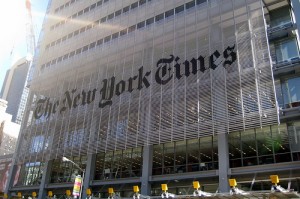
NYT is a propaganda megaphone says correspondent

The New York Times has essentially become a “propaganda megaphone” to peddle the establishment’s narrative — especially when it comes to war — charged foreign correspondent Daniel Simpson, who resigned from the paper in disgust. According to Simpson, the paper, which is often lambasted and ridiculed by conservatives and libertarians for its blatant “liberal” bias, is actually just a propaganda tool for the ruling establishment.

In an explosive interview, the former Times correspondent, who was based in the Balkans during his stint at the newspaper, offered an inside look at how it all works. What appears to have bothered him more than anything was how the supposed paper “of record” was so determined to sell the Iraq war to the American people, even if it meant basically lying or repeating government lies to do so.

“It seemed pretty glaringly obvious to me that the ‘news fit to print’ was pretty much the news that’s fit to serve the powerful,” Simpson explained, citing the warmongering over Iraq as a prime example. “The way that the paper’s senior staff think is exactly like those in power — in fact, it’s their job to become their friends.”

An ambitious reporter, Simpson joined the paper a decade ago when he was just 27 years old. He had been hired to report on the Balkans, where the U.S. government and other Western powers had intervened in an internal conflict. However, within a few months, disillusioned by the Times‘ war-mongering, he resigned.

“I was young and naive and idealistic, I suppose. I thought I was going to be holding people in power to account,” said Simpson, who wrote a recently published book about his experiences entitled A Rough Guide to the Dark Side. “It turned out instead that when I joined in 2002, the New York Times was very much engaged in doing exactly what those in power wanted them to do, and printing fake intelligence information to start the war in Iraq.”

As the establishment’s propaganda about “Weapons of Mass Destruction” in Iraq was getting in full swing, Simpson said he was asked to report bogus information about Serbians selling WMD delivery parts to Iraqi dictator Saddam Hussein. The Serbs, however, were actually just selling spare airplane parts, not WMD delivery systems, he explained.

“They were looking for every possible way of getting this weapons-of-mass-destruction story into the news media,” Simpson told RT, adding that the Washington Post quickly jumped on the dubious allegations. “So I came under enormous pressure from my bosses to start looking at it the same way, and I couldn’t see any evidence for doing that.”

While the Times did apologize for some of its most outrageously bogus WMD “reporting” — or war-mongering, as critics have labeled it — the paper “hasn’t really changed its policy,” Simpson explained. Among other problems, he pointed to Howell Raines, the executive editor during his time at the paper, who wrote a long article in the Atlantic after losing his job in 2004 that offered insight into the way top officials at the paper view its role.

Raines wrote that the Times was “the indispensable newsletter of the United States’ political, diplomatic, governmental, academic, and professional communities.” To Simpson, though, the former executive editor was basically admitting that “he sees his newspaper as being this propaganda megaphone for those who run the world.”

RT host Abby Martin agreed, slamming the paper and the “illegal and immoral” war repeatedly. She said the Times had indeed become a “propaganda megaphone” by simply reprinting government press releases and official statements — the “establishment line” — as if it were truth. Critics of the paper have been saying that for decades.

Asked about how the censorship over such a vast organization could function, Simpson explained that “there are different processes at work.” Citing his own experience, the self-styled “renegade” correspondent said that even in the Balkans, the Times had a pre-determined view of what happened. Editors were not interested in analyzing the tragic effects of Western military intervention, and they certainly were not open to exploring alternative explanations and views.

Reporters, meanwhile, would quickly adapt to their environment and learn to parrot the establishment narrative — at least if they hoped to advance their careers and have their stories published. “I was just so disgusted by this situation that I didn’t want to play the game anymore,” Simpson said, adding that he had previously been “very keen” to “play the game” in order to further his ambitions.

During the interview, Simpson gave various examples of how stories were framed to suit the Times’ — or the ruling establishment’s — world view. “You learn, you internalize these little phrases that you apply to other countries, like Serbia is ‘nationalist’ or engaged in ‘extremist policies,’ but the United States is never doing those things, of course — and you wouldn’t put them in a story,” Simpson explained.

Times employees are expected to tout the agenda no matter how hypocritical. “You’d never frame a story that said the United States has started a war of aggression, but it’s instead engaged in a ‘foreign policy project,’” Simpson added. “Or you would talk about ‘harsh interrogation techniques’ as opposed to torture. These are things that people just learn to do.”

In a separate interview with Green Left Weekly, Simpson echoed those comments, explaining how reporters themselves learn to accept the situation if they want to move forward. “It only seemed possible to rise higher at the Times if I bought their illusions, and having seen through them, this would have been consciously corrupt,” he explained. “Until that point, I’d been unconscious of cooption as a journalist — like most of my peers. But as my eyes lost their scales, I saw my own flaws more clearly, and freaked out.”

In the interest of fairness, it is worth pointing out that the Times recently became the first media outlet to admit that much of the establishment press — the Times included — was allowing the Mitt Romney and Barack Obama presidential campaigns to censor news reports about themselves. The Times actually published a front-page story about the startling practice, leading to an uproar among media critics that eventually sparked policy changes at newspapers nationwide.

The Times also recently ran a column by then-Public Editor Arthur Brisbane openly admitting that “the paper’s many departments … share a kind of political and cultural progressivism … that virtually bleeds through the fabric of The Times.” Of course, that has long been obvious to honest observers. But the fact that the newspaper was actually willing to publicly acknowledge its bias was celebrated by analysts.

On the other hand, the paper has been complicit in covering up some of the worst atrocities in human history. Pulitzer Prize-winning “journalist” Walter Duranty, for example, played a key role in hiding Josef Stalin’s mass murder of millions of Ukrainians while serving as the Times’ chief correspondent in Moscow. Other savage tyrants have benefited from the paper’s “reporting,” too.

Of course, the Times is hardly the only establishment news outlet to peddle propaganda as truth. Amber Lyon of CNN, for example, recently exposed censorship at the Cable News Network and accused her employer of “making me put what I knew to be government lies into my reporting.” Former reporters at Fox and other media outlets have made similar accusations.

The largest media companies in the United States — most of the market is controlled by just a handful of mega-corporations — are regularly deceiving hundreds of millions of Americans through lies, omissions, self-censorship, and by unquestioningly parroting government claims no matter how absurd. And they are starting to pay the price.

Less than one fourth of Americans trust TV news programs, and newspapers across the nation are dying as readers flock to alternative media sources online. In fact, a new Gallup survey just found that distrust in the media hit a new high, with 60 percent of Americans saying they have little or no trust in the mass media to report the news.

As the Founding Fathers knew when they enshrined freedom of the press in the First Amendment to the U.S. Constitution, if the American people hope to remain free, they must have a free press to keep them informed. Today, with much of the “mainstream” press serving as a propaganda megaphone for the establishment, it appears increasingly likely that the alternative media will have to fill the void. The New American