
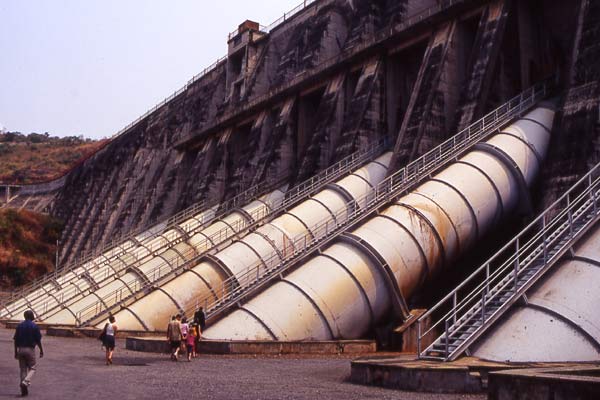
 Cabinet announced yesterday it had approved a treaty between SA and the Democratic Republic of the Congo for the development of the Grand Inga hydroelectric project.
The project to exploit the Congo River for hydropower of 40,000 MW — nearly the size of SA’s current installed capacity — would be developed in phases. The additional source of electricity would be a welcome relief for SA, which is struggling to keep up with increasing demand.
Cabinet spokesman Jimmy Manyi said the purpose of the treaty was to develop an enabling framework linking Congo and SA into the Grand Inga projects, and to allow the countries to jointly explore economic feasibility for the project.
“The project will form part of SA’s government strategy to promote renewable energy in the region, contribute to a reduction of carbon emissions, ensure security of supply and to develop energy infrastructure on the continent and the Southern African Development Community region in particular,” Mr Manyi said.
The treaty could thrust Eskom into a central role in the project. Eskom yesterday declined to comment on Grand Inga, but the power utility has been contemplating its role in regional power projects.
In a speech in Pretoria on Friday, Eskom CE Brian Dames said there was potential for SA to source power from other countries in the region.
Mr Dames said the problem with big projects in the region was that none of them were bankable unless Eskom, which is Africa’s largest power utility, bought the power.
“We see ourselves in the role of buying the power,” he said.
“If opportunities arise to work in partnership with other players to be on the investment side of some of the projects, we would look at those. We are already working with independent power producers in the region ,” he said.
SA, through the integrated resource plan for electricity (IRP2010), has committed itself to a huge rollout of clean power in the period up to 2030, Mr Dames said.
“We have done a modelling exercise on the IRP2010, making certain assumptions about the role of Eskom and of independent power producers. We have found that as it stands, the plan would be extremely difficult to finance, and the cost of implementing it in its entirety out to 2030 might not be affordable for SA,” said Mr Dames.
The cost of the renewable energy, and the nuclear plans, might simply be too steep. SA was committed to reducing its carbon emissions and Eskom supported that.
He said SA was keen to leverage hydro in the north and gas fields in the east and west, as well as the extensive land which the region has available for solar generation.