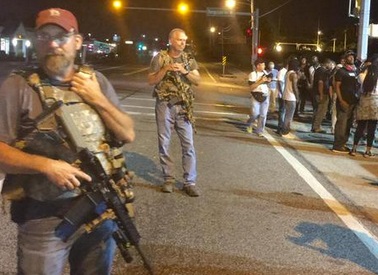
Heavily armed whites arrive in Ferguson

Armed to teeth with semi-automatic assault rifles and handguns, members of the Oath Keepers militia, formed of former and current law enforcement and military officers, have blended into the crowd of Ferguson protesters, saying “We’re on your side.”

At least four members of the ‘Oath Keepers’ arrived in Ferguson on early Tuesday and began patrolling the West Florissant Avenue, walking through the crowds of protesters gathered there for a ‘day of civil disobedience’ following the anniversary of the killing of 18-year-old African-American Michael Brown, shot dead by white Police Officer Darren Wilson.

Armed to teeth with semi-automatic assault rifles and handguns, members of the Oath Keepers militia, formed of former and current law enforcement and military officers, have blended into the crowd of Ferguson protesters,

At least four members of the ‘Oath Keepers’ arrived in Ferguson on early Tuesday and began patrolling the West Florissant Avenue, walking through the crowds of protesters gathered there for a ‘day of civil disobedience’ following the anniversary of the killing of 18-year-old African-American Michael Brown, shot dead by white Police Officer Darren Wilson.

The appearance of heavily-armed white men stirred unease on the part of the civil rights activists from the Black Lives Matter movement, heavily represented at Ferguson protests.

“Why are there men with guns and the police are doing nothing?” prominent activist Kayla Reed demanded on Twitter.

The American nonprofit organization Oath Keepers consists mainly of former and serving US military and law enforcement personnel, as well as members of other paramilitary services, who declare their aim as protecting the US Constitution even at the cost of disobedience to official orders, in case these orders violate fundamental American law.

Expressing his disapproval at the government’s handling of the situation in Ferguson, Oath Keepers volunteer Sam Andrews told RT: “Why the National Guard was not here supporting the St. Louis County Police and supporting the highway patrol and protecting these businesses, to me, is either such a grotesque incompetence or downright criminal negligence.”

“We are family people. And you know what? Nothing is going to change unless we stop electing politician lawyers to officers,” Andrews said, as quoted by Ruptly.

“You elect Donald Trump, you put Donald Trump in office, he’ll change it all, he’ll get rid of these clowns he’ll get rid of these people that violate our rights and we’ll have somebody that actually cares about Americans again,” Andrews said, expressing his support for the Republican presidential candidate.

A year ago, during the first round of protests, they also patrolled Ferguson. The Oath Keepers were also present in November 2014, when more protests erupted in the St. Louis, Missouri, neighborhood.

“Private business people that cannot afford security have asked the volunteers to help protect their businesses. The people in Ferguson have learnt a sad and difficult lesson, that there are not enough police and National Guards to protect all the homes and all the businesses,” a man in military fatigues told Sky News.

But Andrews said it’s not just about defending businesses.

“We have people living in apartments above these businesses…so arson is a lethal threat,” he told RT.
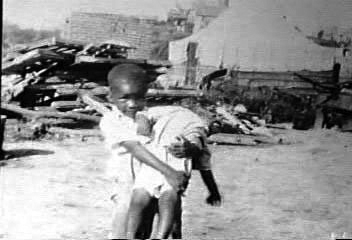
Oprah to explore 1921 Oklahoma race riots

Carrying Hector?
Carrying Hector?

Oprah is developing a race riot miniseries.

A black actress will play a journalist investigating the 1921 Oklahoma race riots, where an estimated 300 people were believed to have been murdered amid post-WWI racial tension surrounding segregation laws and the prosperous black community of Greenwood.

According to a 2011 New York Times story on the subject, “The Tulsa race riot of 1921 was rarely mentioned in history books, classrooms or even in private…an episode so brutal that this city, in a bout of collective amnesia that extended more than a half-century, simply chose to forget it ever happened.”

The announcement came as part of the net’s next slate of programming.

Source: Entertainment

How the 1960s’ Riots Hurt African-Americans

Detroit race riot in 1967

South Africa is currently going through a period of intense social unrest, characterised by so-called “service-delivery protests”. It is estimated that last year 5% of the country’s black population participated in some form of protest action or rioting. The long-term effects could be considerable, as may be learned from this American study of the aftermath of black rioting in the USA during the 1960’s.

How the 1960s’ Riots Hurt African-Americans

by David R. Francis, National Bureau of Economic Research, Cambridge, Massachusetts

“The riots had economically significant negative effects on blacks’ income and employment. Further, those effects may have been larger in the long run – from 1960 to 1980 – than in the short run – from 1960 to 1970.”

“The riots significantly depressed the median value of black-owned property between 1960 and 1970, with little or no rebound in the 1970s.”

Any American of a certain age remembers the race-related riots that tore through U. S. numerous cities in the 1960s. Between 1964 and 1971, civil disturbances (as many as 700, by one count) resulted in large numbers of injuries, deaths, and arrests, as well as considerable property damage, concentrated in predominantly black areas.

Although the United States has experienced race-related civil disturbances throughout its history, the 1960s events were unprecedented in their frequency and scope. Law enforcement authorities took extraordinary measures to end the riots, sometimes including the mobilization of National Guard units. The most deadly riots were in Detroit (1967), Los Angeles (1965), and Newark (1967). Measuring riot severity by also including arrests, injuries, and arson adds Washington (1968) to that list. Particularly following the death of Martin Luther King in April 1968, the riots signaled the end of the carefully orchestrated, non-violent demonstrations of the early Civil Rights Movement.

Social scientists have studied the causes of the riots for a long time. Now two NBER papers by William Collins and Robert Margo instead examine the economic impact of the riots on African Americans and on the cities where they took place. In the first paper, The Labor Market Effects of the 1960s Riots (NBER Working Paper No. 10243), they find that the riots had economically significant negative effects on blacks’ income and employment. Further, those effects may have been larger in the long run – from 1960 to 1980 – than in the short run – from 1960 to 1970.

Until 1975, the racial gap in average earnings among full-time male workers in the United States narrowed. There were periods of sharp convergence, as in the 1940s, alternating with periods of relative stasis, as in the 1950s and early 1960s. After 1970, racial convergence in earnings slowed markedly, in part because many low-wage black males were no longer engaged in full-time work, the authors note. The proportion of blacks living in high-poverty urban neighborhoods increased as well, and residential segregation led to increasingly poor socioeconomic outcomes among young blacks. In this context, Collins and Margo attempt to detect whether the riots contributed to a downward economic spiral that hurt employment opportunities, incomes, and property values.

Although they characterize their baseline estimates as “tentative,” Collins and Margo find a relative decline in median black family income of approximately 9 percent in cities that experienced severe riots relative to those that did not, controlling for several other relevant city characteristics. There is also some evidence of an adverse effect on adult male employment rates, particularly in the 1970s. Between 1960 and 1980, severe riot cities had relative declines in male employment rates of 4 to 7 percentage points. Individual-level data for the 1970s suggests that this decline was especially large for men under the age of 30.

In the second paper, The Economic Aftermath of the 1960s Riots: Evidence from Property Values (NBER Working Paper No. 10493), Margo and Collins investigate the influence of riots on central city residential property values, especially black-owned properties. They find that the riots significantly depressed the median value of black-owned property between 1960 and 1970, with little or no rebound in the 1970s. The baseline estimates for severe-riot cities relative to small-or-no-riot cities range from approximately 14 to 20 percent for black-owned properties, and from 6 to 10 percent for all central-city residential properties. Household-level data for the 1970s indicate that the racial gap in property values widened substantially in riot-afflicted cities relative to others.

The exact mechanisms through which the riots affected economic activity over a long period of time are difficult to identify, but a large number of potentially reinforcing channels exist. Property risk might seem higher in central city neighborhoods than before the riots, causing insurance premiums to rise; taxes for income redistribution or more police and fire protection might increase, and municipal bonds may be more difficult to place; retail outlets might close; businesses and employment opportunities might relocate; middle and higher income households might move away; burned out buildings might be an eyesore; and so on. These damaging aspects of riots, the authors find, apparently outweighed outside assistance directed toward the riot areas in the wake of the disturbances.