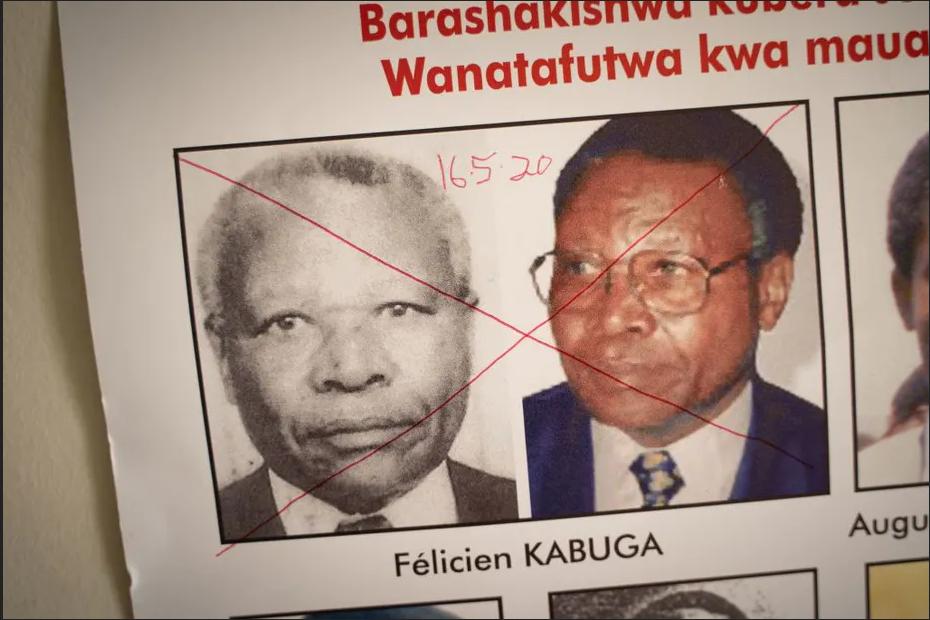
What Kabuga’s arrest means for international criminal justice — and Rwanda

Kerstin Carlson, University of Southern Denmark

Félicen Kabuga, the Hutu financier of Rwanda’s 1994 genocide, has been captured after 26 years in hiding. More than 800,000 Rwandans, primarily Tutsis, were slaughtered by their countrymen in 100 days of genocide.

Kabuga was arrested by French police in a sting operation in a suburb of Paris on May 17. They were acting on an indictment by the International Criminal Tribunal for Rwanda in 1997. Despite a global arrest warrant accompanied by a $5 million bounty, Kabuga avoided authorities for 26 years.

He owned and operated Radio Mille Collines, which broadcast messages of hatred. This included the notorious command to “kill the cockroaches” before and during the genocide. He allegedly imported and distributed the hundreds of thousands of machetes that were instruments of the genocide.

Despite the arrest, there are a number of reasons that Kabuga’s case does not represent a simple triumph for justice.

First, the long anticipated trial that would shed light on how Rwanda’s genocide was organised may not come to pass. Kabuga is at least 84 years old. There is already a fight heating up about where he should be tried: France, Tanzania, or Rwanda. After this question has been resolved, we should expect that his attorneys will argue he is too frail to stand trial. Thus Kabuga’s advanced age and the slow speed of international justice mean that he may never see trial.

Second, his arrest revisits the contested success of transitional justice in Rwanda, and showcases the mixed record of international justice more generally.

The legacy of a tribunal

Based in Arusha, Tanzania, the International Criminal Tribunal for Rwanda was set up in 1994. It operated until 2015. It indicted 93 individuals, and heard 55 cases. Since its closure, outstanding work and cases are handled by the International Residual Mechanism for Criminal Trials, which has branches in The Hague and Arusha. It handles only ongoing cases or outstanding warrants, and has no power to bring new indictments.

International criminal justice faces a number of criticisms. These include that it is slow and expensive, replicates colonial power relations and is overtly political.

In addition to these standard criticisms, during its working lifetime the International Criminal Tribunal for Rwanda faced multiple corruption allegations.

Kabuga was one of nine indicted individuals long at large, an ongoing reminder of the limitations of international criminal justice. Lacking their own police force, international courts rely on the cooperation of states to produce wanted individuals.

In Kabuga’s case, the capture was made possible by the investigative work of a special French office that pursues violators of international criminal law.

That the French followed up on this 26-year-old, cold, indictment is significant. International cooperation and institutional validation can have useful spillover effects for other international criminal justice institutions, specifically the International Criminal Court. It has struggled massively to convince member states to enforce its warrants.

Kabuga’s arrest, and the international cooperation that brought it about, is a reminder of the promise, and premise, that underwrote the tribunal. His alleged participation in the Rwandan genocide is the type of criminality that international justice seeks to prosecute: leaders and enablers who have not personally committed atrocity, but who were central to its deadly reach.

Kabuga’s arrest is thus also a victory against impunity. His trial should reiterate an insistence on rule of law norms making violations of international criminal law prosecutable.

Rwanda’s contentious transitional process

Accountability for international crime is a central component of “transitional justice”. This is a policy designed to substitute liberal, rule of law values in place of ethnic, nationalist, authoritarian or murderous rule.

In the case of the International Criminal Tribunal for Rwanda, “reconciliation” was embedded in the UN Resolution setting it up.

But Rwandan President Paul Kagame has rejected this model of transitional justice. Instead, a firm line is drawn between Tutsis, the victims of the genocide, and Hutus, the perpetrators of the genocide. This erases many facts, such as moderate Hutu victimisation or Tutsi-organised crimes.

Attempts to address facts outside of those officially sanctioned are decisively suppressed by the state. This has included imprisonment and assassination.

One of the International Criminal Tribunal for Rwanda’s biggest failures was arguably its inability to challenge Kagame’s ethnically divisive narrative.

In the first years of its work, prosecutors began investigating crimes associated with the Rwandan Patriotic Front (RPF), the Tutsi forces led by Kagame. In retaliation, Kagame stopped cooperating with the court and had its prosecutor, Carle del Ponte, removed. No RPF members, or Tutsis, were ever indicted by the tribunal.

Kagame is often praised for his stewardship over Rwanda’s economic recovery. Increasingly, however, observers speculate that his authoritarianism will interrupt this economic success. More worryingly, scholars in the area fear that Kagame’s ethnicity-based governance risks future repetitions of cyclical ethnic violence in Rwanda.

Insistence on rule of law norms

In the wake of Kabuga’s arrest, some international criminal justice scholars have supported Rwanda’s call to have him tried in the country, instead of sending him to the tribunal in Arusha.

This call should be resisted.

Present-day Rwanda is a country in which opposition figures die – in jail or otherwise – with alarming regularity. International institutions as well as state governments should demand higher rule of law standards, particularly in a country that has been the recipient of sustained, multifaceted international assistance.The Conversation

Kerstin Carlson, Associate Professor International Law, University of Southern Denmark

This article is republished from The Conversation under a Creative Commons license. Read the original article.

Dan Roodt: #Plaasmoorde has again made South Africa a global topic

SA is a country that is singularly lacking in real debate: it only knows slogans and monochrome distinctions between good and evil. Nelson Mandela was a saint and Verwoerd a disciple of the devil. Nadine Gordimer, who the zealous Swedes thought worthy of the Nobel Prize, publicly admitted she dealt in “Manichean poisons”.

And so Ismail Lagardien took it upon himself to warn Business Day readers of the looming global “regse gevaar” (Echoes of the global far-right movement, March 5), represented by nationalist movements in Europe and a self-proclaimed “race realist” such as Jared Taylor, a soft-spoken American who also happens to be fluent in both Japanese and French.

I mention this because, unlike the self-assured monolingual leftist with his quasi-religious world view denying ethnic or cultural difference, most “populist” heretics have actually gone to the trouble of living or learning about foreign lands. They also tend to respect or appreciate other cultures, and real diversity — as opposed to the fake kind of cramming members of different races into photographs or advertisements.

I suppose I have to congratulate Lagardien for at least noticing there has been some intellectual change in the world over the past decade or so, no mean feat in SA where we are completely out of sync with the rest of the planet, and doomed to become Zimbabwe 2.0.

Due to its farm murders, rampant violence and crime, SA has once again become a global topic, a cause célèbre. It represents something of an antithesis to civilisation, a new Barbary coast where Westerners suffer ignominy, discrimination, as well as grotesque killings and torture. It is ironic that Lagardien cites Rwanda as an outcome of “identity politics”. In the early 1990s, Rwanda had much in common with contemporary SA, where an ethnic majority foists its will onto a minority. That majoritarian will-to-genocide was enunciated in the so-called Hutu Ten Commandments, including the 8th one: “The Hutu should stop having mercy on the Tutsi.”

It is inconceivable that right-wing politicians in Europe, who are all polyglot and ‘europhile’, would ever create another world war, destroying their common heritage

Only the more conservative section of Westerners have any sympathy for the martyrdom of the Afrikaner people today; our so-called “compatriots” are completely indifferent, if not actually in agreement with the anomic freedom fighters attacking us on a daily basis, on farms and elsewhere. However, many young people in Amsterdam have told me that becoming aware of our history and current plight represented a “red pill” to them, changing their lives and outlook forever.

Typically, we are the scapegoats of the regime’s many failures; its venality and inefficiency are not to blame for the lack of jobs and poverty. No, “They stole our land!”

To leftists, any form of vague patriotism or waving a national flag, even during sports matches, is considered “fascist” because it deviates from the internationalist Marxist precept that “the workers (should) have no fatherland”. Lagardien’s tremulous fears of Il Duce’s return contrasts with his silence on the 100-million people killed by communism in the 20th century.

In our society, the egalitarian extremism of the South African Communist Party or EFF is much more likely to lead to concentration camps and genocide than a few middle-aged men discussing Arnold Toynbee or Oswald Spengler. By the way, Spengler’s mammoth work on The Decline of the West has just been published in a new Dutch translation, accessible to Afrikaners.

Lagardien accuses me of “racism” and “a tryst with the US far-right”. According to the chaff currently dispensed at universities, race does not exist … but all whites are racist. Or at least they have “white privilege”. A week ago some caller from KwaZulu-Natal named “Sue” literally sobbed about her white guilt on Radio 702. It reminded me of a well-known book title, Le sanglot de l’homme blanc (The Tears of the White Man) by Pascal Bruckner.

Perhaps that is the ultimate meaning of “reconciliation”: to reconcile oneself with the decadent tristesse of such whites who have already surrendered three thousand years of logical thinking for the blind stupor of secular guilt.

Marine Le Pen is very witty, even if one does not agree with her. She once coined the term “semantic war” which is very useful. The bisyllabic “racist” is merely a weapon in the semantic war, but otherwise illogical and contradictory. It could also be countered with the rhetorical trick: “But I self-identify as black, so how can I be racist?” After all, in the cultural-Marxist wonderland we now live in, you may choose your race and your gender, so why should all whites not qualify for affirmative action and black economic empowerment if they literally just “tick the right boxes” on forms?

A Canadian member of the global “regse gevaar”, Lauren Southern, was born on June 16 1995; there must be some omen there. In one of her many YouTube videos, clad in a very feminine, tutu-like evening dress, she confronts a PC feminist protestor complaining about her complicity with the patriarchy by stating calmly: “But I’m a man. I’m officially a man.” This silenced the protestor completely because within her secular religion, you may not question someone’s “gender choice!”

Multi-cultural societies such as SA, Mexico, Brazil, as well as the more multi-cultural parts of the US and the EU, are intensely violent, with an undeclared war raging in the streets

Lagardien takes a leaf out of the diminutive French former president François Mitterand’s book by alleging that any form of national pride or identity is synonymous with war, or, as he terms it, “blood”. Empirically, we see exactly the opposite today. It is inconceivable that right-wing politicians in Europe, who are all polyglot and “europhile”, would ever create another world war, destroying their common heritage. Geert Wilders, Marine Le Pen, Alice Weidel and Viktor Orbán, to name a few, all want to end the new Cold War with Russia.

On the other hand, multi-cultural societies such as SA, Mexico, Brazil, as well as the more multi-cultural parts of the US and the EU, are intensely violent, with an undeclared war raging in the streets. The American military-industrial complex needs an enemy so as to keep the military order book full, so Europe must be kept divided, always under threat of a nuclear holocaust.

The internet has happily ended the cultural and diplomatic isolation of Afrikaners, still maintained by largely hostile Western embassies in Pretoria that are staffed by left-wing, career diplomats oblivious to the changes in our country and in the world. These days I feel more welcome in Europe or the US than in my own country where the Afro-Marxist extremism of EFF leader Julius Malema has come to define mainstream politics.

Hundreds, if not thousands, of books have been written on Afrikaner identity. They all contain a common mistake, in the sense that we romanticised Africa. Inscribed on a bronze plaque at the Afrikaans Language Monument on the Paarl rock is a quotation from poet NP van Wyk Louw: “Afrikaans is the language that connects Western Europe and Africa … It forms a bridge between the large, shining West and the magical Africa … And what great things may come from their union — that is maybe what lies ahead for Afrikaans to discover.”

Not only would the phrase “magical Africa” no longer be deemed politically correct, but it is simply wrong. There is no bridge; there is only a chasm, a divide, a sombre feeling of dread and horror that our best authors have evoked here and there, almost in spite of themselves. Cultural difference does not usually manifest playfully, as a kind of logical puzzle in the way that Jorge Luis Borges describes it in some of his stories. More typically, as the Germans have discovered after Angela Merkel’s open-border policy, it manifests as crime and violence.

Cultural difference does not usually manifest playfully, as a kind of logical puzzle … More typically, as the Germans have discovered after Angela Merkel’s open-border policy, it manifests as crime and violence

History did not end in 1989 or in 1994. Rather, it paused in 1945 and restarted in 1989. Much of our modernity lay buried under the rubble of the Second World War, figuratively speaking. The power of the Soviet Union, bequeathed to Joseph Stalin by Winston Churchill at Yalta, as well as the Western baby-boomers’ radicalism, imposed a largely uniform mode of thinking on the world, with many taboos. Leonid Brezhnev and Daniel Cohn-Bendit were only two sides of the same coin.

It is only now we are at last daring to question both Marxist-Leninism and cultural Marxism. While institutions remain largely “captured” by the red zealots, especially the universities and the media, individual minds are being freed, “red-pilled”, to question the dominant ideology and to understand our culture and history afresh.

One result is a return of some old issues that have never been resolved, and go as far back as Plato and Aristotle. SA is doomed to repeat its tortuous history, with indigenous whites either trekking away from or revolting against African lawlessness and attacks, with Britain abetting either side. In recent times, Britain has always chosen against us and for the communists, the radicals, the génocidaires even. The former British ambassador Baron Robin Renwick fraternises with Malema and is clearly impressed with him.

But as history repeats itself, we are returning to the 1890s when the injustices and atrocities meted out to us caused a world-wide wave of pro-Boer sympathy, stretching from the US to Russia, from Ireland to Italy. The high-handed contempt with which the ANC regime and the mainstream media treat us, being powerless and disenfranchised, as well as demographically swamped in a display of Hutu-majoritarian domination, may not last forever.

This piece was also published in Business Day on 12 March 2018.