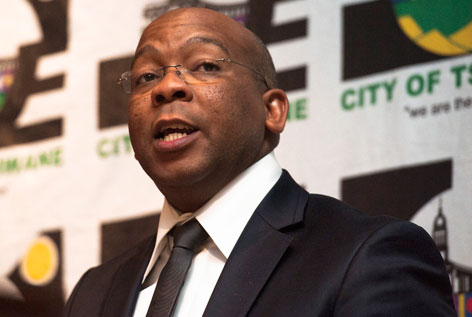
The capital city is set to offer free access to the internet in public spaces.
Poor communities, schools and high-density areas in the city have been targeted for the first phase of the project
The city of Tshwane says the project will be life changing especially for the youth.
We no longer think of Wi-Fi as a luxury, we think of Wi-Fi as the same as electricity and water.
Meanwhile, the Gauteng provincial government is planning to issue tablets with internet connectivity to more than 2 000 Gauteng schools by 2014.
Can you imagine going online while you’re waiting at a bus stop or queuing to pay your water and lights bill?
If all goes well, that’s what Pretoria residents will be doing in the near future.
Tshwane mayor Kgosientso Ramokgopa says “The City of Tshwane will be the first metro in the country to provide city-wide free Wi-Fi. Come November, Church Square will be one of five zones, where you can surf the net free of charge – and you [won’t] even need a password.”
Impoverished communities have been targeted for the first phase, which comes with a price tag of R1 million.
The mayor continues, “The second phase, the 219 schools in Atteridgeville, Soshanguve and Mamelodi will be up and running before the end of calendar year in 2014 and third phase in 2015. We are extending it in the main to government institutions and all other institutions of higher learning.”
The project is part of a collaborative effort by NGOs to bring free Wi-Fi to the continent.
“The intent is to show governments as well as private sector that bandwidth can be treated just as you treat electricity and water,” says Project Isizwe representative Alan Knott-Craig.
And government thinks the country is more than ready.
Dumsani Otumile of Tshwane ICT Management says, “We no longer think of Wi-Fi as a luxury, we think of Wi-Fi as the same as electricity and water – it’s a commodity for us.”
Tshwane is following in Stellenbosch’s footsteps.
Technology experts have given that city’s project the thumbs-up, saying it bridges the digital divide.
Show of force: municipal posse driving into Kleinfontein
There are no signs that say “Whites Only.”
There are, though, men in military fatigues who log the license plates of vehicles approved to enter Kleinfontein, a rural enclave that is home to about 1,000 Afrikaner whites. And there is a bust of Hendrik Verwoerd, the former South African leader who spearheaded white racist rule.
This exercise in separate, self-sufficient living near the South African capital, Pretoria, is more than just a throwback to the apartheid era that ended with the country’s first all-race elections in 1994. In recent days, Kleinfontein and its campaign to be formally recognized as a township have become a touchstone for fresh debate about law, freedom and the kind of “rainbow nation” that South Africa is trying to be.
Kleinfontein, which is all private property, requires its residents to be Afrikaners, descendants of settlers who arrived from Europe centuries ago and speak Dutch-based Afrikaans, the idiom of South Africa’s former overseers. That brings accusations of racism in a nation whose population of over 50 million is mostly black, but the community skirts race references in its manifesto. Descendants of British settlers, for example, would not be welcome to live here.
The community is not organized “on the basis of race,” said Jan Groenewald, chairman of the board of directors of Kleinfontein, which means “Little Fountain” in Afrikaans. Instead, he said, the goal is to preserve a cultural bedrock that stretches back to the lore of the hardy Voortrekker settlers.
The dig-in mindset at the austere settlement echoes that of its ancestors, who drew ox wagons into a defensive circle, a tactic that helped them defeat a much bigger Zulu force at the Dec. 16, 1838 Battle of Blood River. The date has near-mystical import for staunch Afrikaners, though the vast majority of whites accepted South Africa’s new, multi-racial order in 1994 as part of a negotiated settlement.
“We are here to stay,” read Afrikaans-language signs outside modest brick-and-tile homes linked by dirt roads in Kleinfontein.
Residents don’t pay taxes on municipal services because they don’t receive them. They draw water from a spring and are building a sewage system. There is a cafe, a primary school and a care center for the elderly. Zebra, antelope and wildebeest roam in one part of the fenced, 721-hectare (1,780-acre) property. Residents buy many of their goods from outside the fence.
“If I was a racist, we wouldn’t speak to a black. We wouldn’t do business with them,” said Annatjie Oncke, a 49-year-old house cleaner living in a caravan park. She and other poor residents do the kind of menial labor reserved for blacks in the era when whites were in charge. Kleinfontein also has engineers and other skilled workers, as well as retirees.
In the past, small bands of Afrikaners have sought to establish enclaves elsewhere in South Africa, notably in the Northern Cape community of Orania, founded in 1990. Nelson Mandela, South Africa’s first black president, traveled to Orania in 1995 and had coffee there with Verwoerd’s widow in a show of racial reconciliation. Verwoerd was assassinated in 1966.
Kleinfontein has been around almost as long as Orania, but is now under scrutiny in part because it wants local authorities to recognize it as an entity with the right to run its own affairs. The Times, a South African newspaper, reported that provincial lawmakers were informed last year that black police officers were barred from entering the enclave.
Last week, members of the Democratic Alliance, a political party, protested outside Kleinfontein.
“By creating a ‘whites-only’ area, this community is saying that it has no respect for people who are different from them. It is saying that it fears people who are different,” said Mbali Ntuli, the party’s youth leader.
On Wednesday, Kgosientso Ramokgopa, the mayor of Pretoria and surrounding areas, visited Kleinfontein as part of an inquiry into its alleged failure to comply with municipal planning laws. Delegations of the two sides met in a hall with a corrugated iron roof, a church bell mounted outside in a scaffold.
Ramokgopa noted the right of every citizen to “reside in any part of the country,” while Groenewald, Kleinfontein’s chairman, spoke of the right to “self-determination.”
The mood was diplomatic, and jovial at times. Ramokgopa joked about “koeksusters,” a fried, sugary snack favored by his Afrikaner hosts. Groenewald referred to Mandela’s leadership, but also hinted at his resolve with a mention of Koos de la Rey, a general in the 1899-1902 Anglo-Boer war who did not want conflict but fought hard when it began.
South Africa’s national flag does not fly in Kleinfontein, though some residents were seen recently with the “Vierkleur” (“Four-color”), the flag of the Transvaal republic, which in the 19th century formed part of what is now South Africa. A community member handed out a declaration that complained of betrayal and persecution of the “Boer-Afrikaner nation,” and described South African democracy as a sham.
“We find ourselves exiles in our own fatherland,” the statement said. “We experience this new dispensation not as a democracy, but as the dictatorship of an alien majority.”
For some observers, any uproar over Kleinfontein masks bigger challenges about racial integration in South Africa, where average income levels of whites still outstrip those of blacks. Unemployment is high and residents of some districts have protested violently against the government’s failure to provide basic services, a fact that Kleinfontein’s leaders did not let slip in their discussions with Pretoria officials.
Author Eusebius McKaiser said the country is still wrestling with the legacy of “apartheid geography,” in which some districts originally designed for different races still remain largely segregated.
“We need to stop gloating about the anger we feel towards people like those who live in Kleinfontein,” McKaiser wrote in The Star newspaper. “They are honest and crude about their revulsion of people who are different to themselves. We are not fundamentally different to Kleinfontein’s people. We are just less honest, more subtle.”
Ramokgopa, the mayor, toured Kleinfontein in a convoy of vehicles that kicked up dust and had residents peering at the commotion from their windows. He said the “inherent contradictions” at play over Kleinfontein would emerge elsewhere.
“The nature of the conflict in South Africa is defined by race and that’s something that we need attend to,” he said. “The next generation will still be grappling with this question.” – Sapa/AP
So-called Tshwane or Greater Pretoria mayor Kgosientso Ramokgopa will visit the Afrikaners-only community of Kleinfontein outside Rayton, east of Pretoria, on Wednesday.
“The visit is not a law enforcement exercise, but is aimed at fact-finding, reaching out to the community, and understanding their concerns,” Ramokgopa’s office said in a statement on Tuesday.
Members of the mayoral committee would accompany him.
Spokesman Blessing Manale said Ramokgopa would use the visit to reiterate that racial practices had no place in a democratic era.
“The executive mayor has called on the leadership of civil rights organisations and other government agencies to join in this exercise, so as to welcome the minority community of Kleinfontein back into Tshwane and assure them that they have no reason to fear.”
During the visit discussions on amicable remedies for the area’s apparent non-compliance with certain planning and housing regulations and other by-laws would be held.
Last week the Democratic Alliance Youth protested outside Kleinfontein’s gates. The property covers almost 800 hectares. DA Youth leader Mbali Ntuli and a few others entered the area to speak with Kleinfontein leaders.
“We want to show you what South Africa looks like. We achieve nothing by creating secluded areas,” she said at the time.
Kleinfontein controlling body chairman Jan Groenewald insisted in a debate with the DA on Thursday that the criteria for its residents were not based on race.
Inhabitants of the settlement, which had existed for 21 years but came under the media’s spotlight this week, merely wanted to live out their values in seclusion, said Groenewald. This would include providing themselves with their own “municipal” services.
“The people that have free access to Kleinfontein, who can apply, are Afrikaner. [They] are basically people who associate themselves with our Voortrekker history, the Blood River Covenant, and all these historical facts relating to our struggle for independence for the Afrikaner people,” Groenewald told reporters.
The criteria to live in Kleinfontein was “based on cultural, language, traditional, and religious beliefs”.
“You cannot use race as a base to determine anything,” said Groenewald. – Sapa
This website uses cookies to improve your experience. We'll assume you're ok with this, but you can opt-out if you wish. Cookie settingsACCEPT
Privacy & Cookies Policy
Privacy Overview
This website uses cookies to improve your experience while you navigate through the website. Out of these cookies, the cookies that are categorized as necessary are stored on your browser as they are essential for the working of basic functionalities of the website. We also use third-party cookies that help us analyze and understand how you use this website. These cookies will be stored in your browser only with your consent. You also have the option to opt-out of these cookies. But opting out of some of these cookies may have an effect on your browsing experience.
Necessary cookies are absolutely essential for the website to function properly. This category only includes cookies that ensures basic functionalities and security features of the website. These cookies do not store any personal information.
Any cookies that may not be particularly necessary for the website to function and is used specifically to collect user personal data via analytics, ads, other embedded contents are termed as non-necessary cookies. It is mandatory to procure user consent prior to running these cookies on your website.