Saudi Arabia severs diplomatic ties with US

The kissing is over
The kissing is over

Upset at President Barack Obama’s policies on Iran and Syria, members of Saudi Arabia’s ruling family are threatening a rift with the United States that could take the alliance between Washington and the kingdom to its lowest point in years.

Saudi Arabia’s intelligence chief is vowing that the kingdom will make a ‘major shift’ in relations with the United States to protest perceived American inaction over Syria’s civil war as well as recent U.S. overtures to Iran, a source close to Saudi policy said on Tuesday.

Prince Bandar bin Sultan told European diplomats that the United States had failed to act effectively against Syrian President Bashar al-Assad and the Israeli-Palestinian conflict, was growing closer to Tehran, and had failed to back Saudi support for Bahrain when it crushed an anti-government revolt in 2011, the source said.

The growing breach between the United States and Saudi Arabia was also on display in Washington, where another senior Saudi prince criticized Obama’s Middle East policies, accusing him of ‘dithering’ on Syria and Israeli-Palestinian peace.

In unusually blunt public remarks, Prince Turki al-Faisal called Obama’s policies in Syria ‘lamentable’ and ridiculed a U.S.-Russian deal to eliminate Assad’s chemical weapons. He suggested it was a ruse to let Obama avoid military action in Syria.

‘The current charade of international control over Bashar’s chemical arsenal would be funny if it were not so blatantly perfidious. And designed not only to give Mr. Obama an opportunity to back down (from military strikes), but also to help Assad to butcher his people,’ said Prince Turki, a member of the Saudi royal family and former director of Saudi intelligence.

The United States and Saudi Arabia have been allies since the kingdom was declared in 1932, giving Riyadh a powerful military protector and Washington secure oil supplies.

The Saudi criticism came days after the 40th anniversary of the October 1973 Arab oil embargo imposed to punish the West for supporting Israel in the Yom Kippur war.

That was one of the low points in U.S.-Saudi ties, which were also badly shaken by the September 11, 2001, attacks on the United States. Most of the 9/11 hijackers were Saudi nationals.

Saudi Arabia gave a clear sign of its displeasure over Obama’s foreign policy last week when it rejected a coveted two-year term on the U.N. Security Council in a display of anger over the failure of the international community to end the war in Syria and act on other Middle East issues.

In Bahrain, home of the U.S. Fifth Fleet, a simmering pro-democracy revolt by its Shi’ite majority has prompted calls by some in Washington for U.S. ships to be based elsewhere.

The source declined to provide more details of Bandar’s talks with the diplomats, which took place in the past few days.

But he suggested that the planned change in ties between the energy superpower and the United States would have wide-ranging consequences, including on arms purchases and oil sales.

Saudi Arabia, the world’s biggest oil exporter, ploughs much of its earnings back into U.S. assets. Most of the Saudi central bank’s net foreign assets of $690 billion are thought to be denominated in dollars, much of them in U.S. Treasury bonds.

‘All options are on the table now, and for sure there will be some impact,’ the Saudi source said.

‘Prince Bandar told diplomats that he plans to limit interaction with the U.S.,’ the source close to Saudi policy said. – Daily Mail
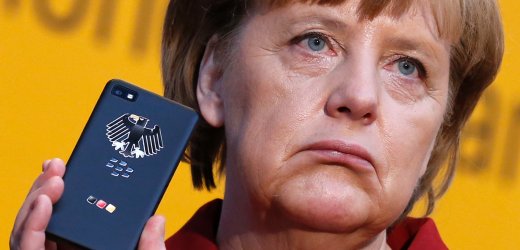
US may have targeted Angela Merkel’s cellphone

German Chancellor Merkel holds a BlackBerry Z10 smartphone featuring high security Secusite software at the booth of Secusmart during her opening tour at the CeBit computer fair in HanoverGerman Chancellor Angela Merkel complained to President Barack Obama on Wednesday after learning that U.S. intelligence may have targeted her mobile phone, and said that would be “a serious breach of trust” if confirmed, her government announced.

The White House denied that the U.S. is listening in on Merkel’s phone calls.

The German government said it responded after receiving “information that the chancellor’s cellphone may be monitored” by U.S. intelligence. It wouldn’t elaborate but German news magazine Der Spiegel, which has published material from NSA leaker Edward Snowden, said its research triggered the response.

Merkel spokesman Steffen Seibert said in a statement the chancellor made clear to Obama in a phone call that “she views such practices, if the indications are confirmed … as completely unacceptable.”

Merkel said among close partners such as Germany and the U.S., “there must not be such surveillance of a head of government’s communication,” Seibert added. “That would be a serious breach of trust. Such practices must be stopped immediately.”

In Washington, White House spokesman Jay Carney said “the United States is not monitoring and will not monitor the communications of the chancellor.”

Merkel raised concerns over electronic eavesdropping issue when Obama visited Germany in June, has demanded answers from the U.S. government and backed calls for greater European data protection. However, Wednesday’s statement was much more sharply worded and appeared to reflect frustration over the answers provided so far by the U.S. government.

Merkel called for U.S. authorities to clarify the extent of surveillance in Germany and to provide answers to “questions that the German government asked months ago,” Seibert said. – Breitbart

Hundreds of AIPAC lobbyists to push for US attack on Syria

aipacThe influential pro-Israel American Israel Public Affairs Committee will deploy hundreds of activists next week to win support in Congress for military action in Syria, amid an intense White House effort to convince wavering U.S. lawmakers to vote for limited strikes.

“We plan a major lobbying effort with about 250 activists in Washington to meet with their senators and representatives,” an AIPAC source said on Saturday.

Congressional aides said they expected the meetings and calls on Tuesday, as President Barack Obama and officials from his administration make their case for missile strikes over the apparent use of chemical weapons by Syrian President Bashar Assad’s government.

The vote on action in Syria is a significant political test for Obama and a major push by AIPAC, considered one of the most powerful lobbying groups in Washington, could provide a boost.

The U.S. Senate is due to vote on a resolution to authorize the use of military force as early as Wednesday. Leaders of the House of Representatives have not yet said when they would vote beyond saying consideration of an authorization is “possible” sometime this week.

Obama has asked Congress to approve strikes against Assad’s government in response to a chemical weapons attack.

But many Republicans and several of Obama’s fellow Democrats have not been enthused about the prospect, partly because war-weary Americans strongly oppose getting involved in another Middle Eastern conflict.

Pro-Israel groups had largely kept a low profile on Syria as the Obama administration sought to build its case for limited strikes after last month’s attack on rebel-held areas outside Damascus.

But they had generally wanted the debate to focus on U.S. national security rather than how a decision to attack Syria might help Israel, a reflection of their sensitivity to being seen as rooting for the United States to go to war. – Reuters