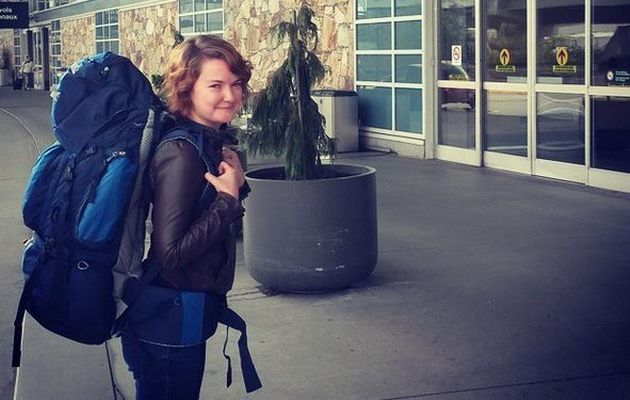
More facts surface about American tourist killed by lion

The day before 29-year-old American tourist Katherine Chappell was mauled to death by a lioness, the film-maker posted a photo on Instagram, laughing about the low price of drinks in South Africa.

The Daily Mail Online reported that “wildlife enthusiast” Chappell worked on an Emmy-winning episode of Game of Thrones and was in South Africa to raise money for animal conservation.

She was on holiday and had travelled from the US via London. Chappell was attacked at The Lion Park near Lanseria on Monday, allegedly after opening a window in the 4×4 she was travelling in, to take a photo of lions.

Her tour guide, Pierre Potgieter is recovering in hospital after suffering a heart attack while trying to push the lion away.

He denied ignoring the park’s rules and driving with open windows through the enclosures.

“That’s not right… not right at all,” the 66-year-old told The Daily Mail Online.

“If that’s what they’re saying, that’s not the case. Not at all.”

The tour company issued a statement on Tuesday, saying that Chappell opened the window at the last minute to take a picture.

Tourists who witnessed the attack, reportedly handed photos of the incident to police.

According to reports, Chapell was driving with a tourist guide with the windows of their car wide open.

Eyewitnesses say that Chapell continued taking pics even as the lioness approached. Her camera has been taken in by police who may review it as evidence in their inquest docket.

The guide who tried to rescue her says their windows were mostly closed while driving through the enclosures. One of the animals lunged through an open window, though.

The 66-year-old tour operator says their windows were closed throughout the drive until the tourist opened a window to take photographs of a pride of lion, when she was attacked.

Kalabash tours said in a statement that Pierre Potgieter fended off the lion and realised the 23-year-old was bleeding profusely from her neck. He then applied pressure to the wound and called for help.

California declares state of emergency after oil spill

California Gov. Jerry Brown declared a state of emergency over Tuesday’s oil spill off the Santa Barbara County coast. It follows news that up to 105,000 gallons of oil leaked out from the ruptured pipeline.

“This emergency proclamation cuts red tape and helps the state quickly mobilize all available resources,” said Governor Brown in a statement. “We will do everything necessary to protect California’s coastline.”

Brown’s office added that six boom boats, three 65-foot collection vessels and hand crews coordinating with the state as clean-up efforts continue. California state oil spill, wildlife and emergency officials are also working to alleviate the situation.

Originally, US Coast Guard officials estimated that the approximately 21,000 gallons of oil had spilled out of a pipeline operated by Plains All American Pipeline, though this calculation is being investigated. The type of oil was later identified as crude, and officials said the spill had stretched out to approximately nine miles across Santa Barbara County’s Refugio Beach.

The company stated to AP that the 105,000 gallon estimate was a “worst-case scenario”and that it does not know exactly how much oil actually seeped into the ocean. The pipeline itself is onshore, but oil traveled down a storm drain before hitting the Pacific Ocean.

Refugio Beach was closed after the oil spill occurred, as was neighboring El Capitan State Beach.

According to the Los Angeles Times, this particular pipeline was constructed in 1991 and had never leaked before this week, company officials said. It is capable of carrying roughly 150,000 barrels every day.

Darren Palmer of Plans All American Pipeline told the newspaper that the company conducted an integrity check on the pipeline two weeks ago but had yet to learn the results.

Local fisheries that have been affected by the spill have also been shut down for the time being, Brown’s office stated.

Linda Krop of the Environmental Defense Center told the LA Times that the Santa Barbara Channel is “one of the most biologically rich places on the planet” and that multiple species of animals could be affected, including migrating whales and seabirds.