Eskom suffers another shock

electricityEskom has suffered yet another setback that could see its funding costs rise or keep taxpayers shelling out for its debts.

A surprise credit rating downgrade comes on top of higher-than-expected coal prices – which could allow the state-owned energy company to pass on its increased costs to consumers.

Credit ratings agency Moody’s downgraded Eskom’s standalone credit quality by one notch on Friday, making it more difficult for it to raise money for its future expansion plans.

Eskom has been trying to get an investment-grade standalone rating so that it can raise the billions it needs without government guarantees.

Acting chief financial officer Caroline Henry diplomatically called the downgrade “a challenge” yesterday.

It adds to other pressures Eskom is facing, which could see it approach energy regulator Nersa for a higher tariff increase.

CEO Brian Dames said recently the high coal price increases gave Eskom the right to approach Nersa for an increase.

Primary energy costs, including for coal, have rocketed 36% over the past year, Eskom’s latest set of financial results reveal. These costs have gnawed into its margins and have seen it earn less than half the profit it did the previous year.

Eskom’s new build programme, with which it aims to keep the lights on, has a capacity expansion budget of about R400-billion up to this year and is expected to grow to more than a R1-trillion by 2026.

Shaun Nel, spokesman for the Energy Intensive User Group, which represents large industrial consumers, said yesterday the downgrade “will obviously increase the cost of capital”.

Eskom has tried to get a stand-alone credit rating since 2008, but Nersa has thwarted its plans several times, most recently in February when it allowed an increase of 8% a year for the next five years although Eskom requested 16%.

The lower increase means a revenue shortfall of about R220-billion over the next five years and was cited by Moody’s as a major factor in its decision.

“This means Eskom would need to borrow more because it will not be able to generate the funds from its own revenues,” said energy analyst Chris Yelland.

The downgrade comes after management two weeks ago admitted that the first power from its Medupi power station would realistically hit the grid only in the second half of next year.

Eskom is running on a very thin reserve margin and would now likely face another winter, when consumption climbs, without Medupi’s added capacity.

According to Nel, the supply constraints have started having a serious impact on the economy.

Industrial users now consume less than they did in 2006, indicating that factories and foundries were closing, said Nel.

“Though Eskom said it would not have to go back to Nersa for two years, it seems like a foregone conclusion that it would have to,” Nel said.

Yelland does not necessarily see Eskom going to the regulator. But he thinks it could go to the government for more credit guarantees.

Outgoing chief financial officer Paul O’Flaherty said two weeks ago that Eskom would not be able to attain an investment grade standalone rating – which would allow it to raise the funds it needs at decent rates – in the “next few years”.

It would continue needing massive state support, he said.

About R250-billion still needed to be raised, O’Flaherty said.

Dames said yesterday that Eskom was “comfortable with the measures [it was] taking with the continued support of [the government]”. – timeslive.co.za
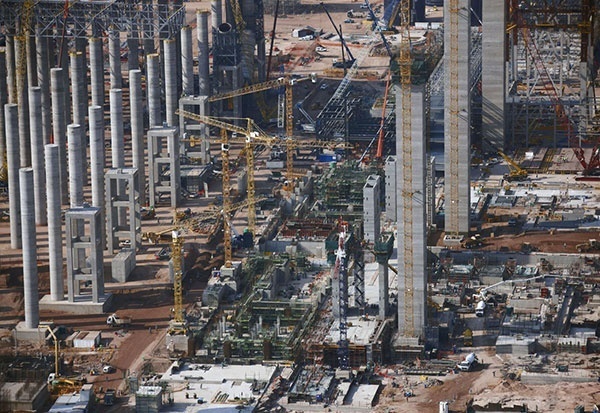
Hello load shedding? Medupi to miss its deadline

Medupi power station

The Medupi power station will probably begin generating electricity six months later than scheduled, Eskom said on Monday.

“Eskom has confirmed that the December 2013 target date is unlikely to be met,” it said in a statement.

“A more realistic target for the first synchronisation of unit six to the grid is the second half of 2014.”

The state power utility blamed technical problems for the delay in having at least one of Medupi’s six 800MW units up and running by December.

“[We] earlier communicated that critical technical challenges need to be resolved in order for unit six to begin producing power. These technical challenges relate to the welding on the boilers, and the control and instrumentation systems for the units. In addition are the ongoing labour challenges.”

The “critical” issues on the boiler related to inadequate post-weld heat treatment, and the replacement of welds which were made using unqualified procedures.

This was not the first delay because of welding problems. Previously, faults in factory welds had been discovered.

In May, Public Enterprises Minister Malusi Gigaba said strong measures were taken against Hitachi for its sub-standard work on the Limpopo power station.

Construction at Medupi was delayed due to failures by Hitachi to deliver top quality boilers at the plant.

Earlier this year, Eskom chief executive Brian Dames was quoted as saying Eskom was considering cancelling two key contracts with Hitachi — in which the ANC’s investment arm Chancellor House had a 25 percent stake –and Alstom.

But later, the utility’s spokeswoman Hilary Joffe said there were no immediate plans to cancel the contracts, and that Hitachi was still in charge of building the boilers.

Joffe warned the country’s power supply would be tight until completion of its two power stations, Medupi and Kusile. Kusile, being built near Emalahleni, Mpumalanga, was expected to add 4800MW to the grid on completion in 2017.

Medupi would add another 4800MW. It was expected to be completed by 2015. It was initially scheduled to make its first contribution to the grid in 2013 and Kusile in 2014.

Unit six was expected to be the first of Medupi’s six units to deliver “first power”.

Eskom said on Monday that effective interventions had been put in place to address the problems, and the progress of repairs was being monitored.

Last month, Eskom, the contractors, and labour signed a new agreement to bring stability and improved productivity to Medupi’s construction.

“All of us on site are now focused on delivering the power station, on time, on budget, safely, and to the required quality standards,” Eskom finance director Paul O’Flaherty said.

Eskom said it had spoken to the global leadership of Hitachi and Alstom to resolve problems with the boiler and the control instrumentation contracts. It had also put resources in place to monitor the contractors.

On labour relations, it said processes had been developed to address grievances, and salary discrepancies were being addressed.

In January, Eskom temporarily closed the power station when contract workers went on strike. Construction was also interrupted in September when workers downed tools.

Workers belonging to the National Union of Metalworkers of SA had questioned the way their year-end bonuses were calculated, and complained that employees who lived in the area were paid less than workers who came in from Johannesburg.

Gigaba intervened in March and said the construction deadline would not change. He said strict penalties would be imposed on contractors should they fail to meet their obligations.

Democratic Alliance MP Natasha Michael on Monday said Gigaba should act.

“The latest delay forecasts a shortfall of power supply in 2014 of 700MW and comes at an expected 15 percent price increase, pushing the cost of the project from R91 billion to R105 billion, an additional R10 billion to taxpayers,” she said in a statement.

“The minister must now act on his word and make sure some heads roll and face the consequences of poor management at the project.”

She said not having power would negatively affect economic growth and job creation. – Sapa

Eskom warns of power cuts during winter

South Africans should brace themselves for what could be the most difficult winter as electricity supply remained constrained, the Public Enterprise Minister Malusi Gigaba said.

“We need to worry about how we are going to go through this winter,” Gigaba said.

He was speaking to residents in Kliptown, Soweto where he was encouraging community members to pay for their electricity and to report illegal connections.

This was part of the 49M energy saving campaign.

Gigaba urged the public to continue with basic electricity saving habits like switching off geysers between 5pm and 9pm.

“We need to change our behaviour… instead of using heaters people should rather use blankets.”

He told residents that with Eskom reaching 40 million new connections last year, it meant by 2017, South Africa would have to have more power stations to meet the growing demand.

“We are still confident that we will, in partnership with all South Africans and with more business joining the partnership, succeed to keep the lights on until we get out of this difficult situation,” said Gigaba.

He finally asked residents to observe Earth Hour on Saturday evening by switching off lights and appliances between 8.30pm and 9.30pm. – Sapa

Eskom, ANC government causing water crisis, says Greenpeace

JOHANNESBURG, June 25 2012 — A water crisis is looming in South Africa, communities are at risk of losing access to water, and coal is right in the middle of it, according to a report released by Greenpeace today. This latest briefing is a stark reminder to the SA government to start pushing Eskom to substantially invest in renewable energy.

South Africa is projected to experience a 17% gap between water supply and demand by 2030, but new mega coal-fired power stations (Medupi and Kusile) are being built by the national utility Eskom without a clear view of what the water impacts are likely to be.

According to Melita Steele, climate and energy campaigner for Greenpeace Africa: “The truth is that in the face of looming electricity price hikes, and a R13.2 billion net profit recorded by Eskom this year, local communities in coal areas may lose their water rights to make way for mines, to help feed Eskom’s coal addiction.”

The briefing entitled: ‘The Eskom factor: Power politics and the electricity sector in South Africa'[1] tries to identify what the real story is behind Eskom’s decisions, outlining Eskom’s role in South Africa, its evolution as a state-owned company, and its current status as an influential player in South African politics [2]. This is combined with an independently commissioned feature story ‘Coal’s hidden water cost to South Africa’ [3], written by award-winning journalist, Yolandi Groenewald.

“Eskom is the only ‘strategic’ water user under the National Water Act, which means that the Department of Water Affairs has to provide it with water, come hell or high water. The problem is that in one day, Eskom uses enough water to grow almost a million kilograms of maize, due to its reliance on coal. If there were a drought, water might have to be taken away from other users. But Medupi and Kusile will push up Eskom’s water usage considerably in the next decade. The impact of new coal-fired power stations on a future water crisis hasn’t been adequately taken into account”, continued Steele.

“South Africa’s current electricity system is geared to supply energy-intensive industries, and building new coal-fired power stations to ‘keep the lights on’ means catering to big business, at the expense of the 12.3 million South Africans without access to electricity. Making profits for a privileged few, while the people of South Africa pay the price.”

“It is time to hold Eskom and the South African government accountable for the decisions being made today, which will affect all of our futures. South Africa’s continued reliance on coal goes to the heart of whether we can keep our taps running with clean water. Greenpeace calls on Eskom to stop building new coal-fired power stations, and instead invest in the substantial rollout of large-scale and decentralised renewable energy projects to allow for a just transition away from coal: creating jobs, ensuring universal energy access, and avoiding a water crisis exacerbated by catastrophic climate change. In the face of South Africa’s already severe water and electricity crises, the government’s inaction is irresponsible”, Steele concluded.