
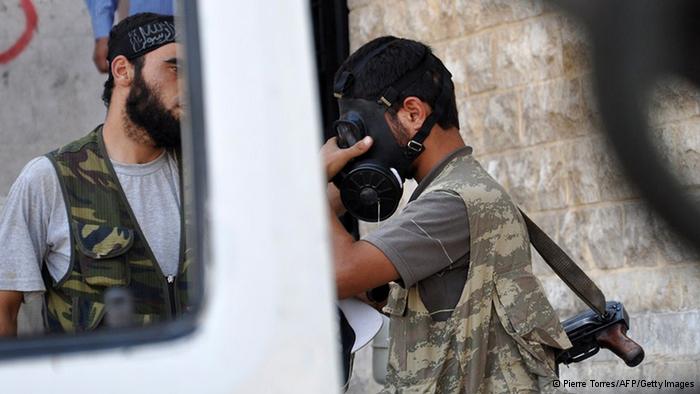
 Russia says a deadly March sarin attack in an Aleppo suburb was carried out by Syrian rebels, not forces loyal to President Bashar Assad, and it has delivered a 100-page report laying out its evidence to the United Nations.
A statement posted on the Russian Foreign Ministry website late Wednesday said the report included detailed scientific analysis of samples that Russian technicians collected at the site of the alleged attack, Khan al Asal in northern Syria. The attack killed 26 people.
Probes from Khan al-Assal show chemicals used in the March 19 attack did not belong to standard Syrian army ammunition, and that the shell carrying the substance was similar to those made by a rebel fighter group, the Russian Foreign Ministry stated.
A statement released by the ministry on Wednesday particularly drew attention to the “massive stove-piping of various information aimed at placing the responsibility for the alleged chemical weapons use in Syria on Damascus, even though the results of the UN investigation have not yet been revealed.”
By such means “the way is being paved for military action” against Damascus, the ministry pointed out.
But the samples taken at the site of the March 19 attack and analyzed by Russian experts indicate that a projectile carrying the deadly nerve agent sarin was most likely fired at Khan al-Assal by the rebels, the ministry statement suggests, outlining the 100-page report handed over to the UN by Russia.
The key points of the report have been given as follows:
• the shell used in the incident “does not belong to the standard ammunition of the Syrian army and was crudely according to type and parameters of the rocket-propelled unguided missiles manufactured in the north of Syria by the so-called Bashair al-Nasr brigade”;
• RDX, which is also known as hexogen or cyclonite, was used as the bursting charge for the shell, and it is “not used in standard chemical munitions”;
• soil and shell samples contain “the non-industrially synthesized nerve agent sarin and diisopropylfluorophosphate,” which was “used by Western states for producing chemical weapons during World War II.”
The findings of the report are “extremely specific,” as they mostly consist of scientific and technical data from probes’ analysis, the ministry stressed, adding that this data can “substantially aid” the UN investigation of the incident.
While focusing on the Khan al-Assal attack on March 19, in which at least 26 civilians and Syrian army soldiers were killed, and 86 more were injured, the Russian Foreign Ministry also criticized the “flawed selective approach” of certain states in reporting the recent incidents of alleged chemical weapons use in August.
The hype around the alleged attack on the eastern Damascus suburb of Ghouta showed “apparent attempts to cast a veil over the incidents of gas poisoning of Syrian army soldiers on August 22, 24 and 25,” the ministry said, adding that all the respective evidence was handed to the UN by Syria.
The condition of the soldiers who, according to Damascus, suffered poisoning after discovering tanks with traces of sarin, has been examined and documented by the UN inspectors, the ministry pointed out, adding that “any objective investigation of the August 21 incident in eastern Ghouta is impossible without the consideration of all these facts.”
UN Secretary General Ban Ki-moon on Tuesday said the UN investigators are set to return to Syria to investigate several other cases of alleged chemical weapons use, including the March 19 incident in Khan al-Assal.
White House spokeswoman Caitlin Hayden said U.S. officials were unmoved by the Russian report and held the Assad government responsible for both the Khan al Asal attack in March and the Aug. 21 attack outside Damascus.
“We have studied the Russian report but have found no reason to change our assessment,” she said.
Richard Guthrie, formerly project leader of the Chemical and Biological Warfare Project of the Stockholm International Peace Research Institute, said the Russian statement on the makeup of the sarin found at Khan al Asal, which the Russians indicated was not military grade, might reflect only that “there are a lot of different ways to make sarin.”
He added: “The messy mix described by the Russians might also be the result of an old sarin stock being used. Sarin degrades (the molecules break up) over time and this would explain a dirty mix.”
Jean Pascal Zanders, a senior research fellow at the European Union’s Institute for Security Studies, said the mix might not have been World War II vintage.
“The Western Allies were not aware of the nerve agents until after the occupation of Germany,” he wrote in an email. “The USA, for example, struggled with the sarin (despite having some of the German scientists) until the 1950s, when the CW program expanded considerably.” – RT/McClatchy