Mandela court decision expected today

Empty graveThe Eastern Cape High Court is expected to make a decision on Wednesday about the relocation of the graves of former president Nelson Mandela’s children.

His grandson Mandla Mandela has brought an application to set aside an order made last week compelling him to return the remains of the three children to Qunu from Mvezo, where he had them reburied two years ago.

The graves are those of Mandela’s eldest son, Mandla’s father, Makgato Mandela who died in 2005; Mandela’s first daughter Makaziwe, who died as an infant in 1948; and Mandela’s second son Madiba Thembekile, who died in a car accident in 1969.

Sixteen members of Mandela’s family want the remains exhumed on Wednesday afternoon.

Last week, the court ordered Mandla Mandela, the official head of the Madiba clan and an African National Congress MP, to return the remains to Nelson Mandela’s childhood home of Qunu, from his birthplace of Mvezo.

However the process was delayed because of an error on the court order giving him until “July 29” to move the remains instead of “June 29”.

On Tuesday, members of the Mandela family opened a case of grave tampering against Mandla Mandela at the Bityi police station. – Sapa

Judge orders ANC municipality to restore Pretoria street names at cost of R2,6m

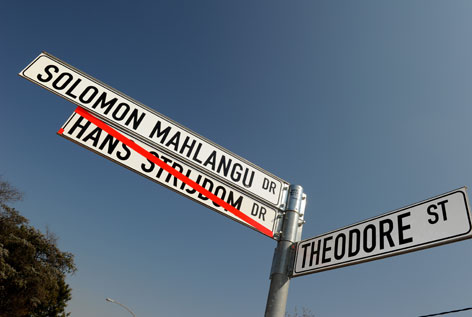
Street name showing a deleted SA prime minister, Hans Strijdom, replaced with a convicted ANC terrorist, Solomon Mahlangu

It was in the interests of justice for finality to be reached in the Tshwane street name saga, a High Court in Pretoria judge said on Thursday.

Judge Bill Prinsloo dismissed the Tshwane Municipality’s application for leave to appeal an interim order, granted in April, interdicting the city from removing old street names and ordering it to re-install old signs which have already been removed.

The order was granted after an urgent application by civil rights group AfriForum pending the outcome of its application to set aside Tshwane’s 2012 resolution to change the “offensive” names of 25 streets.

Prinsloo ruled that his findings on the urgency of the application and the interim interdict he granted were not appealable.

He said the interim order did not amount to a final or definitive finding regarding the rights of any of the parties, and did not interfere with the executive function of the municipality.

There was no chance that another court would come to a different conclusion, he said.

Referring to an Opposition to Urban Tolling Alliance (Outa) case in which the National Treasury successfully appealed against an interim order stopping e-tolling, Prinsloo said the present case was a far cry from the perceived financial consequences in the Outa case.

“In my view, the interim relief does not have an immediate and substantial effect, including serious, immediate and ongoing harm.

“It only perpetuated the status quo involving the retention of the old names under the new names.

“The names have probably been in use for more than a century, are widely known, quite harmless and [their retention is] sure to avoid confusion,” he said.

Prinsloo said the balance of convenience favoured AfriForum, which sought to protect cultural rights, and which stood to be prejudiced if the status quo was not maintained. There was no harm or prejudice whatsoever for the municipality.

He said the R2.6 million it would cost to restore the old names was because of the city’s own conduct. It had had no justifiable reason to remove them at a time when a review application was pending.

The order also did not interfere with executive function, because the new names, which were installed in March 2011, had remained where they were pending the review application.

Prinsloo said an appeal against the interim order could take longer to finalise than the review application, and could delay it for a long time, rendering the proceedings moot.

Such a state of affairs could not be tolerated and was not in the interest of justice, he said.

AfriForum’s Kallie Kriel welcomed the ruling, but said it was not the end of its struggle for the city to recognise the rights of cultural groups.

Tshwane still had a few days left before the court’s deadline to restore the road signs, but if it failed to do so AfriForum would consider appropriate steps, he said.

He hoped the review would be heard before the end of the year or early next year. – Sapa

Mark Shuttleworth’s court application could sink SA exchange control

Mark Shuttleworth

Billionaire entrepreneur Mark Shuttleworth’s bid to have South Africa’s exchange control system declared unconstitutional could have a devastating effect on the country, the SA Reserve Bank (SARB) said on Tuesday.

Jeremy Gauntlett SC, for the SARB, argued that the order sought by Shuttleworth in the High Court in Pretoria was “the most radical court order imaginable”.

“He quite deliberately decided to attack the heart of the scheme and seeks to bring down the pillars of the temple,” said Gauntlett.

“If the applicant succeeds in striking down Section Nine of the Currency Act and declaring all orders and rules unconstitutional, there would be no inhibition on removing capital from this country at all.

“Section Nine is the heart of the exchange control system and he wants to knock [it] down.”

Gauntlett said Shuttleworth claimed it was in the interest of all South Africans to destroy the entirety of the exchange control system in the country.

“He couldn’t get his money out of the country. Now he wants to pull the whole system down. Why should this financial refugee, living on the Isle of Man, speak on behalf of the entirety of South African society?”

Apart from his constitutional challenge to the exchange control system, Shuttleworth wants the court to set aside the levy of more than R250 million he had to pay to get some of his assets out of the country in 2009, and to order the SARB to return the money.

He further seeks an order declaring that the SARB’s so-called “closed door policy” of insisting that members of the public communicate with it through the intermediation of authorised banks is unconstitutional and invalid.

Shuttleworth has blamed the existing system of exchange control in South Africa for “forcing” him to emigrate in 2001.

He had assets worth over R4.27 billion in South Africa when he emigrated, but he transferred the assets out of the country in 2008 and 2009, each time subject to the payment of a 10 percent “exit charge”.

The government abandoned the levy a year after Shuttleworth moved the remainder of his assets out of the country.

Gauntlett argued that Shuttleworth’s application on the levy should be dismissed because he had attacked the wrong decision-maker, as the SARB was only carrying out a decision announced by the finance minister during a speech in Parliament in 2003.

He said the minister’s decision was authorised by statute, and the primary reason for the levy was to dissuade capital flight out of the country and not to raise revenue.

He said the context was that foreign exchange reserves were vulnerable, and that few countries were able to look at a flight of capital comfortably. If a crisis developed overnight there would be the need for swift action.

“There are sophisticated economic forces at work, and there’s a need for fast action for the purpose of protecting the currency. There’s nothing wrong with such a legislative scheme.”

If you have to engage the public before you make a regulation, all regulations in the country could be struck, Gauntlett said.

“When you control foreign exchange, you cannot conceivably say: ‘Let’s put up a billboard somewhere and consult the public.’ You cannot do things that day because people will take their money and go.”

He said these were the realities of how legislatures worked.

“This argument is nonsense on stilts. It was decided it [the 10 percent exit levy] was no longer needed, but that may change,” Gauntlett said.

Judge Francis Legodi reserved judgment. – Sapa

Government is trying to silence me: Juju

Expelled ANC Youth League president Julius Malema insisted on Wednesday that money-laundering charges against him were part of a plot to silence him.

“I am aware that senior government officials… have agitated law enforcement authorities to expedite my arrest and detain me as a means of trying to silence and disrupt the political activities I am involved in,” he said in a statement.

“Attempts to silence our political activities and involvement will never succeed because we carry a revolutionary obligation to speak on behalf of the oppressed and downtrodden masses.”

Malema said he would visit mineworkers in the North West on Thursday to pledge support for their wage protests.

“The struggle for economic freedom is in motion and no amount of suppression and intimidation will silence us,” he said.

“Attempts to banish us and isolate us from the ANC have never succeeded and… [will] never succeed.”

Malema was granted bail of R10,000 by the Polokwane Regional Court on Wednesday.

He was officially charged with money-laundering, for allegedly “receiving proceeds from unlawful activities”.

The affidavit he made in support of his application for bail was not read out in court. The case was postponed to November 30.

Malema said it was “conclusively irresponsible” for the State to issue a warrant of arrest and to take him to court, when it could not produce a docket to justify its charges.

“The rushing of the charging seems to be inspired by other considerations than justice,” he said.

“It is very strange that some political leaders, who are compromised and insisted that my arrest be expedited, are the ones who should respond to more than 700 charges of corruption, fraud and money-laundering.”

Earlier, Malema told supporters outside the court that they needed to make sure President Jacob Zuma was not re-elected at the ANC’s national conference in Mangaung at the end of the year.

“We must make sure Jacob Zuma does not become [remain] president of the ANC… Remove him as a president,” he said.

“Zuma has 700 charges against him. I only have one.”

In his statement, Malema said the “rule of law” could not be undermined by people with political power.

“All South Africans, including Jacob Zuma, should be equal before the law,” he said.

The ANC on Wednesday denied accusations that the charges brought against axed youth league leader Julius Malema were politically motivated.

“We reject this accusation with contempt, as it is misleading and seeking to undermine the rule of law and jurisprudence of the country,” spokesman Jackson Mthembu said in a statement.

“We want to appeal to our structures and to all South Africans to refrain from using inflammatory and unsubstantiated accusations against the ANC and the government agencies.”

The African National Congress in Limpopo and the ANC Youth League have accused the ruling party of using the charges against Malema to fight political battles.

Mthembu said: “In relation to charges favoured against [Malema] we want to state it categorically that the ANC, its president comrade Jacob Zuma and its leadership have no role in the charges.”

Malema appeared in the Polokwane Regional Court on Wednesday.

He was charged with money-laundering and granted bail of R10,000. The case was postponed until November 30.

The ANC called on those who had evidence of the abuse of state powers and its agencies to submit evidence in court as part of the defence.

Mthembu said the ANC was confident that the court would do its job without political motivation.

“It is evident that anybody that suggests the abuse of state powers is trying to water down the implications inherent in the charges and prejudging the case before it has even started,” he said.

“Let’s allow the law to take its course, and presume everyone appearing before the courts innocent until proven guilty.” – Sapa

Malema ‘intentionally took money’

Pensive Juju

Expelled ANC Youth League president Julius Malema is accused of making nearly R4 million from corrupt activities, in papers filed in the Polokwane Magistrate’s Court.

“The accused [Malema] did unlawfully and intentionally acquire ownership… of the amount of money,” according to the charge sheet.

Malema did this “well knowing” — or ought to have reasonably known –that the money “formed part of the proceeds of unlawful activities”, it alleged.

He appeared in court on Wednesday on a charge of money-laundering, and was released on bail of R10,000.

According to the court papers, Malema had clear business ties with On-Point Engineers director Lesiba Gwangwa.

It was alleged that On-Point was fraudulently awarded a R53m tender by the Limpopo department of roads and transport, and that R43m of this had been paid by the department.

“During September 2009 the Limpopo department… identified the need for the establishment of a Programme Management Unit (PMU) to assist it with infrastructure, as the department did not allegedly have the capacity to manage this function.”

The charge sheet stated that the company’s services were to be used for three years as a PMU.

It was required that the company’s management be multi-disciplinary, consisting of architects, land surveyors and engineers.

The company also needed to have experience and knowledge in the design and construction of roads, traffic stations, overload control, cost centres and airport infrastructure.

However, it was alleged that On-Point was not multi-disciplinary, and that the people whose names it submitted as part of its executive were never employed by the company.

On-Point was accused of pretending to have extensive experience and knowledge, when in fact it had existed for only one month at the time it submitted its bid.

It had stated on its tender application that it had nine years of experience.

According to the charge sheet, Malema substantially benefited from the tender payment, using it to fund a farm worth R3.9m and to pay R382,655 for a Mercedez-Benz Viano.

Charges of corruption were brought against On-Point, Gwama Properties, Segwalo Engineering, and Oceanside Trading.

On Tuesday, four people, including Malema’s business associate Lesiba Gwangwa, appeared in court and were granted bail of R40,000 each.

They are accused of fraud, corruption and money-laundering relating to the tender.

Malema will appear in court again on November 30.