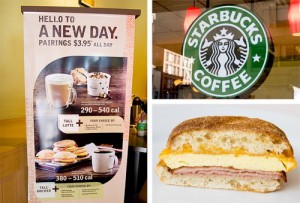
 This morning, Starbucks announced that starting next Tuesday it will post the calorie content of all its coffee drinks and food items in all its company-owned stores in the U.S.
This is big news, and overdue. For many people who don’t want to think about calories, or think they have a good idea of the calories in what they’re eating, Starbucks is the first place they experience sticker shock — the 460-calorie blueberry scone that’s a quarter of the 2000 calories many women aim to eat every day, the seemingly healthful slice of banana-walnut bread that’s 490 calories. But then you can look for and find lower-calorie items on the menu that’s labeled (at Starbucks, for instance, bagels under 300 calories), and start to acquire a sense of the calorie count of what you’re regularly ordering out and eating at home — the real utility of calorie labeling.
The FDA was supposed to release national rules for the national labeling required of all restaurants with at least 20 locations — one of the best, if least-noticed, parts of the Affordable Care Act. Years later, food-industry skirmishes and rumored cold feet by the White House Office of Management and Budget are still holding up those rules, as
Marion Nestle recently
documented. My home state of Massachusetts
passed a statewide calorie-labeling law in 2009; it never got implemented, so restaurants would not need to retool menus once the ACA rules went into national effect. That’s four years of lost opportunity to modify eating behavior. And even after the rules come out, which the FDA says now will be by the end of this year, there’ll be at least another year to wait for them to be implemented.
In the meantime, initial studies of the effects of menu labeling on behavior and weight reduction produced mixed results, to the delight of the food industry. But, as I wrote here, there will always be plenty of people who decide they don’t want the food police telling them what to do, they want to splurge, they’ll order more calories for better bang for the buck. That’s all fine.
The point of public health is not to dictate personal behavior, however many times the soda industry dresses Mayor Bloomberg as a nanny. The point is to make the default food environment more healthful, and mandatory calorie labeling has an important curbing effect on businesses that don’t want to look like they’re only offering high-calorie, unhealthy offerings. Starbucks itself made its own default milk choice 2 percent rather than whole, to get ahead of the sticker shock it knew would come once calorie labeling became the rule in New York City.
One of the less discouraging early studies on consumer behavior, conducted by Stanford researchers at Starbucks stores in New York City, which had calorie labeling, and Boston and Philadelphia, which didn’t yet, showed that people did consciously order lower-calorie items after the information was in their faces every time they made a purchase. Starbucks didn’t take the news as encouragement, though; when I wrote about that and other more-encouraging studies, a spokeswoman implied that the company would wait until national standards were in place before implementing labeling anyplace it didn’t have to.
Starbucks isn’t the first big player to claim good corporate citizenship by not waiting for the FDA. McDonalds itself announced last year that it would post counts on its menu boards. Panera and Au Bon Pain make calorie counts easy to find in all their stores.
But it’s significant. Particularly for the baked-goods-obsessed, like me. Much more important (okay, as important), to my mind, is the fact that the sawdust-seeming baked goods at Starbucks — even if in 2009 the company laudably eliminated artificial flavorings, ingredients, high-fructose corn syrup, and trans fats — are about to improve. Radically.
Last year, Starbucks paid $100 million to buy La Boulange, one of my favorite bakeries, in San Francisco, with the idea of using its skill at scaling up production throughout the Bay Area to produce similar-quality baked goods on a comparatively massive scale. I got to document and taste the Starbucks future when writing a long recent piece on the rollout, which has already begun in hundreds of California stores and will reach thousands of stores by the end of this year. Most of the the new La Boulange baked goods, each and every one of which will be served warm, are vastly better than what Starbucks sells now–and many of them are lower-calorie, too. I suspect that’s part of what’s behind this morning’s Starbucks announcement.
Even better, for the people who value national health over quality baked goods, is that the news on menu labeling has recently gotten better than it ever has been — as many observers predicted would be the case as the data started coming in from longer-term studies than the initial ones that delighted nay-sayers. A just-published large-scale Robert Wood Johnson Foundation review of four years of calorie labeling and the studies done to date shows widespread consumer support for national calorie labeling. Though results on behavior and weight are still mixed, the report finds encouraging changes in certain populations, such as women and people who are overweight; a reduction in the almost universal underestimation of calorie content in fast-food items; possible reduction of overall daily calories people consume once they are exposed to menu labeling in even one restaurant; and — perhaps most encouragingly for the industry that fought and now mostly supports calorie labeling — no reductions in revenue from voluntary labeling.
Even the National Restaurant Association, its president, Dawn Sweeney, said last week in response to a question at a Share Our Strength conference on reducing hunger and teaching people to cook, is eager for the FDA to release its standards — standards it initially opposed, vehemently. There are battles still to be fought: so far movie theaters, grocery stores that sell prepared foods, and bars have wriggled out of labeling requirements.
But everyone’s getting impatient. Canny chains are turning the delay to their public-relations advantage. Today’s announcement by Starbucks is one more message to the FDA: implement national calorie labeling already.