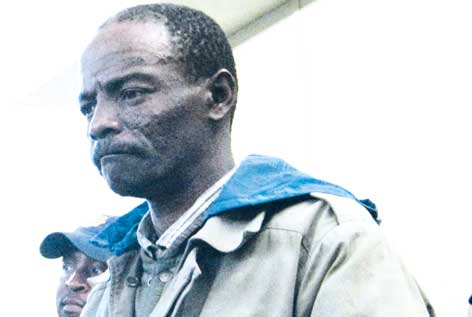
Serial killer German nurse may have killed 178

A German nurse admitted to at least 30 killings.

“A German nurse has admitted killing 30 of his patients by injecting them with cardiovascular medication.

The 38-year-old, identified only as Niels H, told a court-appointed psychiatrist that he had wanted to show off his ‘excellent’ resuscitation skills. He is suspected of having killed 178 patients who were in his care at Delmenhorst hospital, near Bremen, in northern Germany, between 2003 and 2005.

The psychiatrist, Konstantin Karyofilis, told a court in Oldenburg that the accused administered a cardiovascular drug by injecting it into patients’ veins in order to orchestrate medical emergencies that would then require him to resuscitate the patients in the hospital’s intensive care unit.”

Niels H.
Niels H.

‘Serious DNA error’ in Jack The Ripper identity

The scientist who conducted a DNA analysis of the shawl found near the body of one of Jack The Ripper’s victims allegedly made a basic error, which means the identity of one of history’s most notorious killers is in doubt again.

At the beginning of September, armchair detective Russell Edwards declared that 23-year-old Polish immigrant, barber Aaron Kosminski, one of the suspects, was “definitely, categorically and absolutely” Jack The Ripper!

His statement came after genetic analysis of the shawl discovered near Catherine Eddowes, a victim of the notorious murderer, after alleged traces of semen were found there.

The scientist, Jari Louhelainen, who carried out the test, is reported to have made an “error of nomenclature” when using the DNA database to calculate the genetic match.

The alleged error was first spotted by crime enthusiasts in Australia posting on casebook.org. Then, the concerns were echoed by four experts in the field of DNA analysis, including renowned Professor Sir Alec Jeffreys, inventor of genetic fingerprinting.

The experts pointed out the error signifies no DNA link can exist between Kosminski and Eddowes, so any theory that Kosminski is The Ripper would be based on conjecture and supposition. Police at the end of 19th century, however, did have him as a suspect in the case.

All this comes in the wake of the publishing of the book ‘Naming Jack the Ripper’ by Russell Edwards, a businessman who purchased the shawl at an auction in 2007.

“I’ve got the only piece of forensic evidence in the whole history of the case. I’ve spent 14 years working, and we have finally solved the mystery of who Jack the Ripper was. Only non-believers that want to perpetuate the myth will doubt. This is it now – we have unmasked him,” The Guardian quoted Edwards as saying last month.

Edwards hired Dr Louhelainen, a molecular biologist at Liverpool John Moores University, to conduct the test, and the researcher managed to extract seven incomplete fragments of mitochondrial DNA (mtDNA). He then attempted to match their sequences with mtDNA from a living descendant of Eddowes.

The scientist indicated that the DNA contained the alteration “known as global private mutation (314.1C), not very common in worldwide population,” and then Louhelainen concluded the DNA was Karen Miller’s, one of Catherine Eddowes’s female descendants.

However, there has allegedly been an “error of nomenclature,” specialists say, as the mutation in question should be noted as “315.1C” and not “314.1C.”

“315.1C” is not a rare mutation, and is shared by 99 per cent of ethnic Europeans.

Publishers of the book, Sidgwick & Jackson, responded to the allegations, and said that “the author stands by his conclusions” and they are “investigating the reported error in scientific nomenclature.”

“However, this does not change the DNA profiling match and the probability of the match calculated from the rest of the data. The conclusion reached in the book, that Aaron Kosminski was Jack the Ripper, relies on much more than this one figure,” they added.

Source: RT

Black serial killer gets life (amid media indifference)

Bulelani Mabhayi. Picture: Sithandiwe Velaphi

Serial killer Bulelani Mabhayi was jailed for life by the Mthatha High Court, sitting in Butterworth, on Tuesday, said Eastern Cape police.

Mabhayi, 39, had pleaded guilty to 20 charges of murder, six of rape and 10 of housebreaking dating back to 2007, said Brigadier Marinda Mills.

He was sentenced to 20 life terms for each of the murders, five life terms for five of the rapes, and 10 years for the sixth, she said.

He was also sentenced to 10 years on each charge of housebreaking. The sentences would run concurrently. – Sapa

Manhunt for serial killer in Pretoria

murder2A manhunt is underway in Pretoria for a serial killer believed to have raped and killed at least 10 young girls, reports TimesLive. A team of detectives fear that the body count could rapidly increase if he is not found.

Police started patching together evidence three weeks ago, linking the killings, thought to have started in 2004, after the discovery of a body in East Lynne, Pretoria.

A 14-year-old girl found raped, murdered and dumped in Sunnyside, Pretoria, in 2004 is believed to have been the killer’s first victim.

South Africa ranks among the top three countries in terms of the number of serial killers.

Very little is known of the killer’s modus operandi which, according to police sources, appears to be to target teenagers in Pretoria’s northern and eastern suburbs.

The bodies of victims, who were bound, have been found dumped along rivers and streams running through Pretoria.

Detectives involved in the case, including officers from the police’s Investigative Psychology Unit, fear that, unless the killer is caught soon, the slaughter of young girls will continue.

The police are yet to compile a profile of the killer.

Forensic psychologist Dr Jackie de Wet said it was “incredibly difficult” to investigate serial crimes and to profile their perpetrators.

“It requires a lot of hard work, especially gathering useable and credible information. Unfortunately the police do not seem to be taking forensic psychology as seriously as they should. [Police] management, while being aware of the expertise and skills within police ranks, is seemingly under-using this very important resource,” said De Wet.

He said the police we re now including clinical psychologists in investigations “but unfortunately forensic psychology, under which profiling falls, is a very specialised field with a limited number of experts”.

A source with knowledge of the Pretoria investigation said that all the victims, including a boy, were aged between 14 and 19.

“Investigators are looking into at least 10 victims, but it could be more, a lot more.

“Members of the Search and Rescue Unit recently searched open veld near Eersterust where the bodies of five teenage girls, which are now also being looked at as possibly victims [of the serial killer], were found.

“If they are positively linked it could bring the number of victims up to 15,” he said.

He said the veld was searched after the police came to suspect that there were more bodies dumped there.

The bodies of the victims, which were in various stages of decomposition, had all been dumped in open fields around Pretoria.

Two were found in a field behind Mamelodi soccer stadium.

Four were found near the Tshwane metro bus depot, near East Lynne, and two between East Lynne and Eersterust.

At least one victim was found in Colbyn.

The first victim was found beneath the Telkom water tower in Sunnyside.

“When the first body was found, the bizarre crime scene … led police to predict that she was the victim of a serial killer.

“DNA obtained from other scenes and recently analysed alerted us to the fact that a serial killer is on the loose,” the policeman said.

Asked to elaborate on what was “bizarre” about the crime scene, the policeman refused, saying that to do so might jeopardise the investigation.

“We know that there is a serial killer operating in Pretoria. We are busy searching the archives and databases of police stations in the city to determine whether there are any more cases, especially involving missing teenage girls.”

He said investigators were waiting for the results of more forensic tests to determine whether a number of bodies of young girls recently found could be linked to the killer.

“At this stage very little is known about how the attacks occur except that they seem to take place after the victims leave school for home.

“In one case the girl phoned her mother to say she was boarding a taxi and was on her way home.”

Only last week serial rape suspect Shulters Sifiso Makhubo was found hanged in his Johannesburg Central prison cell hours before he was to appear in the Palm Ridge Magistrate’s Court in connection with the rape of 35 girls.