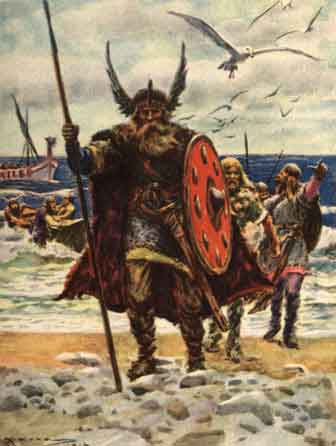
British search for Viking genes in France rankles anti-racist groups

British researchers on Monday began collecting the DNA of residents from Normandy in northern France in search of Viking heritage, but the project has raised concerns amongst some local anti-racism activists.

Around a hundred volunteers from the Cotentin peninsula area are giving DNA samples to academics at the University of Leicester, who are trying to find descendants of the Vikings who invaded what is now Normandy in the 9th century.

The aim is to learn more about “the intensity of the Scandinavian colonisation” in the 9th and 10th centuries in the Cotentin Peninsula, said Richard Jones, a senior history lecturer at the University of Leicester.

That includes trying to find out whether the colonisers kept to themselves or married amongst the locals, he added.

The French volunteers have been chosen because they have surnames that are of Scandinavian origin or that have been present in France since at least the 11th century. They also qualify if all four of their grandparents lived within a 50-kilometre radius of their current home.

French data protection authorities gave their green light to the study, which will be published in 2016, but the DNA testing has raised eyebrows in some quarters.

“We’re worried this will build on the idea that there are real Normans and fake Normans,” said Jacques Declosmenil, head of the local wing of the Movement Against Racism (MRAP) group.

“In the current context of xenophobia, it’s very dangerous. Racists could use this to say: ‘I’ve got proof that I haven’t got any Arab blood,’ for instance.”

But Jones dismissed such concerns, saying the scientists were only studying 2% of a person’s DNA in order to potentially establish Scandinavian ancestry dating back more than 10 centuries. “Anything is possible” for the other 98%, he added.

The team are searching for Viking roots amongst residents in three areas of Britain as well as in Normandy.

But at the nearby University of Caen, medieval history professor Pierre Bauduin said he had warned the Leicester academics that racial origins are “an extremely sensitive topic in France”.

“It’s important that the results of this are not misrepresented by anyone,” he said. – theguardian.com

New DNA tests question Queen’s legitimacy

New DNA analysis of the remains of one of England’s most well-known monarchs, King Richard III, has led to fresh questions over the legitimacy of the present British Royal family, the House of Windsor.

“We question the legitimacy of the current Royal family. If they, the Royal heirs, are prepared to offer their DNA then ‘finality’ would be in order,” Craig Rex, who claims to be a 7th-generation descendant of another well-known English monarch, King George III, told Sputnik Thursday.

Historians remain split on the issue, but some researchers believe George Rex of Knysna in South Africa, was the legitimate first-born son of King George III of England. Now new speculation of a mismatch in the DNA of Richard III has reignited questions over the rightful inheritors of the throne of England.

“We do believe that there were strong ties between my ancestor George Rex of Knysna and the British Royal family at the time,” Rex said, adding that “There are contemporaneous documents, showing the Royal Family went hunting on the Rex estate during visits to South Africa. Why was there this strong connection when George Rex was the supposed son of a distiller?”

In a 1997 documentary, film maker Kenneth Griffith revealed “disturbing evidence” that George Rex was the “forgotten” legitimate son of King George III and should have become King of England. Griffith controversially claimed George III’s first marriage to quaker girl Hannah Lightfoot caused a scandal in the ruling establishment of the day, which was embarrassed about the King having married a commoner.

Second Child of British Royal Couple Expected in April
Griffith claimed the establishment then banished the legitimate off-spring to South Africa. But Griffith George III’s marriage to Lightfoot was never annulled and so, King George’s subsequent marriage to Charlotte Sophia of Mecklenburg-Strelitz in 1761 was illegitimate and so was the Royal status of all their subsequent heirs.

Royalist supporters maintain the documents Griffith produced were 19th century forgeries, aimed at discrediting the Monarchy, but despite descendants of George Rex willing to undertake DNA comparison testing the current Queen and her heirs remain unlikely to provide their own samples.

“Regarding DNA testing the current monarchy, I would welcome any scientific investigation that would reveal the facts that would stand up to peer review,” Trevor Rix, an administrator with a DNA comparison project, told Sputnik Thursday.

“Having said that, the current monarchy is very stable and has an enormous beneficial impact on the country both at home and abroad. I would therefore not want to see the boat rocked too much,” Rix added.

Queen Calls for Unity Following Scotland’s Independence Referendum
Rix, who helps run the “Rix worldwide DNA project”, believes that the evidence he has gathered suggests George Rex of Knysna was not related to George III, but added more DNA comparison was needed before any final conclusions can be reached.

“Although we only have the one Y-DNA test on a Rex descendant of George Rex to go on, that single test matches test results of many descendants of Rix families whose ancestors predate George III,” Rix told Sputnik.

“So, as with the Richard III case, the DNA does not lie. Both cases illustrate that hearsay and descendancy on paper may well lie,” Rix added.

A study published this week in the Nature Communications journal, following DNA tests on the remains of Richard III, produced clear evidence of infidelity in the Royal family line.

Scientists remain uncertain when the break in linage may have occurred, but Dr Anna Whitelock of the University of London told the BBC that any break in the family tree would be unlikely to affect on the current status of the Queen.

‘Racist’ scientist forced to sell Nobel Prize medal

‘I am an unperson’

The geneticist James Watson, who has been ostracized since public comments about black African IQ in 2007, is to auction off his 1962 prize for discovering the structure of DNA. It is expected to fetch in excess of $3 million.

“Because I was an ‘unperson’ I was fired from the boards of companies, so I have no income, apart from my academic income,” said the scientist of the aftermath of the incident seven years ago, which forced him to retire from the Cold Spring Harbor Laboratory, where he had worked for four decades.

“No one really wants to admit I exist,” he told the Financial Times.

Despite his reduced circumstances – Watson has not been invited to give public lectures since 2007 – the American scientist is not living his life out in poverty. He said he plans to donate some of the proceeds of the sale of the medal to the “institutions that have looked after me,” including his alma mater, the University of Chicago, and Cambridge, where he met laboratory partner Francis Crick, with whom he shared the Nobel Prize.

The 86-year-old Watson also plans to purchase art.

“I really would love to own a [painting by English painter David] Hockney.”

The reserve price for the medal, which will be auctioned off at Christie’s in New York on Thursday, is $2.5 million, and there has been speculation that the final value could easily surpass $3 million. Crick’s medal – auctioned off last year to Jack Wang, a relatively obscure Shanghai biotech entrepreneur – fetched about $2.3 million.

“The far-reaching aspects of their discovery affect everybody and are only being appreciated now,” said Christie’s auctioneer Francis Wahlgren.

“I think the guy is the greatest living scientist. There are a lot of personalities in history we’d find fault with – but their discoveries transcend human foibles,” Wahlgren added.

The sale of Nobel Prizes is a recent phenomenon, with Watson’s being only the fourth to go on sale – and the first while the recipient is still alive. The medal awarded to Aage Bohr, the son of Niels, in 1975, attracted a winning bid of about $50,000 in 2012. Notably, American writer William Faulkner’s 1950 medal failed to pass the reserve price at an auction last year.

But for Watson, this is not just a chance to acquire money, but also to “re-enter public life.”

“I’ve had a unique life that’s allowed me to do things. I was set back. It was stupid on my part. All you can do is nothing, except hope that people actually know what you are.”

The iconic image of Watson and Crick giving a presentation on DNA in 1953 at Cambridge University.The iconic image of Watson and Crick giving a presentation on DNA in 1953 at Cambridge University.

Despite a long-standing reputation as an outspoken scientist who sometimes professed eccentric views – such as those linking sunlight and libido – Watson’s downfall was swift.

In October 2007, Watson said to the Sunday Times that he was “gloomy about the prospect of Africa” because “all our social policies are based on the fact that their intelligence is the same as ours, whereas all the testing says not really.”

He later waded into even more dangerous territory, suggesting that anecdotal reports said that black employees were less intelligent, and that there were no talented black scientists who could be recruited to work in his laboratory.

While Watson’s racial theories of IQ have some academic support, such as in Richard J. Herrnstein’s and Charles Murray’s controversial book ‘The Bell Curve,’ this remains one of the most contentious areas of scientific research. Following Watson’s crude remarks, most of the scientific community turned on him, accusing him of prejudice.

It is a charge he rejects to this day.

“I am not a racist in a conventional way,” he told the Financial Times.

“I apologize…the [Sunday Times] journalist somehow wrote that I worried about the people in Africa because of their low IQ – and you’re not supposed to say that.”

‘Serious DNA error’ in Jack The Ripper identity

The scientist who conducted a DNA analysis of the shawl found near the body of one of Jack The Ripper’s victims allegedly made a basic error, which means the identity of one of history’s most notorious killers is in doubt again.

At the beginning of September, armchair detective Russell Edwards declared that 23-year-old Polish immigrant, barber Aaron Kosminski, one of the suspects, was “definitely, categorically and absolutely” Jack The Ripper!

His statement came after genetic analysis of the shawl discovered near Catherine Eddowes, a victim of the notorious murderer, after alleged traces of semen were found there.

The scientist, Jari Louhelainen, who carried out the test, is reported to have made an “error of nomenclature” when using the DNA database to calculate the genetic match.

The alleged error was first spotted by crime enthusiasts in Australia posting on casebook.org. Then, the concerns were echoed by four experts in the field of DNA analysis, including renowned Professor Sir Alec Jeffreys, inventor of genetic fingerprinting.

The experts pointed out the error signifies no DNA link can exist between Kosminski and Eddowes, so any theory that Kosminski is The Ripper would be based on conjecture and supposition. Police at the end of 19th century, however, did have him as a suspect in the case.

All this comes in the wake of the publishing of the book ‘Naming Jack the Ripper’ by Russell Edwards, a businessman who purchased the shawl at an auction in 2007.

“I’ve got the only piece of forensic evidence in the whole history of the case. I’ve spent 14 years working, and we have finally solved the mystery of who Jack the Ripper was. Only non-believers that want to perpetuate the myth will doubt. This is it now – we have unmasked him,” The Guardian quoted Edwards as saying last month.

Edwards hired Dr Louhelainen, a molecular biologist at Liverpool John Moores University, to conduct the test, and the researcher managed to extract seven incomplete fragments of mitochondrial DNA (mtDNA). He then attempted to match their sequences with mtDNA from a living descendant of Eddowes.

The scientist indicated that the DNA contained the alteration “known as global private mutation (314.1C), not very common in worldwide population,” and then Louhelainen concluded the DNA was Karen Miller’s, one of Catherine Eddowes’s female descendants.

However, there has allegedly been an “error of nomenclature,” specialists say, as the mutation in question should be noted as “315.1C” and not “314.1C.”

“315.1C” is not a rare mutation, and is shared by 99 per cent of ethnic Europeans.

Publishers of the book, Sidgwick & Jackson, responded to the allegations, and said that “the author stands by his conclusions” and they are “investigating the reported error in scientific nomenclature.”

“However, this does not change the DNA profiling match and the probability of the match calculated from the rest of the data. The conclusion reached in the book, that Aaron Kosminski was Jack the Ripper, relies on much more than this one figure,” they added.

Source: RT

Research shows Neanderthals’ coexistence with humans from Africa

Neanderthals were extremely advanced for their time

Neanderthals coexisted with early modern humans in Europe for up to 5,400 years, according to researchers from Oxford university who used new techniques to pinpoint when the early cousins of Homo sapiens became extinct.

Scientists used radiocarbon dating evidence for 200 bone, charcoal and shell samples from 40 European archaeological sites to show that the two human groups overlapped for a significant period of time.

It took 300,000 more years for classic Neanderthals with larger brains to evolve. They dominated human life in Eurasia until Homo sapiens, our ancestors, swept in from Africa less than 80,000 years ago. The last Neanderthals died out 20,000 to 30,000 years ago in the Iberian peninsula, their last refuge.

Scientists used radiocarbon dating evidence for 200 bone, charcoal and shell samples from 40 European archaeological sites to show that the two human groups overlapped for a significant period of time.

They also concluded that Neanderthals disappeared gradually at different times in different locations, rather than undergoing rapid extinction.

It was already known that there was some contact and interbreeding between the two groups because research has shown that about 1.5-2.1 per cent of the DNA of modern non-African humans originates from Neanderthals.

However, the Oxford research published in the journal Nature on Wednesday provides the most detailed timeline so far of how this process unfolded.

Neanderthals – a human subspecies related to, but genetically different from Homo sapiens – had lived in Europe for hundreds of thousands of years when the first modern humans migrated out of Africa.

Using the latest carbon dating techniques, researchers were able to establish that the Mousterian toolmaking industry attributed to Neanderthals ended between 39,260 and 41,030 years ago.

Based on the latest evidence of when modern humans arrived in Europe, this suggested the two groups overlapped for between 2,600 and 5,400 years.

It is thought they died out because they were unable to compete with modern humans for food and resources but pinpointing the precise time when this happened has been difficult.

Source: FT

Police officer may be serial rapist

Police rapist
Police rapist Molekoa

The Randburg police constable and sector commander charged with rape and robbery has been linked to seven more rape cases through DNA evidence.

A senior investigating officer for the Independent Police Investigative Directorate (Ipid), Mandlakayise Mahlangu, also told the Hammanskraal Periodical Court that he feared they were dealing with a serial rapist.

Constable Mokolo Karpos Molekoa, 30, together with Ephraim Mazwi, 29, and Maphuthi Molokomme, 27, are applying for bail in the case in which they allegedly gang-raped a 27-year-old female hitch-hiker on July 8 near Hammanskraal.

They allegedly raped the woman in the bushes after she had turned down Molekoa’s advances. The court heard that they left her helpless in the bush.

“She could not walk properly because she was in severe pain. She managed to reach the N1 freeway, where she was assisted by a truck driver,” senior Ipid investigator Khangale Makhado said.

At the time of his arrest, Molekoa was a commander of the Ferndale and Praegville sectors in Johannesburg.

The majority of cases were reported in Olifantsfontein, Sebenza and Rabie Ridge areas.

The accused’s application was postponed to August 31 for the defence to address court and possible judgement.

This has brought to nine the number of rape cases against Molekoa. The 10th is an attempted rape case reported in Ellisras in Limpopo. A warrant of arrest has been issued in the Ellisras Magistrate’s Court.

When the court asked Mahlangu why he was opposing bail though he had visited and confirmed the accused’s addresses, he said: “I suspect we are dealing with a serial rapist here (Molekoa).” – Sowetan

Manhunt for serial killer in Pretoria

murder2A manhunt is underway in Pretoria for a serial killer believed to have raped and killed at least 10 young girls, reports TimesLive. A team of detectives fear that the body count could rapidly increase if he is not found.

Police started patching together evidence three weeks ago, linking the killings, thought to have started in 2004, after the discovery of a body in East Lynne, Pretoria.

A 14-year-old girl found raped, murdered and dumped in Sunnyside, Pretoria, in 2004 is believed to have been the killer’s first victim.

South Africa ranks among the top three countries in terms of the number of serial killers.

Very little is known of the killer’s modus operandi which, according to police sources, appears to be to target teenagers in Pretoria’s northern and eastern suburbs.

The bodies of victims, who were bound, have been found dumped along rivers and streams running through Pretoria.

Detectives involved in the case, including officers from the police’s Investigative Psychology Unit, fear that, unless the killer is caught soon, the slaughter of young girls will continue.

The police are yet to compile a profile of the killer.

Forensic psychologist Dr Jackie de Wet said it was “incredibly difficult” to investigate serial crimes and to profile their perpetrators.

“It requires a lot of hard work, especially gathering useable and credible information. Unfortunately the police do not seem to be taking forensic psychology as seriously as they should. [Police] management, while being aware of the expertise and skills within police ranks, is seemingly under-using this very important resource,” said De Wet.

He said the police we re now including clinical psychologists in investigations “but unfortunately forensic psychology, under which profiling falls, is a very specialised field with a limited number of experts”.

A source with knowledge of the Pretoria investigation said that all the victims, including a boy, were aged between 14 and 19.

“Investigators are looking into at least 10 victims, but it could be more, a lot more.

“Members of the Search and Rescue Unit recently searched open veld near Eersterust where the bodies of five teenage girls, which are now also being looked at as possibly victims [of the serial killer], were found.

“If they are positively linked it could bring the number of victims up to 15,” he said.

He said the veld was searched after the police came to suspect that there were more bodies dumped there.

The bodies of the victims, which were in various stages of decomposition, had all been dumped in open fields around Pretoria.

Two were found in a field behind Mamelodi soccer stadium.

Four were found near the Tshwane metro bus depot, near East Lynne, and two between East Lynne and Eersterust.

At least one victim was found in Colbyn.

The first victim was found beneath the Telkom water tower in Sunnyside.

“When the first body was found, the bizarre crime scene … led police to predict that she was the victim of a serial killer.

“DNA obtained from other scenes and recently analysed alerted us to the fact that a serial killer is on the loose,” the policeman said.

Asked to elaborate on what was “bizarre” about the crime scene, the policeman refused, saying that to do so might jeopardise the investigation.

“We know that there is a serial killer operating in Pretoria. We are busy searching the archives and databases of police stations in the city to determine whether there are any more cases, especially involving missing teenage girls.”

He said investigators were waiting for the results of more forensic tests to determine whether a number of bodies of young girls recently found could be linked to the killer.

“At this stage very little is known about how the attacks occur except that they seem to take place after the victims leave school for home.

“In one case the girl phoned her mother to say she was boarding a taxi and was on her way home.”

Only last week serial rape suspect Shulters Sifiso Makhubo was found hanged in his Johannesburg Central prison cell hours before he was to appear in the Palm Ridge Magistrate’s Court in connection with the rape of 35 girls.