South Africa’s Denel sells lethal attack drones to Saudi Arabia

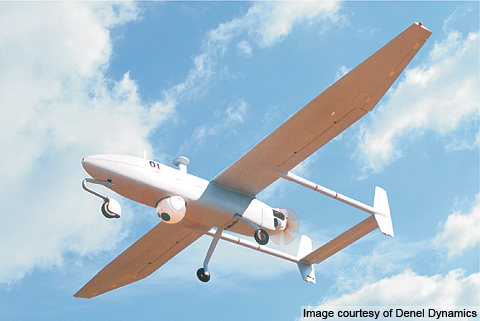
Denel's Seeker 400 drone

Saudi Arabia is buying an armed drone from South Africa after the Obama administration declined to sell the oil-rich kingdom U.S. Predator or Reaper missile-firing unmanned aircraft.

The state-owned South African company Denel Dynamics is working covertly with the Saudis to develop the Seeker 400 drone into an armed combat system for the Saudi military, the Paris-based newsletter Intelligence Online reported March 27.

The Seeker 400 is an advanced version of the company’s Seeker II unarmed surveillance aircraft.

The newsletter stated that the Saudi military would be the first customer to purchase the Seeker 400 armed drone and engineers from Denel are in the kingdom as part of the secret program.

If completed, the sale would allow Saudi Arabia to join the growing number of militaries that operate missile-firing drones—the most advanced weapon currently in use to launch precision strikes on terrorists.

Drone warfare has become the hallmark of the CIA, which is aggressively pursuing terrorists with drone missiles in Afghanistan, Pakistan’s frontier region, Yemen, the Horn of Africa, and elsewhere.

The new drone will be equipped with South Africa’s Mokopa air-to-ground missiles that are currently deployed on Algerian helicopters. The drone also can be outfitted with Impi laser-guided missiles with a range of 10 kilometers.

The drones are believed to be sought by the Saudis for use against the terrorist group al Qaeda in the Arabian Peninsula, which is currently operating in Yemen and has conducted international operations against the United States.

Riyadh has been trying to purchase missile-firing drones from the United States but so far the requests have been denied.

The United Arab Emirates is purchasing an unarmed export version of the Predator called the Predator XP, produced by General Atomics.

According to the newsletter, the Saudis have sought armed drones for several years and want the weapons to counter Iran’s unmanned combat vehicles known as the Karrar and the Shahed 129, which are fitted with Shahid-1 missiles.

“Because it could not procure drones from China, which is allied to Iran, nor from Israel, Riyadh turned to South Africa,” the newsletter stated.

However, Saudi Arabia lacks the infrastructure needed to operate drones. The systems require satellite communications that permit remote video and communications that allow drones to be piloted.

The Seeker 400 can fly for 16 hours and has a range of 250 kilometers with a 100-kilogram payload.

Saudi Arabia’s Prince Sultan Advanced Technologies Research Institute (PSATRI), a joint project of the Saudi air force and the King Fahd University, is also developing surveillance drones for use along the southern Saudi border, the newsletter stated.

Spokesmen for Denel and the Saudi Embassy could not be reached for comment.

News reports in February revealed that Saudi Arabia is hosting a U.S. attack drone base in the southern part of the country that was revealed in satellite imagery.

These satellite images show a remote airstrip deep in the desert of Saudi Arabia. It may or may not be the secret U.S. drone base revealed by reporters earlier this week.

However, the base’s hangars bear a remarkable resemblance to similar structures found on other American drone outposts. And its remote location—dozens of miles from the nearest highway, and farther still to the nearest town—suggests that this may be more than the average civilian airstrip.

The base had been kept secret for two years until disclosed in reports by the Washington Post and New York Times in February.

The base was used for the drone strike in September 2011 that killed American-born al Qaeda leader Anwar al-Awlaki. – Bill Gertz, freebeacon.com

First US city to ban drones

Charlottesville, Va., has become the first city in the United States to formally pass an anti-drone resolution.

The resolution, passed Monday, “calls on the United States Congress and the General Assembly of the Commonwealth of Virginia to adopt legislation prohibiting information obtained from the domestic use of drones from being introduced into a Federal or State court,” and “pledges to abstain from similar uses with city-owned, leased, or borrowed drones.”

The resolution passed by a 3-2 vote and was brought to the city council by activist David Swanson and the Rutherford Institute, a civil liberties group based in the city. The measure also endorses a proposed two-year moratorium on drones in Virginia.

Councilmember Dede Smith, who voted in favor of the bill, says that drones are “pretty clearly a threat to our constitutional right to privacy.”

“If we don’t get out ahead of it to establish some guidelines for how drones are used, they will be used in a very invasive way and we’ll be left to try and pick up the pieces,” she says.

The passed resolution is much less restrictive than the draft Swanson originally introduced, which would have sought to declare the city a “No Drone Zone” and would have tried to banned all drones over Charlottesville airspace “to the extent compatible with federal law.” The draft would have also banned all Charlottesville municipal agencies from buying, leasing, borrowing, or testing any drones.

Councilmember Dave Norris says the city has a “long tradition of promoting civil liberties.”

“It’s just part of our culture here,” he says.

Charlottesville is located 120 miles southwest of Washington, D.C., and has a population of about 43,000. The city is home to the University of Virginia, which has not tried to obtain a waiver to test drones from the Federal Aviation Administration.

The move earned praise from the Electronic Privacy Information Center. Amie Stepanovich, a lawyer with the group, says that the “Charlottesville resolution demonstrates that people care about protecting their civil liberties and Fourth Amendment rights and are willing to devote the time necessary to closely examine this issue.”

“Lawmakers should be looking at [drone privacy] issues now in order to ensure that there are safeguards in place to protect individual privacy from these invasive technologies,” she says.

Smith admits that the final legislation won’t do anything to prevent federal- or state-operated drones from operating over Charlottesville’s skies, but that the symbolic move could push other cities to follow suit.

“With a lot of these resolutions, although they don’t have a lot of teeth to them, they can inspire other governments to pass similar measures,” she says. “You can get a critical mass and then it does have influence. One doesn’t do much, but a thousand of them might. We want this on [federal and state lawmakers’] radars.”

Vice Mayor Kristin Szakos, who voted against the resolution, says she “can imagine ways in which drones might be used for positive things” and that the move was premature.

“I think drones have been used for bad things, but it’s like banning airplanes because they can drop bombs,” she says. “At this point, the city isn’t even talking about using drones. It seems premature to me to ban them altogether.”

Drone media?

Here comes the fly-by media. Preliminary use of diminutive drones is under way among those who see the potential of drones in news gathering, not to mention invasive “gotcha”-style journalism. Deadline Detroit — “a homegrown media revolution” manned by former veteran journalists — has already used footage made by “Tretch5000,” an anonymous hobbyist who used a camera-mounted drone to peek inside abandoned housing and old civic buildings, producing a telling video vignette.

“There’s a part of me that finds this kind of creepy and fraught with ‘big brother is watching’ issues. While we might trust public radio journalists and academics, there were rumors earlier this week that TMZ had purchased a drone to assist in its paparazzi-style coverage of celebrities,” says Vince Duffy, chairman of the Radio Television Digital News Association.

“But why wouldn’t they get one? Could websites that cover celebrities resist the urge to fly drones over celebrity weddings, outdoor red carpets, and beaches where starlets might be caught topless?” Mr. Duffy asks.

The University of Missouri has awarded a $25,000 grant to public radio station KBIA to explore drone journalism in places “reporters can’t go or reach,” while the University of Nebraska has won $50,000 from the Knight Foundation for a new Drone Journalism Lab.Mr. Duffy points out that the Federal Aviation Administration requires unmanned aircraft systems to be within the operator’s line of sight, cruise below 400 feet during daylight hours and avoid airports, among other things.

“Journalism organizations would certainly have many reasons to fly drones far from the person controlling it, or on some type of preprogrammed autopilot course,” Mr. Duffy says. “The FAA is looking into how it can regulate the coming ‘drone age’ safely. They expect to have new rules by 2015. The ethical issues for using drones for journalism will probably be up in the air much after that.” – Washington Times

CIA uses secret drones to kill terrorist suspects

WASHINGTON (AP) — Federal appeals court judges are questioning the CIA’s efforts to block information on the use of unmanned drones to kill suspected terrorists.

A lower court federal judge sided with the CIA last year, dismissing a lawsuit by the American Civil Liberties Union seeking records about the use of drones. In response to an ACLU Freedom of Information Act request, the CIA refused to confirm or deny the existence of responsive records.

The ACLU counters that several high-ranking officials, from then-CIA Director Leon Panetta to President Barack Obama, have publicly acknowledged the use of drones.

Judge Merrick Garland suggested at a hearing Thursday that a speech this year by President Barack Obama’s counterterrorism chief, John Brennan, amounted to an official acknowledgment of the CIA drone program.