Turkey blames Jews for protests

turkeyprotestsA Turkish deputy prime minister linked the “Jewish diaspora” to recent anti-government unrest, drawing condemnation from world Jewish leaders on Tuesday and concern among Turkey’s Jews the comments could make them targets of popular anger.

Deputy Prime Minister Besir Atalay’s office said his comments, made to reporters in the town of Kirikkale and published on the Cihan news agency website on Monday, were taken out of context.

Turkey was rocked by violent protests last month when a small effort to save Gezi Park in central Istanbul from redevelopment mushroomed into a mass demonstration by tens of thousands of people opposed to what they see as Prime Minister Tayyip Erdogan’s increasingly authoritarian rule.

Erdogan, in power for ten years, and other officials have cited conspiracies involving “foreign circles”, an “interest-rate lobby”, foreign media and terrorists engineering the protests to undermine Turkey’s economy and political clout. Atalay’s comments pointed the finger at the ‘Jewish diaspora”.

“There are those inside and outside the country who are envious about Turkey growing too much,” said Atalay, one of four deputy prime ministers.

“They are all uniting. On the one side you have the Jewish diaspora. You have seen the foreign media’s attitude over the Gezi Park events, how quickly they bought into it and how quickly and widely they started broadcasting before any assessment was made,” he said.

In a written statement to the media on Tuesday, Atalay’s office said some of the minister’s comments had been taken out of context and had been added to, resulting in articles stating Atalay had said the Jewish diaspora was behind the protests.

“There was no such statement or assessment made by our Deputy Prime Minister Besir Atalay,” the statement said.

“DESPICABLE”

The World Jewish Congress said it was shocked by what it said were “despicable” and “totally baseless slurs”.

“Mr. Atalay should have the decency to apologize. His remarks are an insult not only to the Jewish people but also to the many Turkish citizens who took part in the protests and who have real grievances,” it said in a written statement.

The Turkish Jewish Community, which represents most of Turkey’s estimated 23,000 Jewish faithful, said Atalay’s remarks could lead to reprisals against its members in a mostly Muslim country of 76 million.

“We are trying to obtain information about the meaning, the scope and details of Deputy Prime Minister Besir Atalay’s statement about the ‘Jewish Diaspora being behind Gezi protests,'” the Turkish Jewish Community and chief rabbinate said in a joint statement on the community’s website.

“(Because) Turkish Jewish citizens, as well as other Jewish people living all around the globe, may be affected and pointed (out) as a target of such a generalization, we wish to express our concerns and share our apprehension and worry of the consequences that such perceptions can cause.”

Turkey’s Jews, most of whom trace their roots to the 15th century when their ancestors found refuge in the Ottoman Empire from the Spanish Inquisition, have in recent years faced pressure as relations between Israel and Turkey soured.

Ties between the erstwhile military allies hit a low in May 2010 when Israeli commandoes killed nine Turkish activists in storming the Mavi Marmara, a ship in a Turkish-led convoy seeking to break a naval blockade of the Gaza Strip.

Earlier this year, Erdogan called Zionism “a crime against humanity”, prompting objections from U.S. Secretary of State John Kerry. President Barack Obama subsequently orchestrated an Israeli apology for the Mavi Marmara raid.

While at least one other member of Erdogan’s ruling party has suggested Jewish involvement in the Gezi protest, the remarks by Atalay appeared to be the first such public accusation by a senior member of the ruling AK Party, which traces its roots to a banned Islamist movement.

In a message on Twitter, the AK Party mayor of the Turkish capital Ankara, Melih Gokcek, said on June 16 the Gezi protests were a “a game of the Jewish lobby” and cited a Turkish newspaper report that a Washingon-based think tank linked to the American Israel Public Affairs Committee lobbying group had predicted the protests earlier in the year. – Reuters
‘Gays are the next Jews’

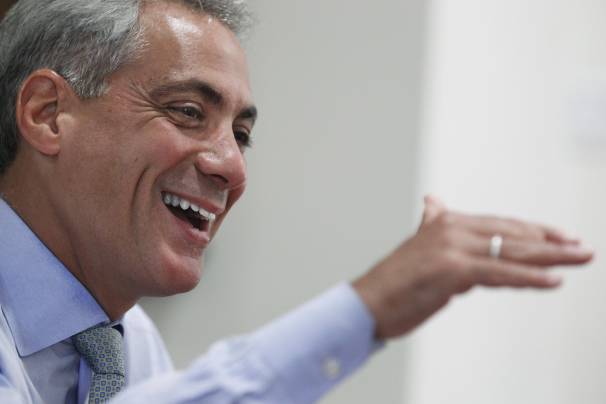
Rahm Emanuel
Rahm Emanuel

By Timothy P. Carney

While raising money for Bill Clinton (who signed the Defense of Marriage Act) in 1992, Rahm Emanuel proclaimed “Gays are the next Jews of fundraising.”


I’m not 100 percent sure what he meant by that, but Democrats have certainly grabbed onto gay issues as a fundraising lever. Democrats today are using the gay marriage ruling as a way to raise money, Paul Bedard writes.


Obama’s core network of fundraisers included many gay men and women who were also gay-marriage activists. I wrote on this after Obama spurred a fundraising boom by announcing his support for gay marriage.

“About 20 percent of Obama’s bundlers — volunteer fundraisers — are gay, according to media reports, with many of them being gay rights activists. For example, Sally Susman has raised at least $500,000 for Obama’s re-election.

Millionaire banking mogul Eugene Sepulveda is another gay half-million-dollar Obama bundler. Rufus Gifford is the finance director for Obama’s re-election campaign, and Andrew Tobias is treasurer of the Democratic National Committee — and both are gay.” – The Washington Examiner


South African Jews, Muslims fly to Washington to heal the rift

South African Jews and Muslims meet at the South African ambassador's residence in Washington

Partnership between Jews and Muslims in South Africa flourished when both communities joined forces in the struggle to end the apartheid regime. But as the common cause uniting them was resolved in the early 1990s, Jews and Muslims, both minorities in South Africa, grew apart and allowed the Israeli-Palestinian conflict to become a wedge issue and a source of ongoing tension.

Now, leaders of the two communities are in Washington are trying to find ways, thousands of miles away from their homeland, to rebuild the bridges.

“The greatest challenge we’ve encountered is South Africa,” said Rabbi Marc Schneier, who is the founder and president of the Foundation for Ethnic Understanding, the organization that put together the joint mission of Muslim and Jewish leaders to the United States. This challenge, which he sees as being more difficult than in other parts of the world in which the group has been trying to promote interfaith dialogue, is made up of a community of 70,000 Jews and a Muslim population 10 times its size, both of which have been far behind the United States in terms of interfaith cooperation. The reason, leaders of both communities agree, has to do more with the Middle East than with relations on the ground in Africa.

“Obviously, Israel is a huge issue,” said Rabbi Ron Hendler, who represented South Africa’s chief rabbi in the mission to Washington. “Many in the Muslim community feel very, very strongly about the Israeli-Palestinian issue, and many in the Jewish community are very Zionist.”

Sitting around a breakfast table at the residence of Ebrahim Rasool, South Africa’s ambassador to the U.S. and one the country’s leading Muslim activists, leaders of the two communities expressed their eagerness to move closer. Rasool, who co-founded the Call of Islam, a Muslim organization formed to fight apartheid, told the Forward that he would like to see the discussion about Jewish-Muslim relations begin not in the founding of the State of Israel in 1948, but rather in 1492, when Christians expelled Jews and Muslims from Spain, a place in which both communities flourished together. Like other activists, Rasool lamented the break in Muslim-Jewish cooperation once South Africa transitioned beyond its racist past. “We all cooperated in fighting apartheid. Our humanity forced us to reach our common values,” he said, “but as soon as that evil was pushed down, we allowed ourselves to retreat to the issue of Israel-Palestine.”

Speaking to two dozens activists gathered at his home, Rasool said that in order to build bridges, both communities need to “divest from the exclusive victimhood.” He quoted South African leader Nelson Mandela, who “knew that victims can’t make peace.”

In practical terms, organizers hope the short trip to Washington can inspire South African Jews and Muslims to follow some of the models set in the United States for interfaith dialogue, including the idea of twinning synagogues and mosques, the flagship program of the Foundation for Ethnic Understanding.

The organization has long sought to spread the idea of interfaith relations beyond the United States and has already conducted programs in Europe and Latin America. This mission, which alongside delegates from South Africa also included representatives from Australia and from New Zealand, is the first attempt to reach out to Jews and Muslims in the Southern Hemisphere.

“South Africa is such a deeply prejudiced society,” said David Jacobson, executive director of the South African Jewish Board of Deputies, the community’s umbrella organization. But it is this deep divide that gave participants hope that just as South Africa overcame its racial tensions, it can build bridges between Jews and Muslims. “If we can do it in South Africa, we can be a beacon to the world,” Jacobson said. – Jewish Daily Forward

93-year old German prosecuted for being a cook at Auschwitz

Hans Lipschis (93)

A 93-year-old man who acknowledges he served with the SS in the Nazis’ Auschwitz death camp but claims he was only a cook is under investigation by German authorities as a possible accessory to murder, a prosecutor said Wednesday.

Hans Lipschis was deported from the U.S. in 1983 for lying about his Nazi past when he immigrated to Chicago in the 1950s after the war.

With no evidence linking him to specific war crimes, however, it was impossible under previous German law to bring charges against him in Germany, said Thomas Will, a prosecutor with the German office that deals with Nazi war crimes.

But now the Lipschis case is being pursued on the same legal theory used to prosecute former Ohio autoworker John Demjanjuk, who died last year while appealing his 2011 conviction in Germany for accessory to murder on the grounds that he served as a guard at the Sobibor death camp.

Under the new line of thinking, even without proof of participation in a specific crime, a person who served at a death camp can be charged with accessory to murder because the camp’s sole function was to kill people.

Even though the Demjanjuk conviction is not considered legally binding because he died before his appeals were exhausted, Will said that his office is investigating a total of about 50 people in the same category.

The initial investigation of the Lipschis case is now done, and the case has been handed to Stuttgart prosecutors to determine whether there is enough evidence to bring charges, Will said.

In an interview this month with Die Welt newspaper at his home in southwestern Germany, Lipschis said he spent his entire time as a cook for the other SS guards of the camp, and had witnessed none of the atrocities. He did say, however, that he “heard about” what was going on.

About 1.5 million people, primarily Jews, were killed at the Auschwitz camp complex between 1940 and 1945. – AP

Mitt Romney’s ‘comments racist and out of touch’

Mitt Romney

JERUSALEM – Mitt Romney told Jewish donors Monday that their culture is part of what has allowed them to be more economically successful than the nearby Palestinians, outraging Palestinian leaders who called his comments racist and out of touch.

“As you come here and you see the GDP per capita, for instance, in Israel which is about $21,000 dollars, and compare that with the GDP per capita just across the areas managed by the Palestinian Authority, which is more like $10,000 per capita, you notice such a dramatically stark difference in economic vitality,” the Republican presidential candidate told about 40 wealthy donors who breakfasted around a U-shaped table at the luxurious King David Hotel.

The reaction of Palestinian leaders to Romney’s comments was swift and pointed.

“What is this man doing here?” said Saeb Erekat, a top Palestinian official. “Yesterday, he destroyed negotiations by saying Jerusalem is the capital of Israel, and today he is saying Israeli culture is more advanced than Palestinian culture. Isn’t this racism?”

The economic disparity between the Israelis and the Palestinians is actually much greater than Romney stated. Israel had a per capita gross domestic product of about $31,000 in 2011, while the West Bank and Gaza had a per capita GDP of just over $1,500, according to the World Bank.

Romney, seated next to billionaire casino owner Sheldon Adelson at the head of the table, told donors at his fundraiser that he had read books and relied on his own business experience to understand why the difference is so great.

“And as I come here and I look out over this city and consider the accomplishments of the people of this nation, I recognize the power of at least culture and a few other things,” Romney said, citing an innovative business climate, the Jewish history of thriving in difficult circumstances and the “hand of providence.”

Romney, in comparing the Israeli and Palestinian economies, made no mention of the fact that Israel has controlled the West Bank, Gaza Strip and east Jerusalem since capturing them in the 1967 war. Israel withdrew from Gaza in 2005, but continues to control access, and has enforced a crippling border blockade since the Islamic militant Hamas seized the territory in 2007.

In the West Bank, Israel retains overall control, and Palestinians only have limited self-rule. Israel controls all border crossings in and out of the West Bank, and continues to restrict Palestinian trade and movement.

The World Bank and the International Monetary Fund have said repeatedly that the Palestinian economy can only grow if Israel lifts those restrictions.

“It’s Israeli occupiers and Palestinians under occupation, and that’s why Palestinians cannot realize their potential,” Erekat said.

The breakfast with top donors – including Adelson, New York Jets owner Woody Johnson and hedge fund manager Paul Singer – concluded Romney’s visit to Israel, the second leg of a three-nation overseas tour designed to bolster the his foreign policy credentials.

Standing on Israeli soil for the first time as the GOP’s presumptive presidential nominee, Romney on Sunday declared Jerusalem to be the capital of the Jewish state and said the United States has promised never to “look away from our passion and commitment to Israel.”

The status of Jerusalem is a critical issue in peace talks between the Israelis and the Palestinians.

During his visit to Israel, Romney did not meet with Palestinian President Mahmoud Abbas or visit the West Bank. He held a brief meeting with Palestinian Prime Minister Salam Fayyad.

Romney’s campaign says his trip abroad, which began in England last week, is aimed at improving the former Massachusetts governor’s foreign policy experience through a series of meetings with foreign leaders. The candidate has largely avoided direct criticism of U.S. President Barack Obama while on foreign soil.

The Jerusalem fundraiser, however, was a political event that raised more than $1 million for Romney’s campaign. It marks at least the second finance event during his tour. The first, in London, attracted about 250 people to a $2,500 per person fundraiser.

Both presidential candidates have aggressively courted American donors living abroad, a practice that is legal and has been used for decades.

Romney’s declaration that Jerusalem is Israel’s capital was keeping with claims made by Israeli governments for decades, even though the United States, like other nations, maintains its embassy in Tel Aviv.

His remarks on the subject during his speech drew a standing ovation from his audience, which included Adelson, the American businessman who has promised to donate more than $100 million to help defeat Obama.

Adelson was among a several donors who flew to Israel for a day of sightseeing with Romney in addition to private meetings with top Israeli officials.

A group of donors also met with a top aide to President Benjamin Netanyahu, one donor said on the condition of anonymity to discuss private meetings.

Romney met with Netanyahu and other leaders before his speech Sunday. He also visited the Western Wall, Judaism’s holiest site, where he was mobbed by worshippers.

In his remarks, Romney steered clear of overt criticism of Obama, even though he said the threat of a nuclear-armed Iran “has only become worse” in the past five years.

Romney flew to the Middle East from Britain, where he caused a stir by questioning whether officials there were fully prepared for the Olympic Games. A stop in Poland will complete his trip.

Four years ago, Obama visited Israel as a presidential candidate, part of a five-nation trip meant to establish his own foreign policy credentials.

A goal of Romney’s overseas trip is to demonstrate his confidence on the world stage, but his stop in Israel also was designed to appeal to evangelical voters at home and to cut into Obama’s support among Jewish voters and donors. A Gallup survey of Jewish voters released Friday showed Obama with a 68-25 edge over Romney.

Romney and other Republicans have said Obama is insufficiently supportive of Israel.

South African Jews shocked by French shooting

The Jewish community is shocked at the murder of four people outside a Jewish school in Toulouse, France, the SA Jewish Board of Deputies said on Tuesday.

“This tragedy has demonstrated how frighteningly vulnerable innocent people can be when pitiless killers driven by irrational hatred target them for attack,” national chairwoman Mary Kluk said.

In a statement, she called the murder on Monday of a rabbi, his two sons, aged five and four, and a young girl, aged seven, cold-blooded.

Kluk extended the Jewish community’s heartfelt sympathy to the affected families and to the French Jewish community.

“We commend the French government for the seriousness with which they are responding to this atrocity and hope that the perpetrator will soon be brought to justice.”

On Tuesday, French President Nicolas Sarkozy admitted that authorities did not know the identity or motivations of the killer.

“Anti-Semitism is obvious. The Jewish school attack was an anti-Semitic crime,” he told reporters in Paris.