Former President Nelson Mandela has been discharged from his three-month admission at Pretoria’s Mediclinic hospital.
The 95-year-old returned to his Houghton home on Sunday morning, where he continues to receive intensive care.
In a statement by the Presidency, they confirmed that his condition remains “critical, and at times unstable.”
He was escourted to his home by medical staff after his long stay which began on June 8, to treat a recurring lung infection.
The international icon celebrated his 95th birthday in hospital on July 18, while the worlds’ media camped outside the medical complex.
Tributes for his recovery came in from around the world.
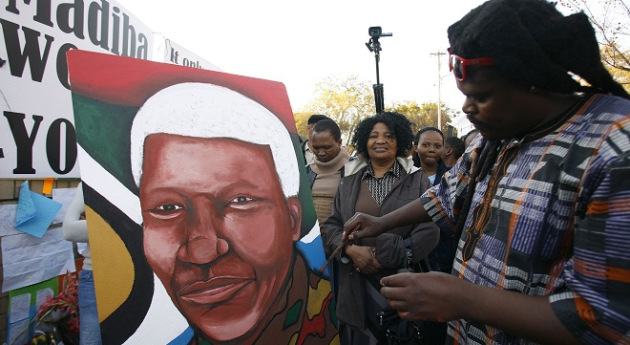
Well-wishers left poems, paintings, flags and floral bouquets outside the Pretoria hospital and his Houghton home.
In a statement this morning, the Presidency said: “We would like to wish him all the best as he continues his recovery at his Johannesburg home.”
“If there are other health conditions that will warrant another hospital admission, we would do so,” added Presidency spokesperson Mac Maharaj.
Maharaj added that his resident has been “reconfigured to all him to receive intensive care there.”
South Africans have been urged to keep praying for him, and to respect Madiba and his family’s private space.
Madiba’s grandson, Mandla, said his discharge was “particularly heartening because it flies in the face of those who have been busy spreading lies that he was in a ‘vegetative state’ and just waiting for his support machines to be switched off”.
He added these kind of people had been “in effect declaring him dead while he was fully alive”.
Days after the Presidency revealed that former President Nelson Mandela’s condition was sometimes unstable his grandson Mbuso Mandela has said that he still hopes that Madiba will be able to leave hospital.
Madiba has spent the past two and half months in the Pretoria Heart hospital, where he is being treated for a recurring lung infection.
Former President Nelson Mandela’s wife Graca Machel was supposed to speak at the Women of Excellence summit hosted by Madiba’s grandson Mbuso, but, just hours before the event was due to begin, she cancelled.
“She said it’s trying times at the moment so she won’t be able to attend because she has to be elsewhere,” said Mbuso.
Two days ago, the Presidency revealed that Mandela’s health did sometimes become unstable but stabilised after what has been referred to as “medical interventions”. It added that doctors were working hard to bring about a turnaround in Madiba’s condition.
“He’s 95 and there are not many people in this country and the rest of our continent that can actually reach that age and still be pretty compos mentis and still be able to look up, raise his hand and all that. So we must understand that he is old and we can’t really have too much expectations of him living forever, even though everyone would love that. So would I,” said Mbuso.
Mbuso Mandela says he understand the public’s need for updates on his grandfather’s health.
“People need to remember that, when he became president of this great country, and he actually did what he did, he then became everybody’s grandfather, everybody’s father. He became the people’s person. So, at the end of the day, we as a family must also understand that he is ours, but he is also our country’s.”
For now, it seems, the media frenzy that surrounded Mandela’s hospitalisation has become comparatively calm. – eNCA
Nelson Mandela’s health is unstable at times but the critically ill South African “icon” has shown “great resilience”, the Presidency said on Saturday, as he spent a 78th day in hospital.
“While at times his condition becomes unstable, the doctors indicate that the former president has demonstrated great resilience and his condition tends to stabilise as a result of medical interventions,” said the statement, the first in nearly two weeks.
The ailing 95-year-old anti-apartheid icon, fondly known by his clan name “Madiba”, was hospitalised in Pretoria on 8 June with a recurring lung infection.
“Doctors are still working hard to effect a turnaround and a further improvement in his health and to keep the former president comfortable,” President Jacob Zuma’s office added.
Presidency spokesperson Mac Maharaj did not elaborate further on his condition.
“There are times when he has those down moments, he responds to treatment, but there are times when it’s not stable,” he told AFP.
“But he’s stable,” he added.
In late June, Zuma cancelled a trip abroad after Mandela’s health deteriorated but his office said he would leave on Saturday for Malaysia for an official visit as planned.
While there, he will also receive a peace award on Mandela’s behalf.
Zuma urged South Africans to continue praying for Mandela and to keep the country’s first black president constantly in their thoughts.
“His condition is still critical but stable,” said the statement, echoing the updates on his condition for weeks.
The Presidency is the official channel for public updates about Mandela’s health, and had not issued a statement since 11 August.
Then, Mandela was said to be making “a slow but steady improvement” but that he remained critically ill.
His youngest daughter Zindzi Mandela said two days earlier that he was able to sit up unaccompanied and was “more alert, more responsive”.
At the end of July, Zuma’s office said Mandela was continuing to show signs of improvement after scares were reported.
US television network CBS said Mandela had undergone a surgical procedure to unblock a dialysis tube.
The broadcaster also reported occasions of Mandela having not responded to his medicines and his life support machine having shown distress.
Mandela has faced several health scares in recent years and his lung problems date back to his 27 years in apartheid jail.
His current hospitalisation — now entering a 12th week — is his longest since he walked free from jail in 1990 and went on to become the country’s first leader to be elected in elections which saw whites marginalised .
He has been absent for years from public life, and South Africans have become more familiar with his frailty but his latest ill health prompted a groundswell of wellwishers to gather outside his hospital.
His 95th birthday last month was marked by charitable deeds, with many people offering 67 minutes of service for the 67 years he was in public service.
In December, he spent nearly three weeks in hospital to be treated for a lung infection and gall stones.
In March, he was admitted overnight for a scheduled check-up, followed by a 10-day admission for pneumonia later that month. – AFP
Nelson Mandela moved into his Victor Verster in 1988. A few year later the world watched in awe as Mandela walked free from Victor Verster prison.
Western Cape premier Helen Zille says: “We’ve heard some really interesting stories about the house… a lot of anecdotes. I mean we were told how Madiba saw a microwave for the first time and thought it was a TV. I mean everything in this house is still the same and we need to preserve such history”
23 years later the refurbished Madiba Freedom Walk Road was opened. It has cost the DA municipality R6 million to upgrade the road.
The DA believes tourists will flock to the place in numbers and the refurbished road would make access easier.
“Correctional facilities are very strict. Before, anyone coming to the house had to go through the prison gate. Now the road grants everyone easier access to the Madiba house,” says Correctional services’ Jacobus Sinclair.
The Madiba house is now a landmark that is etched in history, according to the main opposition party.
Police officers were searching all vehicles entering the Pretoria hospital where former president Nelson Mandela’s was receiving treatment on Sunday.
The Medi-Clinic Heart Hospital’s two entrances, on Park and Celliers Streets were manned by SA Police Services members and security guards since Mandela was admitted to the private facility on June 8 with a recurring lung infection.
Motorists were being requested to open their boots as the cars were searched at the hospital’s security check-points.
Two vehicles of the Tshwane metro police were stationed near the entrances.
Some well-wishers arrived at the Celliers Street entrance and read the numerous get-well-soon messages posted on the hospital’s security wall. A collection of flags, bouquets of flowers and multi-coloured paintings adorned the hospital’s walls.
Earlier on Sunday, the Presidency announced that Mandela, 95, was slowly but steadily improving.
“The medical team also reiterated that although his health was improving steadily, Madiba still remains in a critical condition,” spokesperson, Mac Maharaj said in a statement.
The former terrorist has been critically ill in hospital for over two months. He is now entering his third month and 65th day in hospital. – Sapa
Former president Nelson Mandela is conscious, but still in a critical condition. That’s according to Anglican Bishop Joe Seoka.
The ailing former statesman is conscious and aware, Seoka told reporters outside the Medi-Clinic Heart Hospital, in Pretoria, where Mandela is being treated.
Seoka, who is the president of the SA Council Of Churches, said Mandela’s wife Graca Machel had informed them of his condition.
The Bishop was part of a group of religious leaders from the SACC who delivered prayers for Mandela and ministered to his family.
They did not go into the room was Mandela was being treated.
“We did not see him,” said Seoka. “We prayed in a room reserved for visitors.”
Asked whether Mandela would be discharged soon, Seoka said he had no information on that.
Mandela has been in hospital for almost two months. He was admitted to hospital on June 8 with a recurring lung infection. – Sapa
A good number of people in Britain and beyond have had the honour of being stripped of their knighthoods and awards by the honours forfeiture committee since 1995.
Last year a former Manchester headteacher, Jean Else, became the first woman to have her damehood annulled.
The forfeiture committee was established to guard the system of knighthoods, peerages and other awards.
The committee’s recommendations are submitted to the Queen through the prime minister. Any decisions on forfeiture are formally published in the London Gazette.
It is composed of senior civil servants. Meeting at least once a year, the committee examines individual cases brought to its attention and reviews general policy about how the system should operate.
The Commonwealth award is removed by a different forfeiture committee.
Robert Mugabe, knighted in 1994, to cheers of African liberation and Mandela worshipping, had the honour withdrawn in 2008 following the international furore over violent, disputed elections. Bob had become slightly too black for his boots.
The Romanian dictator Nicolae Ceausescu, honoured by the British government in an attempt to improve relations within Europe during the cold war had his knighthood revoked just in time. He fell from grace the day before his execution by a revolutionary firing squad.
Anthony Blunt, the keeper of the Queen’s pictures, was knighted for his services to art only to have his status revoked in 1979 shortly after the prime minister, Margaret Thatcher, had exposed his double life as a Soviet spy in parliament.
Another victim of the hasty re-writing of history is the Italian dictator Benito Mussolini.
Mussolini had been the first Italian to receive the honour. He was given the Knight Grand Cross of the Order of the Bath in 1923 from King George V, no less.
Il Duce lost his knighthood when Italy joined Nazi Germany in 1940 in declaring war on the UK.
The case of Roger Casement remains one of the most controversial forfeitures. A distinguished diplomat and human rights campaigner, he was eventually hanged for treason. He had attempted to deliver weapons to Irish republicans before the Easter Rising in 1916.
The Presidency said Nelson Mandela’s condition continued to improve on Tuesday.
Former President Mandela still remains in a critical but stable condition in hospital in Pretoria, and continues to show improvement, the Presidency said on Tuesday.
Madiba was admitted to Medi-Clinic Heart Hospital in the early hours on June 8 with a recurring lung infection.
His ambulance broke down on the way to the hospital, and he has had two “scares” and minor surgery.
Earlier this month Madiba spent his 95th birthday in hospital while visitors and well-wishers continued to leave flowers, cards and candles at the tribute wall outside the hospital.
The Mandelas are going to have to wait for the loot
A court application for the removal of trustees by former president Nelson Mandela‘s children has been struck off the roll, the law firm Norton Rose Fulbright said on Monday.
The ongoing battle revolves around the removal of George Bizos, Tokyo Sexwale, and Bally Chuene as directors of Harmonieux Investment Holdings and Magnifique Investment Holdings.
The application to remove them, brought by Makaziwe Mandela and Zenani Mandela-Dlamini, was removed from the roll for hearing this week by notice of removal, said Norton Rose Fulbright spokeswoman Candice Collins.
The firm, which represents Bizos, Sexwale, and Chuene, said that after Ismail Ayob withdrew as the attorney for the Mandela children, the court directed them to provide a new address for service by Friday and to file further affidavits by 30 August.
Also on Monday, Mandela’s grandson Nkosi Zwelivelile Mandela condemned the women’s action as a blatant attempt to disregard and undermine decisions Mandela made while he was “strong”.
“I consider the action by my relatives as a blatant abuse of the elderly.
“Why wait until the sponsor of a trust is not well to question decisions that he made [a] long time ago?” he asked.
He considered the court action nothing more than an attempt to “loot Nkosi Dalibhunga’s [Mandela] money that he has so carefully set out how it must benefit the family, and who must guide decisions relating to that”.
He believed all the people appointed by his grandfather were men of integrity, who had always had his grandfather’s confidence and support.
“All of us are mere beneficiaries and should be grateful that Nkosi Dalibhunga was kind enough to consider our needs through this trust and we should, therefore, avoid this type of actions that clearly infringe on his dignity,” he said. – Sapa
This is a grim time of year for a hospital in the Eastern Cape, where mattresses are laid on floors to cope with the stream of young men with severe injuries from botched circumcisions at initiation ceremonies.
Some patients with amputations, a doctor says, were told by their handlers that their genitals would grow back, reflecting a fog of misinformation that makes it hard to stop what has become an annual health crisis.
The traditional ritual, which goes back centuries, is meant to usher youths into manhood, inculcating them with the responsibilities to become valued members of their community.
Former president Nelson Mandela wrote about the spiritual meaning of his own circumcision in the same province where the Holy Cross Hospital is struggling to handle the influx of injured males.
At least 60 males have died at initiation schools in the Eastern Cape since the start of the initiation season in May, health officials confirmed.
Thirty of them died in the last six weeks, and 300 others were hospitalised with injuries.
Dingeman Rijken, a doctor at Holy Cross Hospital, says “It is becoming a psychological issue.” Rijken has treated 140 initiates in the last year and admitted another 150 for serious injuries.
“I have had to tell eight boys this season that they’ve lost their glans or parts of their penis, so it is a health problem. We can’t run away from it, we need to address it.”
He said nurses struggle to keep up with the overflow of more than 68 initiates who were admitted in the last two weeks with badly infected genitals, dehydration or other serious injuries.
The worst of the injuries occurred after botched circumcisions performed by inexperienced traditional nurses, who use the same spear on multiple initiates without protecting against the spread of infections, then cover up wounds with tightly wrapped bandaging that cuts off blood supply to the area.
After about 10 hours the genitals can become gangrenous and in some cases permanently damaged, but many initiates do not seek hospital treatment for another five to 10 days, Rijken said.
By this time very little can be done. Doctors cannot perform surgery because initiates suffer from sleep deprivation and dehydration and are not in a condition to give consent.
In minor cases, Rijken cleans off loose gangrenes around the affected area, bandages it and treats it with antibiotics, which eventually may result in a partial amputation of the penis. In more serious incidents, boys wait a period of one to six weeks until the entire organ falls off, he says.
Initiations are mostly practiced, though not exclusively, by the Xhosa. Young males participate in the ritual as a formal preparation for adulthood, usually undergoing circumcision and survival tests in secluded sites.
Most of the deaths in the Eastern Cape were in Pondoland, where the practice was banned in the 1820s by its then ruler, and then reintroduced in the last three decades as men who left their communities to work in mine fields were ostracised because they were not considered men if they were not circumcised, Rijken said, citing his research of its history.
Government legislation stipulates that participants should be at least 18, but parents can sign a consent allowing younger boys to participate.
Rijken has monitored more than 60 ceremonies and rescued several injured boys, and says he sees initiates mostly between ages 14 and 17, but has treated boys as young as 12 who are too young to understand the implications of losing their male organ.
He said initiates rarely complain about pain because they fear being beaten by nurses and ridiculed by peers for not properly observing a tradition that encourages initiates to develop a tough demeanor.
One patient had part of his injured penis “yanked off” as punishment for complaining, and those who suffer penile amputations are frequently told by handlers that their penises would grow back, Rijken said.
“But that’s why we need to involve the community, to tell them it won’t grow back,” he said. – AP
He is accused of insulting everyone from his brothers to Madiba, dishonouring tradition, taking drugs, handing out chieftaincies as favours and sexually abusing his relatives.
He is the king accused of a two-decade reign of terror.
This is Buyelekhaya Zwelibanzi Dalindyebo, king of the AbaThembu, whose relatives have been trying to unseat him for a year.
The Thembu people are one of the handful of nations and population groups which speak Xhosa in South Africa. In Xhosa the name is abaThembu, aba- being a common prefix for peoples. In the 19th century they were frequently known as the “Tamboekie” or “Tambookie” people. The most internationally famous Thembu person is Nelson Mandela, whose father was a reigning nobleman from a junior branch of the Madiba clan of kings.
The fight has become more public recently, with Dalindyebo openly insulting President Jacob Zuma, who has failed to withdraw Dalindyebo’s kingship as the royal family requested.
A year ago, the royal family wrote a lengthy memo listing their grievances about their king. This memo was used in September last year as the basis of the royal family’s decision to remove Dalindyebo as king.
The memo and minutes of that meeting were then sent to then minister of co-operative governance and traditional affairs Richard Baloyi and Zuma to finalise the dethroning.
But a year later, the minister and the president have still not done this. The royal family believe that the former minister was the cause of the delay.
The Presidency referred The Star’s queries on this to the ministry, and the ministry – under both Baloyi and now Lechesa Tsenoli – failed to respond to queries.
The memo was written by Nkosi Daludumo Lindikhaya Mtirara, a senior member of the AbaThembu Traditional Council and Dalindyebo’s uncle.
The memo lists dozens of complaints about Dalindyebo.
“The kingdom is in crisis under the guidance of the current king,” said Mtirara.
“The king is not ready and has no interest in the affairs of the kingdom, chieftainship, including values, principles, ethics, standards, process and procedures.”
Dalindyebo became king in July 1992. He succeeded his father, Sabata Jonguhlanga, who died in exile in 1986 and is regarded as an anti-apartheid hero for his opposition to homeland rule.
On Tuesday Dalindyebo’s lawyer, Zehir Omar, linked the removal matter to the 2009 conviction. He was confident the conviction would be overturned on appeal and that Dalindyebo would thus not be removed as king.
He referred to the rest as untested allegations. “In every family there are undertones of envy and jealousy,” said Omar.
He said the king was “immersed in personal troubles” and very affected by the hospitalisation of Mandela.
“When a loved one like Mandela is in hospital for a long time… it causes havoc psychologically among the family.”
The allegations include:
* Buyelekhaya Dalindyebo’s 2009 conviction for culpable homicide and 15-year sentence. He is still out on bail pending an appeal.
Recently, The Star reported that the Mthatha High Court ordered officials to reconstitute missing court records so that the appeal can go ahead.
* Dalindyebo proposed that the kingdom secede from South Africa, which caused division.
* He was accused of sexually assaulting three female relatives, then trying to convince them to withdraw charges.
* He allegedly persuaded a man to pose as the father of one victim, “to ensure that the Department of Home Affairs gives her the necessary documentation to cross the country so that evidence for prosecution for alleged rape cases is destroyed”.
* He publicly insulted a range of people, including relatives, Eastern Cape Premier Noxolo Kiviet, the late Kaizer Matanzima and Madiba.
* He expelled his mother Nomoscow and siblings from the royal household and later dishonoured her funeral.
* He publicly spoke “of his sexual interest” in female relatives, said women “are the gifts/presents that he prefers”, and there is suspicion “that he has even fathered some of the family members”.
* He dishonoured rituals, such as allowing unauthorised people to handle ritual matters, and disregarded traditions and customs.
* He failed to honour funerals of various close family members, insulted people at funerals, arrived “unpresentable” and late at a funeral, and disrupted proceedings.
* He smokes dagga in public.
* He established or upgraded chieftaincies unprocedurally.
* He unlawfully incorporated people from KwaZulu-Natal into the AbaThembu.
* He was “unable to identify the level (strategic, operational and tactical) where a king should operate”.
* He considers only those close to him for chieftaincies and headmanships.
* He was involved in assaulting a nursing sister and a security officer at a Mthatha hospital.
* He tried to remove traditional leaders from their posts.
* He “successfully created the chieftainship of Mvezo with expectation for the fulfilment of a quid pro quo. Currently, he is fighting against the same institution,” said the memo.
* Family members no longer attend the king’s meetings because of his lack of respect for them.
Kings get an official certificate of recognition issued by the president and receive a state salary of about R1 million a year, plus various other state-funded benefits.
The legal process for dethroning them is set out in the Traditional Leadership and Governance Framework Act of 2003.- IOL
The Mandela family feud ostensibly about graves, continued unabated on Friday.
Lawyers for former president Nelson Mandela’s grandson Mandla Mandela returned to the High Court in Mthatha on Thursday to seek the return of the remains of three family members to Mvezo.
“We brought an application on July 3 to rescind a court decision and the matter was set down for today 1/8Thursday 3/8,” said his lawyer Gary Jansen.
The court had ordered Mandla Mandela to move the remains from Mvezo back to Qunu.
Lawyers for other members of the Mandela family filed a notice opposing this application. They had 14 days to file opposing papers.
On July 3 the court ordered him to return the remains of his grandfather’s three children to Qunu from Mvezo, where he moved them two years ago. It then dismissed his application to rescind its decision as frivolous.
The remains are those of Mandela’s eldest son Madiba Thembekile, who died in a car accident in 1969; Mandla Mandela’s father Makgatho Mandela, who died in 2005; and Mandela’s first daughter Makaziwe Mandela, who died as an infant in 1948.
Wesley Hayes, for Makaziwe Mandela and 14 other Mandela relatives, confirmed the matter was in court on Thursday.
“I can confirm that the matter was erroneously placed on the roll by the respondent’s (Mandla Mandela’s) attorneys,” he said.
“Today saw the removal of the matter. The next step for us would be to file the opposing affidavit in due course.”
On July 6, Jansen said a complaint would be lodged against the Mandela family’s lawyers for misleading the courts on the condition of former president Nelson Mandela’s health.
The complaint relates to an affidavit submitted by the 15 members of the Mandela family in an application to exhume the remains of the three.
Jansen said the Mandela family’s lawyers had used the affidavit to mislead the court. – Sapa
Any person sound of mind must be truly perplexed by Mandela`s lightning-fast deification… given the fact that he basically sat in a locked room for 27 years whilst, occasionally, hitting stones into smaller stones.
It is as if he was somehow `anticipated` by History – predestined, so to speak, to assume a `future` role engendered by a blooming (pun intended) Zeitgeist during his time in jail … and notbecause he was in jail. For he, as an individual, certainly did not do anything before and during his imprisonment to even remotely deserve all the god-like accolades bestowed on him.
Is this possible? I mean; is it possible that History can `anticipate` someone … Mandela in this case?
Well, according to (Husserlian) phenomenology, it is inevitable… given the right circumstances. For, according to Edmund Husserl, subjective experience can only be made objective through ideal meanings.
Meaning that the ever-subjective experiences of any individual, like you and me, are always `mediated/filtered` by ideal types/meanings engendered by the socio-cultural world we find ourselves embedded in.
For example, take the phenomenon of lightning. A typical traditional Westerner walking on the High Veld will –upon seeing a flash of lightning – give an ideal meaning to this (his/her) subjective experience via the instrumental reason inherent in Western Science. In other words, it was an electrical discharge – the ideal meaning, causality.
A typical traditional African walking on the High Veld will – upon seeing a flash of lightning – give an ideal meaning to this (his/her) subjective experience via basic social-bound strategic reasoning. In other words, the lightning struck because the (dead) forefathers are angry… and therefore need to be appeased – usually by sending the chief`s witch-doctor to kill one of the former`s opponents.
Be that as it may, where does god-Mandela fit in here? Well, it was his very absence that turned him into the `god` (the ideal meaning of, inter alia, morality) `anticipated` by History.
For whilst there, he never had to get his hands `dirty` like, for example, Thatcher, Kohl and Reagan did or, for that matter, Castro, Khrushchev and Ho Chi Min… in order to fight the Cold War.
Just imagine if Mandela had not been incarcerated in 1964 and had, instead, been democratically elected to be the President of South Africa in 1964.
Do you really think that, given his communist leanings, his great friends and backers like, Castro, Khrushchev, Joe Slovo (a KGB colonel), Ronny Kasrils et cetera, that the zealously-capitalist Americans and, especially, the Anglo-Saxon mine owners in South Africa would have sat idly by if he, Mandela, did exactly what he had written about in his only original, albeit very trite, intellectual piece called How to be a Good Communist?
I think not!
Inversely; do you really think the KGB, Chris Hani, Joe Slovo, Ronnie Kasrils, Castro et ceterawould have sat idly by if Mandela had gone all neo-liberal (as he did in 1994) on them … at the height of the Cold War in 1964?
I think not!
This just illustrates that Mandela`s absence from real life (i.e. his time in jail) was his saving grace… his path to deification. For, as mentioned before, it allowed him the space not to get his hands dirty by having had to make tough decisions during a very difficult and inherently viscous period in History, the Cold War.
Now, given the fact that Pax Americana won – and became the, hitherto, unchallenged ruling morality of planet Earth – it, the Sheeple, needed a secular-humanist `ideal meaning `, a Messiah (after a symbolic `ordeal` in the desert) – to embody (i.e. to `become the flesh` of) this new `eternal` utopia.
The exact neo-liberal utopia Francis Fukuyama tried to peddle with his rather boring book calledThe End of History and the Last man.
Be that as it may; the West – after having sighed a collective sigh of relief after they had won this very dirty war – desperately needed an ideal meaning to consolidate its moral superiority… someone `unmarked/unblemished` by the bitter war they had just won.
We can, as mentioned before, only make subjective experiences objective through ideal meanings. This includes moral phenomena, of course.
So who better to step up to the (moral) plate than South Africa`s own Rip van Winkle – theegomaniacal Xhosa goat herder from Quonu – whose hands and soul appeared ever sounstained… simply because he sat in a locked room for 27 years whilst, occasionally, hitting small stones into smaller stones.
A former SA Defence Force surgeon general has refused to divulge details of meetings and discussions he had with former president Nelson Mandela.
Dr Niel Knobel told Wouter Basson’s unethical conduct hearing at the Health Professions Council of South Africa (HPCSA) on Wednesday there was information he could not disclose as it was top secret.
“I may not refer to documents that are top secret and that could jeopardise South Africa’s position internationally, as well as compromise … Mandela.
“Please understand my position as an officer who retains my ranks until the day I die and my commission stands. I am not going to jeopardise it and I’m certainly not going to make any remarks about [former] president Mandela,” Knobel said.
The council’s professional conduct committee is holding a hearing into allegations of unethical conduct against Basson, a Cape Town cardiologist.
Earlier, Knobel said he had meetings with Mandela and noted there was a lot of interest among the South African Defence Force (SADF) members when he returned from the meetings, wanting to know what they had discussed.
An affidavit made by Knobel during the Truth and Reconciliation Commission proceedings was presented before the committee.
The affidavit is a statement regarding the chronology of events around the SADF’s chemical and biological weapons programme, with special reference to Basson’s role.
Cross-border kidnappings
Knobel argued that he could not give evidence on the affidavit as some of the appendices which were supposed to be attached to it were not available.
The charges against Basson arise from his involvement in the apartheid government’s chemical and biological warfare programme in the 1980s and early 1990s.
He is accused of acting unethically by being involved in the large-scale production of Mandrax, cocaine and teargas, of weaponising teargas, and of supplying it to Angola’s Unita rebels leader Jonas Savimbi.
Basson is also accused of acting unethically by providing disorientating substances for cross-border kidnappings, and making cyanide capsules available for distribution to operatives for use in committing suicide.
In 2002, Basson was acquitted by the North Gauteng High Court of criminal charges arising from his conduct.
The HPCSA reviewed the judgment to establish if there were grounds to continue with an inquiry against him.
The state appealed the high court decision in the Supreme Court of Appeal, but the appeal was dismissed. The state then went to the Constitutional Court to appeal the decision. That was also dismissed in September 2005.
Unlawful and biased
In 2006, the HPCSA started its own process of investigating Basson’s conduct. A charge sheet was drawn up and the inquiry began in November 2007.
However, the inquiry was delayed when the HPCSA’s main expert witness fell ill. The inquiry resumed again in September 2008.
During the November 2008 hearing, Basson’s lawyers argued that the case brought against him was unlawful and biased.
Basson’s legal team then went to the High Court in Pretoria to stop the inquiry. The matter was heard in the high court in 2010. The court dismissed Basson’s application in May 2010. The next month, Basson appealed the decision in the same court, but lost.
The hearing then resumed officially in September 2011. In January 2012, Basson brought another application before the HPCSA’s professional conduct committee to dismiss the matter. However, this application was also dismissed.
The hearing continues on Thursday.- SAPA
This website uses cookies to improve your experience. We'll assume you're ok with this, but you can opt-out if you wish. Cookie settingsACCEPT
Privacy & Cookies Policy
Privacy Overview
This website uses cookies to improve your experience while you navigate through the website. Out of these cookies, the cookies that are categorized as necessary are stored on your browser as they are essential for the working of basic functionalities of the website. We also use third-party cookies that help us analyze and understand how you use this website. These cookies will be stored in your browser only with your consent. You also have the option to opt-out of these cookies. But opting out of some of these cookies may have an effect on your browsing experience.
Necessary cookies are absolutely essential for the website to function properly. This category only includes cookies that ensures basic functionalities and security features of the website. These cookies do not store any personal information.
Any cookies that may not be particularly necessary for the website to function and is used specifically to collect user personal data via analytics, ads, other embedded contents are termed as non-necessary cookies. It is mandatory to procure user consent prior to running these cookies on your website.


 Former President Nelson Mandela has been discharged from his three-month admission at Pretoria’s Mediclinic hospital.