Could Romney’s older, white voters withstand Obama’s rising tide of black and Hispanic youths?

Typical Obama voters? Young and not so white?

By MICHAEL ORESKES
Associated Press

TAMPA, Fla. (AP) — One way to think about this year’s election is as a contest between the impact of a sour economy (advantage Romney) and the power of the nation’s shifting demographics (advantage Obama).

Put simply, the groups that support President Barack Obama most strongly – blacks, Hispanics, young people, unmarried women – have been growing as a share of the electorate. Those who support Mitt Romney the most – white working men and older people – have not.

This demographic tide is so strong that some Democrats came away from their 2008 victory feeling that a political reordering was in the works that could be as important as the New Deal realignment that ushered in a generation of Democratic strength after the Great Depression.

The Great Recession put a deep dent in that hope of theirs, as it soured most other optimism around America.

But now both Republicans and Democrats see that the demographic tide is still running. But it is running into the effects of the bad economy.

As Republicans convened here this week, Jeb Bush, the former Florida governor, issued a warning to his fellow Republicans. Perhaps the economic hard times would get them through this year. But soon they would have to face the longer-term implications of America’s population shifts.

“Our demographics are changing, and we have to change. Not necessarily our core beliefs, but the tone of our message and the message and the intensity of it for sure,” Bush said. “I don’t think that’s going to have an impact in this election though. . But long-term, conservative principles, if they’re to be successful and implemented, there has to be a concerted effort to reach out to a much broader audience than we do today.”

—

DEMOCRATS ARE hoping Bush is wrong about the impact this year. In fact, it could be said they are hoping the continuing demographic shifts will salvage Obama from the wreckage of the economy.

Charles Cook, one of the country’s foremost analysts of election trends, says that basic public opinion about the election has been so stable now for so many months “that the makeup of the electorate is one of the few critical questions.”

There are different ways to express the changes that electoral makeup is undergoing.

The percentage of the electorate that is white and not of Hispanic origin has been dropping steadily. It was about 90 percent of the vote in the 1970s. By 2008 it was 74 percent. The white vote has declined an average of 3 points each presidential election since 1992.

Will the trend continue into 2012?

Yes, concludes a study by a liberal think tank that looked at census data in battleground states. The researchers, Ruy Teixeira and John Halpin of the Center for American Progress, combined declines in the white electorate (3 percent) with growth among blacks and Hispanics (2 percent) as well as college-educated whites (1 percent), who are more sympathetic to Democrats than white voters in general. That produced a total swing of 6 percent toward voters more likely to favor Obama.

But demographics are not always destiny. Population trends don’t actually register voters or bring them to the polls. The drubbing Democrats took in 2010 was largely explained by the very low turnout among some of their normally loyalist voters. Young voters who helped elect Obama in 2008 stayed away in droves at the midterm. So did blacks and Hispanics

The same thing could happen this year. “Will Democratic apathy and Republican energy make the electorate much more conservative leaning than its underlying demographics would suggest?” Teixera and Halpin asked.

That question is driving both sides, and the effects can be seen everywhere in the presidential campaign.

Just Wednesday, Obama campaigned among University of Virginia students in Charlottesville, one of four college-town appearances he is making in a week to gin up enthusiasm among young voters.

“Go out there, register,” he implored the students, “Stand up. If you do, we will win Virginia and if we win Virginia we will win this election and we will finish what we started.”

Meantime, Ann Romney went to the Latino Coalition lunch here at the Republican convention, part of a concerted Republican effort to reduce Obama’s margins among Hispanics. “I admire your community so much because I know how much you value family and what sacrifices you make for your families,” she said.

She stressed the Republican theme that Obama was unsympathetic to small business. “The Latino community is the huge engine of small business,” she said, and “they are mistaken if they think they are going to be better off” if Obama is re-elected.

—

REVIVING THE economy is an appeal Republicans hope will be heard by all voters, including those who have leaned Democratic. The downturn hit everyone, after all. Pat Mullins, Republican chair in Virginia, said party polling had found that Hispanic voters were less worried about immigration policy than unemployment.

“They’re concerned about the same things we are – that their kids have the advantage to better themselves,” he said. “That’s what they moved here for.”

But around the convention there is a palpable subtext, exemplified by Jeb Bush, that just relying on the economic message was a recipe for trouble, certainly in the long term. “We need to start being certain these various communities have leadership roles,” Mullins said.

The question of roles sparked some blunt exchanges this week.

The chairman of next week’s Democratic National Convention, Los Angeles Mayor Antonio Villaraigosa, took a shot at the Republicans for lining up a string of minority speakers at the opening night of the convention. “You can’t just trot out a brown face or a Spanish surname and expect people are going to vote for your party or your candidate,” Villaraigosa said.

Indeed, the racial fault lines between the parties are creating conversations that are not always pretty.

A search for black faces at the Republican convention has become a kind of game on Twitter under the hashtag “negrospotting.” The pop singer Clay Aiken wrote that he and his brother had been watching and taking a drink each time they spotted a black face and were, as their hashtag put it, “soberasamormon.” This prompted the country star John Rich to tweet that Aiken “should be ashamed for racist comments like that.”

The Republican Party says delegates aren’t asked to identify their race, so they don’t know how many are black. The Joint Center for Political and Economic Studies, which has been counting just that since 1974, says there are 46 black delegates, or about 2 percent.

And when it comes to Hispanics, Romney hurt himself during the primaries, particularly when he refused to support Republican Florida Sen. Marco Rubio’s legislation to address the problem of young illegal aliens who were brought to the United States by their parents and have lived here for years, gone to school and built lives but remain illegal. Obama then outmaneuvered Romney by unilaterally suspending deportations of these residents.

To counter this, Romney took a step that reflects the very notion Jeb Bush raised – to look at the makeup of the electorate, shape the message and change its intensity. For his speech Thursday evening, the newly minted nominee has chosen someone to introduce him who reflects that changing demographic and can, not coincidentally, help to deliver it: Marco Rubio.

Women still support Obama

Sarah Formato cuddled the whiny three-year-old on her lap and cast her thoughts back to 2008, when she had voted for Barack Obama.

“Politicians are in the pockets of big companies,” she said. “Obama understood the problem. He wasn’t going for that.”

Today, Formato’s enthusiasm has waned. “He hasn’t changed anything,” she complained. Nonetheless, she added with a shrug, “I would give him another shot.”

The president’s fierce struggle for re-election hinges in part on women such as Formato, whose support has turned lukewarm. The 31-year-old stay-at-home mom lives in a swing district in a swing state – the sprawling suburbs of Arapahoe County, southeast of Denver.

Few doubt that Obama will win a majority of female votes nationwide, as he did in 2008. The question is whether he will capture enough of them in key states to offset a comparative lack of enthusiasm among men. And the cracks in his support among women appear to depend on whether they have children or not.

According to a national Reuters/Ipsos poll of 25- to 45-year-olds, mothers tend to differ from women without children on issues ranging from the economy, taxes and military spending to healthcare and birth control – as well as on presidential candidates.

Childless working women favour Obama over Mitt Romney, the presumed Republican nominee, by a striking 20 points, 46% to 26%.

“Obama has done pretty well, stimulating the economy, getting out of Iraq and investing in healthcare,” said Joanna Giddens, 27, who works for a Denver nonprofit and can’t afford health insurance.

Working mothers were less likely to favour the president, by 42% to 34%. Stay-at-home mothers such as Formato, along with unemployed mothers, gave the president only a five-point margin: 37% to 32%.

What the groups have in common is that, so far, no more than three out of 10 of the women polled support Romney.

In 2008 women made up 53% of the electorate, and Obama won their vote by 13 points over John McCain, compared to his overall victory of seven points. Then in the 2010 congressional elections, women voted Republican by a narrow margin. They helped elect a GOP-controlled House that has sought to thwart the president’s agenda.

Today, Obama and Romney are neck and neck in the polls, and both are furiously courting female votes.

“It’s a scary time to be a woman,” says a thirtysomething woman in an Obama ad that aired in swing states. A narrator explains: “Romney opposes requiring insurance coverage for contraception, and Romney supports overturning Roe versus Wade,” the 1973 Supreme Court decision affirming the right to abortion.

Democrats are accusing Republicans of a “war on women”.

Romney has responded by homing in on women’s financial insecurity. “The real war on women is being waged by the Obama administration’s failure on the economy,” he says.

On Wednesday, Romney announced a new “Women for Mitt Coalition” headed up by his wife Ann, who is more popular than he is, according to some polls. – Reuters

Romney’s running mate Paul Ryan attacks Obama’s economic ‘record of failure’

Paul Ryan

NORFOLK, Va. (AP) — Appearing for the first time as Mitt Romney’s running mate, Wisconsin Rep. Paul Ryan is attacking President Barack Obama for what he calls a “record of failure.”

The seven-term congressman says Obama has led the “worst economic recovery in 70 years.” He notes that unemployment has been above 8 percent for more than three years – the longest stretch since the Great Depression.

He spoke in remarks prepared for delivery at the first public appearance of the new GOP ticket.

Ryan, the architect of a controversial budget plan, is promising not to “duck the tough issues.” And he says he has the courage to tell the truth.

Obama congratulates Macky Sall on Senegalese election win

US President Barack Obama congratulated Macky Sall on Monday for winning Senegal’s presidential poll, praising the west African nation as “a leading example of good governance and democracy at work.”

Obama, who was in South Korea for a nuclear security summit, also paid tribute to outgoing President Abdoulaye Wade “for his leadership and friendship to the United States” during his presidency.

“Senegal has, through this election, reaffirmed its tradition as a leading example of good governance and democracy at work in Africa and remains an example for its neighbors,” Obama said in a statement.

“The government and people of Senegal have once again demonstrated their commitment to political expression through peaceful, democratic elections, making it harder for non-democratic forces near and far to prevail,” he said.

“Today’s results deepen hopes across the continent and around the world that the quest for human dignity cannot be denied and that Africa’s democratic wave must continue.”

He said the United States “looks forward to maintaining its strong partnership and close engagement with the people and government of Senegal to continue to strengthen democracy, peace, and prosperity in the region.”

Secretary of State Hillary Clinton hailed Sall’s victory and congratulated the authorities for organizing “the election process, which international and domestic observers agree was credible, orderly, and transparent.”

The chief US diplomat said the “election was an important step forward for democracy in Africa and for the Senegalese people,” adding Washington hoped to strengthen its partnership with the Senegalese people and government.

Senator Chris Coons, a Democrat who chairs the Senate Foreign Relations Subcommittee on African Affairs, congratulated Sall, applauded the Senegalese for “conducting free, fair, and transparent elections,” and praised Wade.

“President Wade’s swift and peaceful concession is also a victory for Senegal and its people, and a critical milestone for its democratic system,” Coons said.

Sall defeated veteran leader Wade in an election lauded around the world as an example for African democracy.

Senegal was jubilant after the poll, which brought Wade’s increasingly controversial rule to a crushing end and disproved fears that political chaos was on the way in a country regarded as a regional beacon of democracy.

Record gun sales on fears of Obama re-election

by Joel McDurmon

Star-Telegram.com (Ft. Worth) reports that fears of an Obama re-election are sustaining record high gun sales which began with the President’s first days in office:

Enthusiasts are stocking up on guns and ammunition, and some in the industry are wondering whether sales are spiking as they did after Democrat Barack Obama won the presidency in 2008.

That rush created a nationwide shortage.

“We’re at the top of the roller coaster and we’re about to plummet down the side,” said DeWayne Irwin, owner of the Cheaper Than Dirt gun store in north Fort Worth, which set a sales record for the month of February. “It’s fixing to happen again. I don’t know if it will be to the same extent it was before, but I see it coming.

“Look who the Republicans are trying to put against Obama,” he said. “It’s the Keystone Kops and people are getting scared. People are terrified he’s going to get re-elected and then he won’t care about getting votes next time. He’ll just pass whatever legislation he wants.”

Some say the uptick in sales at gun stores could also be linked to anything from the arrival of tax refunds to a spending spree by fans of the National Geographic Channel’s Doomsday Preppers show, which chronicles people preparing for the end of the world.

Nationwide, more people than ever are buying firearms.

Last year, the FBI received more than 16.3 million inquiries from people running criminal background checks on potential gun buyers. That’s up from 12.7 million in 2008 and 11.4 million in 2007, FBI records show.

One website, Ammo.net, has called Obama “the greatest gun salesman in America.”

‘No child behind’ failing in the USA

No child left behind
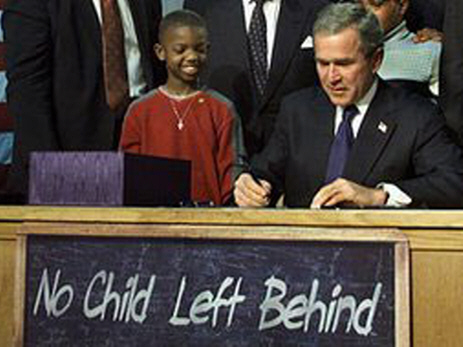
President Bush signing 'No Child Left Behind' into law

It could be the beginning of the end for No Child Left Behind.

The goal was lofty: Get all children up to par in math and reading by 2014. But the nation isn’t getting there, and now some states are getting out.

In a sign of what’s to come, President Barack Obama on Thursday freed 10 states from some of the landmark law’s toughest requirements. Those states, which had to commit to their own, federally approved plans, will now be free, for example, to judge students with methods other than test scores. They also will be able to factor in subjects beyond reading and math.

“We can combine greater freedom with greater accountability,” Obama said from the White House. Plenty more states are bound to take him up on the offer.

While many educators and many governors celebrated, congressional Republicans accused Obama of executive overreach, and education and civil rights groups questioned if schools would be getting a pass on aggressively helping poor and minority children – the kids the 2002 law was primarily designed to help.

The first 10 states to be declared free from the education law are Colorado, Florida, Georgia, Indiana, Kentucky, Massachusetts, Minnesota, New Jersey, Oklahoma and Tennessee. The only state that applied for the flexibility and did not get it, New Mexico, is working with the administration to get approval.

Twenty-eight other states, the District of Columbia and Puerto Rico have signaled that they, too, plan to flee the law in favor of their own plans.

The government’s action on Thursday was a tacit acknowledgement that the law’s main goal, getting all students up to speed in reading and math by 2014, is not within reach.

The states excused from following the law no longer have to meet that deadline. Instead, they had to put forward plans showing they will prepare children for college and careers, set new targets for improving achievement among all students, reward the best performing schools and focus help on the ones doing the worst.

Obama said he was acting because Congress had failed to update the law despite widespread agreement it needed to be fixed.

“We’ve offered every state the same deal,” Obama said. “If you’re willing to set higher, more honest standards than the ones that were set by No Child Left Behind, then we’re going to give you the flexibility to meet those standards.”

The executive action by Obama is one of his most prominent in an ongoing campaign to act on his own where Congress is rebuffing him.

No Child Left Behind was one of President George W. Bush’s most touted domestic accomplishments, and was passed with widespread bipartisan support in Congress. It has been up for renewal since 2007. But lawmakers have been stymied for years by competing priorities, disagreements over how much of a federal role there should be in schools and, in the recent Congress, partisan gridlock.

The law requires annual testing, and districts were forced to keep a closer eye on how students of all races were performing – not just relying on collective averages. Schools that didn’t meet requirements for two years or longer faced increasingly harsher consequences, including busing children to higher-performing schools, offering tutoring and replacing staff.

Over the years, the law became increasingly unpopular, itself blamed for many ills in schools. Teachers and parents complained it led to “teaching to the test.” Parents didn’t like the stigma of sending their kids to a school labeled a failure when requirements weren’t met. States, districts and schools said the law was too rigid and that they could do a better job coming up with strategies to turn around poor performance.

A common complaint was that the 2014 deadline was simply unrealistic.

As the deadline approaches, more schools are failing to meet requirements under the law, with nearly half not doing so last year, according to the Center on Education Policy. Center officials said that’s because some states today have harder tests or have high numbers of immigrant and low-income children, but it’s also because the law requires states to raise the bar each year for how many children must pass.

The current law requires schools to use standardized tests in math and reading to determine student progress. The waivers announced Thursday do not excuse states from those requirements but instead give them the freedom to use science, social studies and other subjects in their measures of student progress.

The 10 states also now can include scores on college admission exams and other tests in their calculation of how schools are performing. They can be excused from penalties included in the federal law but had to come up with their own set of sanctions for low-performing schools.

For example, Georgia will replace the law’s pass-or-fail with a five-star rating system and will use end-of-course tests and Advanced Placement performance in its measure of students.

In Oklahoma, schools are to be taken over by the state if they consistently fail to meet standards.

Kentucky – the first state to formally ask the federal government to be excused from some requirements when Gov. Steve Beshear sent a letter to Washington last summer – will use ACT college-entrance exams and other assessments by that company in its measures.

The schools still have to focus on the subgroups of students outlined in the federal law, such as English language learners and students with disabilities.

Not everyone applauded Thursday’s announcement.

While No Child Left Behind isn’t perfect, said Jeanne Allen, president of the Center for Education Reform, it’s thrown a valuable spotlight on problem schools. She said giving districts and states more flexibility “without firm consequence” is not reform.

“If school district power were the answer to our education woes, our nation would be soaring high above the rest of the world in achievement. It is not, and it will not, until our leaders – just as the people they serve – face both rewards and sanctions for the education systems they govern,” Allen said.

Nancy Zirkin, executive vice president of the Leadership Conference on Civil and Human Rights, said, “Our coalition will continue to play an active role in holding all 10 of these states and the Department of Education accountable for our children.”

But some educators also said Obama’s plan gives states flexibility with more clear and attainable goals.

Gene Wilhoit, executive director of the Council of Chief State School Officers, said under the waiver plan states essentially have a contractual relationship with the federal government to deliver on the approved plan.

“I think there is a legitimate concern or fear out there on the part of people that by giving these waivers, states might be `let off the hook’ in terms of accountability, and I think what you’ll find is just the opposite,” Wilhoit said. “They have raised the standards. They have put in place much more focused attention to the lowest performing, they have put in place professional development activities that didn’t exist prior, and they are holding those schools much more accountable.”

In Colorado, Bridget Cole, a 4th grade teacher who was eating an egg salad sandwich with a group of student on a field trip to the Colorado state Capitol, said she was relieved to hear the news out of the White House.

“No Child Left Behind never changed how I taught. I know what my kids need. It’s easier for me to see where my kids need to be rather than pay attention to what the federal government tells me my kids need to be,” Cole said.

While the president’s action marks a change in education policy in America, the reach is limited. The populous states of Pennsylvania, Texas and California are among those that have not said they will seek waivers, although they could still do so.

Some states might wait to see if Obama wins re-election November, said Jeffrey Henig, professor of political science and education at Teachers College, Columbia University. Others might bet the administration “won’t be in a position to strongly clamp down on them for failure to meet progress goals that the administration has indirectly indicated it admits are unrealistic,” Henig said.

Education Secretary Arne Duncan said states without waivers will be held to the standards of No Child Left Behind because “it’s the law of the land.”

Until now, the issue of education has stayed largely out of the presidential race.

But Sen. Mike Enzi, R-Wyo., ranking member of the Senate committee with jurisdiction over education, said Obama was using education as a “political poker chip.”

“This action clearly politicizes education policy, which historically has been a bipartisan issue,” Enzi said. “It is time for the president to work with Congress on important issues like this instead of acting unilaterally.”

And when Rep. John Kline, R-Minn., the chairman of the House Education and the Workforce Committee, released new legislation Thursday that would rewrite No Child Left Behind, it included a provision that prohibits the education secretary from coercing states into adopting specific academic standards in exchange for a waiver.

Duncan maintained this week that the administration “desperately” wants Congress to fix the law.

In an election year in a divided Congress, action on Capitol Hill appears unlikely.