Grisly lynching just minutes after CAR peace promise

car2
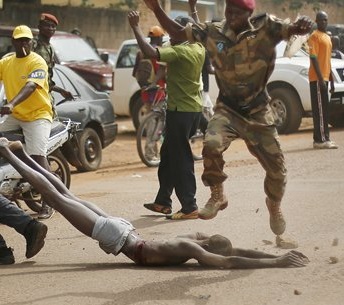
Army recruits stomp on a suspected rebel

A group of soldiers in the turbulent Central African Republic capital of Bangui lynched a suspected rebel on Wednesday, minutes after hearing CAR’s new president promise to restore peace at a ceremony reinstating the divided country’s army.

A Reuters witness saw about 20 uniformed soldiers accuse a member of the crowd at a training centre in the capital Bangui of having belonged to Seleka, the mostly Muslim rebel group that seized power in a coup last March.

They then stabbed him repeatedly until he was dead. A soldier stamped on the lifeless body, which was then dragged through the streets, dismembered and set alight as residents looked on and took photographs.

Ten minutes earlier, about 20 metres away, the new interim president, Catherine Samba-Panza, had addressed the crowd of at least 1,000 soldiers at a ceremony meant to re-introduce the army to the nation after it effectively disappeared from view during Seleka’s rule.

“Within a month, I would like to fully secure the greater part of the country, and I aim to stick to my word,” she said.

Samba-Panza was appointed two weeks ago to lead the country until elections are held next February, after coup leader Michel Djotodia stepped down under intense international pressure. She made clear it would take time to restore order.

“At a certain point, everyone will be held responsible for their acts. I am warning troublemakers who continue to sow disorder in the country,” she said.

Seleka’s 10-month occupation of cities and towns across the country has been marked by rampant looting, torture and murder.

The deep resentment they spawned among the Christian majority led to the formation of Christian “anti-balaka” militias, meaning “anti-machete” in the local Sango language, further fanning the flames of inter-religious bloodshed.

About 1 million people, a quarter of the former French colony’s population, have fled their homes. Even the presence of 1,600 French soldiers and 5,000 African troops has so far failed to stop the tit-for-tat violence, which the UN says has already killed more than 2,000 people.

At least 22 people, including 16 women, were killed on Wednesday when Seleka fighters attacked the northwestern city of Nzakone, according to a resident of the village contacted by Reuters.

Chadian peacekeepers have been accused of facilitating the movements of Seleka leaders responsible for a new wave of atrocities.

Many of Seleka’s fighters come from Chad and Sudan, but Chadian officials deny supporting the rebels.

Chadian military officials said on Wednesday they had detained and disarmed 262 fleeing Seleka fighters that had entered Chad, seizing more than 300 weapons, ammunition and a dozen vehicles.

“We didn’t want to give our weapons to the French, so we crossed over to give them to the Chadians,” Seleka’s Colonel Ahmat Abdelkérim Bahar told a Reuters journalist in the town of Doba.

France’s defense minister says the military is likely to extend its mission in Central African Republic.

Jean-Yves Le Drian told RTL radio Thursday that extending the UN-mandated six-month mission was probably the best way to ensure a peaceful political transition.

Source: France24

Cannibal in Central African Republic eats his enemy’s leg

mcentafrThe BBC reports that “a man who ate another man’s flesh in the Central African Republic has told the broadcaster that he was seeking ‘revenge’ for the murder of family members”.

The man, who calls himself “Mad Dog”, was in a Christian mob who attacked a Muslim in the capital Bangui.

He said he had been “angry” because Muslims killed his pregnant wife, his-sister-in law and her baby.

At least 1,000 people have been killed since violence broke out in the Christian-majority country in December.

Tens of thousands have also been forced to flee their homes in the sectarian conflict.

‘Magic’ powers

“Mad Dog” told the BBC’s Paul Wood he had seen his victim sitting on a minibus and decided to follow him.

More and more people joined him until he was at the head of a mob of some 20 youths, he said.

They forced the bus driver to stop and dragged the Muslim man out on the street, where he was beaten and stabbed before being set on fire.

Footage of the incident shows “Mad Dog” eating the man’s leg.

According to eyewitnesses, no-one tried to intervene.

Some people in the Central African Republic wear amulets containing the flesh of men they have killed because they believe it makes them invincible. – extract from bbc.co.uk

CAR welcomes SA’s involvement

South Africa’s foreign policy regarding the embattled Central African Republic (CAR) remains unchanged, President Jacob Zuma said on Sunday.

A meeting clarified a number of issues, Zuma said after hosting a top-level CAR delegation, led by Prime Minister Nicolas Tiangaye at the Mahlamba Ndlopfu presidential residence in Pretoria.


“We received the prime minister of the CAR as an envoy from the president currently leading that country. Michel Djotodia (Seleka’s rebel leader) had indicated that he would want to send a delegation to come and see me,” said Zuma.


“We are very happy with the message brought by Tiangaye. We have had a very good discussion with the prime minister. We think it (the Pretoria meeting) has helped to clarify certain things and also to deal with the relations between the two countries.”


Zuma said South Africa recognised the CAR’s transitional government, based on the January 2013 agreement signed in Libreville, Gabon.


Part of the transitional road map endorsed by the regional Economic Community of Central African States bloc was the formation of a national transitional council. That council subsequently elected Djotodia as interim president of the country.


“Once the forces that were fighting President Bozize took over, the leader said the constitution was suspended, as well as Parliament and the judiciary. That is the government we said we are not going to recognise, with everybody else,” Zuma said.


“There was a regional meeting which changed the status of the (Djotodia) authority. We did not say there was anyone who could not be elected to the transitional authority. The Libreville agreement, which is legal, is what is operating now.”


Bozize appointed Tiangaye, a widely respected lawyer and human rights activist, prime minister in January following the Libreville ceasefire agreement.


He kept his job when the Seleka rebels made the final push for Bangui, forcing Francois Bozize into exile at the end of March.


Tiangaye is part of the transitional government meant to prepare for elections within 18 months.


On Sunday, Tiangaye said his trip sought to cement bilateral relations between South Africa and his country. Speaking in French, Tiangaye offered condolences for the deaths of 13 South African soldiers on March 23.


“The message I brought is a message of calm and peace. We would like to take that unfortunate incident as a page of history that we will now turn to open a new one,” he said through a translator.


Tiangaye said it was regrettable there had been “a personalised relationship” between South Africa and Bozize.


“We regret that the past relations with the former president (Bozize) were more personalised, and we are now aiming at improving these relations to be more at a state level,” he said.


“It was not the fault of President Zuma or the government of South Africa. It was because President Bozize was hiding the nature of the relationship between the two countries.”


He said his visit to Pretoria, with a senior delegation from the strife-torn country, would mark the beginning of a new phase in the relationship.

“We are convinced we have now entered a new chapter and that the relationship will be more transparent to both countries. This is the message that I transmitted to President Zuma and the people of South Africa on behalf of the people of the CAR,” he said. – SAPA