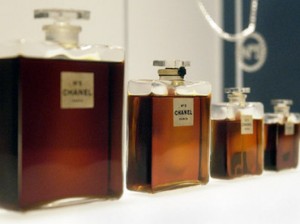
 Scientists have found that some of the ingredients in Chanel’s iconic No. 5 scent and a number of other perfumes can cause allergic reactions. EU health officials are considering banning the perfumes from sale.
European scientists unveiled a list of 100 ingredients thought to be hazardous to human health, adding 74 more substances to a previous, similar list. Among these is tree moss, traces of which are featured in the iconic Chanel scent, which has been in production for nearly a century. The list of potentially harmful perfumes also includes Guerlain’s Shalimar and one from Thierry Mugler, The Daily Mail reports.
The European Commission is now considering whether perfumes containing these substances, even in small amounts, should be banned from sale. Such a decision would strongly affect the manufacturers.
Perfumers found the initiative ridiculous, saying the whole industry could be devastated. “Chanel No. 5 has never done any harm to anyone,” Sylvie Jourdet of the French perfumers’ society is quoted by The Daily Mail as saying.
The whole idea remains dubious, considering the fact that different people have different allergies. “Lemon, jasmine and bergamot all contain allergenics,” Jourdet said. “It is the death of perfume if this continues. The more you use natural ingredients, the more there is a risk of allergies.”
Scientists have called for a ban on some of the ingredients on the list, while they say the use of others should be limited. They’ve suggested that 12 substances – including such popular components of perfumes as lemon citral, coumarin, found in tonka beans and eugenol, found in rose oil – be limited to 0.01 per cent of the product.
“It would be the end of beautiful perfumes if we could not use these ingredients,” Françoise Montenay of Chanel says.
The ingredients used in perfumes are not regulated by law as are other products despite the profound sensory influence it may exert. The perfume industry has made significant inroads recently on secret “mood changing” diffusers in public spaces.
Some critics even say it’s the scent of “death.”
The environmental group Greenpeace said Monday that at least 36 well-known perfume brands contain chemicals that are hazardous to health and the environment.
At a press briefing at the Chicken Bacolod Restaurant in Quezon City, Francis de la Cruz, Greenpeace Southeast Asia toxics campaigner, said that phthalate esters and synthetic musks-two toxic man-made to chemicals-are contained in several perfumes.
“These chemicals are known to be persistent and they intensify once they enter the body by inhaling or through the skin,” he said.
“It’s not acute poisoning but it’s chronic, it stays in our system and accumulates in the fatty tissues of living organisms,” he added.
De la Cruz said phthalate has been found to have bad effects on the DNA, evil sperm and restricts lung function in men. Synthetic musks can attack living tissues, he said.
These perfumes containing toxic agents, he said, and they are Terre by Hermes, CK One, Eternity for Men and Eternity for Women of Calvin Klein, Boss in Motion of Hugo Boss; Envy Me of Gucci, Blue Pole of Ralph Lauren, True Star of Tommy Hilfiger, She of Armani, No.5 of Chanel, Floral Dream of Adidas, Cinema of Yves Saint Laurent and Sunset of Naomi Campbell.
Randomly selected brands of perfume was sent for to quantitative analysis for phthalates and synthetic musks at the Netherlands laboratory, TNO Environment and Geosciences, which conducted the study from 2003 to 2004.
The complete list includes Floral Dream by Adidas, In Leather by Aigner, Natural Aqua, Bulgarian Emporio Armani by Armani, White Musk, Eau de Parfum by The Body Shop and High Speed by Bogner, BLV Night by, CK One for Men, Eternity for Men and Eternity for Women by Calvin Klein, the Baiser Du Dragon by Cartier, Chance Not. 5 by Chanel, Poison and Also Poison by Christian Dior, Him by FCUK, Fiorucci Loves You, Envy Me by Gucci, Boss by Hugo Boss, Manifest My by Isabella Rosellini, Classique and Badly by the Jean Paul Gaultier, Nightlife by Joop! , Iris Blue by Melvita, Waterlove by Mexx, Sunset by Naomi Campbell, XS Pour Homme by Paco Rabanne, and Jamaica Man and Jamaica Woman by Puma.
Ken Cook, President of the watchdog organization Environmental Working Group (EWG), is alerting consumers to the risks they’re taking each time they reach to sprits a wrist or neck. It’s one thing to know that the US does a generally abysmal job of regulating personal care product ingredients – another thing entirely to know that EWG found 38 “secret” (unlisted) ingredients in the 17 popular perfumes they recently tested.
Here’s what’s even worse: 66% of those unlisted ingredients in those 17 perfumes have not been assessed by the FDA for safety, and 19% of listed ingredients haven’t been vetted for safety, either. No problem, right? I’m not ingesting my perfume, right? Wrong. Your skin is your largest organ, and it drinks up most of what you put on it, chemicals and all. Would you drink a bottle of juice with 38 “secret” ingredients in it? Probably not.
From EWG’s email alert:
“We found 38 unlisted chemicals in our testing. The average fragrance tested contained 14 secret chemicals. Among them are chemicals associated with hormone disruption and allergic reactions, and many substances that have not been assessed for safety in personal care products by the US Food and Drug Administration (FDA) or the industry’s own safety panel.”
Companies are getting away with this secretive, smelly nonsense because the 1973 Fair Packaging and Labeling Act doesn’t regulate “fragrance” ingredients. So when you see “fragrance” listed on a product label, that’s a red flag – it’s likely there to cover all manner of evils.
According to EWG: “The vague term ‘fragrance’ covers chemicals that can be linked to reproductive damage, hormone disruption, and can trigger allergic reactions.”
If South Korean voters think they can smell victory when they go to the ballot box, they are absolutely right.
A team of supporters of presidential candidate Lee Myung-bak secretly sprayed a perfume called “Great Korea” at his rallies.
Volunteers were sent to voting booths in 2007 to ensure the same scent is drifting through the air.
“It will remind people of the identity of Lee Myung-bak. The concept of the perfume is hope, victory and passion,” said Oh Chi-woo of the conservative Grand National Party’s culture and arts team.
“They’ll just smell it today. But when they cast their votes, they’ll remember,” he said in the central town of Jecheon, standing by an open vegetable market where any smell from mounds of garlic and onions was drowned out by the slightly cloying scent of “Great Korea.”
The “fragrance of the president” offensive had been carried out on the quiet since the start of Lee’s campaign, he said.
One party volunteer, Kwon Hae-jin, said voters had responded well, noting some smokers who had complimented her on the pleasant scent.
“People will probably realise this is Lee’s smell,” she said, spraying bursts of the perfume into a gathering of supporters.
Latest opinion polls suggest she may not need to bother. Lee’s popularity rating is about 30 points ahead of his nearest rival.


