Hacker explains to FBI how he steered airliner mid-flight

A computer security expert has revealed that he accessed aircraft control systems on up to 20 occasions, according to an FBI search warrant.

The founder of One World Labs, Chris Roberts, was detained for questioning and had his hardware confiscated in April by federal agents after exiting a United flight from Chicago to Syracuse, New York following a tweet suggesting he might attempt to hack into a flight’s entertainment system.

In a search warrant application, obtained by APTN National News, Roberts previously claimed to have told agents that during his research he used his skills and equipment to gain access to the aircraft control systems on as many as 20 occasions.

“During these conversations, Mr. Roberts stated … that he had exploited vulnerabilities with IFE systems on aircraft while in flight. He compromised the IFE systems approximately 15 to 20 times during the time period 2011 through 2014. He last exploited an IFE system during the middle of 2014,” FBI Special Agent Mark Hurley wrote in his application.

During at least one of these “test” flights, Roberts “stated that he then overwrote code on the airplane’s Thrust Management Computer while aboard a flight,” the document claims. “He stated that he successfully commanded the system he had accessed to issue the CLB or climb command. He stated that he thereby caused one of the airplane engines to climb resulting in a lateral or sideways movement of the plane.”

The court document does not mention during which particular flights the interference with the aircraft controls took place.

According to the affidavit, Hurley met with Roberts in February and March to discuss IFE security vulnerabilities with regards to the Boeing 737 and 757, and Airbus A320 aircraft. It was during these interview sessions that Roberts revealed that his hacking into IFE that was produced by Panasonic and Thales.

When Roberts revealed his hacking abilities, Hurley writes that he had warned the programmer that accessing plane’s in-flight systems without authorization is a federal crime. Roberts, at the time said he understands and promised not to engage in such activity.

But after his April 15 tweet, the FBI apparently alleged the security expert could attempt to repeat success, and did go on to detain and question the man. The agents and technicians who inspected the aircraft which he flew to Chicago, before connecting to New York, allegedly found tampering on two electronic boxes next to Roberts’s seat. According to affidavit, one of the electronic boxes had been damaged.

“Technical specialists with the FBI believed that he may have just [hacked the plane’s system] again, or attempted to do so using the equipment then in his possession,” it said.

When the agents confiscated Roberts’ equipment in Syracuse – including a MacBook, an iPad, three hard drives and numerous removable USB flash drives – he denied hacking into any systems during the flight from Denver to Chicago.

“We believed that Roberts had the ability and the willingness to use the equipment … to access or attempt to access the IFE and possibly the flight control systems … and that it would endanger public safety to allow him to leave the Syracuse airport that evening with the equipment,” Hurley’s report states.

Roberts meanwhile told the Wired that the FBI has taken his remarks about hacking out of context of their comprehensive discussions with the agency.

Germanwings crash supports 9/11 speculation

Advances in sensor technology, computing and artificial intelligence have made human pilots less necessary than ever in the cockpit. After the Germanwings crash some seem less worried about being branded a 9/11 conspiracy nut.

Because information collected after the terrorist attacks of September 11, 2001 has raised questions about the alleged ability and motivation of the people accused of piloting four Boeing 757 and 767 planes into the World Trade Center, the Pentagon building and a field in Shanksville, Pennsylvania, speculation has since lingered regarding the covert use of technology to precisely navigate the four airliners that day without onboard pilot control.

By 1999 already, Boeing 757 and 767 aircraft contained digital flight control systems that can “automatically fly the airplanes on pre-selected routes, headings, speed or altitude maneuvers.”

On October 9, 2001, Cubic Defense Systems, Inc. applied for a U.S. patent that removes control of an aircraft from its pilot and utilizes an aircraft’s auto-pilot system to implement an uninterruptable pre-programmed autopilot flight plan in order to navigate an aircraft to a given destination during an emergency. This would be accomplished through the use of an electronic or mechanical relay or relays, that become activated by pilot operation of an aircraft hijack notification system.

Surprisingly to some, none of the four aircraft destroyed on September 11, 2001 in NY are known to have entered unique transponder hijack notification codes, suggesting either modified function or insufficient activation time.

One optional feature of the Cubic system is termination of an aircraft’s ability to communicate.

In two cases, hijacker communications aimed at passengers on-board American Airlines flight 11 and United Airlines flight 93 on September 11, 2001 were heard instead by air traffic controllers, suggesting modified communication functions.

In 2014, airlines carried 838.4 million passengers on more than 8.5 million flights. Commercial aviation is already heavily automated. Modern aircraft are generally flown by a computer autopilot that tracks its position using motion sensors and dead reckoning, corrected as necessary by GPS. Software systems are also used to land commercial aircraft.

In a recent survey of airline pilots, those operating Boeing 777s reported that they spent just seven minutes manually piloting their planes in a typical flight. Pilots operating Airbus planes spent half that time.

And commercial planes are becoming smarter all the time. “An Airbus airliner knows enough not to fly into a mountain,” said David Mindell, a Massachusetts Institute of Technology aeronautics and astronautics professor. “It has a warning system that tells a pilot. But it doesn’t take over.”

The Pentagon has just that system and has deployed automated piloting software in F-16 fighter jets. The Auto Collision Ground Avoidance System reportedly saved a plane and pilot in November during a combat mission against Islamic State forces.

The Pentagon has invested heavily in robot aircraft. As of 2013, there were more than 11,000 drones in the military arsenal. But drones are almost always remotely piloted, rather than autonomous. Indeed, more than 150 humans are involved in the average combat mission flown by a drone.

Because the Flight Data Recorders (FDRs) for American Airlines flight 11 and United Airlines flight 175 were not recovered, details regarding the operation of each aircraft on 9/11 are not known. The FDRs for American Airlines flight 77 and United Airlines flight 93 were recovered and indicate pilot control of each aircraft.

However, the FDR readout file for American Airlines flight 77 was completed four hours and fifteen minutes before the said FDR was recovered, suggesting false or altered FDR information.

And the FDRs for American Airlines flight 77 and United Airlines flight 93 are virtually the only ones during the previous 20 years of major National Transportation Safety Board (NTSB) U.S. aviation mishap investigations, for which unique inventory control serial numbers were not published.

Such serial numbers are required to facilitate FDR data readouts. In fact the NTSB possesses no records pertaining to the positive identification of the FDRs for American Airlines flight 77 and United Airlines flight 93.

Germanwings investigation is hardly conclusive

Christine Negroni is an aviation journalist and safety specialist who is writing a book on aviation mysteries to be published by Penguin in 2016.

Negroni says the evidence so far shows first officer Andreas Lubitz deliberately flew the plane to a lower altitude.

We know also that the plane wound up crashing into a mountain. The question French prosecutor Brice Robin has not answered is how he knows the co-pilot had that end in mind.

We know the plane was commanded down to a lower altitude after reaching 38,000 feet. We do not yet know why.

We know the Captain, identified in web postings as Patrick Sonderheimer, left the cockpit and was unable to get back in. We do not know that he tried to enter using the door passcode or that the door was blocked beyond the normal locking function. All we know is that the cockpit voice recorder shows he tried to enter by knocking.

There may be reasons for trying to enter by knocking, including confusion or distraction due to alarm.

We know that the first officer Lubitz failed to heed the knocks on the door. We do not know if this was deliberate. We know Lubitz was breathing. Both his inappropriate action in not heeding the knocking on the door and his breathing is consistent with deliberate action OR incapacitation.

We know the plane descended. We do not know if this was via programming the plane to descend or flight by hand by the first officer. A conscious and lucid pilot does not fly a plane into a mountain unless it is deliberate. An addled or unconscious pilot does not see or recognize the threat of a mountain and does. Either one of those options is possible, but the evidence presented so far does not allow conclusions.

Finally, unlike in the United States and other countries, the French judicial authorities are in charge of cockpit voice recorders and flight data recorders, which then makes them available to the air safety agency the Bureau d’Enquêtes et d’Analyses. There’s a reason for this increased oversight: In the crash of an Airbus A-320 in 1988, BEA was suspected of tampering with FDR data.

As a consequence, air accidents in France are seen through the prism of criminality. In other countries seasoned air safety investigators understand there is a multitude of factors that contribute to a disaster and will wait to have all the evidence before drawing conclusions.

This is the only way I can understand how the Marseilles French prosecutor made the tremendous leap of logic in concluding that the first officer “wanted” to crash the plane killing all 150 onboard.

The evidence so far shows Lubitz deliberately flew ​the plane to a lower altitude and a crash resulted. The question not answered in anything I’ve heard or seen is whether he intended for that to happen. This is not a subtle quibble. It makes a monumental difference in what really happened to Germanwings Flight 9295.

Air disaster movie opens with similar plot to Germanwings

An Oscar-nominated film will still be released in the UK despite its disturbing similarities to the Alps air disaster.

Argentinian film Wild Tales features a mass killer who locks himself in the cockpit of a passenger jet and crashes it in to the ground to murder everyone on board.

In terrifying scenes the fictional passengers panic and one tries to smash his way through a door to get to the controls in chillingly similar circumstances to the ill-fated Germanwings Airbus A320 flight.

The fictional killer invites his enemies on to the flight, including a lover who jilted him and a colleague who was hard on him at work, so he can kill them.

Despite protests the highly-acclaimed movie will be shown in British cinemas from today, however, it was released in Spain and Germany last year.

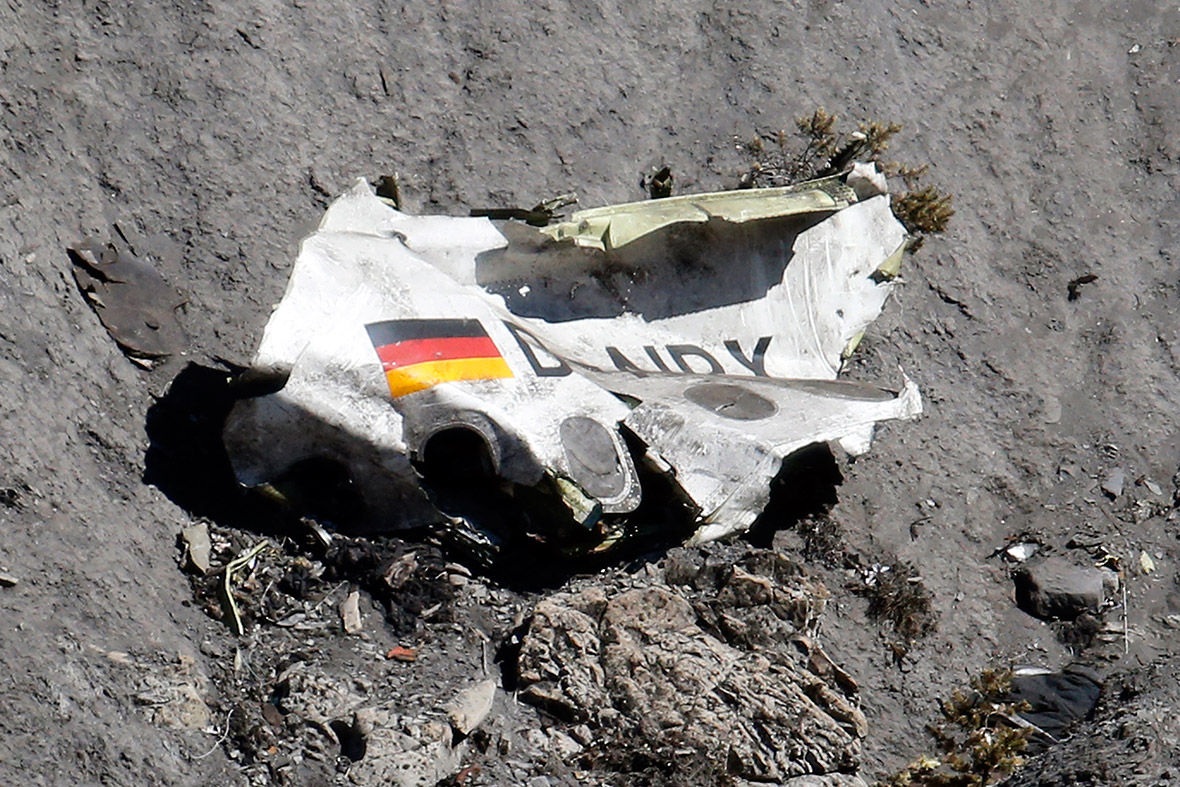
On Tuesday he locked the captain out of the Airbus A320’s cockpit before setting the airliner’s controls to descend into a rocky valley, obliterating the plane and killing all 150 on board.

Reports in Germany suggest the locked-out pilot may have resorted to using an axe in a desperate bid to get through the armoured door as the plane hurtled towards the ground.

Meanwhile Düsseldorf University Hospital said in a statement Friday that Lubitz had been undergoing diagnosis there since last month, DPA news agency reported. “Reports telling that Andreas L. [Lubitz] received treatment against depression at our clinic are inaccurate,” a hospital spokeswoman said, adding: “It was diagnostic tests.”

Lubitz’s colleagues have described his behaviour as ”normal,” and said he didn’t seem to be suicidal.

“I got to know him…as a very nice, fun and polite young man,” Klaus Radke, head of the local flight club in the town of Montabaur in western Germany, said. He added that Lubitz came across as “a completely normal guy.”

Co-pilot had no death wish say friends

The co-pilot named in the Germanwings plane crash was Andreas Guenter Lubitz.

The 28-year-old was from Montabaur, a town in the district seat of the Westerwaldkreis in Rhineland-Palatinate, Germany, according to a local flight club.

Acquaintances said he was in his late 20s and showed no signs of depression when they saw him last autumn.

“He was happy he had the job with Germanwings and he was doing well,” said a member of a glider club, Peter Ruecker, who watched him learn to fly.

“He gave off a good feeling.”

Lubitz had obtained his glider pilot’s license as a teenager and was accepted as a Lufthansa pilot trainee after finishing a tough German college preparatory school, Ruecker said.

His Facebook page lists his interests, including German electronica band Schiller, French superstar DJ David Guetta, his local Burger King, 10-pin bowling, aviation humour and a technical website about the A320 model of aircraft he flew into a mountainside.

Marseille prosecutor Brice Robin said the co-pilot “never said a word” in the 10 minutes before the crash, which killed 150 people.

He said he never answered a question or opened the door before the plane hit the ground and the plane’s descent was “voluntary”.

The Federal Aviation Administration praised Lubitz’s skills and included him in the prestigious FAA Airmen Certification Database.

The database contains the names certified pilots who have “met or exceeded the high educational, licensing and medical standards established by the FAA”.

Aviation Business Gazette announced the award in September 2013, writing: “Pilot certification standards have evolved over time in an attempt to reduce pilot errors that lead to fatal crashes.

He had undertaken 630 hours of flight time in an A320, according to Germany’s Bild.

Mr Brice said earlier that co-pilot Lubitz directed the plane into the ground but the passengers only realised what was happening “in the last moments”.

“He took this action, for reasons we still don’t know why,” he said.

“We can only deduce he destroyed the plane. He voluntarily allowed the plane to lose altitude.

“I think the victims only realised at the last moment because on the recording you only hear the screams on the last moments.”

Source: The Mirror

French president declares contents of second black box missing

French President François Hollande said the contents of a second black box found on Wednesday were missing as investigators managed to extract audio recordings from the first flight recorder recovered from Germanwings flight 4U9525.

French investigators say they have succeeded in extracting “usable data”, including sound and voices, from the first black box recovered from the Airbus A320 that crashed in the French Alps.

After revelations emerged that one of the pilots was locked out of the cockpit as Germanwings flight 4U9525 crashed and killed 150 on board, speculation has swirled as to what exactly happened in the moments before the disaster.

A senior military official involved in the investigation has told the New York Times that the audio from the “black box” flight recorder reveals that one of the pilots left his seat and then exited the cockpit.

He can then be heard knocking lightly on the door in an attempt to get back in. Soon after, he can reportedly be heard trying to break the door down.

No conversation is heard. Minutes later the plane hit a mountain in the French Alps, killing all 150 on board.

It remains unknown which pilot was in the cockpit and which was locked out.

The information remains unconfirmed by authorities.

The co-pilot had been on the job since September 2013 and had 630 hours of flying experience. He “was First Officer at Germanwings since September 2013,” a Lufthansa spokeswoman told AFP.

By comparison the plane’s pilot had more than ten years experience and 6,000 hours of experience flying the Airbus A320 model.

Neither of the pilots have been named.

French aviation safety expert Christophe Naudin told The Local that it remains unclear whether someone else may have gained entry to the cockpit.

“We don’t know whether the pilot left and was locked out or someone else entered the cockpit and locked him out,” he said.

“What’s troubling is that apparently we don’t hear voices anymore once the door is locked.”

Once the cockpit door is locked it is impossible to gain access, even with the code, explained Naudin.

Reinforced cockpit doors were installed on all planes at the behest of the US in the aftermath of 9/11.

“This case could show that having reinforced doors does not necessarily increase security and safety on airplanes,” Naudin said.

The is the biggest mystery is what happened with pilot inside. No distress signal was sent from the plane and the crew failed to respond to ground control’s desperate attempts to make contact.

Authorities have said the plane was still flying at the moment of the crash, meaning it did not explode mid-air.

Aviation experts have suggested several theories.

“If the pilots did not stop the airplane from flying into the mountains, it is because they were unconscious or dead, or they had decided to die, or they were forced to die,” one expert told the AFP news agency.

Authorities hope to find the second black box to reveal more.

Unlikely. The head of France’s Bureau d’Enquetes et d’Analyses (BEA) crash investigation agency, Remi Jouty, told reporters he still had “not the slightest explanation” for the tragedy at this stage.

“It is inexplicable. The plane was in perfect condition and the two pilots were experienced,” Lufthansa chief executive Carsten Spohr said in Frankfurt.

Weather did not appear to be a factor in the crash, with conditions calm at the time, and Germanwings had an unblemished safety record.