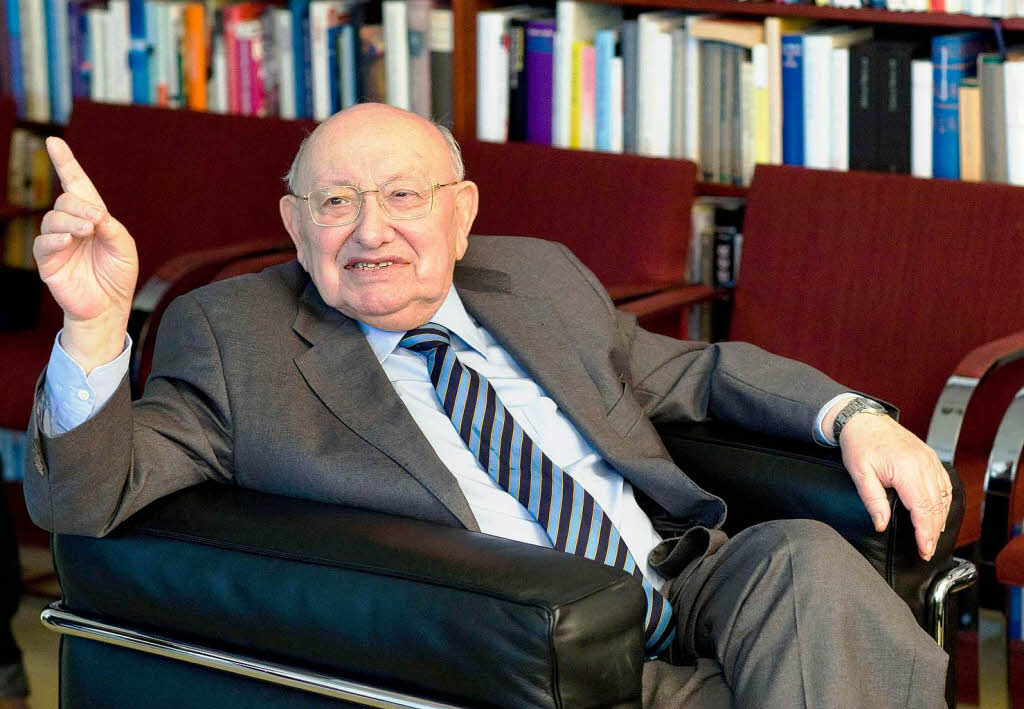
Germany’s Nobel-winning author Gunter Grass, translated into Afrikaans by PRAAG, said he feared humanity was “sleepwalking” into a world war, in the last interview he gave before his death on Monday.
“We have on the one side Ukraine, whose situation is not improving; in Israel and Palestine things are getting worse; the disaster the Americans left in Iraq, the atrocities of Islamic state and the problem of Syria,” he told the Spanish newspaper El Pais in the interview published Tuesday.
“There is war everywhere; we run the risk of committing the same mistakes as before; so without realising it we can get into a world war as if we were sleepwalking,” he added.
Spain’s top-selling newspaper said the interview, carried out at the author’s home in Luebeck in northern Germany on March 21, was his last before his death aged 87.
Grass, who achieved worldwide fame with his debut and best-known novel “The Tin Drum” in 1959 opposed the installation of nuclear missiles on German soil.
In his lengthy interview with El Pais, he also expressed concern over climate change and overpopulation.
“As the years went by I realised that we have the possibility to autodestruct, something that did not exist before: it was said that Nature caused famine, droughts, the responsibility lay elsewhere,” he said.
“For the first time we are responsible, we have the possibility and the capacity to auto-destroy ourselves and we don’t do anything to eliminate this danger.
“All of this together makes me realise that things are finite, that we don’t have an indefinite amount of time.
“If we take into account the existence of our planet, we have to recognise that we are guests that spend a short and very determined period in this world and all we leave behind is nuclear waste,” he added.
– ‘Need to understand Russia’ –
His Danzig Trilogy is set in the ethnically-mixed region of his childhood. Danzig was handed to Poland after the war, when its ethnic German population fled or were expelled.
Grass, who was wounded and taken prisoner by the Allies during World War II, said his strong work ethic stemmed from several near-death experiences he had as a youth.
“During the space of three or four weeks, during the war, I had five or six possibilities to die like many others of my age. I am still conscious of that,” he told El Pais.
“The fact that I work as much as possible serves to prove to myself that I have survived, that I exist, that I am still living, that I am alive.”
Grass also discussed the rise of tensions between the West and Russia, saying Russia’s long history of occupations needed to be taken into account.
“There are Russian traumas, since Napoleon, since World War II, with 27 million dead when the Germans arrived… and now the fear of being surrounded by the enemy has returned to it,” he said.
“We need to understand it and that is what we have to do, understand Russia,” he added.
The writer Günter Grass, who broke the silences of the past for a generation of Germans, has died in hospital in Lübeck at the age of 87.
German president Joachim Gauck led the tributes, offering his condolences to the writer’s widow Ute Grass. “Günter Grass moved, enthralled, and made the people of our country think with his literature and his art,” he said in a statement. “His literary work won him recognition early across the world, as witnessed not least by his Nobel prize.”
Günter Grass
“His novels, short stories, and his poetry reflect the great hopes and fallacies, the fears and desires of whole generations,” the statement continued.
Tributes began to appear within minutes of the announcement of Grass’ death on Twitter by his publisher, Steidl.
In the UK, Salman Rushdie was one of the first authors to respond, tweeting:
This is very sad. A true giant, inspiration, and friend. Drum for him, little Oskar. https://t.co/5b4Y7fTtin
The Turkish Nobel laureate Orhan Pamuk had warm personal memories: “Grass learned a lot from Rabelais and Celine and was influential in development of ‘magic realism’ and Marquez. He taught us to base the story on the inventiveness of the writer no matter how cruel, harsh and political the story is,” he said.
He added: “In April 2010 when there was a mushroom cloud over Europe he was in Istanbul and stayed more than he planned. We went to restaurants and drank and drank and talked and talked … A generous, curious and a very warm friend who also wanted to be a painter at first!”
Grass found success in every artistic form he explored – from poetry to drama and from sculpture to graphic art – but it wasn’t until publication of his first novel, The Tin Drum, in 1959 that he found the international reputation which brought him the Nobel prize for literature 40 years later. A speechwriter for the German chancellor Willy Brandt, Grass was never afraid to use the platform his fame afforded, campaigning for peace and the environment and speaking out against German reunification, which he compared to Hitler’s “annexation” of Austria.
Grass was born in the Free City of Danzig – now Gdansk – in 1927, “almost late enough”, as he said, to avoid involvement with the Nazi regime. Conscripted into the army in 1944 at the age of 16, he served as a tank gunner in the Waffen SS, bringing accusations of betrayal, hypocrisy and opportunism when he wrote about it in his 2006 autobiography, Peeling the Onion.
The writer was surprised by the strength of the reaction, arguing that he thought at the time that the SS was merely “an elite unit”, that he had spoken openly about his wartime record in the 1960s, and that he had spent a lifetime “working through” the unquestioning beliefs of his youth in his writing. His war came to an end six months later having “never fired a shot”, when he was wounded in Cottbus and captured in a military hospital by the US army. That he avoided committing war crimes was “not by merit”, he insisted. “If I had been born three or four years earlier I would, surely, have seen myself caught up in those crimes.”
Instead he trained as a stonemason, studied art in Düsseldorf and Berlin, and joined Hans Werner Richter’s Group 47 alongside writers such as Ingeborg Bachmann and Heinrich Böll. After moving to Paris in 1956 he began working on a novel which told the story of Germany in the first half of the 20th century through the life of a boy who refuses to grow.
A sprawling mixture of fantasy, family saga, bildungsroman and political fable, The Tin Drum was attacked by critics, denied the Bremen literature prize by outraged senators, burned in Düsseldorf and became a global bestseller.
Speaking to the Swedish Academy in 1999, Grass explained that the reaction taught him “that books can cause offence, stir up fury, even hatred, that what is undertaken out of love for one’s country can be taken as soiling one’s nest. From then on I have been controversial.”
A steady stream of provocative interventions in debates around social justice, peace and the environment followed, alongside poetry, drama, drawings and novels. In 1977 Grass tackled sexual politics, hunger and the rise of civilisation with a 500-page version of the Grimm brothers’ fairytale The Fisherman and His Wife. The Rat (1986) explored the apocalpyse, as a man dreams of a talking rat who tells him of the end of the human race, while 1995’s Too Far Afield explored reunification through east German eyes – prompting Germany’s foremost literary critic, Marcel Reich-Ranicki, to brand the novel a “complete and utter failure” and to appear on the cover of Der Spiegel ripping a copy in half.
His last novel, 2002’s Crabwalk, dived into the sinking of the German liner Wilhelm Gustloff in 1945, while three volumes of memoir – Peeling the Onion, The Box and Grimms’ Words – boldly ventured into troubled waters.
Germany’s political establishment responded immediately to the news of Grass’s death. The head of the German Green party, Katrin Göring-Eckardt, called Grass a “great author, a critical spirit. A contemporary who had the ambition to put himself against the Zeitgeist.”
“Günter Grass was a contentious intellectual – his literary work remains formidable,” tweeted the head of the opposition Free Democratic party, Christian Lindner.
The foreign minister Frank-Walter Steinmeier was “deeply dismayed” at the news of the author’s death, a tweet from his ministry said.
Steinmeier is a member of the Social Democratic party, which Grass had a fraught relationship with – after campaigning for the party in 1960s and 70s, he became a member in 1982, only to leave ten years later in protest at its asylum policies.
“Günter Grass was a contentious intellectual who interfered. We sometimes miss that today,” SPD chairwoman Andrea Nahles said.
While there were plenty of tributes recognising Grass as one of Germany’s most important post-war writers, social media users swiftly revived many of the controversies of his divisive career, bringing up his membership of the SS and his alleged anti-Semitism.
Speaking to the Paris Review in 1991, Grass made no apology for his abiding focus on Germany’s difficult past. “If I had been a Swedish or a Swiss author I might have played around much more, told a few jokes and all that,” he said. “That hasn’t been possible; given my background, I have had no other choice.”
The controversy flared up again following by publication of his 2012 poem What Must be Said, in which he criticised Israeli policy. Published simultaneously in the Süddeutsche Zeitung, the Italian La Repubblica and Spanish El País, the poem brought an angry response from the Israeli ambassador to Germany, Shimon Stein, who saw in it “a disturbed relationship to his own past, the Jews, and Israel”.
Despite his advanced age, Grass still led an active public life, and made vigorous public appearances in recent weeks. In a typically opinionated interview for state broadcaster WDR, which he gave in February after a live reading from Grimms’ Words, Grass called his last book a “declaration of love to the German language”.
He also talked about how the internet and the loss of the art of letter-writing had led to a “new illiteracy”. “Of course that has consequences,” he said. “It leads to a poverty of language and allows everything to be forgotten that the Grimm brothers created with their glorious work.”
He also remained critical of western policy in the Middle East (“now we see the chaos we make in those countries with our western values”), and talked about how his age had done nothing to soften his political engagement.
“I have children and grandchildren, I ask myself every day: ‘what are we leaving behind for them?’ When I was 17, at the end of the war, everything was in ruins, but our generation, whether for good reason or not, had hope, we wanted to shape the future. That’s very difficult for young people today, because the future is virtually fixed for them.” – The Guardian
Marcel Reich-Ranicki, who grew up in Poland and Nazi Germany, survived the Warsaw Ghetto and went on to become post-war Germany’s best-known literary critic, has died at age 93.
The sharp-tongued Reich-Ranicki established himself as West Germany’s premier arbiter of literary taste after arriving with no money in 1958 from communist Poland, where he had served as a diplomat and intelligence agent in the late 1940s.
The Frankfurter Allgemeine Zeitung newspaper said Reich-Ranicki died in Frankfurt on Wednesday. It didn’t give further details.
Reich-Ranicki didn’t shy away from hard-biting criticism of authors, saying once that “clarity is the politeness of the critic; directness is his obligation and his job.” In his 1999 memoirs, “My Life,” he conceded that he had a reputation as “a man of literary executions.”
Initially part of the left-leaning literary circle known as Group of 47, along with Nobel laureate Guenter Grass, Reich-Ranicki wrote for the weekly Die Zeit, then led the literature section of the conservative-minded Frankfurter Allgemeine Zeitung daily from 1973 to 1988. After that, he became the star of ZDF public television’s “Literary Quartet,” a popular book program.
Reich-Ranicki said he recommended German novelist Heinrich Boell for the Nobel Prize for literature. Boell won in 1972.
Reich-Ranicki was by turns supportive and critical of Grass – with whom he fell out for a time after describing one of Grass’ books as “a complete failure.”
Reich-Ranicki was born into a Jewish family in Wloclawek, Poland, on June 2, 1920. When he was 9, his family moved to Berlin following the bankruptcy of his father’s construction company.
He recalled his elementary school teacher saying to him as he left: “You are going, my son, to the land of culture.” In Berlin, Reich-Ranicki went to high school but by the time he wanted to attend university to study German literature in 1938, the Nazis had come to power and he was denied entry because he was Jewish. He was then deported to Poland.
After Nazi Germany’s invasion of Poland in 1939, Reich-Ranicki, like other Jews, was soon forced to live in the Warsaw Ghetto. There he worked as an interpreter for the ghetto’s Jewish administrative council.
Speaking to the German Parliament in 2012, he recalled the day in July 1942 when the Nazi SS informed the Jewish council of plans for the inhabitants’ “resettlement” to the east – a Nazi euphemism for deportation to the death camps, and the beginning of the end of the ghetto.
Reich-Ranicki, who took minutes of the meeting, recalled that a “deathly silence” was followed by uproar. He said those present “seemed to sense what had happened: that the sentence had been pronounced for the biggest Jewish city in Europe. The death sentence.”
Discovering that, as an employee of the Jewish council, he was among those exempted from immediate deportation along with their wives, Reich-Ranicki hurriedly married his girlfriend Teofila, whom he called Tosia.
In February 1943, the couple escaped the Warsaw ghetto. A typesetter and his wife on the outskirts of Warsaw hid them in the basement or attic of their house during the day. At night, they made cigarettes, which the typesetter then sold. This continued until the Red Army arrived the following year.
Reich-Ranicki’s parents and brother were killed in the Holocaust. His sister, Gerda, and her husband escaped to England from Germany shortly before the war.
Having survived the war, Reich-Ranicki joined Poland’s communist party. He said he and his wife credited their survival to the Red Army and that communist ideas appeared “very attractive” at the time. But, after returning from his stint as the Polish consul in London and as an agent with Poland’s fledgling intelligence service, he was briefly detained and kicked out of the party amid the increasingly repressive atmosphere of the late 1940s.
He was still able to publish literary criticism in 1950s Poland and even had his expulsion from the communist party revoked – although he said he was never officially informed. But, disillusioned in part by an upturn in anti-Semitism, he decided not to return in 1958 from a study trip to West Germany; his wife and son, who had already flown to London, joined him there.
Born Marcel Reich, he took the name Ranicki when he worked for the Polish government in London after the war. He shifted to the double-barreled Reich-Ranicki when he launched his career as a critic in West Germany.
Reich-Ranicki never denied having been a member of Poland’s communist party, but became embroiled in an argument about his past in 1994 when, following a German television report, he had to acknowledge having worked for the Polish intelligence. He had previously criticized some East German intellectuals for not coming clean about alleged ties to their country’s secret police.
“I regret nothing that I did then, and I see not the slightest reason to justify myself,” Reich-Ranicki said.
His wife died in 2011 and he is survived by their son, Andrew. – AP
This website uses cookies to improve your experience. We'll assume you're ok with this, but you can opt-out if you wish. Cookie settingsACCEPT
Privacy & Cookies Policy
Privacy Overview
This website uses cookies to improve your experience while you navigate through the website. Out of these cookies, the cookies that are categorized as necessary are stored on your browser as they are essential for the working of basic functionalities of the website. We also use third-party cookies that help us analyze and understand how you use this website. These cookies will be stored in your browser only with your consent. You also have the option to opt-out of these cookies. But opting out of some of these cookies may have an effect on your browsing experience.
Necessary cookies are absolutely essential for the website to function properly. This category only includes cookies that ensures basic functionalities and security features of the website. These cookies do not store any personal information.
Any cookies that may not be particularly necessary for the website to function and is used specifically to collect user personal data via analytics, ads, other embedded contents are termed as non-necessary cookies. It is mandatory to procure user consent prior to running these cookies on your website.