Anyone flying into the Waterkloof Air Force Base near Pretoria without authorisation should expect to be intercepted and escorted out or, at worst, shot down.
That is the official procedure for dealing with unauthorised aircraft.
Minister of Defence and Military Veterans Nosiviwe Mapisa-Nqakula told Parliament in a written response released on Wednesday that there were “standard operation procedures” for intercepting non-compliant aircraft.
“Acting against non-compliant aircraft will normally be limited to escorting them out of the Waterkloof Air Force Base and, in very specific instances, may entail the aircraft being instructed to proceed to a predetermined ‘force-down’ airfield (could be a military air base) under military aircraft escort, where they would then be instructed to land and be handed over to the relevant state authorities for further processing.
“Acting against non-compliant aircraft in a lethal manner will only be considered in very extreme circumstances,” she added.
“The air force’s responsibilities are to force down non-compliant aircraft under military aircraft escort, and under exceptional circumstances we may shoot down the non-compliant aircraft.”
Mapisa-Nqakula said that, after landing, non-compliant aircraft would be handed over to relevant authorities such as the police, the SA Civil Aviation Authority, Sars, or Customs and Excise.
She was responding to questions from Cope MP Mlindi Nhanha.
The questions followed the controversial use of the Waterkloof base by the Gupta family’s wedding guests, which involved the landing of an airliner with questionable authorisation.
In that case, the aircraft was not intercepted or seized, although it was issued with a fine by the Civil Aviation Authority for not having a foreign operator permit.
The minister said air bases did not have critical zones that couldn’t be used by private aircraft.
“Military air bases are not currently registered as national key points,” she explained.- IOL
‘The principal of Healdtown was Dr. Arthur Wellington, a stout and stuffy Englishman who boasted of his connection to the Duke of Wellington. At the outset of assemblies, Dr. Wellington would walk onstage and say, in his deep bass voice, “I am the descendant of the great Duke of Wellington, aristocrat, statesman, and general, who crushed the Frenchman Napoleon at Waterloo and thereby saved civilization for Europe — and for you, the natives.” At this, we would all enthusiastically applaud, each of us profoundly grateful that a descendant of the great Duke of Wellington would take the trouble to educate natives such as ourselves. The educated Englishman was our model; what we aspired to be were “black Englishmen,” as we were sometimes derisively called. We were taught — and believed — that the best ideas were English ideas, the best government was English government, and the best men were Englishmen.’ – Nelson Mandela, Long road to freedom, p. 37
Black-consciousness activist Andile Mngxitama writes in The roots of anti-Indian racism about the nouveau-riche vulgarity of the Guptas and why blacks resent Indians:
“The vulgarity of the showmanship at the Gupta wedding shows a desperate attempt to flee from blackness. The same madness is seen throughout post-colonial Africa, in the form of conspicuous consumption, and we would do well to remember that this is true for South Africa as well. The ministerial handbook is a bible for entering the white world. Why do we think Julius Malema and Jacob Zuma want houses with bunkers? Why would Juju so prize his R250 000 watch? These are all comical schemes to run away from blackness.”
However, it is too late to try and wean blacks from so-called “conspicuous consumption” and the abuse of public money to buy cars, houses, clothes and other status symbols. It is like trying to talk a drug addict out of his habit when he is already in an advanced stage of dependency.
Both blacks and Indians in South Africa have as their model the English, who are the most vulgar nation in Europe. The English pray to money and ostentation like others pray to God, tradition or nationality. Britain only became civilised in the nineteenth century and therefore lacks any real culture or tradition, unlike the French, the Italians, the Austrians/Germans or the Spanish.
In their quest to become “English gentlemen” and British celebrities, South African blacks are going to bankrupt the country. Having the right house, the right car, watch, jewellery, etc., is what counts. Mngxitama is right when he says: “…they are merely running away from blackness and mimicking whites, like all blacks do”. V.S. Naipaul wrote a novel called The mimic men, the title of which characterises the behaviour of the ruling class of a newly independent Caribbean country. However, South Africa’s nouveau riche class of blacks and Indians are not mimicking whites in general, they are mimicking Britain, possibly the last of Europe’s class societies.
In a way, I think the ANC is doing Afrikaners a favour by impoverishing us through affirmative action and BEE. I see it with my children. They accept that they are never going to be rich, being the wrong colour and speaking a marginalised, oppressed language. Therefore what is important to them is getting more than 80% for mathematics or writing an Afrikaans essay that would simply blow their teachers away.
We will go back to living simple lives like our grandparents did, keeping a few chickens and fruit trees, but with the difference that we will use technology to harness energy and invent new ways of survival. While billionaire blacks run Eskom and burn coal, we will turn to the sun and solar energy. The other day I heard over the radio that there are now light bulbs that only use 1W of electricity. Amazing! Soon we will have no need of this “English” civilisation which is but the final stage of decadence and decline before it collapses, exhausted, like a beached whale.
The greatest civilisation that Europeans built, was the Roman one. It was founded upon stoicism, asceticism, wearing a simple toga and a wooden armband, to show that you were proud to be poor. Poor but intelligent, cultivated and patriotic. When Rome became decadent under Nero and others, it declined and ultimately came crashing down.
Contemporary Britain is extremely decadent, but South Africa is even more decadent. It has surpassed its colonial centre in its plebeian excess, its sexual, dipsomaniac, money- and drug-crazed, orgiastic consumption.
If only we had had any educated authors, they could have written brilliant novels about the last days of Empire, the Trimalchian splendour of the Guptas. They invaded our country with Anglo-Indian arrogance, as if the Raj had suddenly risen from the dead, Lazarus-like, in Sun City.
Max du Preez is of the informed opinion that South Africa is not a “Banana Republic” echoing similar statements from the ruling ANC elite (or should that rather be ruling ANC regime). Admitting that the state of affairs in Africa’s economic powerhouse is following the blueprint of Africa in true African style would be tantamount to High Treason for people like Max. Rather bury your head in the sand and intone “is not” a million times
Please note that I use the term “ informed” loosely as Max’s latest instalment of wisdom about Africa is based solely on the lunatic left-wing ravings contained in a book written by three members of Academia in the UK and which by and large claims that Zimbabwe’s land grabs (or redistribution of land in Leftist PCspeak) were successful.
Claims that have subsequently been refuted by Roy Bennett of the MDC. The same Roy Bennett who is the rightful Minister of Agriculture (although Bob refuses to appoint him in the position, rather arresting him on numerous occasions under false pretenses). A refutation backed by Zimbabwe’s own internal governmental statistics. It now takes an amazing 245 000 people to achieve roughly half of what 6 000 white farmers managed in producing food. The UN has indicated that 1,6 million Zimbabweans will starve if urgent food aid is not provided. Yet the land grabs were successful…huh? Subsistence farming is a success? Double huh? What happened to “the breadbasket of Africa”?
(Liberal Logic 101 – statistics are only valid if they support the liberal ideology, otherwise they are moot and inconsequential. Immediately resort to name-calling and if that doesn’t work the other person must be a racist.)
Max endeared himself to white South Africans and Afrikaners in particular with his anti-white rhetoric, socialist ideology, liberal constipation, Cultural Marxism and a talent for keeping himself in the limelight by making startling statements as displayed in his article in The Mercury.
Back to South Africa not being a Banana Republic. What is a Banana Republic? Below I have quoted a very loose definition from Wikipedia – yes I know liberals – Wikipedia isn’t scientific fact (as if that is ever of any consequence to you) but for the purposes of my opinion piece it will suffice. Anyway, I am concerned that most liberals don’t know what the Oxford dictionary is, never mind Merriam Webster
“Banana republic is a political science term for a politically unstable country whose economy is largely dependent on the export of a single limited-resource product, such as bananas. It typically has stratified social classes, including a large, impoverished working class and a ruling plutocracy that comprises the elites of business, politics, and the military. This politico-economic oligarchy controls the primary-sector productions and thereby exploits the country’s economy.”
Based on recent events such as the Madikazela-Mandela / Janie Odendaal & Abel Twala saga, Nkandlagate, the steamrolling of the PIB Act, the new BEE codes, the CAR debacle, e-Toll, most recently the Guptas’ private use of a military airbase and the violence and intimidation that will precede next years’ elections, especially in the Western Cape, it seems that South Africa fulfils most of the definition above.
Maybe our saving grace is that we can export more than just one product – although we have been a net importer of most items for quite some time now. Those dang Chinese just makes everything so much cheaper than what we can. It has done just wonders for our clothing industry – it created so many job opportunities… not.
Still have the opinion that South Africa is not a Banana Republic, Max? Maybe you’re right. I mean the term Banana Republic is so blasé and imperialistic.
Maybe we should rather have a look at a neologism such as Absurdistan. It is more contemporary and new age than Banana Republic. What is an Absurdistan? you may well ask. Once again, I will use Wikipedia for a loose definition
“Absurdistan is a term sometimes used to satirically describe a country in which absurdity is the norm, especially in its public authorities and government.”
Now that sounds more like it, doesn’t it, Max? Cadre deployment, government squandering money on silly things like street-name changes and international shopping trips, strikes that ruin the economy to pander to the wishes of a few power-hungry individuals, teachers that cannot teach their subjects, handbooks thrown in fields & rivers, two generations of functioning idiots, ministers that weigh more than your average Shetland pony, a youth development agency – NYDA – that spends all its money on salaries for cronies, and an R85-million building in Pretoria that cannot be utilized and lame denials from our President’s Office. Don’t get me started on the silliness of some of our government spokesmen and the idiocy they wish us to believe as truth. I mean, for heavens’ sake – the Minister of State Security didn’t even know his wife was a drug dealer. How absurd is that?
Max, I’m afraid that your beautiful multi-cultural and diverse dreamscape Utopia has come apart at the seams and no amount of wishful thinking and propaganda will fix that – ever. There is no reasoning that will correct what went wrong. There is no political remedy – the ANC has created a voter base dependent on hand-outs and social grants.
So what will it be Max, Banana Republic or Absurdistan?
A stray dog scavenges for food in a dark passage leading to a nondescript apartment block in Rani Bazar, Saharanpur – a dusty, fly-infested city in northern India, nearly 200km from Delhi.
Several window frames are in dire need of a coat of varnish. Old towels and two saris are draped over a wrought-iron balustrade .
Until 1989, this 30-room building was home to the Gupta brothers – Ajay, 45, Atul, 42, and Rajesh, 39 – who are now super-rich South African residents.
In South Africa there is growing concern about the Guptas’ cosy relationship with President Jacob Zuma – but in Saharanpur, locals sing the praises of a “hard-working” family and their dad, Shiv Kumar Gupta.
The family’s patriarch, who died in 1994, and his wife, Angoori, 61, lived in the building in Rani Bazar with their three sons, a daughter, Achla, 44, and various relatives.
The brothers’ uncle, Amarnath, 75, who is bedridden, and his wife, Sumitra, 74, still live in a modest flat in the building, which is owned by the Guptas. Amarnath’s widowed daughter-in-law, Beena Gupta, 50, occupies a four bedroom flat in the same building, with her three children.
They lived in relative obscurity in Saharanpur, where Shiv Kumar was among a handful of locals to own a car.
One of his businesses, Gupta and Company, specialised in distributing soapstone powder, a key ingredient in talcum powder.
Shiv Kumar also made money importing spices from Madagascar and Zanzibar through his Delhi-based business SKG Marketing.
And he ran five “co-operative” stores, earning commission on the sale of oil, rice, wheat flour and corn meal to locals who qualified for government ration cards.
In an interview with the Sunday Times, Atul, the brain behind Sahara Computers in South Africa, said: “We are never shy of our background. I am proud of it. We come from families that do not show or expose their business to others. It is considered showing off.”
Their home in India contrasts with the brothers’ lifestyle in South Africa, where they shuttle between a R52-million compound in Johannesburg and Mark Thatcher’s former house in Cape Town, which was advertised for sale for R24.5-million. Family members are escorted by bodyguards; use a helicopter and three fixed-wing aircraft; have nine pilots at their beck and call and enjoy the services of five personal chefs.
Atul said they considered themselves ” fortunate that we have never had to think about money since being born”.
For years, and despite the Gupta family’s growing wealth, Atul’s father cycled daily to the Lord Shiva temple in Bada Baba Lal Dass, where he fed bread to sacred cows and stray dogs.
Shiv Kumar was known for his generosity to the poor, often dishing out thousands of meals to the needy.
Now the Gupta’s flat in Rani Bazar stands empty: when the three brothers visit Saharanpur, they stay with their sister in a wealthy suburb.
Beena said of the family: “I am very proud of Ajay. He’s the king of Saharanpur and he’s our God. He’s like a Bollywood celebrity here.”
The contrast between the brothers’ childhoods and their lives now are startling. Their children in Johannesburg are chauffeured to top private schools; their fathers were taken to primary school in a rickshaw.
However, when the trio went to secondary schools in India, they were accompanied by an armed guard.
Atul said: “We had no threats. It was just a precaution. As a family we generally try to be security conscious. We were born like that.”
They remain that way today: the Guptas’ compound in Saxonwold is monitored by closed-circuit surveillance cameras.
When he finished school, the eldest brother, Ajay, completed a BCom at the JV Jain Degree College. Atul and Rajesh obtained bachelors’ degrees in science from the same institution.
After graduating, all three brothers commuted between Saharanpur and Delhi for about four years to look after SKG Marketing, and settled in India’s governing and commercial centre in the late ’80s.
During this time Atul completed courses on assembling, repairing and maintaining Apple hardware, and became a computer supervisor at a printing company in Delhi.
Around this time the family sent Atul to China to investigate businesses there. Had it worked out, the Guptas would probably never have set foot in South Africa.
Said Atul: “Ajay wanted to … (but) we didn’t have much option to invest in China because they only wanted us to buy between 5% and 12% (shares) in the factory, while Ajay wanted management control.”
In 1993 Atul was sent to South Africa by Shiv Kumar, who believed “Africa would become the America of the world”.
Atul said his elder brother “was a genius, an out-of-the-box thinker”. Ajay and his father “strategised” every day. “My dad and he were the same.”
In 1994, the Gupta family transferred R1.2-million into an account Atul had opened in South Africa. With this money, as well as other “double-digit millions” that the family later transferred, he opened Correct Marketing in 1994, an import and distribution business selling computers and components.
Around the same time he also tried to set up a chain selling shoes imported from India, but struggled to get customers to pay. In about 1996 he sold Liberty Da Trend, the boutique he owned in Johannesburg’s Killarney Mall.
“I didn’t come with money. As and when I requested money, my family transferred the money,” Atul said.
From a modest turnover of R1.4-million in 1994, Correct Marketing’s sales rocketed to about R97-million in 1997 – the year its name changed to Sahara Computers.
Sahara Holdings, the parent company of the various Gupta businesses, has an annual turnover of more than R2-billion, and the businesses employ about 10000 people.
Atul said he was “amazed”: setting up shop in South Africa was relatively easy “because we didn’t find any red tape …” “I was beginning to like South Africa”.
Meanwhile, in Delhi in the early ’90s, Ajay was studying to become a chartered accountant, and from 1995, he began visiting South Africa.
Rajesh, who, according to Atul is a “very close friend” and business partner of Zuma’s son, Duduzane, joined the Gupta businesses here in 1997.
The two younger Gupta brothers and their families have become South African citizens. Ajay, who came to the country permanently in 2003, and their mother, Angoori, hold Indian passports.
The Guptas have kept their links with Saharanpur, taking the South African cricket team to the city in 2005.
Javed Sabri, the bureau chief of a local newspaper, said: “The stadium was packed that day as people came to see the South Africans.”
“Ajay has made a huge contribution to the South African economy and we are very proud of him.”
Sabri described the family as “nice, down-to-earth people”.
Those in Saharanpur who knew the Guptas, from politicians to lecturers and schoolmates, referred to Ajay as a “Bollywood star”, “a genius”, “clean-hearted”, “sweet-natured” and a supporter of the poor.
Swami Bharat Bhushan, head of the Mokshayatan International Yogashram , said Ajay took him to South Africa five years ago .
“He made me sit in his chair and then told me, with tears in his eyes, that he was where he was today because of the time he spent at the ashram.”
Ajay also helped 60 girls from poor families in Saharanpur to marry by donating furniture and household goods to them. He built an old-age home and distributes fruit from Gupta orchards to the poor.
The Guptas believe in the extended family system, preferring to live with their mother in Johannesburg. The Saxonwold compound consists of four mansions.
The main house boasts a grand piano in the hallway, and a large photograph of Shiv Kumar hangs from a wall in the lounge. There is a cricket pitch and swimming pool amid the manicured gardens and lawns.
Matriarch Angoori loves playing cards with her children on Sundays.
“Ajay can cancel any meeting in his life when he and his mother are playing cards,” said Atul.
The three brothers don’t smoke or take alcohol. Their wives, Shivani, Chetali and Arti, still enjoy cooking, despite having the chefs on the staff.
The brothers and their sister also honoured their father’s wish that they each have only two children: the four siblings have produced six sons and two daughters.
Sister Achla’s son, Varun, who completed a degree in electrical and electronics engineering at the University of Johannesburg, is a trainee at Shiva Uranium – a company in which the family has shares.
Achla’s daughter, Vega, obtained a BCom from the same university.
Ajay’s son, Kamal Kant, is in his first year of a BCom degree, and the other five Gupta children are still at school.
The family has close ties with the who’s who of Bollywood, including Shahrukh Khan who, together with his son, Aryan, played cricket with the Gupta children in their back yard.
Anil Kapoor, one of the stars of the film Slumdog Millionaire, stays with the Guptas whenever he’s in South Africa.
Recently the family hosted a Twenty20 cricket match between South Africa and India at Durban’s Moses Mabhida Stadium as well as a concert to launch their controversial newspaper.
The Guptas also holdthe naming rights to the Newlands and Kingsmead stadiums and count among their friends Indian cricketer Sachin Tendulkar.
But it is their cosy relationship with Zuma and his family that has fuelled unease over the power the Guptas appear to wield in local business circles.
Atul confirmed that South Africa’s president had attended a Diwali function at their home in October.
“He goes and sits next to my family at the temple. This Diwali he did that.”
Atul said they met Zuma “around 2002, 2003 when he was the guest at one of Sahara’ s annual functions”.
But, he said: “Please tell us about any unfair business practice or any benefit which the Gupta family had because of Zuma. We have never taken (any benefit) and we will never take (any).”
He said they also enjoyed good relations with opposition politicians. “Tell me if there’s anything wrong in it? We came to this country by choice and we believe that this is the right country for the Gupta family.”
South Africans have been insulted by the Gupta family’s alleged misuse of government resources, Cosatu said on Wednesday.
“It is an absolute insult to the people of South Africa that private individuals can use a public facility for their social activities and that state officials should escort them,” the trade federation’s spokesman Patrick Craven said in a statement.
The Congress of SA Trade Unions (Cosatu) along with the SA Communist Party (SACP) were reacting to claims made on Tuesday, that access was granted to the Guptas, to land an aircraft ferrying their friends and family from India, at the Waterkloof Airforce Base in Pretoria.
“There is no reason in our view that such should have been allowed as it can possibly compromise the security of our country and its sovereignty,” the SACP said in a statement.
On Tuesday, ANC spokesman Jackson Mthembu called for those who authorised the landing at the national key point to explain how they got to that decision.
“Those who cannot account must be brought to book. The African National Congress will never rest where there is any indication that all and sundry may be permitted to undermine the Republic, it’s citizens and its borders,” he said.
Earlier in the day, SA National Defence Force (SANDF) spokesman, Siphiwe Dlamini said the force was not aware of any permission granted for the Gupta family to use the base in Pretoria.
However Gupta family spokesman Gary Naidoo insisted in a brief statement that permission was obtained from the SANDF to use the base.
He said the Indian High Commission, and not the family, applied for and was granted the permission.
Attempts to confirm this with the High Commission in Pretoria were unsuccessful.
The affluent Guptas were celebrating the wedding of Vega Gupta, 23, to Indian-born Aaskash Jahajgarhia at the Sun City resort in the North West. – Sapa
This website uses cookies to improve your experience. We'll assume you're ok with this, but you can opt-out if you wish. Cookie settingsACCEPT
Privacy & Cookies Policy
Privacy Overview
This website uses cookies to improve your experience while you navigate through the website. Out of these cookies, the cookies that are categorized as necessary are stored on your browser as they are essential for the working of basic functionalities of the website. We also use third-party cookies that help us analyze and understand how you use this website. These cookies will be stored in your browser only with your consent. You also have the option to opt-out of these cookies. But opting out of some of these cookies may have an effect on your browsing experience.
Necessary cookies are absolutely essential for the website to function properly. This category only includes cookies that ensures basic functionalities and security features of the website. These cookies do not store any personal information.
Any cookies that may not be particularly necessary for the website to function and is used specifically to collect user personal data via analytics, ads, other embedded contents are termed as non-necessary cookies. It is mandatory to procure user consent prior to running these cookies on your website.

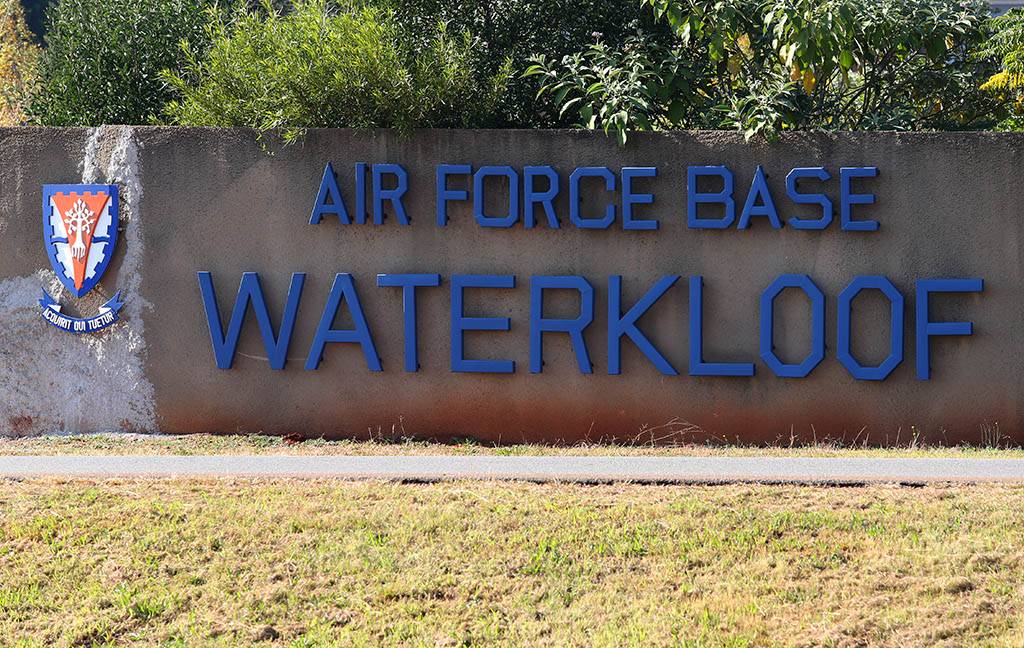
 Anyone flying into the Waterkloof Air Force Base near Pretoria without authorisation should expect to be intercepted and escorted out or, at worst, shot down.


