Drug overdoses now leading cause of death in US

American lawmakers are grappling with ways to respond to a worsening heroin epidemic. Drug overdoses are now the leading cause of death in the US, surpassing car accidents and gunshot wounds, according to the Centers for Disease Control and Prevention.

Lawmakers attending a House of Representatives judicial committee hearing on Tuesday learned that the number of people overdosing on opioids has quadrupled in the past decade, with many deaths occurring in the upper class, particularly among women and in suburban areas.

“There were over 43,000 deaths in 2013, or approximately 120 per day, over half of which involved either a prescription painkiller or heroin. These are our family members, friends, neighbors, and colleagues,” Jack Riley, acting deputy administrator of the Drug Enforcement Agency, told the committee.

Drug deaths now outnumber deaths from gunshot wounds (over 33,600) and motor vehicle crashes (over 32,700) in the United States, according to the CDC.

Riley said there are more than 600,000 heroin users in the US today, and agency officials say the figure is likely to be undercounted, as it is based on a household survey and wouldn’t account for all heroin users among homeless populations.

The sheer volume of heroin that is coming into the country and the number of people turning to it has been driving the levels of drug abuse up, according to analysts. Between 2008 and 2012, the DEA saw a 232 percent increase in drug busts along the Mexican border. Last year alone, agents seized 281 kilograms of heroin.

The biggest gateway to heroin is an addiction to prescription drugs. Increases in overdoses seen among women and the wealthy may be accounted for by previous addiction to prescribed pills, according to the CDC. When pills become too expensive or difficult to obtain, people may have turn to a cheaper alternative – heroin at $10 a bag.

What is also unique about the opioid epidemic is that it is no longer just a border or urban problem, but a suburban problem as well. Local law enforcement has largely been left to handle the epidemic on their own, but they are increasingly looking for answers from the federal level. The DEA and other experts see a connection between drug cartels and small street gangs in local towns like Chesapeake, Virginia.

‘Oz needs PM, not Shylock and drug dealer’s cousin’

Indonesians have mobilized in record numbers to collect cash for the Australian PM, who touched a raw nerve by bringing up Australia’s $1 bn in tsunami relief aid to Jakarta while making a clemency appeal for convicted drug traffickers.

Images of Australian Prime Minister Tonny Abbott with red tape crossed over his mouth can be seen all over Indonesia, particularly in Jakarata. Loads of silver coins are covering banners spread on the ground – all part of the “repay” protest campaign that has spread like a bushfire across the island nation.

As part of the international relief effort for the 2004 earthquake and tsunami off the west coast of Sumatra that killed more than 100,000 people, Australia was quick to offer $1 billion in aid relief.

Speaking this week, Abbott hinted that it is time for the Asian nation to repay its debt by freeing two members of the famous Bali Nine, currently on a death row. The Bali Nine was a name given to a group of nine Australians who were arrested in Bali in 2005 Bali for planning to smuggle 8.3 kg (18 lb) of heroin, valued at over $3 million, from Indonesia to Australia.

“Let’s not forget that a few years ago when Indonesia was struck by the Indian Ocean tsunami, Australia sent a billion dollars worth of assistance,” Abbot said. “I would say to the Indonesian people and the Indonesian government: we in Australia are always there to help you and we hope that you might reciprocate in this way at this time,” the PM stated, referring to death-row Australian nationals Andrew Chan and Myuran Sukumaran.

The plea sparked a fierce backlash, with Indonesians comparing Tony Abbott to Shakespeare’s Shylock, the moneylender in The Merchant of Venice who demanded a pound of flesh if his loans weren’t paid back.

Many ordinary Indonesians are enraged. During a protest on Sunday, thousands rallied to express their anger and continue to coin collection campaign.

The Pro-Indonesia Coalition, for example, organized a “Coin for Australia” movement during a car-free day at a roundabout near Hotel Indonesia.

“Let us not let our dignity being bought by Tony Abbot,” action coordinator Andi Sinulingga said at the event.

Rian, one of the event organizers, told the Sydney Morning Herald that it was a joy delivering the coins to the Australian embassy, saying that if every person donates one coin, which has a population of 250 million, Indonesia could pay back the “small amount of money donated by Australia.”

“So, don’t you ever mention something as tiny as $1 billion in relief for us,” Rian said. “We are a nation that refuses to be colonized, a nation that would like to tell other nations not to try to destroy this republic.”

“Australians need a prime minister, not a Shylock and drug dealer’s cousin,” read a banner during Sunday’s protest. A Twitter campaign using the hashtags #KoinuntukAustralia, #coinforAustralia and #coinforAbbott has also generated a lot of steam.

Indonesia plans to execute 11 convicts on death row, including the drug convicts from Australia, Andrew Chan and Myuran Sukumaran, whose clemency pleas had been rejected by President Joko Widodo. Earlier this week, however, the vice president’s office said that the execution of two Australian smugglers had been delayed by up to one month.

Indonesia executed six drug offenders in January, including five foreigners, prompting Brazil and the Netherlands to recall their ambassadors.

Heroin trafficking handed to Islamic State

According to the UN, world heroin production stands at 430-450 tons, of which only 340 tons actually reach the market, the rest being seized or destroyed.

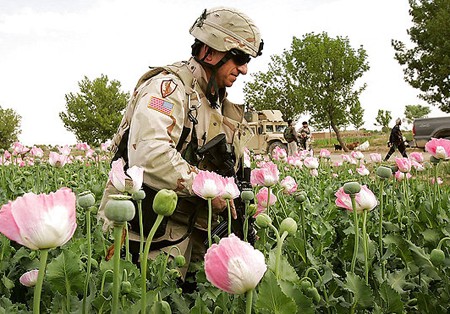
Top heroin producing countries are: Afghanistan (at least 380 tonnes), Myanmar and Laos (at least 50 tonnes).

According to John F. Sopko, the US government’s special inspector general for Afghanistan, the reconstruction efforts undertaken by Afghanistan have collapsed in the face of the continued expansion of drug cultivation drugs and criminal organizations. Afghan farmers reportedly earned some $ 3 billion in 2013.

Since 2010, the Russian authorities have consistently accused NATO of exporting Afghan heroin to Europe.

The switch from using drugs planes run by NATO to those controlled by the Islamic Emirate confirms the links between the two organizations. This came just after President Hamid Karzai left office, September 29, 2014.

The Islamic Emirate uses a cocktails of drugs to condition its fighters according to protocols that appear to have been prescribed by the CIA.

According to the Russian Federal Drug Control Service (FSKN), more than half of the heroin consumed in Europe currently comes from Afghanistan via the Islamic State.

Source: Reseau Voltaire

Six Tanzanians busted for heroin

Six Tanzanian nationals, five men and one woman, will be appearing in the Randburg Magistrates’ Court on 26 September in connection with a 19kg-heroin bust made by the Hawks special investigation unit in June.

The heroin was estimated to be worth R23-million and was allegedly produced in Canada before making its way to South Africa, where the suspects were arrested with the drugs in Vereeniging.

Heroin is one of the main ingredients in ‘nyaope’, a highly addictive and destructive concoction which also contains cannabis, crystal methamphetamine, and other psychoactive drugs.

Rat poison and swimming pool chlorine is sometimes added to the mix as well.

The drug is fast gaining popularity among black youths in South Africa and is a grave cause for concern to anti-drug lobbyists due its damaging nature.

Major drug lab uncovered in Kwazulu-Natal

drugsIn a national Crime Intelligence driven operation, the SAPS Counter Narcotics team has uncovered a major drug lab in Alexander Drive, in Gillits, KwaZulu-Natal on Saturday night at approximately 20:00.

The team followed up on intelligence of the manufacture of heroin straws which led them to an elite house in the Gillits area, just outside Pinetown.

The nineteen men arrested are all foreign nationals of ages between 18 and 37 years. They are likely to face charges of possession and dealing in drugs. The entire operation, we estimate, has a street value of over R41 million which consists of R21.4 million worth of heroin straws, R4.1 million of mandrax tablets, R15 million of heroin powder and equipment.

The detection of this lab has come just days after the same team uncovered a major drug distribution centre in Kempton Park which was worth R75 million.

According to Lieutenant General Solomon Makgale, “We have no doubt that an operation of this magnitude is the work of a syndicate and we believe that we are making great inroads in bringing these major drug syndicates to its knees.

“While we applaud our Crime Intelligence unit for a job well done, we certainly don’t lose sight of enormous role our communities are playing to complement our efforts to minimise the scourge of drugs and the ill effects it has on our societies.” – South African Police Service