No law or policy for ‘mastering the Internet’

Britain’s GCHQ is scanning servers in multiple foreign countries for vulnerable ports, according to German newspaper Heise. Using a tool called Hacienda, the intelligence agency seeks to ‘master the internet’ for sources of espionage.

Spanish for estate, Hacienda can port scan all of the servers in a country to provide information on user endpoints and scan for potential vulnerabilities. The ability to port scan is not new, but the scale of its use by government spies, with 27 countries scanned by 2009, has shocked many familiar with the software.

“In 2009, the British spy agency GCHQ made port scans a ‘standard tool’ to be applied against entire nations,” Heise reports. “Twenty-seven countries are listed as targets of the Hacienda [program].”

The process of scanning entire countries and looking for vulnerable network infrastructure to exploit is consistent with the meta-goal of “Mastering the Internet”, which is also the name of a GCHQ cable-tapping program. Targeted protocols include SSH, HTTP and FTP, among others.

Systems may be attacked simply because they might eventually create a path towards a valuable espionage target, even without indications this will ever be the case. Based on this logic, every device is a target.

The database resulting from the scans is shared with other spy agencies in the UK, US, Canada, Australia and New Zealand. MAILORDER is described in the documents as a secure transport protocol used between the ‘Five Eyes’ spy agencies to exchange collected data.

System and network administrators face the threat of industrial espionage, sabotage and human rights violations created by nation states indiscriminately attacking network infrastructure and breaking into services.

GCHQ says it will not comment on “intelligence matters” but reiterates that everything that it does is done within a strict legal framework. “It is a longstanding policy that we do not comment on intelligence matters,” a GCHQ spokesperson told The Inquirer.

“All of GCHQ’s work is carried out in accordance with a strict legal and policy framework, which ensures that our activities are authorized, necessary and proportionate, and that there is rigorous oversight, including from the Secretary of State, the Interception of Communications and Intelligence Services Commissioners and the Parliamentary Intelligence and Security Committee.

“All our operational processes rigorously support this position,” they added.

British intelligence is permitted to go further in surveillance than similar agencies in other Western countries, according to Edward Snowden. The former NSA contractor believes the powers of the British intelligence establishment are not restricted effectively enough by “law or policy”. The lack of legal restrictions allows UK intelligence services to target more people than is necessary.

Source: RT
80 percent of US packaged foods contain dangerous chemicals

Reuters
Reuters

Roughly 80 percent of all the packaged foods sold within the United States contain chemicals outlawed in other parts of the world, Britain’s Daily Mail reports.

Six common food additives found in an estimated 8-out-of-10 products sold in American stores are banned outside of the US, the Mail claims, putting millions of Americans at risk of consuming chemicals considered too dangerous for humans in other countries.

Grocery shop items including best-selling soft-drinks and cereal sold in the US contain additives such as brominated vegetable oil, olestra and others that have been banned in the European Union and elsewhere.

The Daily Mail cites ‘Rich Food, Poor Food,’ a recently published book by Jayson Calton and Mira Calton, as the source for their claim that the majority of American groceries contain the additives.

Among the common items containing the chemicals are Mountain Dew, Chex Mix and Hungry Man frozen dinners, which are made with additives outlawed overseas due to health risks. The Caltons say these products are filled with some of the six “Banned Bad Boys” that are used in America but absent in supermarkets overseas.

“One of the most common ‘Bad Boys’ is different variations of food coloring, which actually is made from petroleum and is found in everyday items like soda, sports drinks, mac and cheese, cake, candy and several other common, American products,” reports the Daily Mail. One of the chemicals in that food coloring, they add, has been proven to cause various different cancers. Those artificial dyes have been outlawed in Norway, Finland, Austria, France and the United Kingdom

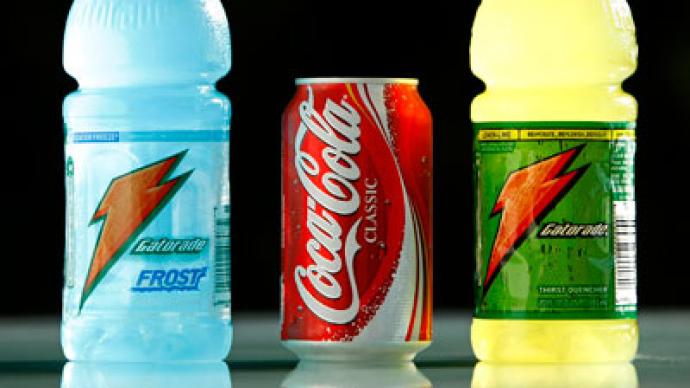
Another additive, brominated vegetable oil, has been banned in over 100 countries because it’s been linked to causing major organ damage, birth defects and hearing loss, among other side effects. Brominated vegetable oil, or BVO, is used in Mountain Dew, Gatorade, Powerade and Squirt — and around 10 percent of all drinks sold in the US.

A petition started earlier this year to get BVOs out of beverages sold in the US received over 206,000 signatures on the website Change.org.

“BVO is banned other places in the world, so these companies already have a replacement for it,” the petition’s author, Sarah Kavanagh, told The New York Times. “I don’t see why they don’t just make the switch.”

Another additive, potassium bromate, is used in American bakeries to speed up the process of preparing wraps, rolls and other bread products. It’s derived from the same chemical as BVO, though, and has been tied to causing kidney damage and cancer. That’s why it’s been outlawed in Europe, Canada and China, but not in the US.

Also on the Calton’s list is azodicarbonamide, a chemical the Daily Mail notes is used to make things like bleach and rubber yoga mats.

Azodicarbonamide is “approved to be a bleaching agent in cereal flour” and is “permitted for direct addition to food for human consumption,” according to the Food and Drug Administration. Along with waxy preservatives called butylated hydroxyanisole (BHA) and butylated hydroxytoluene (BHT) used in bubble gums, though, the additive has been banned in parts of Europe for potential health risks.

Rounding out the authors’ ‘Bad Boys’ list are Synthetic growth hormones rBGH and rBST and the chemical arsenic. They’ve both been banned in the EU for a variety of reasons, and perhaps for good reason: the arsenic put in American poultry can kill a human being if consumed in a high enough dosage.- RT

Snowden’s plane will pass through US airspace

moscowsnowdenEx-CIA contractor, Edward Snowden’s plane to Cuba will pass through US airspace, an Interfax source reports. Washington has an extradition notice against Snowden on charges of espionage and could intervene if the plane enters US jurisdiction.

Aeroflot flight SU150, leaves Moscow at 14:04 local time (11:04 GMT) and will fly through US airspace a couple of kilometers from the coast of New York on its way to Havana, reported Russian news agency Interfax, citing a source in Sheremetevo airport air traffic control. Snowden is checked into the flight to Havana in seat number 17A, reports the Associated Press, citing Aeroflot.

The source added that US air traffic control can legally ground the plane and take Snowden into custody on charges of espionage, theft and conversion of government property. However, the pilot may change the course of the flight so as not to pass through American airspace.

“The pilot of the plane is within his rights to change the course of the flight and there should be enough fuel to do so,” said the source to Interfax.

The Ecuadorian government has confirmed that Snowden filed for asylum and is processing the request.
WikiLeaks has actively assisted Snowden in eluding the US extradition order, has confirmed the fugitive’s final destination will be Ecuador.

Mr Snowden is “bound for the Republic of Ecuador via a safe route for the purposes of asylum, and is being escorted by diplomats and legal advisers from Wikileaks.”

The news that former CIA contractor Edward Snowden had left Hong Kong emerged on Sunday. The city’s authorities published a statement saying that Snowden had legally and voluntarily left Hong Kong on Sunday on a flight to a “third country” with a stopover in Moscow. The statement also said that the documents for Snowden’s extradition submitted to the Hong Kong authorities by Washington were not sufficient to be able to “process the request.”

The White House said it was “disappointed” with Hong Kong’s move to let Snowden go and has urged Russia to consider every option to expel the fugitive.

“The US is advising these governments that Snowden is wanted on felony charges, and as such should not be allowed to proceed in any further international travel, other than is necessary to return him to the United States,” a state department official said.

Washington has stressed they will seek cooperation from whichever country Snowden arrives in.

Snowden initially fled to Hong Kong after leaking troves of classified data to UK newspaper the Guardian, including information of the US spy program Prism.- RT