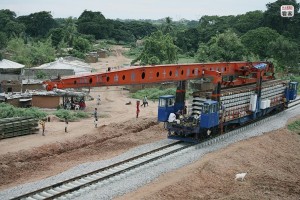
 The Chinese, investing heavily in Africa to secure its oil and other raw materials for their expanding economy, are spearheading a new era of railroad building to unlock the continent’s interior.
This is an echo of the long-gone colonial empires when a century ago British and French engineers first opened up Africa to plunder its riches.
The railroad frenzy is being accompanied by a massive push to build several major ports along the coast of East Africa to accelerate exports across the Indian Ocean, mostly to China, India and Japan, as well as lay down a network of oil and gas pipelines to these ports.
“Railways are key to increasing regional trade,” said Darlan Fabio de David, chief executive of Rift Valley Railways, a private equity-backed company rehabilitating the line between the Kenyan port of Mombasa and the inland Ugandan capital of Uganda that was built by the British between 1896 and 1901.
Kenya, which has found oil, is a key link in all this because it lies on the Indian Ocean. There are plans to build a huge deepwater port at Lamu which would act as a rail and pipeline hub for regional exports.
Further north, landlocked Ethiopia is another. It has no ports, but it has long been a pivotal economic player in the region, funneling goods from inland Africa to the continent’s ports through its rail lines.
Extending that network would stimulate economic activity further inland and export trade via the Red Sea port of Djibouti in the Horn of Africa.
In Tanzania, which with neighboring Mozambique is on the cusp of a major offshore gas boom, the main port of Dar es Salaam, the capital, could greatly enhance its importance as the main export center for copper and cobalt from Zambia and the Democratic Republic of Congo.
Congo’s mineral-rich, and war-ravaged, Katanga province produces 580,000 metric tons of copper a year and about 60,000 metric tons of cobalt. Zambia produces 6,750,000 tons of copper annually.
Between them they account for 7 percent of the world’s copper output and roughly half the planet’s cobalt.
New rail lines, replacing the costly road system currently in use, would cut transportation costs. Hauling these products to the east coast rather than southward via Durban in South Africa would allow the DRC and Zambia to export larger volumes of minerals.
The Chinese have been making massive investments in Africa over the last decade in return for access to the continent’s mineral riches.
The recent oil and gas discoveries in East Africa, ideally located for direct shipment eastward across the Indian Ocean, and the prospect of more to come have accelerated Chinese investment in streamlining transportation systems to the planned megaports.
On Nov. 28, the presidents of Kenya, Uganda, Rwanda and the fledgling state of South Sudan conducted the groundbreaking of Kenya’s $4 billion Mombasa-Nairobi line, financed by the Export-Import Bank of China, which will run parallel to the existing colonial-era line.
“The project will define my legacy as president of Kenya,” declared Uhuru Kenyatta.
The first section will link the Kenyan port of Mombasa to the capital, Nairobi, reducing the journey time from 15 hours to about four.
It is said to be the country’s biggest infrastructure project since independence 50 years ago.
The cost of the railway will be $5.2bn (£3.2bn) – mostly funded by China.
Some Kenyans have complained that the contract was given to the Chinese state-owned China Road and Bridge Corporation (CRBC) without going to tender.
Kenyan President Uhuru Kenyatta and his Chinese counterpart Xi Jinping agreed the deal in August in Beijing.
There are now almost 1 million Chinese living in Africa. A decade ago, there only a few thousand.
China’s new president, Xi Jinping, visited Tanzania and the DRC in the summer, his first major foreign tour, underlining Africa’s importance in China’s economic strategy.
China recently overtook the United States as the world’s largest importer of oil. Almost 80 percent of Chinese imports from Africa are mineral products.
China is the continent’s leading business partner, with trade — which tripled over the last decades — exceeding $166 billion. That’s expected to soar over the next 10 years when the new railroads, pipelines and ports kick in.
Direct investment — usually building airports, highways, schools, factories and railroads — is more difficult to quantify because much of Beijing’s funding goes through tax shelters. But China’s ambassador to South Africa recently said it “exceeds $40 billion.”
Another major project is rehabilitating the rail link between Addis Ababa, Ethiopia’s capital, and the port of Djibouti, a tiny former colony of France on the Red Sea, which links the Mediterranean with the Indian Ocean.
The 475-mile, $3 billion line is being built largely by Chinese companies, as is the Mombasa-Nairobi track. China will also provide most of the locomotives and rolling stock. – UPI/BBC


