Western Province triumph over Griquas

Western Province player

Western Province produced a fine display of running rugby in their six-try 45-21 win over Griquas in their Currie Cup match at Newlands on Saturday afternoon.

The crowd of just under 10 000 rejoiced as the match produced seven tries, five of which were scored in the first half.

Both sides made several handling errors, and Province probably left another four tries out on the field.

Given the favourable underfoot conditions at the kick-off there was every prospect of the teams running the ball at every opportunity and that was very much the order of the day in the first half.

Province needed only three minutes at the start to take play up to the Griquas 22-metre line and came good when they ran in a tap-penalty for fullback Joe Pietersen to score. Flyhalf Demetri Catrakilis goaled the conversion from the touchline to give Province a 7-0 lead.

It took Griquas some time to wrest the initiative and when they did they cracked the Province midfield defence nine minutes later for flanker Marnus Schoeman to run in unchallenged from 25 metres out. Flyhalf Francois Brummer converted to level the score at 7-all.

In the next 20 minutes, Province took the match by the scruff of the neck and ran three in three unanswered tries to record a rare first-half bonus point. The three-try burst followed concerted Province pressure, both on defence and attack.

Wing Gerhard van den Heever and centre Marcel Brache scored after interceptions, and flanker Deon Fourie dotted down after a rolling maul.

Catrakilis was in splendid form with the boot, goaling all three tries from the touchline to crown the 21-point burst.

In between Van den Heever and Brache’s try Pietersen scored a long-range penalty, to help Province secure a commanding 31-7 lead at the break.

Neither team managed to strike a measure of rhythm in early second-half play, especially as the defence was considerably tighter on both sides.

Griquas held a territorial advantage and managed several sorties into the Province 22-metre area where they managed one particularly good scrum in the 53rd minute which resulted in a penalty try. Brummer converted to reduce the deficit 31-14.

Province managed to put the setback behind them and despite several substitutions their game started to flow again and their efforts were rewarded when the hardworking hooker Scarra Ntubeni snatched up the ball from broken play, ran in from 25 metres out and dotted down in the corner. Again Catrakilis converted splendidly (38-14).

This advance seemed to knock the stuffing out of the Griquas’ challenge and they were never in the game again. Instead Province kept probing away with strong ball-in-hand runs and grubber kicks through the opposition defence.

Most of their raids into the Griquas 22-metre area looked promising but only one try emerged, thanks to fine finishing by eighthman Jebb Sinclair.

Catrakilis added the conversion to round off Province’s scoring in the match.

Wing Rocco Jansen scored a converted try in the final minute of the match.

Scorers: Western Province: Tries: Joe Pietersen, Gerhard van den Heever, Marcel Brache, Deon Fourie, Scarra Ntubeni and Jebb Sinclair. Conversions: Demetri Catrakilis (6). Penalty: Pietersen.

Griquas: Tries: Marnus Schoeman, penalty try, Rocco Jansen. Conversions: Francois Brummer (3). – Sapa
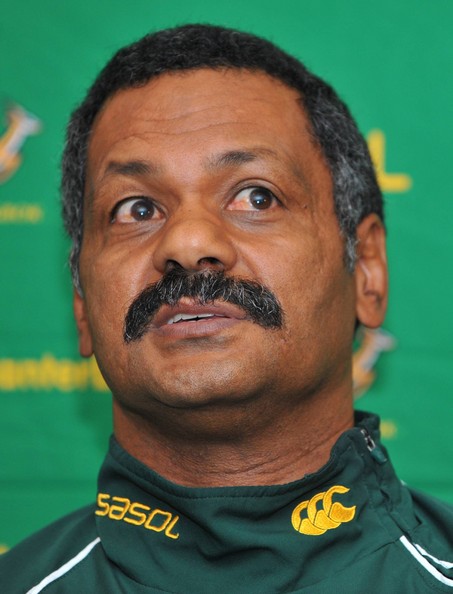
South African rugby ‘too white’, says former Springbok coach

Peter de Villiers

By making the Springbok team too white, black South Africans were being alienated from the sport and the team, which was divisive for the country, former Springbok coach Peter de Villiers said in an internet radio interview.

“We have to know what country we’re living in, and at the moment we’re turning a lot of black people against us by making the team white,” he told Ballz Radio earlier this week.

De Villiers did not want to comment on the Springbok team’s recent performance, as he said he had not watched the team lose their match against the All Blacks 21-11 in Dunedin, New Zealand last week, Beeld reported.

“People don’t want to talk [about race], but I have to… we’re breaking up the country, and damaging a sport that we all love,” De Villiers said.

He did not want to comment on current Springbok coach Heyneke Meyer’s selections for the team, but said that the best players should be sent onto the field.

“I don’t want to comment on his team selections, but I do know that you can’t keep doing the same thing and expect different results.” – Sapa

Australian parliament to apologise to ‘Black Power’ sprinter

Tommie Smith (centre) and John Carlos (right) showing the Black Power salute in the 1968 Summer Olympics while Silver medalist Peter Norman (left) wears an OPHR badge to show his support for the two Americans. Photo: Wikipedia

An Australian athlete who supported the famous Black Power salute of two black Americans at the 1968 Mexico Olympics was Monday to be the subject of a parliamentary motion that he be given an apology for how he was treated.

Peter Norman was the silver medallist in the 200m at Mexico City, and stood on the dais alongside United States athletes Tommie Smith and John Carlos, who both put a black-gloved fist in the air in a civil rights protest.

Norman, who died of a heart attack in 2006, backed their gesture and wore an Olympic Project for Human Rights badge in support.

Lawmaker Andrew Leigh said on his website that parliament would debate his motion to apologise posthumously to Norman “whose courageous stance for racial equality got him blocked from competing in subsequent Olympics”.

The motion apologises “for the wrong done by Australia in failing to send him to the 1972 Munich Olympics, despite repeatedly qualifying; and belatedly recognises the powerful role that Peter Norman played in furthering racial equality”.

Leigh, who has the support of Norman’s family, said while the selectors for the 1972 Games had passed away, he did not think Australia “did the right thing by him”.

“I don’t think we gave recognition to somebody who’d done so much to stand for racial equality,” he told the Australian Broadcasting Corporation.

Norman ran a time of 20.06 seconds in Mexico, and afterwards when the two American athletes said they were going to give the Black Power salute on the podium, said: “I’ll stand with you.”

The Australian Olympic Committee rejected the suggestion that Norman was “punished” for his role in the powerful gesture.

“He was not shunned by the AOC,” a spokesman said.

“As to his non-selection in the 1972 Olympics, it had nothing to do with the incident in Mexico City four years earlier.”

Australian Olympic historian Harry Gordon, who was present during the Mexico medals presentation, described Norman as “a sincere young man whose favourite tracksuit was adorned with the words ‘God is love'”.

He wrote that Norman was cautioned by Australia’s chef de mission at the time to be careful about his public statements but there was no punishment or reprimand. – AFP

Swimmers seek exposure besides the Olympics

Michael Phelps with his hoard of medals

Michael Phelps has always talked about changing the sport of swimming. He certainly made it more exciting by collecting more Olympic medals than any other athlete in history. But where does the sport go now that its most visible star is retiring?

Swimming doesn’t have an established worldwide circuit, so the biggest chance its athletes have to be in the spotlight is at the games. Some top competitors feel it’s time to capitalize on the window of opportunity Phelps’ success and the games created.

“It is hard for swimmers, just because it’s every four years and we only really get one time to shine,” Phelps’ American rival Ryan Lochte told The Associated Press. “(A full-time circuit) is what we need if we want to make the sport bigger than what it is or what it was.”

In between Olympics and the biannual world championships, swimmers compete in a hodgepodge of international events such as the Pan Pacific championships, Asian Games, Pan American Games, Asian championships, European championships and Commonwealth Games.

“The calendar is so full that it’s impossible for coaches to understand how to accommodate the preparation, priorities and obligations of the athletes,” Cornel Marculescu, the executive director of swimming governing body FINA, said Monday.

The closest thing swimming has to an international regular season is the World Cup series – eight meets over six weeks starting in October with stops in Dubai, Doha, Stockholm, Moscow, Berlin, Beijing, Tokyo and Singapore.

The circuit pales in comparison to winter sport World Cups like the one in Alpine skiing, or even the Diamond League in athletics. It’s held in short-course venues that are half the size of Olympic pools, often failing to draw the top athletes.

During last year’s series, Phelps competed in just two World Cups, while Lochte has never been to one. Americans usually prefer to compete in USA Swimming’s Grand Prix series, but even in those events they’re not necessarily racing to win.

At a Grand Prix meet in Charlotte, North Carolina, in May, backstroker Nick Thoman swam with a beard, Phelps had a scruffy face and an unshaven body, while Lochte competed in a skimpy brief. Not exactly what you saw in London, where sleek, shaven swimmers competed in the latest compression racing suits.

Why so much disregard for these meets? Because swimming is a training-based sport, and for many countries the Olympics are all that really matters.

“Swimming is not cycling or tennis where you go from one circuit to another. It takes a long time to prepare for a very short moment and that’s the nature of the sport,” Australia head coach Leigh Nugent said.

More high-level competition could change the way athletes approach training. Many Olympic swimmers train nonstop for two, three or four years leading up to a games, with daily workouts of up to 10 miles (15 kilometers). That may turn out to be rewarding for the very best, but most of the nearly 1,000 swimmers who compete at an Olympics go home without a medal.

There’s also a worry that more racing won’t produce the routine record-breaking swims that an event like the Olympics does, because it’s impossible to train to reach that level of performance all the time.

“I say you just appreciate great racing. It doesn’t necessarily have to be a world record,” said American breaststroker Eric Shanteau, a cancer survivor who won a gold medal with the U.S. 4×100-meter medley relay squad. “It’s more about following the story of any one of us. It’s pretty interesting to see how we train and how we race during those years, not just how we race at the Olympics.”

Sponsorship plays a role, too. Current prize money at World Cup meets is just $1,000 for race winners, $500 for second place and $250 for third. Overall points leaders for men and women over the course of the series win prizes of $100,000 each.

Cameron van der Burgh of South Africa, who set a world record to win the 100 breaststroke at these games, suggested allowing swimmers to wear personal sponsors – even non-swimming brands – on their caps. That’s not allowed right now, but such sponsorship is common in other sports, such as skiing, where athletes sport logos on their headgear.

“Most sponsors come and go, ‘We would love to sponsor you, but how are we going to get the (exposure)?'” he said. “You can’t say, ‘OK when I hit the wall and win and they take my photo I’ll put your logo on my cap.’ That’s what’s stopping people.”

Total prize money for the U.S.-based Grand Prix series this year was about $20,000, although USA Swimming plans to multiply that by five or six times for the next edition.

“There’s kind of this sweet spot between having enough money to attract good athletes and from our financial team perspective of not having so much money involved that the top athletes are chasing the money at the expense of their training,” USA Swimming executive director Chuck Wielgus said. “The ultimate goal is the performance at the Olympics and everything works backward from there.”

Coaches met with FINA on Sunday to discuss possible changes to the World Cup.

While the World Cup is now based exclusively in Europe, the Middle East and Asia, not too long ago there were also stops in New York and Sydney. One of the problems for swimming organizers is finding pools with enough seating to host big events. In the U.S., Olympic trials, which draw thousands of spectators, are held in a temporary pool.

“The World Cup circuit is not a bad thing,” Swimming Canada CEO and coach Pierre Lafontaine said. “We have to figure out a way to make it more exciting, maybe a regional approach to meets and the winners of the regional go up to super series and so forth.”

Still, USA Swimming is content with its Grand Prix series, and doesn’t show any interest in the World Cup.

How about a drastic move like linking World Cup results to Olympic or world championship qualifying? That would certainly spice up the series.

“We sure hope not,” Wielgus said. “Part of our swimming culture in the United States is that we want to have the opportunity to select our Olympic team based on trials, not over a series of meets. … We’ll fight very hard to protect our right to do that.” – AP