Kenyan Vice-President William Ruto left Nairobi to fly to The Hague Monday, a day before the start of his crimes against humanity trial at the International Criminal Court.
Ruto, 46, charged with masterminding deadly post-election violence five years ago, is the most senior politician to date to face ICC judges, and his trial will start just days after Kenyan MPs voted to abandon the court in a world first.
He waved to the small crowd at the airport as he left, but made no comment.
Ruto is accused by the ICC of masterminding some of the 2007-2008 post-election unrest that left at least 1,100 dead and more than 600,000 homeless.
Fellow accused Joshua arap Sang, a radio boss accused of inciting and helping coordinate attacks during the violence, is already in The Hague, after flying there over the weekend.
Both will plead not guilty.
On Sunday, Ruto prayed in church alongside President Uhuru Kenyatta, also accused of organising a campaign of murder, rape, persecution and deportation, whose ICC trial begins on November 12.
However, Kenyatta on Sunday said that he will not allow both leaders to be away from Kenya at the same time.
“We will work with ICC, and we have always promised to do this,” Kenyatta told a rally of supporters. “But it must understand that Kenya has a constitution, and Ruto and myself won’t be away at the same time.”
Kenyatta, who will also plead not guilty, said the “charges are false and will be dismissed”.
“The plotters of this scheme will be named and shamed. The victory won’t be Ruto’s, Sang’s or mine, but for Kenya,” he said to cheering crowds.
Kenya’s 2007 elections were marred by allegations of vote rigging, but what began as political riots quickly spiralled into a wave of ethnic killings and reprisal attacks, the worst violence in the country since independence in 1963.
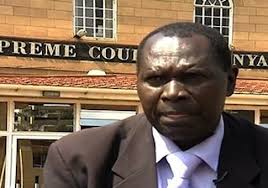
A Nairobi lawyer wants to sue Israel and Italy for killing Jesus Christ.
Dola Indidis is taking his case to the International Court of Justice.
Indidis is Catholic and says he knows Jesus had to die, as espoused in the Bible.
But he doesn’t believe it was necessary for Christ to die so brutally.
Two thousand years after the fact, he wants Israel and Italy to be held accountable for the actions of Roman governor Pontius Pilate and Herod the King of the Jews.
“My case is that Pontius Pilate, who tried Jesus Christ, had no jurisdiction. The judge himself says on the record, says he had no jurisdiction. Later he changed the story when he was under pressure.
“He convicted Jesus, who also did not have an equivocal plea of guilty, and he sentenced him a sentence which was also not lawful…”
Indidis says Pope Francis is aware of his case and that some in the Vatican support it.
Few of Indidis’s compatriots feel the same though — but he’s adamant the ancient wrong needs to be corrected.
He’s seeking a judgment from the International Court of Justice that the legal process wasn’t followed.
Scholars, campaigners and lawyers can for the first time readily access more than 2,200 documents from a largely unknown archive housed at the United Nations that documents thousands of cases against accused World War II criminals in Europe and Asia.
The unrestricted records of the United Nations War Crimes Commission were put online in early July by the International Criminal Court after an agreement with the U.N., a move spurred by British academic Dan Plesch, who has been leading the push for greater access to the archive. The documents relate to more than 10,000 cases.
Plesch said Friday that following his research at the archive in New York he was invited to give a guest lecture on the War Crimes Commission at the International Criminal Court in The Hague, Netherlands, in March 2012 by Hans Bevers, the head of the prosecutor’s research office. Bevers suggested the ICC might be interested in obtaining the archive and Plesch said he put him in touch with the U.N. office that manages the archives.
“It was a happy coincidence of him doing research here, him doing research there, and the ICC wanting to put as many archives as possible online,” U.N. chief archivist Bridget Sisk said Friday.
“Our goal is to make available as widely as possible open archives of the organization,” she said. “The collaboration with ICC adds to the world’s permanent war crimes tribunal the historical record in international criminal justice.”
U.N. spokesman Martin Nesirky said putting the unrestricted part of the archive online “will greatly enhance the availability of these materials to those engaged in research into the development of international criminal law, as well as to researchers from other academic disciplines.”
The War Crimes Commission was established in October 1943 by 17 allied nations to issue lists of alleged war criminals – ultimately involving approximately 37,000 individuals – and examine the charges against them and try to assure their arrest and trial.
The commission was shut down in 1948, three years after the now 193-member United Nations officially came into existence. In 1949, the U.N. Secretariat drew up rules making the archive available only to governments on a confidential basis. In 1987, limited access was granted only to researchers and historians.
Plesch and his colleagues continue to seek access for researchers to the still restricted sections of the files, which he said contain some 30,000 sets of pre-trial documents submitted to the commission by national and military tribunals to judge whether the case should be pursued.
“These files contain details of many charges of crimes that are not being prosecuted extensively today, including rape and forced prostitution, and crimes by ordinary soldiers,” Plesch said.
He said that following representations by his team to the U.S. State Department, the U.S. Holocaust Memorial Museum, which is a federal agency, is pursuing access to the commission’s entire archive – hundreds of thousands of pages in 400 boxes.
The International Criminal Court said more than 2,240 documents, totaling 22,184 pages, with search data for each document, have been added to the ICC Legal Tools Database.
The records include meeting minutes and other documents from the commission and its subordinate bodies as well as “a small but wide-ranging portion of the war crimes trial reports sent to the commission by national authorities” from Australia, Canada, China, Czechoslovakia, France, Greece, the Netherlands and Norway, the ICC said.
Research on the War Crimes Commission conducted by Plesch and colleague Shanti Sattler will be presented at a conference Sept. 10-11 at the University of London’s School of Oriental and African Studies where Plesch heads the Center for International Studies and Diplomacy. The conference is supported by the International Bar Association and will be chaired by South African Judge Richard Goldstone.
This website uses cookies to improve your experience. We'll assume you're ok with this, but you can opt-out if you wish. Cookie settingsACCEPT
Privacy & Cookies Policy
Privacy Overview
This website uses cookies to improve your experience while you navigate through the website. Out of these cookies, the cookies that are categorized as necessary are stored on your browser as they are essential for the working of basic functionalities of the website. We also use third-party cookies that help us analyze and understand how you use this website. These cookies will be stored in your browser only with your consent. You also have the option to opt-out of these cookies. But opting out of some of these cookies may have an effect on your browsing experience.
Necessary cookies are absolutely essential for the website to function properly. This category only includes cookies that ensures basic functionalities and security features of the website. These cookies do not store any personal information.
Any cookies that may not be particularly necessary for the website to function and is used specifically to collect user personal data via analytics, ads, other embedded contents are termed as non-necessary cookies. It is mandatory to procure user consent prior to running these cookies on your website.