Gaza: France experiencing ‘torrent of internet hate’

Given the many threats of violence and murder they have to deal with, moderators struggle to cope psychologically.

The deadly Israeli offensive in Gaza has unleashed a torrent of hate on media websites and social networks in France that moderators find increasingly difficult to contain.

The bombardment by land, sea and air that has killed at least 425 Palestinians has enflamed tensions far afield from the Middle East, especially in France with its large Muslim and Jewish communities.

Paris protests in support of Gaza residents have degenerated into violence on several occasions.

“As soon as you talk about Israel, it crystallises all passions, with up to 20 000 or 30 000 comments sometimes after an article, of which we will only let five to 10 percent through,” said David Corchia, head of Concileo, a firm of moderators that counts the dailies Le Figaro and Liberation as clients.

Helped by software that automatically reports suspect keywords, online moderators can filter comments in accordance with special legal requirements in France as well as client requests. Those laws ban racist, anti-Semitic or discriminatory messages among others, as well calls for violence.

The moderators have little time to decide whether to let a remark through, and generally block 25 to 40 percent of comments.

But on the subject of the Israeli-Palestinian conflict, the rejection rate can reach 95 percent.

“There are three times as many comments than normal, all linked to the Israeli-Palestinian conflict,” said Jeremie Mani, head of Netino, which looks after the websites of the Le Monde daily, Europe 1 radio and major French television channels.

Netino’s 250 moderators, most of them based in Madagascar, deal with tens of millions of comments every month.

“We see racist or anti-Semitic messages, very violent, that also take aim at politicians and the media, sometimes by giving journalists’ contact details,” Mani said.

“This sickening content is peculiar to this conflict. The war in Syria does not trigger these kinds of comments.

“On the pro-Palestinian side, identical messages are posted on dozens of sites. On the pro-Israeli side, there are fewer messages but they are better organised,” he said.

The vitriolic messages about the conflict come up not only after content about the conflict itself — but can be found under any subject.

“On an article about the Tour de France, after four comments it’s about Gaza,” said Mani.

“On one story about salmon fishing, I saw a comment saying: ‘Stop talking about this, the problem is there are too many Jews’.

“Without any moderation, these hate messages would invade everything, particularly as they quickly breed followers.”

Media sites are not the only platforms that fall victim to violent messages. Public spaces on social networks such as the Facebook pages of famous people are targeted, and those comments are first published before they can be removed.

And while the current Israeli-Palestinian conflict may generate a large amount of vitriol, other issues with a racial or ethnic element do too.

Corchia said that when a teacher was stabbed to death by a student’s mother in front of her young pupils earlier this month, racist messages began pouring in as soon as the foreign-sounding name of the assailant was revealed.

And when a former local election candidate for the Front National was given a nine-month jail sentence this week for comparing France’s black justice minister, Christiane Taubira, to a monkey, Corchia said that on one story, moderators were only able to publish 500 comments out of 10,000.

“We watch for word associations. For example, any allusion to World War II is eliminated,” he said.

Pierre Duhau-Laurent, marketing director for Atchik Services, which moderates the websites of the French presidency and the Le Parisien daily, said “organised propaganda” was currently sweeping social networks at night.

“Israeli Prime Minister Benjamin Netanyahu has bought sponsored tweets for his messages. And Hamas’s response is just as organised,” he said.

Given the many threats of violence and murder they have to deal with, moderators struggle to cope psychologically.

French municipal candidate gets prison sentence for ‘monkey’ racism

A former candidate in France’s recent municipal elections who likened the nation’s justice minister, who identifies as black, to a monkey was sentenced to nine months in jail for hate speech.

The National Front, a party that has often come under fire for its leaders’ comments about the nation’s immigrant populations, was fined almost $68,000 and the candidate, Anne-Sophie Leclere, was fined more than $40,000 on top of her prison sentence.

In October 2013, Leclere, the National Front’s candidate for the northern municipality of Rethel in March’s elections, posted a photo of Socialist Justice Minister Christiane Taubira — originally from French Guiana, a French overseas department in northern South America — next to a photo of a monkey. Laws in France bar communication intended to incite hatred, harm or discrimination against anyone because of ethnic, national or sexual identity or handicap.

“I prefer to see her swinging in a tree than to see her in government,” Leclere told TV channel France-2 in an interview, echoed across French media.

In a more recent, similarly explosive remark, the party’s founder, Jean-Marie Le Pen, father of the party’s current leader, Marine Le Pen, said in May the Ebola virus could solve the world’s “demographic explosion” and Europe’s “immigration problem.” Many of France’s immigrants are from its former colonies in Africa, the only continent where Ebola has been reported.

National Front spokeswoman Huguette Fatna, originally from Martinique and the party’s former political consultant on its few remaining colonial-era territories, called the ruling an attack on free expression.

“We have no freedom of speech here. We call ourselves democratic — we should have freedom of speech,” Fatna said.

She added that the National Front will appeal the ruling. The party ousted Leclere immediately after a scandal erupted over her comments, apologizing on her behalf, but Fatna said Leclere’s prison sentence was “excessive.”

The case has in recent months sparked debate over France’s laws against racist speech. Despite Leclere’s comments, in April the National Front received its largest share of municipal votes ever.

Gabe Rottman, legislative counsel at the American Civil Liberties Union, said that when racist views are silenced by law, they sometimes grow in strength.

“There is a concern that unless the speech is legitimately incitement [to violence], when the government shuts them down, it gives them more credence to what they are saying. And it forces that stuff underground, where it can turn violent,” Rottman said.

Houria Bouteldja, spokeswoman for the anti-racist political movement Les Indigenes de la Republique — The Indigenous of the Republic — and a leading voice on the rights of France’s people of color, also said the law does not work to effectively combat racism in a country where, for some, it has become a political platform.

“There are people that are against the expression of the extreme right,” Bouteldja said. “But we also have the racism of the left.”

Charlie Hebdo, a weekly leftist publication, has on numerous occasions printed cartoons that French Muslims like Bouteldja have decried as Islamophobic. No formal legal battle was launched against the publication, though, and the nation’s Foreign Affairs Minister Laurent Fabius, although he decried the publication as imprudent for stirring unrest in the Muslim world, qualified the cartoons as being protected by “freedom of speech.”

“I say, allow free speech or censor racism on both sides,” Bouteldja said.

Rottman said the United States does not have laws against racist speech precisely because they are often arbitrarily enforced.

“One of the reasons we don’t have inciting-hatred laws like we see in other countries is these laws leave it up to government as to what constitutes hate speech — they are subject to arbitrary use and potential misuse.”

Although Bouteldja’s organization applauds the ruling that punishes Leclere’s racist remarks, she emphasized that Taubira’s government has upheld laws barring women from wearing Muslim head coverings in schools and women from wearing facial veils in public venues.

“This xenophobia — it’s a production of the French state, not just the extreme right. This Islamophobia — the laws against Islamic dress, they are upheld by the government of Ms. Taubira.”

Bouteldja said that combating racism will take more than laws, that it will take a “mobilization of society against the racism of the state.”

“There needs to be a political consciousness of identifying the victims of racism and forbidding it. In the ’30s, it was the Jews. Now it’s the blacks, the Muslims and the Roma.” – Al Jazeera

Is France racist? Monkeys, bananas and a black minister

Christiane Taubira
Christiane Taubira

 “Is France Racist?” That was the recent headline in a leading French newspaper, after a far-right magazine compared the country’s black justice minister to a monkey. The incident has triggered self-reflection in France, where the far-right National Front party is ahead is some polls, and figures show a 23-percent rise in reported racist incidents last year.

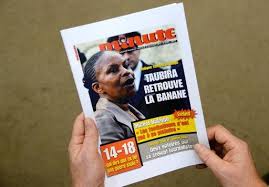
The front cover of the far-right magazine Minute earlier this month depicted Justice Minister Christiane Taubira with a caption that read: “Clever as a monkey, Taubira gets her banana back” – a play on the French slang for smile.

A Paris court has opened an inquiry into the publication.

Deputy Education Minister George Pau-Langevin described it as an attack on French values. She said she thinks all French people care about the republic because it was built on the rejection of discrimination and racism, and on the equality of all people. That’s why everything that goes against those fundamental principles of the republic harms the republic itself.

Christiane Taubira – who is from French Guiana, an overseas department of France – has been subjected to a series of racial slurs, including being compared to a chimpanzee by a candidate for the right-wing National Front. Taubira said she fears a threat to France’s social cohesion.

There has been a recent change of tone in public debate, said Rainbow Murray, an expert in right-wing French politics at Queen Mary University of London. “There’s always been an underlying racism in France shown by the difficulty in ethnic minority people finding employment. But there’s been perhaps more willingness to express that racism openly in recent months.”

Some observers trace France’s current racial tension back to 2005, when riots occurred in the suburbs of Paris and other cities. Former president Nicolas Sarkozy, then France’s interior minister, described the rioters as “racaille” or scum – crossing a rhetorical line in describing the primarily immigrant communities.

Murray said France has never properly integrated its large immigrant communities. “One thing that’s unique about France compared to the UK and the U.S. and similar examples, is that they’re not multiculturalist. They’re integrationalist. So they deny the existence of difference even when it’s really there. And because of that they don’t have explicit policies capable of coping with race. They don’t even acknowledge race in census data.”

Author and blogger Priscilla Lalisse-Jespersen, an American from Alabama who moved to Paris with her French husband, traces the rise in racism to France’s economic woes. She spoke to VOA via Skype. “Unemployment is rising. The president’s approval is dropping steadily; he’s right now the most unpopular president in French history. France is also afraid of globalization, and they also have a national identity crisis.”

President Francois Hollande has condemned the attacks on Taubira. Rights groups accuse him of a lukewarm reaction – and warn that taboos over public displays of racism are collapsing. – Voice of America

Senior journalist calls Libération shooting ‘good news’

Nicolas Demorand, Liberation Editor-in-Chief, looks rather relaxed
Nicolas Demorand, Liberation Editor-in-Chief

A gunman opened fire in the lobby of a French newspaper office in Paris on Monday, gravely wounding a photographer’s assistant before fleeing.

“Blood in the hall of this newspaper may be some good news,” Annette Lévy-Willard, a senior staff writer at Libération told the New York Times. “This outrage could break France’s racist and anti-Semitic fever.”

Police and representatives of the ultra-left Liberation say a 27-year-old photographer’s assistant is in serious condition after being shot in the chest and arm.

The culture minister of the increasingly unpopular leftwing Socialist government called the newspaper founded by Jean-Paul Sartre, a “pillar of our democracy.”

The paper supports François Hollande who has become the most unpopular French president on record. Only 26% of French people have a positive opinion of the Socialist president, a BVA poll showed. It was the worst score for a French leader since BVA began polling 32 years ago.

The poll shows Hollande’s near-unanimous unpopularity among right-wing voters: 97% have a bad opinion of the Socialist leader, a level never reached by any president among supporters of other parties, even Sarkozy who deeply antagonised many left-wing voters.

Some 84% French people believed government policy was not efficient and 74% felt it was not fair. Meanwhile, in the run up to crucial local and European elections next spring, the far-right Front National is rising in popularity and now has the same level of approval ratings as the Socialist party.

Libération has been struggling with financial difficulties and layoffs in recent years as many readers shun the paper as a result of it’s support for the unpopular French president.

Benny Lévy (aka Pierre Victor) was a philosopher, political activist and author as well as a political figure of May 1968 in France, and the personal secretary of Jean-Paul Sartre from 1974 to 1980. Along with him, he helped founding the French newspaper Libération in 1972.

Benny Lévy is known for his unusual itinerary from Maoism to Judaism, or “from Mao to Moses”.

Editorially, the paper is supportive of gay marriage, a recent controversy in France. Earlier this month, the newspaper ran a long interview with Christiane Taubira, France’s black minister of justice, who had promoted the government’s new law permitting same-sex marriage.

“It is a very serious attack on a media outlet, on Liberation,” minister Aurelie Filipetti said. President Hollande, on an official visit to Israel, sent a strong message home about the attack: “It’s always freedom of information that is threatened.”

Nicolas Demorand, Liberation Editor-in-Chief, also gay, expressed his concern over what he says is an increase in the number of attacks in Paris.

“There is a high level of violence that compromises the work of many newsrooms and can have tragic consequences as the ones that occurred this morning,” Demorand said.

“We need to launch an alert a collective alarm in the face of the new stage in the rise of violence in Paris,” Demorand urged.

Soon afterward, shots were fired at the headquarters of a major French bank west of Paris, and a gunman briefly took a man hostage nearby.

The Paris police headquarters said that it is not clear whether the three incidents are linked, but that authorities are increasing security in all three places as well as media offices around Paris.

As police hunt for the attacker or attackers, a helicopter was seen flying over the neighbourhood that includes the French president’s office and the nearby Champs-Elysees avenue.


The word ‘banana’ leads to racism investigation

Christiane Taubira
Christiane Taubira

The French government has opened a racism investigation after a far-right magazine used word “banana” in a picture of the country’s black justice minister on its cover.

In a statement Wednesday, Prime Minister Jean-Marc Ayrault said he had brought Minute magazine to the attention of the Paris prosecutor, citing French law that forbids racist abuse.

The magazine described Justice Minister Christiane Taubira as “crafty as a monkey” and referred obliquely to an incident when she was greeted by racist taunts from a young girl at a recent protest against gay marriage in the western city of Angers. She was also compared to a monkey on the Facebook page of a candidate for the right-wing National Front party.

Helene Valette, a spokeswoman for the magazine, said the cover was satire and accused the government of trying to distract the French from the country’s real problems.

“It’s a front page with a play on words. There’s nothing mean about it,” Valette said. – AP