British banks most exposed to Chinese market instability

Disclosures from two of Asia’s largest lenders showed that British banks are among of the most vulnerable to the current market troubles in China.

In its latest report, HSBC said outstanding loans to China grew 12 percent in the past year to $36.2 billion. Standard Chartered also revealed its overall exposure to Chinese customers rose by 30 percent during the same period.

The rapid growth of the Chinese economy has seen a rise in the numbers of British banks acting as foreign lenders, resulting in a record total of $221.2 billion outstanding loans to China, more than twice the total of US banks, with $86.5 billion outstanding loans.

UK banks were also the largest source of new loans to China during the year ending March 31, topping the list of 25 countries whose banks report their lending data.

The revelations come as the pound suffered its worst day of trading against the Euro in six years.

After months of strong trading against the Euro due to the Greek financial crisis, the pound fell by 2 percent, before regaining half a percent and finishing the day in a 1.5 percent drop.

Speaking during a visit to Finland on Tuesday, Chancellor George Osborne said Britain’s open economy made it vulnerable to economic tremors across the globe.

Source: RT

American financial markets bear no relationship to reality

By Paul Craig Roberts and Dave Kranzler

As we have demonstrated in previous articles, the bullion banks (primarily JP Morgan, HSBC, ScotiaMocatta, Barclays, UBS, and Deutsche Bank), most likely acting as agents for the Federal Reserve, have been systematically forcing down the price of gold since September 2011. Suppression of the gold price protects the US dollar against the extraordinary explosion in the growth of dollars and dollar-denominated debt.

It is possible to suppress the price of gold despite rising demand, because the price is not determined in the physical market in which gold is actually purchased and carried away. Instead, the price of gold is determined in a speculative futures market in which bets are placed on the direction of the gold price. Practically all of the bets made in the futures market are settled in cash, not in gold. Cash settlement of the contracts serves to remove price determination from the physical market.

Cash settlement makes it possible for enormous amounts of uncovered or “naked” futures contracts — paper gold — to be printed and dumped all at once for sale in the futures market at times when trading is thin. By increasing the supply of paper gold, the enormous sales drive down the futures price, and it is the futures price that determines the price at which physical quantities of bullion can be purchased.

The fact that the price of gold is determined in a paper market, in which there is no limit to the supply of paper contracts that can be created, produces the strange result that the demand for physical bullion is at an all time high, outstripping world production, but the price continues to fall! Asian demand is heavy, especially from China, and silver and gold eagles are flying off the shelves of the US Mint in record quantities. Bullion stocks are being depleted; yet the prices of gold and silver fall day after day.

The only way that this makes sense is that the price of bullion is not determined in a real market, but in a rigged paper market in which there is no limit to the ability to print paper gold.

The Chinese, Russians, and Indians are delighted that the corrupt American authorities make it possible for them to purchase ever larger quantities of gold at ever lower prices. The rigged market is perfectly acceptable to purchasers of bullion, just as it is to US authorities who are committed to protecting the dollar from a rising price of gold.

Nevertheless, an honest person would think that the incompatibility of high demand with constrained supply and falling price would arouse the interest of economists, the financial media, financial authorities, and congressional committees.

Where are the class action suits from gold mining companies against the Federal Reserve, its bullion bank agents, and all who are harming the interest of the mining companies by short-selling gold with uncovered contracts? Rigged markets–especially on the basis of inside information–are illegal and highly unethical. The naked short-selling is causing damage to mining interests. Once the price of gold is driven below $1200 per ounce, many mines become uneconomical. They shut down. Miners are unemployed. Shareholders lose money. How can such an obviously rigged and manipulated price be permitted to continue? The answer is that the US political and financial system is engulfed with corruption and criminality. The Federal Reserve’s policy of rigging bond and gold prices and providing liquidity for stock market speculation has damaged the US economy and tens of millions of US citizens in order to protect four mega-banks from their mistakes and crimes. This private use of public policy is unprecedented in history. Those responsible should be arrested and put on trial and they should simultaneously be sued for damages.

US authorities use the Plunge Protection Team, the Exchange Stabilization Fund, currency swaps, Federal Reserve policy, and purchases of S&P futures to support an artificial exchange value of the dollar and to provide the liquidity needed to support stock and bond prices, with the latter so artificially high that savers receive negative real interest rates on their saving.

The authorities have created a financial system totally out of sync with reality. When the authorities can no longer keep the house of cards standing, the collapse will be extreme.

It is a testament to the complicity of economists, the incompetence of financial media, and the corruption of public authorities and private institutions that this house of cards was constructed. The executives of the handful of mega-banks that caused the problem are the people who are running the US Treasury, the New York Fed, and the US financial regulatory agencies. They are using their control over public policy to protect themselves and their institutions from their own reckless behavior. The price for this protection is being paid by the economy and ordinary Americans – and that price is rising.

The latest orchestrated takedown of the gold price is related to two events (see the graphs below). One is that the Federal Reserve decided to boost the upward spike in the dollar’s exchange rate from the Fed’s announcement of the end of Quantitative Easing (QE). The Fed’s announcement of the end of dollar creation in order to support bond prices lessened the rising anxiety in the world about the US dollar’s value when the supply of new dollars continued to increase faster than the US output of goods and services. The Fed reinforced the boost that its announcement gave to the dollar by having its bullion bank agents drive down the gold price with naked short-selling.
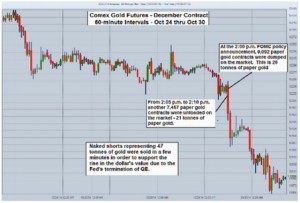
ss3Screen shot 2014-11-04 at 12.59.45 PM


Naked short selling was also used to offset the effect on the gold price by the Bank of Japan’s surprise announcement on October 31 of a massive new program of QE. Apparently, the Bank of Japan either has been pressured by Washington to inflate Japan’s currency in order to support the dollar’s value or is applying a policy based on the Keynesian Phillips Curve that 2-3% inflation stimulates economic growth. Japan has been in the economic doldrums for a long time and is now reduced to pre-Reagan “snake oil” prescriptions in a desperate attempt to revive its economy.

Japan’s announcement of infinite money creation should have caused the price of gold to rise. To prevent a rise, at 3:00 AM US Eastern Time, during one of the least active trading periods for gold futures, the electronic futures market (Globex) was hit with a sale of 25 tonnes of uncovered Comex paper gold contracts, which dropped the gold price $20 dollars. No legitimate seller would destroy his own capital by selling a position in this way.

The gold price stabilized and moved higher, but at 8 AM US Eastern Time, and 20 minutes prior to the opening of the New York futures market (Comex), another 38 tonnes of uncovered paper gold futures were sold. The only possible purpose of such a sale is to drive down the price of gold. Again, no legitimate investor would unload a huge amount of his holdings in this way, thereby wiping out his own wealth.
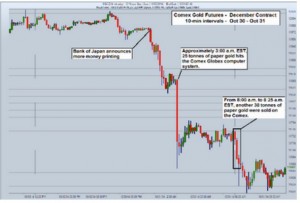
ss4Screen shot 2014-11-04 at 1.01.51 PM


Allegedly, the United States is the home of scientific economics with the predominance of winners of the Nobel Prize in economics. Despite these high qualifications, the price of gold, silver, equities, and bonds that are set in the US bear no relationship to economic reality, and American economists do not notice.

The divergence of markets from economic reality disturbs neither public policymakers nor economists, who promote the interests of the government and its allied interest groups. The result is an economy that is a house of cards.

For additional reading see: http://investmentresearchdynamics.com/the-system-is-terminally-broken/

Dr. Paul Craig Roberts was Assistant Secretary of the Treasury for Economic Policy and associate editor of the Wall Street Journal. He was columnist for Business Week, Scripps Howard News Service, and Creators Syndicate. He has had many university appointments. His internet columns have attracted a worldwide following. Roberts’ latest books are The Failure of Laissez Faire Capitalism and Economic Dissolution of the West and How America Was Lost.

A difficult question: The rigged gold market

In a radio interview recently Alasdair Macleod was asked a question to which he could not easily give a satisfactory reply: if the gold market is rigged, why does it matter?

I have no problem delivering a comprehensive answer based on a sound aprioristic analysis of how rigging markets distorts the basis of economic calculation and why a properly functioning gold market is central to all other financial prices. The difficulty is in answering the question in terms the listeners understand, bearing in mind I was told to assume they have very little comprehension of finance or economics.

I did not as they say, want to go there. But it behoves those of us who argue the economics of sound money to try to make the answer as intelligible as possible without sounding like a committed capitalist and a conspiracy theorist to boot, so here goes.

Manipulating the price of gold ultimately destabilises the financial system because it is the highest form of money. This is why nearly all central banks retain a holding. The fact we don’t use it as money in our daily business does not invalidate its status. Rather, gold is subject to Gresham’s Law, which famously states bad money drives out the good. We would rather pay for things in government-issue paper currency and hang on to gold for a rainy day.

As money, it is on the other side of all asset prices. In other words stocks, bonds and property prices can be expected to rise measured in gold when the gold price falls and vice-versa. This relationship is often muddled by other factors, the most obvious one being changing levels of confidence in paper currencies against which gold is normally priced. However, with bond yields today at record lows and equities at record highs this relationship is apparent today.

Another way to describe this relationship is in terms of risk. Banks which dominate asset markets become complacent about risk because they are greedy for profit. This leads to banks competing with one another until they end up ignoring risk entirely. It happened very obviously with the American banking crisis six years ago until house prices suddenly collapsed, threatening to take the whole financial system down. In common with all financial bubbles everyone ignored risk. History provides many other examples.

Therefore, gold is unlike other assets because a rising gold price reflects an increasing perception of general financial risk, ensuring downward pressure on other financial asset prices. So while the big banks are making easy money ignoring risks in equity and bond markets, they will not want their party spoiled by warning signs from a rising gold price.

This is a long way from proof that the gold market is manipulated. But the big banks, and we must include central banks which are obviously keen to maintain financial confidence, have the motive and the means. And if they have these they can be expected to take the opportunity.

So why does it matter if the gold price is rigged? A freely-determined gold price is central to ensuring that reality and not financial bubbles guides us in our financial and economic activities. Suppressing the gold price is rather like turning off a fire alarm because you can’t stand the noise.

Source: cobdencentre.org

Shares fall on European debt worries

(Reuters) – Asian shares fell on Thursday after a weak Spanish bond sale heightened concerns about funding difficulties for weaker euro zone countries, further undermining sentiment hurt by fading expectations of more stimulus from the U.S. Federal Reserve.

MSCI’s broadest index of Asia Pacific shares outside Japan .MIAPJ0000PUS fell for a second straight session, easing as much as 1.3 percent to a four-week low, while Japan’s Nikkei average .N225 fell 0.9 percent, also to a four-week low, after putting in its worst performance in five months a day earlier. .T

Shanghai shares .SSEC, which resumed trading after a three-day break, gained after a private sector survey of purchasing managers showed that China’s services sector expanded in March and business confidence hit an 11-month high, though overall activity remained below its long-term average.

The renewed risk aversion after a strong Asian equity performance in the first quarter comes as investors factor in less support for global economic growth, waning hopes of more monetary easing from the United States, and the potential fading of the effects of the European Central Bank’s huge liquidity injections.

“More policy support from the ECB in the near-term appears unlikely, following the hawkish slant in tone during its press conference,” said Barclays Capital analysts. “Widening peripheral European government bond spreads, higher Treasuries, higher implied vol, a lower EUR and a stronger USD are reminiscent of past episodes of elevated European concern.”

Risk currencies steadied, with the Australian dollar off a near three-month low of $1.0245 hit on Wednesday, and the euro holding above $1.3100 after falling nearly 1 percent the day before. Gold and oil also recovered on Thursday.

Spot gold inched up 0.3 percent to $1,624 an ounce. U.S. crude futures rose 0.8 percent to $102.23 a barrel while Brent crude added 0.5 percent at $122.90 a barrel.

On Wednesday, global stocks .MIWDPUS fell over 1 percent, gold tumbled to its lowest in nearly three months and oil shed more than 2 percent.

Asian credit markets weakened, with the spread on the iTraxx Asia ex-Japan investment-grade index widening by 5 basis points.

ASIA WARY OF INFLATION

Frances Cheung, senior strategist for Asia ex-Japan at Credit Agricole CIB in Hong Kong, said market liquidity was very thin and investors were digesting mixed signals about economic and monetary policy outlook.

“Triggered by inflation pressures, room for easing (by Asian central banks) is reduced now. Supply-side inflation is not good for the economy, so investors are more cautious,” she said, but added that the current market downturn was a correction from strong performance earlier in the year.

Inflation in most Southeast Asian countries has slowed, so policymakers are likely to continue supporting growth by keeping rates steady, but they remain wary of the recent rise in oil prices.

ECB CALM ON SPAIN

Borrowing costs for Spain, the euro zone’s fourth largest economy, jumped at bond auctions on Wednesday, with the 10-year bond yield leaping to 5.7 percent, its highest since January. It overshadowed a successful step back into debt markets by similarly highly indebted Portugal.

Ten-year Spanish yields had fallen as low as 4.6 percent in late January as cheap ECB cash fuelled a rally in weaker peripheral state debt.

But ECB President Mario Draghi appeared relaxed about the rise in Spanish yields, after the bank kept interest rates steady as expected at a policy meeting on Wednesday.

Draghi also dismissed a German-led push for the ECB to start planning a retreat from emergency crisis-fighting. But some financial market analysts detected a shift in the ECB’s monetary policy back to a more traditional one focusing on maintaining price stability, as Draghi stressed the bank was keeping a close eye on price pressures.

Some market players said such fears may be overdone, pointing to a key gauge of how investors perceive risk, the VIX index .VIX.

The VIX, which measures expected volatility in the Standard & Poor’s 500 index .SPX over the next 30 days, failed to keep its gains after rising above resistance at its 50-day moving average. The index hit a high of 17.74 on Wednesday, its highest in nearly a month, before retreating. A fall in the index reflects easing risk aversion.

Upbeat U.S. private-sector jobs data by payrolls processor ADP on Thursday suggested the labor market was continuing to strengthen ahead of key non-farm payrolls data due on Friday, which is expected to show the U.S. economy added 203,000 jobs last month, after February’s non-farm payrolls rose 227,000.