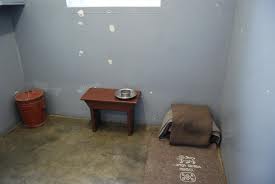
Nelson Mandela’s old prison cell on Robben island has undergone a strange transformation.
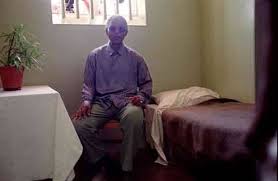
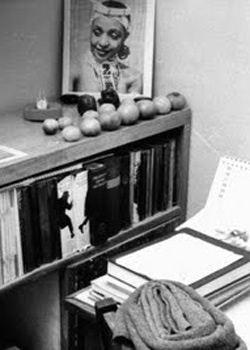
Photos from the Johannesburg archives show a cosy cell with furniture and books and above all, a bed and mattress.
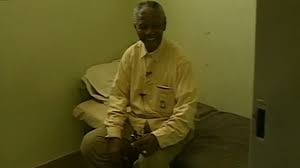
On many later visits by Mandela to his old cell in the company of foreign journalists and film crews, not much had changed. His books were no longer there, but the furniture looked the same.
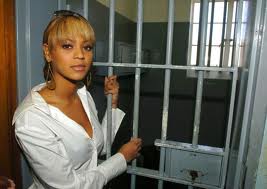
Even recent visits by the likes of Beyoncé showed the cell as it had been while the famous South African was imprisoned there for inciting violence and terrorism.
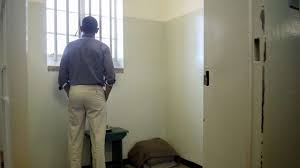
With president Barack Obama’s most recent visit however, the cell suddenly strangely took on the appearance of a bare, 19th century gaol, stripped of all furniture.
Mandela in his cell after his release
Mandela on a later visist to the same cellBeyonce at Mandela’s cell with the furniture visibleFrom the Joburg Artchives, his desk, books and shelf with a photo of his wife WinnieObama visiting the now bare cellThe new 19th century look bears no resemblance to the original cell
A man called Michael Blum turned up in our street, staying in the house opposite. He is a French-speaking Israeli who lives in Vienna. He said he was doing a “project” on the house and the area. He had a grant from somewhere and asked if he could come and talk to me. He was a short, energetic little mesomorph who arrived and immediately set up video equipment – something I was not expecting.
I remember thinking at what a disadvantage I was as I shrunk into the sofa like a small pile of sand and he asked me all the expected questions, slowly building to what he really wanted to ask. Would the people who live in the house have been able to live there during the years of apartheid? And what had I thought when they first moved in? I said, “noise”, which is always my horror. I explained that I had had meningitis and it had damaged cranial nerves that amplified sound in my head. Busy little Mr Blum video-ed away.
He then organised a sort of halfhearted party on a patch of lawn that abuts the street, which he importantly called “The Green Patch Party”. There were some breakdancers, some students, a few peripatetic vagrants whom we had never seen before – and of course Mr Blum batting about with a video camera. Mr Blum went away and our street returned to its normal old slightly low-rent atmosphere. However, searching through the Internet for something, I came across Michael Blum’s name again as being the author of something called “Very Real Time”, his project on 17 Aandbloem Street and there I was – as usual – the old colonial racially biased person.
He described the flaky party on the grass as becoming, “A milestone in Cape Town’s partying history”.
“It aimed,” wrote Blum, in his lefty join-the-numbers prose with its self-congratulatory subtext, at “squatting” the patch of grass in front of the house. Well thank you Mr Blum, we as residents in the area, have spent a long time trying to “unsquat” the grass in front of our houses.
He went on to say, “The appropriation of the small piece of land in front of the house can be seen as a natural extension of the private sphere”.
This sort of half-baked thinking, this lauding of the underdog, this scream of ecstasy over anything disadvantaged, ill, poor, mad or homeless and this thoughtless beating down of anyone who earns a living by actually going to work is big business in the art world of Europe. Grants can be got with a flick of the finger, if the projects come sashed with kneejerk words like Aids, apartheid, Robben Island.
Mr Blum is a true journeyman of this type of thinking; his other work is a “book specifically designed for waiting rooms”, which purports to be “following the visual paradigm of loss and exploring related issues through diverse imagery”.
In South Africa we have always been victims of a foreign eye, often attached to a camera, filtering across our lives with ease. Many of us have given up time to try to explain this country; few of us have been rewarded. And the harder we tried to explain, the more subtle the thought, the easier the whole thing was to misunderstand. When I said to Mr Blum that whenever I saw new neighbours I was worried about noise, he conveniently saw it as racial, because what would his principals think if he came back without some white bogeyman?
His report states, “Lin Sampson, despite her political opinions, sat with the Black Noise guys and talked with them”. Once in the thick of apartheid, a British TV station asked to interview me. They took me to someone else’s house and posed me beside a pool with a drink with a little umbrella in it. It appeared with a voice-over that went, “While Lin Sampson sits beside her pool sipping a drink, her maid lives less than 5km away in a cardboard box”.
I didn’t even have a maid. But the real irony of Mr Blum’s essay is that until he turned up we were all living together quite happily.
President Barack Obama was “deeply humbled” by a visit Sunday to the cell where a now critically ill Nelson Mandela spent years as a prisoner, as he urged a young generation of Africans to take up his hero’s mantle.
The US leader lauded Mandela and other inmates of Robben Island who “refused to yield” in the face of white minority rule, as he paid homage to the ailing icon he was unable to see in hospital.
Obama, accompanied by his wife Michelle and young daughters Sasha and Malia, visited the bleak lime quarry where 34 communist and radical leaders –including Mandela — endured hours of backbreaking work on the rocky outcrop in the Atlantic Ocean.
After staring out the barred window of the small damp cell where Mandela spent two thirds of his 27 years in prison, and contracted tuberculosis, Obama took a few minutes to write a note in the visitors book.
“On behalf of our family we’re deeply humbled to stand where men of such courage faced down injustice and refused to yield,” he wrote.
“The world is grateful for the heroes of Robben Island, who remind us that no shackles or cells can match the strength of the human spirit.”
Obama later made Mandela the keystone of an address urging students at the University of Cape Town and elsewhere across the vast continent to make a difference.
“I took my first step in politics because of South Africa,” he said, recalling his attachment to the anti-apartheid movement in the 1970s as a student in California.
Echoing Robert Kennedy’s call for non-violent change that was made in the same wood panelled hall half a century ago, Obama urged the students to help shape a continent that is moving forward apace.
He recounted Kennedy’s electrifying words that June day in 1966.
“Each time a man stands up for an ideal, or acts to improve the lot of others, or strikes out against injustice, he sends forth a tiny ripple of hope.”
“And crossing each other from a million different centres of energy and daring, those ripples build a current which can sweep down the mightiest walls of oppression and resistance.”
Obama said leaders like Mandela and Kennedy were a challenge to him “but more importantly they stand as a challenge to your generation.”
“They tell you that your voice matters, your ideas, your willingness to act on those ideas, your choices can make a difference.”
“If there is any country in the world that shows the power of human beings to affect change, this is the one.
“You have shown us how a prisoner can become a president.”
While Obama acknowledged that Africa is moving forward, he said more work needed to be done.
“There is no question that Africa is on the move, but it is not moving fast enough for the child still languishing in poverty… It’s not moving fast enough for the protester who is beaten in Harare, for the woman who is raped in eastern Congo,” he said to a warm reception from the packed auditorium.
Obama’s warm welcome however was not universal. Riot police fired rubber bullets and stun grenades at around 300 hundred anti-Obama protesters on Saturday in the township of Soweto, once a flashpoint in the anti-apartheid struggle.
His tour of Senegal, South Africa and Tanzania is aimed at changing perceptions that he has neglected Africa since his election in 2008, while also countering China’s growing economic influence in the resource-rich continent.
Mandela’s illness placed Obama in a tricky political spot, forcing him to balance his desire to push for a new economic relationship with Africa, with the need to properly honour his hero, who has been in intensive care for more than three weeks.
On Saturday, Obama and his wife Michelle called Mandela’s wife Graca Machel, and the president then privately visited several daughters and grandchildren of Mandela, to offer support and prayers.
But he decided against rolling up in his massive entourage at the Pretoria hospital where the 94-year-old Mandela lies, worried that he would disturb his peace.
“I expressed my hope that Madiba draws peace and comfort from the time that he is spending with loved ones,” Obama said in a statement using Mandela’s clan name.
Machel said she drew “strength from the support” of the Obama family.
Mandela, once branded a terrorist by the United States and Britain, was freed in 1990 and became president after the first fully democratic elections in 1994. – AFP
US officials have been working flat out for the past month to secure Robben Island for Barack and Michelle Obama on Sunday.
Fields were cleared for five helicopters to land, US security personnel installed new telephone lines and the museum’s VW sedan emblem was covered for the visit.
Robben Island Museum tourism manager Thulani Mabaso, a former political prisoner, said he didn’t know how many US security officials had been deployed.
On Thursday, he helped two men in civilian clothes with American accents board the ferry to the island.
Helicopters, believed to be part of a security detail that included three CH-46 Sea Knights and two SH-60 Seahawks, landed at the Union Buildings in an exercise in preparation for the official visit of Obama.
The two men didn’t talk to each other or other passengers on the way to the island. They were more concerned about a trolley loaded with five black plastic containers they brought with them.
Mabaso later mentioned to the Cape Times that the men were working for the US government. “The Americans are creating their own communication line between the island and Cape Town,” he said.
Obama’s administration has organised for five helicopters to land on the day, while two will circle the island. Obama will travel in a Volkswagen sedan vehicle, owned by the museum, but Mabaso said they were ordered to cover the car’s emblem. The other officials would travel in mini-buses that also belonged to the museum.
“When president (Bill) Clinton came here the Americans wanted to bring their own two buses, but when they airlifted it with a helicopter from Cape Town the one chain broke and the bus fell in the ocean.”
Mabaso said the SANDF had offered to bring a fire engine and medical equipment to the island. Only 27 of the 280 museum staff would be on the island when the Obamas visited. “We are here to support, but the US handles all the security,” said Mabaso.
The Washington Post reported the US is to use its own aircraft carrier, complete with medical trauma centre, stationed offshore on the Obama visit.
Military cargo planes will bring 56 support vehicles, including 14 limousines, to the country. cobus.coetzee@inl.co.za
The hopeful story President Barack Obama wants to tell about Africa is represented in the first stop of his weeklong trip to re-engage the continent, in a country where democracy recently overcame an impending electoral crisis.
During his visit to Senegal on Thursday, Obama also will reflect on the ties many African-Americans share with the continent as he takes a tour of Goree Island, Africa’s westernmost point. By some accounts, millions of Africans were shipped off into slavery across the Atlantic Ocean through the island’s “Door of No Return.”
It’s the first of two island visits Obama planned to highlight racial atrocities of the past. The second was scheduled for Sunday at South Africa’s Robben Island, where anti-apartheid leader Nelson Mandela was imprisoned for 18 years.
But Mandela’s condition could affect Obama’s plans. The former South African president is gravely ill, and Obama foreign policy adviser Ben Rhodes said it would be left to the Mandela family to decide whether he is up for a visit from Obama this weekend.
Mandela’s legacy hangs over the entire trip, with Senegal among many African countries that have benefited from his example of a peaceful transition to power. “So much of the democratic progress that we see across the continent I think can be tied in some way to the inspiration that Nelson Mandela set,” Rhodes said.
Obama’s focus in Senegal will be on the modern-day achievements of the former French colony after half a century of independence. He planned to meet with Senegalese President Macky Sall, who ousted an incumbent president who attempted to change the constitution to make it easier for him to be re-elected and pave the way for his son to succeed him. The power grab sparked protests, fueled by hip-hop music and social media, that led to Sall’s election.
But such people-powered democratic transitions are not always the story of the African experience. Fighting and human rights abuses limited Obama’s options for stops in his first major tour of sub-Saharan Africa since he took office more than four years ago. Obama is avoiding his father’s homeland, Kenya, whose president has been charged with war crimes, and Nigeria, the country with the continent’s most dominant economy. Nigeria is enveloped in an Islamist insurgency and military crackdown.
Obama’s itinerary in Senegal was designed to send a message, purposefully delivered in a French-speaking, Muslim-majority nation, to other Africans in countries that have not made the strides toward democracy that Senegal has. Obama plans to meet with civil society leaders at the Goree Institute and visit the Supreme Court to speak about the importance of an independent judiciary and the rule of law in Africa’s development.
“It’s not enough to have elections, it’s not enough to have democratically elected leaders,” Rhodes said. “You need to have independent judiciaries. You need to have confidence in the rule of law. You need to have efforts to combat corruption. Because, frankly, not only is that good for democracy and respect for human rights, but it’s critical to Africa’s economic growth, because where you have clear rules of the road and efforts to combat corruption, businesses will invest, and jobs will be created and growth will take off. And that’s what we want to see.” – AP
This website uses cookies to improve your experience. We'll assume you're ok with this, but you can opt-out if you wish. Cookie settingsACCEPT
Privacy & Cookies Policy
Privacy Overview
This website uses cookies to improve your experience while you navigate through the website. Out of these cookies, the cookies that are categorized as necessary are stored on your browser as they are essential for the working of basic functionalities of the website. We also use third-party cookies that help us analyze and understand how you use this website. These cookies will be stored in your browser only with your consent. You also have the option to opt-out of these cookies. But opting out of some of these cookies may have an effect on your browsing experience.
Necessary cookies are absolutely essential for the website to function properly. This category only includes cookies that ensures basic functionalities and security features of the website. These cookies do not store any personal information.
Any cookies that may not be particularly necessary for the website to function and is used specifically to collect user personal data via analytics, ads, other embedded contents are termed as non-necessary cookies. It is mandatory to procure user consent prior to running these cookies on your website.