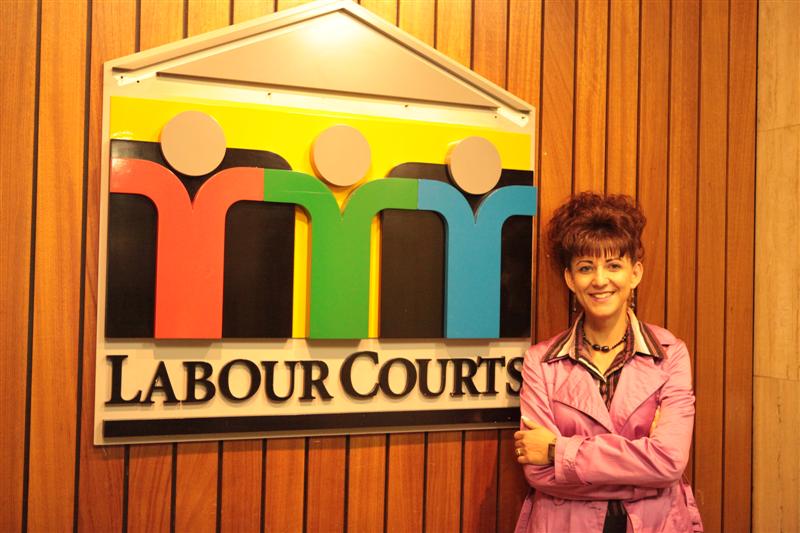
Appeal Court: Police ‘clearly discriminated against’ white police officer

Lt-Col Renate Barnard

The Supreme Court of Appeal (SCA) said on Thursday the SA Police Service had clearly discriminated against Lt-Col Renate Barnard on the basis of race.

The SCA has upheld an appeal against a decision of the Labour Appeal Court (LAC) that overturned a decision of the Labour Court, Sapa reported.

The Labour Court held that Barnard had been unfairly discriminated against when she was not appointed to a higher position.

She was not promoted to position of superintendent within a specialised unit of the SAPS, despite being the best candidate for the post. The court held that Barnard had clearly been discriminated against on the basis of race.

Barnard had twice applied unsuccessfully for promotion to the position.

The position was that of superintendent within the then National Evaluation Services (NES), dealing with complaints by the public and public officials on any matter regarding the police services.

Despite recommendations by an interviewing panel and her divisional commissioner, the national commissioner did not appoint her.

The reason given was that racial representivity at the level of superintendent would be negatively affected.

On Thursday, the SCA said it noted that the appeal turned on its own facts and that it would be presumptuous to assert and foolish to assume that the decision in this case would be an all-embracing guide to deciding future cases.

“If we are to build a cohesive society with cohesive components within the state structure, we have to be situation sensitive,” the SCA said.

The judgment further stated that to redress past imbalances with affirmative action measures, race had to be taken into account, but it should do so fairly and without losing focus that the ultimate objective was to ensure a fully inclusive society.

“One [society] compliant with all facets of our constitutional project,” it stated.

Appeal Court orders South Africa to investigate torture in Zimbabwe

tortureSouth Africa’s top appeals court on Wednesday ordered the police to investigate Zimbabwean officials who are accused of carrying out torture in the neighbouring country.

The case was brought before the Supreme Court of Appeal following allegations of torture of opposition party members in March 2007 in Zimbabwe.

The allegations include charges of water-boarding and electrical shocks being applied to the genitalia of activists opposed to long-serving President Robert Mugabe.

“This decision is really significant and is very much a precedent,” said Priti Patel, the deputy director of the Southern Africa Litigation Centre (SALC), which had filed the suit.

“The court’s decision makes it clear that South Africa has a legal obligation to investigate the perpetrators of international crimes wherever those crimes were committed,” she said.

According to SALC, the suspects visit South Africa, and therefore the government had an obligation to investigate the allegations.

The South African National Prosecuting Authority had claimed before the court that it was not required to investigate the alleged perpetrators because they were not presently in the country, but this was rejected by Judge Mohammed Navsa.

The NPA can still appeal the decision to the Constitutional Court, the country’s highest court.

Mugabe, who won elections this year to extend his 33 years at the helm of Zimbabwe, has denounced the attempts to investigate the 17 officials accused of torture as an assault on his country’s sovereignty.

An investigation could strain relations between the two countries. – dpa

Bursary for whites only legal, court finds

The Supreme Court of Appeal ruled it was within someone’s right give bursaries to only white students, according to a report on Saturday.

The ruling came after Daphne de Villiers from Stellenbosch in her last will and testament determined that the trustees of the Jean Pierre de Villiers Trust, which she created, must allocate R250,000 yearly to white students at four universities for certain degrees, Beeld reported.

These were the universities of Stellenbosch, Pretoria, the Free State and Cape Town.

Five appeal court judges found on Friday that it would not help to apply in court for the bursary to go to pupils of another race as it was not the person’s last wishes.

De Villiers was warned before her death that this might be problematic but she was insistent, according to the report.

[ad 1]

After her death all four universities refused to become involved with the bursaries due to the racial connotation.

The administrators approached the court to remove the word ‘white’ on grounds of discrimination.

It was ruled that if white student could not benefit from the bursaries that the money should go to a charity as De Villiers stipulated. – Sapa