Fracking hot: Tap water set on fire

flamingtapwaterA video made by a man from North Dakota shows him cautiously holding a lighter up against the stream of water coming out of his tap, prompting large flames to rise up into the faucet. North Dakota has been home to a fracking boom over the past few years.

“First time I did it, it was a huge fireball [that] took up the entire sink – so that’s why I’m a little jumpy doing it. I don’t want to blow up the bathroom here,” he laughed during the demonstration. A huge flame shot up as the running water appeared to catch alight.

“Really weird, right?” he questioned as he switched the camera off. The video has had over 400,000 views. It was only uploaded within the last three weeks, garnering attention on a global scale. The video prompted one commenter to note sarcastically that there was “nothing like a refreshing glass of fire.”

His stunt with the tap water seems reminiscent of notorious 2010 documentary film ‘Gasland’ when a Colorado resident conducts a similar feat.

The scene in particular has been thrown into question by investigative journalist, Phelim McAleer, who postulated that residents in the man’s neighborhood had been able to light tap water on fire since around the 1930s because of naturally occurring methane. The filmmaker later said that his findings were irrelevant.
However, Haughney’s video has sparked speculation that the North Dakota fracking boom and nearby oil drilling and hydraulic fracturing is responsible for the apparently flammable tap water.

A Louisiana family noted a similar incident at the beginning of December, and they blamed a gas company for nearby drilling. The fire “blew up and caught the fringe of the curtains,” according to the daughter Sarah Evans, who spoke to local station, KSLA12

The highly controversial process of injecting water, sand and various chemicals into layers of rock in hopes of releasing oil and gas deep underground has drawn harsh criticism from environmentalists.

While supporters say fracking brings jobs and opportunities for energy independence, detractors have pointed to exaggerated employment claims – not to mention the health risks related to chemicals used in the practice.

And experts say the flammable water could be caused by a high concentration of methane in the line, which occasionally occurs naturally.

In October, researchers found high levels of radioactivity, salts, and metals in water and sediment located downstream from a treatment facility which processes fracking wastewater from oil and gas production sites in Pennsylvania’s Marcellus shale formation.

At the end of November, northern Texas towns experienced some 16 earthquakes over a period of three weeks, while in December, opponents of the practice experienced a rare victory when the Pennsylvania Supreme Court that a 2012 law allowing gas companies to drill anywhere in the state unconstitutional.

North Dakota is the second largest oil-producing state in the US, reaping more than 911,000 barrels of shale gas on a daily basis. – RT

Water UK admits fracking compromises water supply

Two industry groups signed a Memorandum of Understanding stating that their members will minimize the impact of onshore oil and gas development in the UK on the country’s water resources.The memorandum accompanies a report released by Water UK. The report concludes that ”where water is in short supply there may not be enough available from public water supplies or the environment to meet the requirements for hydraulic fracturing.”While the aim of the mutual agreement was to give the public greater confidence and reassurance that everything will be done to minimize the effects on water resources and the environment during fracking, some organizations are speaking out against agreement.

“Water is a key concern for people in areas where drilling is proposed, particularly among farmers, who’re worried for their livestock,” said Greenpeace energy spokesperson Anna Jones. ”A voluntary agreement between Water UK and its major new client is unlikely to alleviate these concerns.

Under the memorandum, members of Water UK and UK Onshore Operators Group pledge to work together to identify and resolve risks around water or wastewater including:

Baseline monitoring requirements to assess impacts of onshore oil and gas development on the quality and quantity of local water resources.

Plans relating to site water management, especially water reuse, to improve understanding of local impacts.

Onshore oil and gas company development plans, including scenarios for expansion of exploration and development within a local area and what this means for short and long-term demand for water at specific locations.

The expected volumes and chemical and biological composition of waste water as well as preferred disposal routes.

“This agreement acknowledges that fracking will impact and affect the UK’s water resources and environment,” Jones said. But she also warns, “you will never regulate away the risks of fracking.”

frackingThe UK is not the only nation feeling a strain on water resources from the fracking boom. In the U.S. record temperatures this summer led to water shortages and drought in states like Texas and Colorado.

According to an AP analysis, the vast majority of counties in these states have fracking operations. In October, a report was released showing that the volumes of water used for fracking in the Marcellus Shale states of West Virginia and Pennsylvania are putting a major strain on freshwater reserves.

“The desperate search for shale gas and oil mustn’t be allowed to cause water shortages for critical public purposes,” said Tony Bosworth, a campaigner.

“Fracking is not the solution to our energy problems—it won’t lead to cheaper energy bills,” Bosworth said. “The government should pull the plug on its dash for dirty shale gas and develop Britain’s plentiful renewable power potential.” – wakingtimes.com

Government to take half of fracking projects

Susan Shabangu
Susan Shabangu

The government will take a 20% “free carry” in all new oil and gas projects, and reserve the right to buy another 30% at market-related rates, which will allow it to take its interest in projects to an effective 50%, it emerged on Thursday.

Mineral Resources Minister Susan Shabangu broke the news when she announced that the technical regulations for shale gas hydraulic fracturing (fracking) in the Karoo and other petroleum sector technical regulations had been approved by the Cabinet.

The regulations will be published in the Government Gazette next week.

However, it was not yet clear yesterday whether the free carry and the reserve will be included in these regulations.

The size of the free carry stake has surprised the industry.

Ms Shabangu told a post-Cabinet media briefing that Cabinet had approved the free carry and reserve last November, but did not explain why they had not been made public until now.

Free carry in the oil and gas sector takes place when a government is able to take a percentage of production without having contributed to the capital and exploration costs of the project.

Ms Shabangu said previously the mining sector had contributed little to the country’s direct economic development.

“The petroleum industry is completely new and the state will have to also be a free carrier … the reason for the technical regulations, particularly for the hydraulic fracturing, is how is it going to happen,” she said.

“The policy agreed to by the Cabinet of November says the state will have 20% free carry, but it also says if the state has another interest it can be up to 50%, but the 30% can be market related.”

During last month’s public hearings on amendments to the Mineral and Petroleum Amendment Act, oil and gas companies, especially ExxonMobile and Royal Dutch Shell, criticised the draft law for not having stated up front what the free carry obligations would be.

Several other oil and gas representative bodies complained that leaving the free carry and other state interests to regulations and not including them in the act made their planning and risk assessment very difficult.

They also pointed out during their oral presentations that the world norm was for governments to take a 10% free carry.

ExxonMobile’s SA GM Russ Berkoben told Parliament last month that South Africa’s potential offshore oil and gas reserves were possibly located in some of the most dangerous seas in the world, entailing significant exploration risks.

Therefore, he said, the fiscal and regulatory terms had to be as attractive as possible to encourage investment in the sector, otherwise companies would rather go to other countries with more accessible resources and simpler laws.

The regulations to be published next week will allow for a 30-day public consultation.

The immediate reaction from Royal Dutch Shell, Sasol and the South African Oil and Gas Alliance to Ms Shabangu’s announcements was that they welcomed the clarity emerging from them. However, they would have to study the regulations extremely carefully before making further comment.

Shell is exploring prospects off the west coast, while Exxon plans to search for crude and natural gas after acquiring rights to blocks near Durban.

Webber Wentzel partner Jonathan Veeran said that “10% ( free carry) was what one would have expected”. While the clarity on the percentages is helpful, it does mean that companies would have to test whether it would still be economically viable to continue with their projects, he said.

Mr Veeran said South Africa had a very underdeveloped upstream oil and gas sector and this meant it would still have to be seen whether even local companies could absorb this state interest.

Democratic Alliance MP James Lorimer said: “If the Cabinet was deliberately trying to sabotage the prospects of South Africa developing an offshore oil industry, they could hardly be going about it any differently to how they are behaving.”

He added that after listening to what the industry said in the public hearings on the new mineral and petroleum bill, the minister should have been moving towards realism rather than descending into “kleptocratic fantasy land”.

Treasure the Karoo Action Group and civil rights organisation Afriforum said yesterday that they did not believe this to be a proper consultation and were preparing to stop fracturing in the Karoo in the courts if necessary. Treasure the Karoo Action Group CEO Jonathan Deal said: “Government is effectively embarking on a business plan without proper consultation with the public.”

He said that should the government go ahead with its plans to frack in the Karoo, it would effectively lead to another e-tolling saga where a lot of money is invested with no real return and no popular support.

“The fact of the matter is that government has not heard the total story about fracking and is only listening to one side. It is not just about the ecology, but also that fracking is not a sustainable option,” he said.

Ms Shabangu said one of the report’s main recommendations was to ensure that the regulatory framework was robust enough to mitigate any negative effect should fracking be approved.

Mr Deal referred to comments by outgoing Royal Dutch Shell group CEO Peter Voser in the Financial Times this week that he regrets entering his company in the US fracking sector where it had to take a $2.1bn impairment. – Business Day

Oil, fracking chemicals spill into Colorado’s floodwaters

Fracking equipment damaged

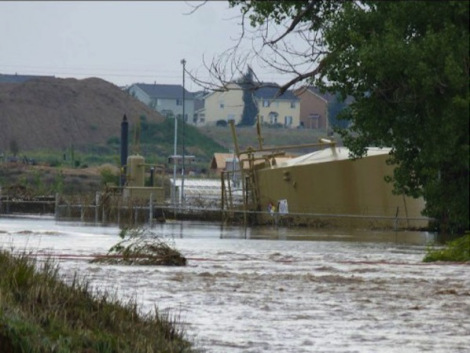
Heavy rains returned to Colorado in the US on Sunday and hampered rescue efforts after last week’s flash floods. The confirmed death toll has risen to seven, and hundreds are still unaccounted for. An estimated 1,500 homes are destroyed. Some 1,000 people in Larimer County, north of Boulder, were awaiting airlifts that never came on Sunday — they were called off because of the foul weather.

The floods have also triggered other problems that have gotten a lot less media attention: Fracking infrastructure has been inundated and its toxic contents have spilled out. Pipelines that transport fossil fuels are sagging and snapping under pressure. Tanks that store chemicals and polluted water are being overwhelmed and toppling over. Oil and gas wells are flooding.

The Boulder Daily Camera reports:

Lafayette-based anti-fracking activist Cliff Willmeng said he spent two days “zig-zagging” across Weld and Boulder counties documenting flooded drilling sites, mostly along the drainageway of the St. Vrain River. He observed “hundreds” of wells that were inundated. He also saw many condensate tanks that hold waste material from fracking at odd angles or even overturned.

“It’s clear that the density of the oil and gas activity there did not respect where the water would go,” Willmeng said. “What we immediately need to know is what is leaking and we need a full detailed report of what that is. This is washing across agricultural land and into the waterways. Now we have to discuss what type of exposure the human population is going to have to suffer through.” …

A spokesman for the Colorado Oil and Gas Conservation Commission said the agency is aware of the potential for contamination from flooded drilling sites, but there simply is no way to get to those sites while flooding is ongoing and while resources are concentrated on saving lives.

The Denver Post interviewed a farmer who ignored evacuation orders and watched as floodwaters overwhelmed a drilling operation on his land and released some oil. The newspaper also reported that at least one oil pipeline was confirmed to have been broken open by the floodwaters. From the article:

Oil drums, tanks and other industrial debris mixed into the swollen [South Platte River] flowing northeast. …

One pipeline has broken and is leaking, Weld County Emergency Manager Roy Rudisill. Other industry pipelines are sagging as saturated sediment erodes around the expanding river.

East Boulder County United, a group that fights fracking, has been posting photographs on its Facebook page of fracking tanks and other equipment toppled over or submerged by floodwaters. Blogger TXsharon has also been posting updates and photographs.

Meanwhile, experts are beginning to discuss the links between climate change and the floods. The flooding was worsened by drought and wildfires, both of which have been linked to global warming and which left the ground dry and hard. That reduced the amount of water that the soil could absorb from the unusual late-summer inundation.

“This was a totally new type of event: an early fall widespread event during one of the driest months of the year,” Brad Udall of the University of Colorado-Boulder told National Geographic News. “As the climate warms further, the hydrologic cycle is going to get more intense.”

Climate Central notes that it “will take climate scientists many months to complete studies into whether manmade global warming made the Boulder flood more likely.” But the wild weather hitting the state lately fits general climate change projections:

An increase in the frequency and intensity of extreme precipitation events is expected to take place even though annual precipitation amounts are projected to decrease in the Southwest. Colorado sits right along the dividing line between the areas where average annual precipitation is expected to increase, and the region that is expected to become drier as a result of climate change.

That may translate into more frequent, sharp swings between drought and flood, as has recently been the case. Last year, after all, was Colorado’s second-driest on record, with the warmest spring and warmest summer on record, leading to an intense drought that is only just easing.

Might the fracking industry have worsened Colorado’s floods by contributing to climate change, then spilled its toxic chemicals into those floodwaters? That would be a cruel double-punch. – grist.org

Children banned from discussing fracking in their lifetime


frackingwater
Frack gag: No discussion about water contamination

The 7- and 10-year-old children of a Pennsylvania couple that reached a settlement following a lawsuit involving health issues brought on by fracking have been barred from discussing details of the case for the rest of their lives.

Though a gag order is not unusual in itself when large corporations reach a settlement with plaintiffs in court, the August 2011 case of a family that went to court with Range Resources Corporation, Williams Gas/Laurel Mountain Midstream, and Markwest Energy due to the environmental and health impact caused by gas fracking operations has raised eyebrows for its inclusion of the couple’s young children.

The Pennsylvania family reached a $750,000 settlement with the gas companies, and have used the award to relocate. In exchange, however, Chris and Stephanie Hallowich agreed that no member of their family could comment on the case “in any fashion whatsoever.”

Details of the case only emerged recently when the Pittsburgh Post-Gazette managed to get court transcripts released. The paper’s reporters were originally barred from attending the settlement hearing, and had to wait until a three-judge panel of the Pennsylvania Superior Court ruled that a lower court had erred in blocking the unsealing of the records.

Court records, which should have included details of the settlement but did not, paint a confusing picture for Chris and Stephanie Hallowich as they tackled the significance of their gag order.

“We know we’re signing for silence forever, but how is this taking away our children’s rights being minors?” Stephanie Hallowich asked the judge.

“I mean, my daughter is turning 7 today, my son is 10.”

According to the transcripts, Judge Polonsky, who oversaw the case, was unable to clarify. The family’s attorney, Peter Villari, questioned whether the order would be enforceable.

“I, frankly, your Honor, as an attorney, to be honest with you, I don’t know if that’s possible that you can give up the First Amendment rights of a child,” stated Villari.

Along with the gas companies, the Hallowich family also sued the state’s Department of Environmental Protection. In its ruling to unseal court records, the superior court also noted that the August 2011 hearing during which the record was sealed was held three days prior to schedule, without an official notification of the change of date, reports the New York Times.

According to Bruce Baizel, Energy Program Director at Earthworks, which focuses on mineral and energy development, the motives behind restrictive gag orders post-settlements is to conceal any evidence of adverse environmental impact from hydraulic fracturing, or fracking.

“The refrain in the industry is, this is a safe process. There’s no record of contamination. That whole claim would be undermined if these things were public,” Baizel told ClimateProgress.

Moreover, attempts to measure the number of settlements with non-disclosure agreements have failed.

“They don’t have to be registered, they don’t have to be filed. It’s kind of a black hole,” says Baizel.

Prior to the settlement the Hallowichs said that nearby gas drilling had caused “burning eyes, sore throats, headaches and earaches, and contaminated their water supply.”

Once the settlement was reached and the gag order enacted, however, a spokesman for Range Resources stated that the family had “never produced evidence of any health impacts,” and that the Hallowichs primary motive for moving was instead due to “an unusual amount of activity around them.” – RT

Saudi prince warns against fracking

saudiprinceA Saudi prince has warned that his oil-reliant nation is under threat because of fracking technology being developed elsewhere around the world.

Billionaire Prince Alwaleed bin Talal said the Gulf Arab kingdom needed to reduce its reliance on crude oil and diversify its revenues.

His warning comes as rising shale energy supplies in the United States cut global demand for Saudi oil.

In an open letter to his country’s oil minister Ali al Naimi and other government heads, published on Sunday via his Twitter account, Prince Alwaleed said demand for oil from Organisation of the Petroleum Exporting Countries (Opec) member states was “in continuous decline”.

He said Saudi Arabia’s heavy dependence on oil was “a truth that has really become a source of worry for many”.

He added that the world’s biggest crude oil exporter should implement “swift measures” to diversify its economy.

Prince Alwaleed, owner of international investment firm Kingdom Holding, is unusually outspoken for a top Saudi businessman.

But his warning reflects growing concern in private among many Saudis about the long-term impact of shale technology.

It is allowing the US and Canada to tap unconventional oil deposits which they could not reach just a few years ago.

Chancellor George Osborne has also announced support for fracking in Britain and in offshore waters, to ease a reliance on foreign oil and gas.

Some analysts think this may push demand for Saudi oil, as well as global oil prices, down sharply over the next decade.

Over the past couple of years the Saudi government has taken some initial steps to develop the economy beyond oil.

It has sought to liberalise the aviation sector and provided finance to small, entrepreneurial firms in the services and technology sectors.

Mr Naimi said publicly in May that he was not concerned about rising US shale oil supplies.

Prince Alwaleed told Mr Naimi in his open letter, which was dated May 13 this year, that he disagreed with him.

The prince said: “Our country is facing a threat with the continuation of its near-complete reliance on oil, especially as 92% of the budget for this year depends on oil.

“It is necessary to diversify sources of revenue, establish a clear vision for that and start implementing it immediately.”

The prince said Saudi Arabia should move ahead with plans for nuclear and solar energy production to cut local consumption of oil.

The shale oil threat means Saudi Arabia will not be able to raise its production capacity to 15 million barrels of oil per day (mbpd), Prince Alwaleed argued.

Current capacity is about 12.5mbpd; a few years ago the country planned to increase capacity to 15mbpd, but then put the plan on hold after the global financial crisis.

While most Saudi officials have in public insisted they are not worried by the shale threat, Opec has recognised that it needs to address the issue.

In a report earlier this month, Opec forecast demand for its oil in 2014 would average 29.61mbpd, down 250,000bpd from 2013. It cited rising non-Opec supply, especially from the US.

The fracking warning comes as Saudi Arabia announced three foreign consortiums – led by US, Spanish and Italian firms – have won a $22.5bn contract to build Riyadh’s 110-mile, six-line metro train network. – Sky News

Fracking a disaster in drought-stricken regions

fracking2US states suffering a drought are facing a dire water crisis exacerbated by hydraulic fracturing. The procedure consumes vast amounts of water, which has driven up prices and depleted certain aquifers and rivers.

In drought-stricken regions, fracking is taking a serious toll on the water availability of local communities, in some cases turning water into a scarce and expensive resource. The procedure powerfully blasts water, fine sand and chemicals into the ground to shatter rock formations and release oil or gas.

Fracking is occurring in several counties in Arkansas, Colorado, New Mexico, Oklahoma, Texas, Utah and Wyoming, which are currently suffering a severe drought, the Associated Press reports. Although the procedure requires less water than farming or overall residential uses, it contributes to the depletion of an already-scare resource.

Some oil and gas companies manage to drain states of their water supply without spending any money, by depleting underground aquifers or rivers. But when unable to acquire the resource for free, the corporations can purchase large quantities at hefty prices.

“There is a new player for water, which is oil and gas,” Colorado farmer Kent Peppler told AP, noting that he is fallowing some of his corn fields because he can’t afford to irritate them. “And certainly they are in a position to pay a whole lot more than we are.”

Peppler, president of the Rocky Mountain Farmers Union, said that the price of water has skyrocketed since oil companies have moved in. The Meade, Colo. Farmer said he used to pay $9 to $100 per acre-foot of water at city-held auctions, but that energy companies are now buying the excess supplies for $1,200 to $2,900 per acre-foot.

Last year, the city of Aurora sold 2.4 billion gallons of sewer water to the oil company Anadarko for $9.5 billion, AP reports.

With oil and gas companies willing to spend large sums of money on excess sewer water, the cost of this valuable resource has risen across several drought-stricken states. Some local farmers, unable to afford crucial irrigation for their fields, say they are praying for rain.

“I was going to bed every night and praying to the good Lord that we would get just one rain on the crop,” West Texas cotton farmer Charlie Smith told AP, noting that he is selling some of his groundwater to drillers, since it is not enough to irrigate his crops. “I realized we’re not making any money farming, so why not sell the water to the oil companies? Every little bit helps.”

Environmental activists are calling for limitations on drilling in drought-stricken regions.

“We don’t want to look up 20 years from now and say, ‘Oops, we used up all our water,” said Jason Bane of the Western Resources Advocates.

Last summer’s record-breaking drought, which was the worst since the 1930’s Dust Bowl, resulted in a crop shortages that raised prices in US grocery stores. With a lack of water to irrigate crops across the US this year, Americans may once again find rising prices of both water and food.  – RT

A fracking health scare

US residents living near gas fracking sites frequently develop health problems as chemicals used in the gas extraction have been tracked in water and air surrounding the sites, a new report has found.

­The Marcellus Shale natural gas field, which stretches across several eastern states, is the biggest and cheapest natural gas field in the US and could contain “almost half of the current proven natural gas reserves in the US,” a Standard & Poor’s report said this week.

But the fracking report, titled “Gas Patch Roulette: How Shale Gas Development Risks Public Health in Pennsylvania,” details health impacts faced by residents near Marcellus Shale. The report, conducted by Earthworks’ Oil & Gas Accountability Project, shows that negative health impacts are not isolated incidents. Close to 70 percent of those living near a fracking site reported an increase in throat irritation and 80 percent suffered from sinus problems after drilling began.

Residents were found to have health complications resulting from Earthworks’ Oil & Gas Accountability Projec due to their proximity to fracking sites, shortly after gas development began. The closer a resident lived to a fracking site, the worse their health became. Half of all survey participants living near such a development site reported they had no problems before drilling began, but suffered from allergies, asthma, arthritis, cancer, high blood pressure, and heart, kidney, pulmonary and thyroid conditions.

Of survey participants, 81 percent also reported experiencing bad odors from the chemicals used in gas and oil development. Some of these chemicals include ammonia, chlorine, gas, propane, ozone, diesel, sulfur and kerosene.

“The clear association between gas development and public health impacts revealed by this research demands that states stop ignoring the problem and start developing the standards necessary to protect the public,” said President of Subra Company, Wilma Subra.

But people haven’t proven to be the only victims of fracking. The report described that 22 out of 108 interviewed residents had pets or livestock that showed health complications after gas development began, including hair loss and seizures.

The Earthworks’ Oil & Gas Accountability Projec has been struggling to properly oversee shale oil and gas development due to a lack of staff, resources, data and a high number of legal loopholes.

“For too long, the oil and gas industry and state regulators have dismissed community members’ health complaints as ‘false’ or ‘anecdotal,’” said project author Nadia Steinzor in a press release published by Earthworks. “With this research, they cannot credibly ignore communities any longer.”

Fear of fracking

Fuel is usually found in unattractive places. Geologists discovered the biggest oil and natural gas reserves in the deserts of the Middle East and beneath the permafrost of Siberia. Countries in temperate Central Europe, on the other hand, have only modest reserves. One of them lies some 5,000 meters (16,000 feet) beneath the surface in Rotenburg/Wümme, an administrative district in the northwestern German state of Lower Saxony.

Using a method known as “fracking,” Germany could exploit domestic sources to meet its natural gas needs for 20 years. But safety worries have prompted government authorities to refrain from granting the permits that companies need to use the controversial technique.

ExxonMobil, which operates a well called “Bötersen Z11” uses “induced hydraulic fracturing,” or “fracking” for short.

ExxonMobil plans to inject about 350,000 liters (92,500 gallons) of water, mixed with a cocktail of chemicals, into the well under high pressure. The liquid is supposed to penetrate into the rock at the bottom of the pipe and trigger a long-term loosening effect. Hair-line fractures will create a network of tiny channels from which natural gas can escape for at least 15 years, according to ExxonMobil estimates.

But what ExxonMobil still lacks is official permission to do this. The state mining agency has been sitting on the company’s application for the last year, hesitant to move forward with its approval.

“Unfortunately, fracking has become a scary word,” says Dieter Sieber, a mining engineer and fracking expert at ExxonMobil. A cart decorated with pamphlets from a local citizens’ initiative is parked at the entrance to the drilling site. The group aims to “protect God’s creation,” and one of its signs proclaims: “Stop Fracking!”

The public reservations and protests are coming at a surprisingly late point. As a method to increase the yields of hydrocarbon deposits, fracking has been in use for almost 50 years. In Germany, it has been instrumental in preventing domestic natural gas production from drying up altogether. Very few Germans are aware that, until the 1980s, almost a quarter of the natural gas being burned in Germany came from domestic sources. Although it’s still about 12 percent today, that number is declining by about 1 percent a year.

The deposits that have already been discovered are almost exhausted. About 300 wells have been fracked in Germany since the 1960s. Without imports, more than three-quarters of which come from Russia, Norway and the Netherlands, Germany would soon find itself without natural gas — if there weren’t another alternative, that is.

In May, Germany’s Federal Institute for Geosciences and Natural Resources (BGR) published a study concluding that there are up to 2.3 trillion cubic meters (81 trillion cubic feet) of technically recoverable natural gas under German soil, primarily in the northern state of Lower Saxony and the western state of North Rhine-Westphalia. This would amount to more than 20 times Germany’s annual consumption of natural gas.

The reserves are in deposits that are described as “unconventional,” consisting of shale and coal formations, which are the primary “source rocks” of hydrocarbons. They were long considered unexploitable because they are substantially denser than “conventional” deposits found in more porous sandstone. The coveted fuel simply doesn’t flow out of shale formations — which is where fracking comes in.

Fracking is now proving to be a key technology for extracting oil and gas from shale formations. In Germany, the natural gas reserves that could be exploited in this manner would have “the potential to make up for declines in production in recent years,” explains geophysicist Dieter Franke, a geophysicist who heads the BGR’s oil and gas geology department. In light of the sheer magnitude of proven reserves, this could be seen as a conservative estimate.

Since the mid-1990s, Americans have been far more aggressive and active when it comes to fracking. Geologists estimate that — after China and, presumably, Russia — the United States has the third-largest shale natural gas reserves on Earth, or about 20 times as much as Germany. The United States is exploiting these reserves on a large scale and even hopes to use fracking to end its dependence on gas imports.

Now the United States is also taking a similar approach with shale oil. Thanks to fracking, the Midwestern state of North Dakota already produces more than half a million barrels of oil from the Bakken shale formation. As a result, this year, the state surpassed Alaska in oil production for the first time. According to a forecast by the Organization of Petroleum Exporting Countries (OPEC), oil-tanker traffic to North America could very well be eliminated by 2035.

In contrast to the United States, which once met its own oil requirements and is now enthusiastic about returning to this status, government agencies in Europe are tentative. France, which is assumed to have the largest unconventional gas reserves in Western Europe, has yet to issue a single fracking permit. German authorities have only permitted isolated test fracking. The last fracking operation in German bedrock was conducted in late July 2011 — also by ExxonMobil — at the “Buchhorst T12” site, a conventional gas deposit in Bundsandstein, a type of colored sandstone that lies below large parts of Western and Central Europe.

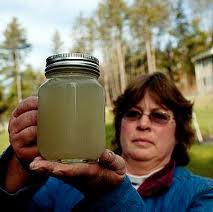
Horror stories from the United States, an El Dorado for companies engaged in fracking, have discredited the technology. A documentary film about the practice showed a fireball emerging from a faucet, a result of the presence of methane in drinking water. People are starting to realize that pumping 13 million liters of chemical-laced water into a hole can have unpleasant consequences.

Fracking will pollute water, causing cancer

Artist's impression of the fracking process

KwaZulu-Natal – SA’s top water research body has warned the government to think carefully about the serious risk of water pollution from cancer-causing chemicals and radioactive compounds from future underground “fracking” operations across huge swathes of the country.

A new report by the state-funded Water Research Commission says shale gas rock-fracturing (fracking) will not only happen in remote sections of the Karoo. In fact, the government had already issued fracking exploration permits in six of the nine provinces, including a massive chunk of southern KwaZulu-Natal stretching almost as far north as Pietermaritzburg.

The scientists note that future fracking, at depths 4km below the earth’s surface, could be over a much wider area of the country – including most of the high-lying areas south of latitude 29°C in KZN (a line which starts at Mtunzini in the east and stretches inland past Estcourt towards Bloemfontein and Kimberley).

The report also identifies a number of risks to human health, water and the natural environment from fracking wells. These risks included:

– Widespread pollution of groundwater, rivers and lakes with dozens of cancer-causing fracking compounds and other “highly toxic” pollutants such as benzene, hydrochloric acid and isopropanol.

– Accidental release of underground uranium and other radioactive elements into the water and soil.

– Underground mini-earthquakes, cave-ins and land subsidence.

– Privatisation of parks and other state land where the public is excluded from fracking land and gas fields for safety reasons.

– Above-ground air pollution from methane and other shale gas wells.

– Lower property values.

However, water pollution is the main emphasis of the 84-page Water Research Commission report by Gideon Steyl (University of the Free State chemistry department), Gerrit van Tonder (University of the Free State Institute for Groundwater Studies) and Luc Chevallier (Council for Geoscience).

The scientists note that gas-drilling companies in the US have been trying to hide the toxic nature of many fracking chemicals.

However, the commission cites a report from the US House of Representatives last year which identified at least 29 commonly used fracking chemicals that were known or probable cancer-causing agents, or were regulated as hazardous to drinking water and air.

These chemicals are mixed with water and pumped underground at very high pressure to fracture and crack the rock formations to release buried pockets of methane and other gas formed millions of years ago from rotting mounds of mud, vegetation, algae and other organic matter.

Some chemicals included benzene (a known cancer-causing chemical) along with a variety of acids and petroleum products.

A study by the University of Buffalo in the US last year also raised concern about the possible release of underground uranium and other radioactive compounds when rocks are cracked up with hydrochloric acid.

Another US study published last year showed that the methane gas level in underground drinking water was generally 17 times higher in fracking areas compared with well water where no fracking took place.

However, Steyl and his colleagues voiced dismay over the difficulty in tracking down truly unbiased international studies on the impacts of fracking, since most were done by industry and private interests.

Even official US government reports claiming no damage to public health or the environment stood in contradiction to numerous adverse reports by US citizens and the US Environmental Protection Agency.

The commission researchers note that a single fracking event in a single well used the same amount of water needed to irrigate eight to 10ha of maize during a growing season.

Every time a well was fracked, large volumes of chemicals were added to the water-pressure mixture. Although chemicals only made up between 0.5 and 2 percent of the mixture, the volume of hazardous chemicals in a single fracking event could total between 34 000 and 136 000 litres.

Even if just 1 percent of dangerous fracking chemicals leaked out of the concrete well drillings during a single fracking, Steyl estimated that 490 litres of hazardous chemicals could contaminate underground water. This could pose “serious hazards” to the environment and to underground water drunk by people and livestock.

Despite these concerns, the scientists appear to recognise that fracking is a fait accompli and they have listed a set of 10 recommendations to limit harm. They include compulsory “full disclosure” of every chemical used. Any fracking well should be at least 10km away from residential areas to reduce chemical exposure risks.

All drilling records should be freely available to the public, and a thorough baseline study should be done to measure pre-fracking quality of water, soil and air by an “unbiased” body such as a university.

Legal action should also be taken against any drilling company after a first offence. They should be forced to clean up damage, and be banned from future fracking in SA. However, even in the US, there were fewer than 10 inspectors to monitor more than 3 500 fracking wells in Pennsylvania. – The Mercury