Did Mandela’s friend supply chemical weapons to Syrian rebels?

Prince Bandar bin Sultan and Nelson Mandela

by Terry Crawford-Browne

REPORTS from Syria by Jordanian journalists allege that it was Prince Bandar bin Sultan of Saudi Arabia who distributed those chemical weapons to the Syrian rebels.( Here he is shown with that other unrepentant terrorist)

If true, it indicates the chemical attack in Damascus to have been a false-flag operation by the American war business.

This would be entirely in keeping with Prince Bandar’s history of organising the Afghan mujahideen in the 1980s, the Iran-Contra weapons exchanges, Libya in 2011, the suppression of the Shia uprising in Bahrain, Saudi support for the coup d’etat in Egypt and support for Syrian rebels.

Other reports confirm that Prince Bandar also went to see Russian President Vladimir Putin last month and offered to buy $15bn worth of Russian weapons provided Mr Putin abandoned Syrian President Bashar al-Assad. Mr Putin gave him short shrift.

Prince Bandar was not only the Saudi ambassador in Washington for 22 years and friends of Ronald Reagan and the Bush family, but he also negotiated the 1985 £43bn Al-Yamamah weapons deal with Margaret Thatcher, which Tony Blair renewed in 2007 with the Al-Salaam weapons deal.

When the British Serious Fraud Office investigated the bribes which BAE Systems paid him, Prince Bandar allegedly threatened blood in the streets of London.

Mr Blair squelched the investigation citing “national security.” The Guardian newspaper revealed a couple of months later how BAE with collusion of the British government had laundered bribes to Prince Bandar of over £1bn through Riggs Bank in Washington DC and other US banks.

Most importantly, Prince Bandar and Ms Thatcher negotiated the Al-Yamamah deal under the British Official Secrets Act, meaning that it cannot be investigated in Britain.

Saudi Arabia ships thousands of barrels per day of oil consigned to the Bank of England, which is then distributed to Shell and BP.

Over the years a surplus has developed, which is guesstimated to be worth over $150bn. Its purpose is a) to guarantee British and US support for the Saudi royal family against domestic insurrection and b) to fund covert destabilisation of resource-rich countries in Asia and Africa under the guise of the war on terror.

Having targeted Afghanistan, Iran, Iraq, Yemen, Somalia, Libya and other countries over the years, Syria and Egypt are Prince Bandar’s current targets. When will SA be targeted by the American and British “war business” given our country’s mineral wealth?

Saudi Arabia made lavish donations to the African National Congress. Prince Bandar was also the only foreigner present at Nelson Mandela’s secret wedding to Graca Machel, and was a frequent visitor to SA when the arms deal was being negotiated.

Saudi will bankroll Egypt after crackdown sees Western aid withdrawn

Minister al-Faisal
Saudi Foreign Minister al-Faisal

Saudi Foreign Minister Prince Saud al-Faisal on Monday pledged to fill any financial gaps left by Western countries withdrawing aid from Egypt over its crackdown on Muslim Brotherhood protesters that has left hundreds dead since last week.

“To those who had declared they are stopping aid to Egypt or are waving such a threat, the Arab and Muslim nations are wealthy with their people and resources and will not shy away from offering a helping hand to Egypt,” he told state news agency SPA.

Meanwhile, Egypt’s public prosecutor ordered on Monday the detention of deposed President Mohamed Morsi for 15 days pending an investigation into allegations he participated in “violent acts”, state news agency MENA said.

On Thursday, Egyptian judicial authorities extended Mursi’s detention period for 30 days in a separate case.

Morsi, who was overthrown by the army on July 3, is being held at an undisclosed location on allegations of murder and spying. The new case centres on protests that took place in front of the presidential palace last December, MENA said. – Reuters

Saudi prince warns against fracking

saudiprinceA Saudi prince has warned that his oil-reliant nation is under threat because of fracking technology being developed elsewhere around the world.

Billionaire Prince Alwaleed bin Talal said the Gulf Arab kingdom needed to reduce its reliance on crude oil and diversify its revenues.

His warning comes as rising shale energy supplies in the United States cut global demand for Saudi oil.

In an open letter to his country’s oil minister Ali al Naimi and other government heads, published on Sunday via his Twitter account, Prince Alwaleed said demand for oil from Organisation of the Petroleum Exporting Countries (Opec) member states was “in continuous decline”.

He said Saudi Arabia’s heavy dependence on oil was “a truth that has really become a source of worry for many”.

He added that the world’s biggest crude oil exporter should implement “swift measures” to diversify its economy.

Prince Alwaleed, owner of international investment firm Kingdom Holding, is unusually outspoken for a top Saudi businessman.

But his warning reflects growing concern in private among many Saudis about the long-term impact of shale technology.

It is allowing the US and Canada to tap unconventional oil deposits which they could not reach just a few years ago.

Chancellor George Osborne has also announced support for fracking in Britain and in offshore waters, to ease a reliance on foreign oil and gas.

Some analysts think this may push demand for Saudi oil, as well as global oil prices, down sharply over the next decade.

Over the past couple of years the Saudi government has taken some initial steps to develop the economy beyond oil.

It has sought to liberalise the aviation sector and provided finance to small, entrepreneurial firms in the services and technology sectors.

Mr Naimi said publicly in May that he was not concerned about rising US shale oil supplies.

Prince Alwaleed told Mr Naimi in his open letter, which was dated May 13 this year, that he disagreed with him.

The prince said: “Our country is facing a threat with the continuation of its near-complete reliance on oil, especially as 92% of the budget for this year depends on oil.

“It is necessary to diversify sources of revenue, establish a clear vision for that and start implementing it immediately.”

The prince said Saudi Arabia should move ahead with plans for nuclear and solar energy production to cut local consumption of oil.

The shale oil threat means Saudi Arabia will not be able to raise its production capacity to 15 million barrels of oil per day (mbpd), Prince Alwaleed argued.

Current capacity is about 12.5mbpd; a few years ago the country planned to increase capacity to 15mbpd, but then put the plan on hold after the global financial crisis.

While most Saudi officials have in public insisted they are not worried by the shale threat, Opec has recognised that it needs to address the issue.

In a report earlier this month, Opec forecast demand for its oil in 2014 would average 29.61mbpd, down 250,000bpd from 2013. It cited rising non-Opec supply, especially from the US.

The fracking warning comes as Saudi Arabia announced three foreign consortiums – led by US, Spanish and Italian firms – have won a $22.5bn contract to build Riyadh’s 110-mile, six-line metro train network. – Sky News

South Africa’s Denel sells lethal attack drones to Saudi Arabia

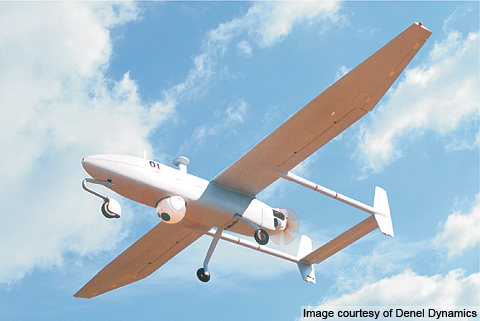
Denel's Seeker 400 drone

Saudi Arabia is buying an armed drone from South Africa after the Obama administration declined to sell the oil-rich kingdom U.S. Predator or Reaper missile-firing unmanned aircraft.

The state-owned South African company Denel Dynamics is working covertly with the Saudis to develop the Seeker 400 drone into an armed combat system for the Saudi military, the Paris-based newsletter Intelligence Online reported March 27.

The Seeker 400 is an advanced version of the company’s Seeker II unarmed surveillance aircraft.

The newsletter stated that the Saudi military would be the first customer to purchase the Seeker 400 armed drone and engineers from Denel are in the kingdom as part of the secret program.

If completed, the sale would allow Saudi Arabia to join the growing number of militaries that operate missile-firing drones—the most advanced weapon currently in use to launch precision strikes on terrorists.

Drone warfare has become the hallmark of the CIA, which is aggressively pursuing terrorists with drone missiles in Afghanistan, Pakistan’s frontier region, Yemen, the Horn of Africa, and elsewhere.

The new drone will be equipped with South Africa’s Mokopa air-to-ground missiles that are currently deployed on Algerian helicopters. The drone also can be outfitted with Impi laser-guided missiles with a range of 10 kilometers.

The drones are believed to be sought by the Saudis for use against the terrorist group al Qaeda in the Arabian Peninsula, which is currently operating in Yemen and has conducted international operations against the United States.

Riyadh has been trying to purchase missile-firing drones from the United States but so far the requests have been denied.

The United Arab Emirates is purchasing an unarmed export version of the Predator called the Predator XP, produced by General Atomics.

According to the newsletter, the Saudis have sought armed drones for several years and want the weapons to counter Iran’s unmanned combat vehicles known as the Karrar and the Shahed 129, which are fitted with Shahid-1 missiles.

“Because it could not procure drones from China, which is allied to Iran, nor from Israel, Riyadh turned to South Africa,” the newsletter stated.

However, Saudi Arabia lacks the infrastructure needed to operate drones. The systems require satellite communications that permit remote video and communications that allow drones to be piloted.

The Seeker 400 can fly for 16 hours and has a range of 250 kilometers with a 100-kilogram payload.

Saudi Arabia’s Prince Sultan Advanced Technologies Research Institute (PSATRI), a joint project of the Saudi air force and the King Fahd University, is also developing surveillance drones for use along the southern Saudi border, the newsletter stated.

Spokesmen for Denel and the Saudi Embassy could not be reached for comment.

News reports in February revealed that Saudi Arabia is hosting a U.S. attack drone base in the southern part of the country that was revealed in satellite imagery.

These satellite images show a remote airstrip deep in the desert of Saudi Arabia. It may or may not be the secret U.S. drone base revealed by reporters earlier this week.

However, the base’s hangars bear a remarkable resemblance to similar structures found on other American drone outposts. And its remote location—dozens of miles from the nearest highway, and farther still to the nearest town—suggests that this may be more than the average civilian airstrip.

The base had been kept secret for two years until disclosed in reports by the Washington Post and New York Times in February.

The base was used for the drone strike in September 2011 that killed American-born al Qaeda leader Anwar al-Awlaki. – Bill Gertz, freebeacon.com