Turkey: Police deploys tear gas on thousands

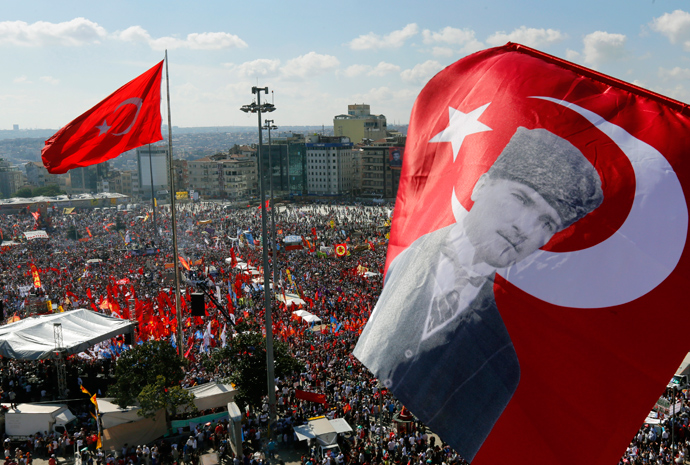
Turkish flag depicting Mustafa Kemal Ataturk as thousands gather in Istanbul's Taksim square June 9, 2013

Police again deployed tear gas and water cannons to quell more than thousands protesters that gathered in downtown Ankara. Just a few kilometers away, the Turkish PM was addressing his supporters after warning his patience with the demos “has a limit”.

At least two people were injured in fresh clashes in downtown Kizilay square in the Turkish capital, AFP reported.

Turkish Prime Minister Tayyip Erdogan, was meanwhile addressing supporters elsewhere in the city, calling on them to prepare for pro-government rallies next weekend in Istanbul and Ankara.

“On Saturday, are you ready for a big Ankara meeting? … The next day we will have the Istanbul meeting,” Erdogan said to cheering crowds in Ankara, as riot police moved in against protesters.

On Sunday, Erdogan held a string of pro-government rallies across the country.

Erdogan remained defiant over the ongoing protests, again calling the protesters “marauders” and urging the supporters of his Justice and Development Party (AKP) to “teach them a lesson” at the next local polls as he spoke in the southern Turkish city of Adana.

“Those now at Taksim, those who burn and destroy, those at various places across the country, I ask them, in the name of which freedom are you doing this?” Erdogan said in a speech at the Mediterranean Games in Mersin.

“There is an end to our patience,” Erdogan warned in Ankara airport, as the massive crowd of his supporters chanted slogans like “We are ready die for you, Tayyip!”

The Taksim protesters do not represent all the people of Turkey, the prime minister argued.

“Are the people only those at Gezi Park? Aren’t those who came to meet us at Istanbul airport people too? Those who are gathered now in Ankara; aren’t they people, too?” he exclaimed.

On Saturday night, a rally in the Turkish capital which started peacefully was also dispersed with tear gas and water cannons. According to witness reports on Twitter police were targeting and detaining “random” youths in the crowd. At least three arrests were reportedly made.

Authorities deployed over 4,000 riot police to quell the unrest, witnesses claim.

In Istanbul, a massive crowd packed the whole of Taksim Square was joined by the fans from rival football teams Fenerbahce, Besiktas and Galatasaray, AFP reports. Police kept away from the scene. In the city’s western Gazi neighborhood things did not go so peacefully as protesters hurled incendiary devices and taunted police, which resulted in fresh clashes.

Earlier, parliamentary Speaker Cemil Cicek said the mass protests that have been gripping the country are now “under control” and the process “is becoming normalized and increasingly in line with common sense.”

“We are ready to listen to all reasonable, legal and democratic demands,” he added.

At the same time, Istanbul’s mayor declared that Gezi Park would not be used as a venue to build a shopping mall, but the project to create a replica of Ottoman-era military barracks there would continue.

“We are definitely not thinking of building a shopping mall there, no hotel or residence either. It can be… a city museum or an exhibition center,” Istanbul mayor Kadir Topbas said as quoted by AFP. “The plan for the barracks was part of our election promises, the people gave us the authority to do it.”

The Turkish government dismissed press rumors of an early election on Saturday following the party meeting on the grounds it was unnecessary. Prime Minister Erdogan, who has been criticized by protesters for his overly authoritarian ruling style, returned to Turkey on Thursday night to a throng of supporters at Istanbul airport. A number of counter-demonstrations are said to be planned next week, as anti-government protests enter their 10th day.

Social upheaval began in Turkey last week when a demonstration against the demolition of a central park in Istanbul was brutally dispersed by police. In response, protesters occupied Istanbul’s Taksim Square and clashed with police repeatedly during the subsequent days. Many are calling for Prime Minister Erdogan’s resignation.

ANC Women’s League to approach Equality Court over ‘Angie’s panties’

The protest image in question

The ANC Women’s League intends approaching the Equality Court after protesting teachers displayed a pair of panties they said belonged to Basic Education Minister Angie Motshekga.

“The [African National Congress’s Women’s League] noted with dismay disturbing media reports about some Sadtu members publicly displaying a piece of underwear attributed to Basic Education Minister Angie Motshekga during last week’s protest march,” Limpopo ANCWL secretary Maleke Mokganyetsi said in a statement.

“They must face the full wrath of our criminal justice system.”

Describing the SA Democratic Teachers’ Union as “counter-revolutionary”, Mokganyetsi said protesters who displayed the panties in Pretoria on Wednesday had to be condemned.

“We refer to the short-sightedness and stupidity of a female-dominated union that humiliates and suppresses other women.”

The Sadtu protest was a call for the resignation of Motshekga and her director general Bobby Soobrayan.

A photograph of the large panties shows them being stretched across a piece of wire. The slogan “Puluma ya Angie” is written in black pen across its front.

“We are very much disappointed in those who are suppose to teach our children about sexual violence and gender discrimination, but opt to promote it in our streets,” said Mokganyetsi.

Sadtu spokesman Mugwena Maluleke said earlier this week the union was non-sexist and promoted equality.

“We therefore cannot condone such an act,” Maluleke said. – SAPA

Farmlabour threaten more militant protests

Smoke rises from burning farms in the Ceres valley

Farmworkers on Sunday threatened to go back to the streets if their demand of a R150 minimum wage was not heeded.

The Coalition of Farm Worker Representatives said that the strike by farmworkers had been suspended until government made a determination on the minimum wage.

“We have given the government until 4 December to institute the minimum wage of R150 per day and to concede to our other demands that farmworker are in the process of gathering.

“If they do not do so, 4 December will see the intensification of protest actions, both in scope and in militancy,” said the organisation’s spokesperson Billy Xabela.

He said the organisation rejected views that the strike in the Western Cape farms was the outcome of interventions by outside forces.

“We recognise that some workers have decided to return to work for now and some to continue striking.

“Our immediate task is to support farmworkers whether they are back at work or still striking.” Xabela said government both at national and provincial level had “consistently” listened to the farmers rather than the farmworkers.

“To date it is only the minister of agriculture that has shown an interest in the protests of the farmworkers.”

Police

He condemned the behaviour of the police during the strike and said they conducted themselves as “thugs”.

The organisation also demanded the release of farmworkers who had been arrested for intimidation and public violence during the strike. Over the weekend, police continued to monitor areas of the Western Cape which had been affected by the protests of striking farmworkers.

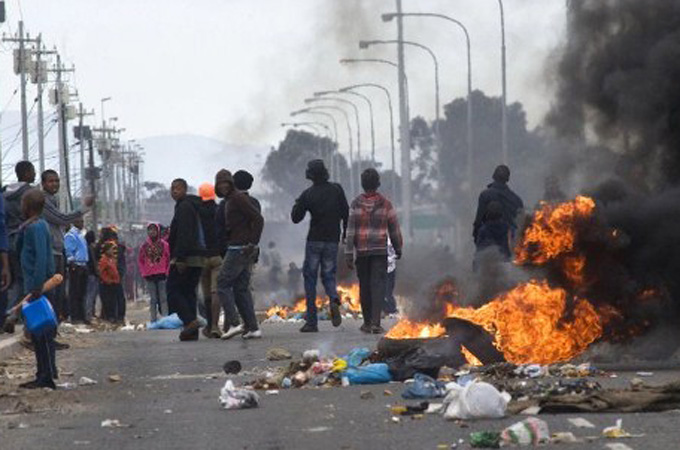
On Friday, protesters looted shops and torched businesses in the Hex River Valley and roads in the province, including the N2, were blockaded with rocks and burning tyres.

Protests over wages in the province spread across the Boland, with table grape harvesters demanding to be paid R150 a day. Most earned between R69 and R75 a day.

The labour department met with various farmers’ unions on Friday and negotiations are set to start on Thursday.

The Commission for Conciliation, Mediation, and Arbitration would mediate the talks.

The department called for interested parties to comment on a possible review of the sectoral determination for farmworkers, which prescribes minimum wages and conditions of employment.

About 300 farmworkers who went on strike in Wolseley in the Western Cape returned to work on Friday, according to the SA National Civic Organisation.

Provincial general secretary Vusi Myeki said the workers agreed to suspend the strike for at least two weeks pending a decision on the farmworkers’ minimum wage. – Sapa

March turns violent as thousands protest service delivery

Over 7 000 protesters, carrying sticks and knobkerries, arrived at the Benoni Customer Care Centre, at the corner of Elston Avenue and Tom Jones Street, in separate groups on October 17, to hand over a memorandum.

The town was brought to a standstill for two hours, from 8am, and almost all the shops were closed for safety reasons.

The protesters, some as young as 10, vandalised a number of shops, stoned passing motorists, stole goods belonging to hawkers and upturned rubbish bins.

The door of the Department of Education was also broken in the process. No one has been arrested, despite all of this.

The situation calmed as both the SAPS and Metro Police started to arrive in numbers. A police helicopter was also hovering in the sky, to try to keep order.

The protesters were residents of the Actonville hostel and the informal settlements in Actonville and Wattville.

Residents said they wanted houses.

“We have been living in shacks for many years and we are tired of this,” said a woman who wanted to remain anonymous.

An Actonville Hostel resident said they have sewage running all over the hostel and that they were promised proper housing, but that nothing has naterialised.

After handing over their memorandum, the protesters tried to break down the Customer Care Centre fence, in order gain access to the premises, but police used stun grenades to disperse the crowed.

The protesters were then escorted out of town by a police officers. Benoni resident Stephen Frances (19) was beaten with sticks and robbed of his money and cellphone by unruly protesters.

He was walking along Elston Avenue when a mob of protesters pounced on him for no particular reason.

“I did nothing to these people, but they decided to beat me up and take my money and cellphone,” said Frances, who emerged from the crowd running for his life.

He showed the City Times the marks sticks left on his body. –  The Citizen

Pretoria stays! Pretoria bly!

Scene of a previous protest organised by the Pretoria stays! group

I hereby support the efforts that PRAAG have made since 2003 to save the name of Pretoria. I am also prepared to add my name to a class action human rights application without any financial obligation to the relevant authorities or courts to enforce the international legal principle that the culture and place names of minority groups may not be changed by the state and that the South African state shall protect the existence and the national or ethnic, cultural, religious and linguistic identity of minorities within its territory.

Hiermee steun ek die pogings van PRAAG sedert 2003 om die naam van Pretoria te red. Ek is ook bereid om my naam te voeg by ‘n klasaksie- menseregte-aansoek sonder enige finansiële verpligting teenoor die toepaslike owerheid of howe om die volkeregtelike beginsel te laat geld dat die kultuur en plekname van minderheidsgroepe nie deur die staat verander mag word nie en dat die Suid-Afrikaanse staat die bestaan en die nasionale, etniese, kulturele, godsdienstige en taalkundige identiteit van minderhede binne sy gebied moet beskerm.

[emailpetition id=”3″]
[signaturelist id=”3″]

Violent protests rise dramatically

Rising expectations

Protest activity rose dramatically in the first eight months of this year, according to a report by the Multi-Level Government Initiative.

About 80% of the protests were violent.

The Multi-Level Government Initiative, which tracked protests between February 2007 and August 2012, released its protests barometer in Cape Town yesterday.

The research corroborates the findings of local governments and data collated by intelligence service Municipal IQ.

It shows that there has been an unprecedented increase in the number of protests and in the use of violence by protesters.

Western Cape felt most of the protesters’ wrath.

“Protest” is defined by the researchers as “any complaint or issue cited by protesters in reports, whether related to the delivery of municipal services or not, over which citizens decide to, and actually engage in, [sic] organised public protest activity”.

Findings included that:

  • Protest activity rose dramatically in the first eight months of 2012, with 226 protests;
  • If current trends continue, this year will have more than twice as many protests as last, and more than in 2010 and 2011 together;
  • Western Cape surpassed Gauteng as the province with the highest number of violent protests this year;
  • Before 2012, Western Cape recorded its highest protest activity during an election year;
  • Western Cape, Eastern Cape and Gauteng accounted for 56.98% of protests; and
  • Occupation and housing were the most cited issues, 303 in the six-year period. Poor service delivery was second, with 218 protests. Grievances related to broken promises and government officials ignoring protesters’ complaints have risen exponentially since 2010 but account for less than 10% of complaints.

This year , Western Cape shot past Gauteng as the province with the biggest number of violent protests.

The head of the research project, Professor Jaap de Visser, said the researchers had begun collecting information on a very complicated issue.

“Let us build up our knowledge about protests over a period of time.

“The government should put serious effort into analysing protest activity and use the information to improve its performance and engagement,” he said.

Pro-South African and ‘Occupy’ protestors clash in Californian capital

SACRAMENTO, Calif. (AP) — At least two law enforcement officers were injured Monday during a clash with members of the Occupy movement who were at the state Capitol to counter a rally by a group protesting violence by blacks against whites in South Africa.

The clash erupted in the afternoon as California Highway Patrol and Sacramento police officers were escorting about 35 members of the South Africa Project to a parking garage after their protest outside the Capitol building.

About 50 members of Occupy Oakland began throwing cans and bottles at the South Africa group and at the officers. The Occupy members then clashed with the officers as people with the pro-whites group hurried into the parking garage.

“It was the activists across the street engaging the officers,” said CHP officer Sean Kennedy.

Two officers suffered minor injuries and were taken to a hospital. CHP Capt. Andy Menard said one officer who was struck in the face by an object was released from the hospital. The second officer was getting X-rays after apprehending a person suspected of throwing objects, Menard said.

Kennedy said the officer who was struck by an object was showing signs of possibly being affected by some type of chemical or pepper spray.

The CHP arrested three members of the Occupy group on suspicion of disobeying an officer.

The violence abated after a large contingent of law enforcement arrived at the scene, about a block from the Capitol.

The clash followed a tense afternoon during which peace officers kept the two groups separated outside the Capitol.

Members of the South Africa Project were trying to draw attention to what they said is black-on-white violence in that country. Organizers said similar demonstrations were planned in other states and elsewhere in California.

The group was mostly male and white, some with shaved heads and prominent tattoos.

Many of the Occupy protesters, some wearing hoods or masks, said they came from the San Francisco Bay area to counter what they called a racist group affiliated with former Louisiana Ku Klux Klan leader David Duke.

Morris Gulett, a spokeman for the South Africa Project, called the clash in Sacramento unfortunate.

“It’s not surprising that the counter-protesters got in the way of the peaceful march we wanted it to be,” Gulett said. “Our intention was to conduct a peaceful march.”

Occupy protesters had been cursing at the South Africa Project rally and at officers keeping the two sides apart.

Ryan Stark, 26, who said he is part of Occupy Sacramento, said he joined the protesters challenging the South Africa Project protesters because there needed to be a showdown.

“I didn’t throw anything … but these sorts of demonstrations need to happen,” he said, referring to the counter protest. “They do have the right to say what they want, but we’re not going to let it fly.”

The public was being kept away from the scene of the confrontation by police officers, who were not commenting to reporters. The city’s light rail system was stopped through the section of downtown where the clash occurred, and commuters were not allowed to leave the area.

Earlier in the day, a 17-year-old girl with Occupy Oakland was taken to Juvenile Hall after she became combative and assaulted an officer who asked her to pick up litter, Kennedy said.

Associated Press photographer Rich Pedroncelli contributed to this report.