Arms for rebels ‘very dangerous’: Syrian foreign minister

Walid-al-Moallem, Syria s foreing minister
Walid-al-Moallem, Syria
s foreing minister

The decision by the United States and its allies to arm rebel groups in Syria is “very dangerous” and will prolong the violence and killing on the ground, Syria’s foreign minister said Monday.

Walid al-Moallem said sending more weapons to the opposition will also hinder efforts to bring both sides to the table in a planned peace conference in Geneva. He said his country remains ready and willing to take part but added President Bashar Assad will not step down.

Al-Moallem’s comments came two days after an 11-nation group that includes the U.S. met in the Qatari capital of Doha and agreed to step up military and other assistance to the Syrian rebels. He said all those who met in Doha “have Syrian blood on their hands.”

U.S. Secretary of States John Kerry, who took part in the conference, would not disclose details of the aid, saying only that it would re-balance the fight between the rebels and the government. Assad’s better-equipped forces are increasingly backed by fighters from Lebanon’s Hezbollah militant group.

“We are not scared,” al-Moallem said of the decision. “If they dream or are delusional about achieving a balance with the Syrian Arab Army, I think they need to wait years and this won’t be achieved.”

“They will not be victorious no matter how much they conspire,” al-Moallem added. He said arming the rebels “is a dangerous decision because it aims at prolonging the crisis, prolonging the violence and killing and encouraging terrorism.”

The Friends of Syria gathering in Doha was Kerry’s first meeting with his counterparts on the practicalities of assisting the Syrian rebels since President Barack Obama announced that the U.S. would send lethal aid to the opposition. The decision came despite concerns that the weapons could fall into the hands of Islamic extremists in the rebel coalition.

Obama’s change of policy was partly based on a U.S. intelligence assessment that Assad had used chemical weapons, but Kerry expressed deeper concern about Damascus’ foreign support. He said that Iranian as well as Hezbollah fighters had joined the war.

Al-Moallem denied categorically that any Iranian fighters were in Syria. Damascus admits that Hezbollah is assisting government troops.

The foreign minister said his regime was willing to take part in any peace conference, but will go to Geneva not to hand over power to the other side but rather to establish “a real partnership” and a national unity government that includes representatives of all Syrian society.

“President Bashar Assad will not step down,” he said. “If anyone has such illusions on the other side, my advice to them is not to go to Geneva,” he said. He nonetheless called the conference an “opportunity that should not be missed.”

He defiantly said Syria will not accept any solutions or even ideas dictates from the outside.

More than 93,000 people have been killed in Syrian conflict that started in March 2011 as largely peaceful protest against Assad’s rule. The uprising turned into a bloody insurgency in response to a military crackdown by regime forces on the protest movement. In the past year, the war has taken on increasingly sectarian overtones. – AP
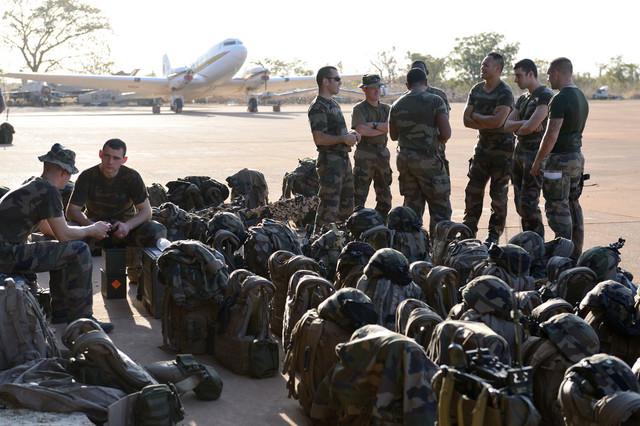
French war in Mali with hostage crisis in Algeria

French troops arriving in Mali

French troops fought Islamist rebels in Mali while in neighbouring Algeria Al-Qaeda-linked fighters killed two people, took more than 40 foreign hostages and called for an end to France’s “crusade”.

Chad meanwhile announced it would be sending 2,000 soldiers to fight in Mali.

After days of air strikes on Islamist positions in northern Mali, controlled by the rebels since April, French and Malian ground forces battled the insurgents in the central towns of Diabaly and Konna.

But the assault on a gas field over the border in Algeria dramatically raised the stakes.

Islamists said they were holding 41 foreign hostages, including seven Americans, after their attack on the In Amenas gas field in the east of the country.

A group calling itself “Signatories for Blood” claimed the action in a post to the Mauritanian website Alakhbar.

The attack was in reprisal for “the crusade being waged by French forces in Mali” and for Algerian’s cooperation, it said, calling for an end to the operation.

Algerian Interior Minister Dahou Ould Kablia said that one Briton and an Algerian had been killed in the attack, while another six people — a Briton, a Norwegian a Scot and three Algerians — had been wounded.

Other reports said the hostages included Japanese, Malaysian, Norwegian and Filipino nationals. Dublin confirmed the kidnapping of an Irish national while the US State Department said several of its nationals were being held.

The attackers had also demanded the release of 100 Islamists held in Algeria in exchange for their hostages, a worker at the gas field site told AFP.

The attack came less than a week after France launched its air strikes on Islamists in northern Mali on January 11 and just days after Algeria opened its airspace to French fighter jets engaged in the mission.

Jointly operated by British oil giant BP, Norway’s Statoil and state-run Algerian energy firm Sonatrach, the gas field is located 1,300 kilometres (810 miles) southeast of Algiers, close to the Libyan border.

On the ground in central Mali, French troops engaged Islamist fighters in Diabaly, a town seized two days earlier by fighters led by Algerian Abou Zeid, one of the leaders of AQIM.

“The special forces are currently in Diabaly, in close-quarter combat with the Islamists. The Malian army is also in place,” a Malian security source said on condition of anonymity.

There were also clashes near Konna, the central town Islamists seized last week, prompting the French intervention, security sources said.

The French military said it had secured a strategic bridge on the Niger river near the town of Markala, south of Diabaly, blocking a key route to Bamako.

French Defence Minister Jean-Yves Le Drian said the western zone around Diabaly was home to “the toughest, most fanatical and best-organised groups. It’s under way there but it’s difficult”.

— ICC launches Mali war crimes probe —

The International Criminal Court said it had launched a warcrimes probe Wednesday, as rights groups and military sources denounced the Islamists’ use of child soldiers and use of civilians as human shields.

“Different armed groups have caused havoc and human suffering through a range of alleged acts of extreme violence,” chief prosecutor Fatou Bensouda said in a statement.

“I have determined that some of these deeds of brutality and destruction may constitute war crimes.”

Chad announced Wednesday it would send 2,000 soldiers to Mali, a significant boost to the African forces gathering there.

“We intend to send an infantry regiment and two support battalions, which comes to around 2,000 men,” Moussa Faki Mahamat told Radio France Internationale. They would work closely with the Malian army and the multinational West African force taking shape, he added.

Nigeria will command the UN-approved 3,300-strong multinational African intervention force and has promised 900 troops. Niger, Burkina Faso, Togo, Senegal, Guinea and Ghana have also promised troops.

Some 2,000 men will arrive within the next 10 days, according to a report from a meeting of regional army chiefs seen by AFP.

Ivory Coast President and ECOWAS regional bloc chairman Alassane Ouattara called for all European countries to lend support to the operation after a meeting with Chancellor Angela Merkel in Germany.

Germany has already pledged two transport planes and Italy logistical support.

France says it will ultimately send 2,500 troops, pitted against what are thought to be around 1,300 Islamic fighters.

Mali has been effectively split in two since April 2012, when Islamists took advantage of a military coup in Bamako and an offensive launched by Tuareg separatists in the north to seize half the country.

The UN and aid agencies report some 370,000 Malians have been displaced by the fighting. – AFP

UK cuts social services to finance Afghan war

British soldiers in Afghanistan
British soldiers from B Company, 2 Mercian set off on an operation in Malgir, Helmand

The UK has revealed that the cost of its involvement in the war in Afghanistan has reached $27.6 billion, and may end up being as much as $32.5 billion. Meanwhile, the UK continues to slash domestic social services to reduce its budget deficit.

UK Prime Minister David Cameron said that Britain has no plans to abandon Afghanistan: “We will be contributing £70m [US$113 million] a year to help pay for the Afghan National Security Forces.”

The UK recently announced an accelerated plan to withdraw 3,800 of its 9,000 troops from Afghanistan in 2013. However, like the US, the UK will maintain an undisclosed number of soldiers in Afghanistan to help local forces with security after NATO’s mission ends in 2014.

“Because of the success of our forces and the Afghan National Security Forces… we’ll be able to see troops come home in two relatively even steps – 2013 and 2014,” Prime Minister Cameron told Parliament.

At least 438 British troops died during the UK’s 11-year involvement in the widely unpopular and expensive war. UK opinion polls suggest that a majority of British voters think the war is “unwinnable,” and would like to see the soldiers come home ahead of schedule.

And while the UK continues to spend money in Afghanistan, even past the 2014 mark, vital domestic services are being cut. Public spending in 2011 and 2012 dropped by 1.58 per cent ($17.5 billion), the Guardian reported.

The country’s healthcare budget was reduced by 1.2 percent including inflation, about $2 billion, and the education budget was cut by 5.7 percent including inflation, about $5.4 billion.

Cameron has warned that Britain must continue with deep cuts to public spending to reduce the UK’s budget deficit.

In 2012, local patient care was put at risk when GPs were asked to cut services including childhood immunization campaigns, out-of-hours care and minor surgery.

The funding of arts organizations and museums in England will also be cut by $18.8 million starting in 2013. And more than 200 UK libraries were closed this year alone.

The cuts to education have mostly affected children from poor families – one of the repercussions was the closure of primary schools’ breakfast clubs, which were run by charities that provided free breakfasts. – RT

The West has failed Christians

Too young to be a victim

In January 1945, my mother, too young even for school, joined millions of other ethnic Germans fleeing westwards from Breslau as the Red Army advanced. My forefathers had lived in this region of Silesia (German since 1242) for at least nine generations that I know of. The forced repatriation – a process that might now be called ethnic cleansing – of my mother’s family and millions of other civilians from groups whose nationality would in future be inextricably linked to their ethnicity, was largely overlooked in the euphoria that swept the world at the end of World War II.

They never returned.

Now we are witnessing another wave of civilian displacement in the Middle East with hundreds of thousands of Christians being forced to flee  as they are banished from their 2,000 year old homelands in today’s remarkable surge in Arabian people power.

Their fate has been largely forgotten as the global media attention has moved on from Egypt and Libya and encamped in Syria to watch the terrible bloodshed in Damascus, Houla, Aleppo and Homs. Innocent people on all sides are enduring awful hardship, death and torture; civil war does not discriminate between young and old, rich or poor. In the ghastly bloodletting we are now seeing, no one seems safe from the prospect of sudden death and destruction of property.

Desperation

Yet for the two million plus Syrian followers of Christ, whose lineage goes back 2000 years to St Paul’s proselytising in the first century AD, these are especially desperate times. Ethnic cleansing is an ugly phrase, but that’s just what is going on right now for Christians in Syria. The unspeakable truth now is that the sizeable Christian communities in war-torn Syria are at greater threat of ethnic cleansing from their ancestral homes than has been the case for generations – often at the hands of the self-styled freedom fighters so feted by the Western press.

These fighters, increasingly rent-a-mob Jihadists with no real stake in the affairs of Damascus, do not see the enclaves of Christians as genial neighbours who they have lived alongside for centuries, as many Syrian rebels do. It is true religious minorities often find their most assured protection under dictatorships. It pays not to rock the status quo.

But to use this as a reason to attack them, destroy ancient churches and hold them to ransom seems a convenient excuse. The Jihadists  simply see them as representing an infidel faith and have turned their attentions on them in a way that was so much rarer for the Syrian-based rebels. Syria’s Christians, who make up less than 10 per cent of the estimated 23 million population, include Greek Orthodox, Syriac Orthodox, Maronite and Melkite Greek Catholic faithful.

Already thousands have left, part of a larger tide of displaced Syrians escaping the conflict in which opposition groups say 27,000 people have died. In the Homs area 80,000 have fled as churches and community centres have been targeted, defaced, and their religious icons stolen. Whilst it is true that some Christians have held prominent positions under Assad  they have also taken leading roles in the political opposition to Assad’s rule, there are other Christians, like George Sabra, who ran for presidency of the opposition Syrian National Council, who have been staunchly anti-Assad.

The Iraqi example

These Christians are now abroad, staying with friends, in gardens or in churches in Lebanon, in Turkey, anywhere out of the firing line. Some have resorted to taking the Government’s side and bearing arms, a move anathema to them throughout history. What my Syrian Christian constituents fear is that once gone, there will be no coming back. A rebel victory and a harder Islamist regime, may very well not want the return of a pluralist society, with Christians living alongside Shiite and Sunni Muslims as they have since biblical times.

Events in Iraq provide us with a timely example. Amidst savage bloodletting between Sunnis and Shiites in the aftermath of the US-led invasion of Iraq in 2003, the story of Iraq’s Christian population is one that is rarely told. But since the invasion it is estimated that half their number has desperately been driven to exile outside the country.

Some 330,000 Iraqi Christians fled in the past decade to Syria alone – and are now fleeing again. Others have found safe haven in Jordan and naturally some have come to these shores, including to my constituency, the Cities of London and Westminster. Under Saddam Hussein, some Christians had risen to the top of politics, most notably Tariq Aziz, Hussein’s Deputy Prime Minister. Yet since the dictator’s fall, violence against the Christian minority, who were often associated with the “crusading invaders”, has included kidnappings, the beheading of a priest, the bombing of ancient churches and forced conversion to Islam.

This is the backdrop to the fate that I fear will within a decade or so befall the long established Christian population in this region.

The West must act now to protect the Christians of Syria, Egypt and Iraq and make sure religious freedoms for Christians are enshrined in the laws of any future new regimes if we wish to avoid a similar scale of civilian displacement. And we must ensure that the banishment from their homelands of Middle Eastern Christians over the years ahead is not a dark derivative of the Middle Eastern uprising. – Mark Field, The Independent