How evil was apartheid?

blake_ancient_of_daysby Albert Brenner

How does one measure evil? Is there such a thing as a universal ‘index’ according to which deeds of evil can be judged?

If we, for example, take the Universal Declaration of Human Rights as the final arbiter of what is evil and what is not, how could we then judge Zimbabwe as being more evil than, for example, China or Saudi Arabia – two countries enjoying marvelous ties with the West despite their abysmal human rights records and lack of democracy.Is this blatant hypocrisy, or just the obligatory Realpolitik of individual nations surviving in a cynical world where might is right?

Be that as it may; it would be quite an interesting exercise to give Joe and Jane Average a list of five words to rank according to the evilness ‘index’ of the West.For example; take the words Apartheid, Gowon, Mengisthu, Hutu and Kim IL Sung, and then give them a rating-number, 1 – 5, on the supposed scale of the evil they signify. Try it.

It would not be surprising if your ranking closely resembles the original order of the words I listed. The last four words/names will most probably be vaguely familiar and have some negative connotations, whereas the first word, Apartheid, is guaranteed to conjure up images of the most evil kind.

The question now obviously is whether evil is evil most foul simply because you know about it, especially in view of the fact that the above four words/names that you are not really familiar with denote genocides of a million and more!

Did you know that fewer than 2000 people were killed by security forces in South Africa during the 42 years of Apartheid? And did you know that 80% of all the politically motivated deaths during Apartheid (total 20 000) was due to black-on-black (mostly tribal) violence? 2000 too many of course, but seen against the background of the never-ending vilification of white South Africans, the four million-man genocides mentioned above and innumerable unknown other evils like, for example, Robert Mugabe’s knighthood – awarded by the Queen while he was massacring over 20 000 Matabeles in 1984, surely must illustrate that selective (media-borne) knowledge of evil can never be the ultimate criteria when putting together an ‘index’ of universal evil.

Lest I stand accused of quantifying evil, let us examine the reason why Apartheid’s 2000 dead in 42 years is judged as being more evil than, amongst others, Pol Pot’s 2 million dead in 4 years and Rwanda’s 1 million dead in 3 months.

Apartheid South Africa was ruled by whites, and whites (the West) demand that their kin, wherever they may find themselves on this lonely planet, act according to the moral standards they have set themselves, be it those inherent in human rights, democracy or neo-liberalism, in general.Whenever a white nation transgresses, it is punished till it conforms… and rightly so. Noble and honourable indeed the West’s moral hegemony is, especially given the fact that none of the other races bother to do so at all.

Japan can’t be bothered (except financially) by China’s human rights abuses and lack of democracy, neither can black South Africa by Mugabe’s horror regime, or Saudi Arabia by the Taliban’s madness. Different moral strokes for different coloured folks, it would seem.

But then, the West has always been on a mission to make existence as livable as possible, for all humanity. A quest not easily undertaken or brought to fruition, especially when living in the moral outskirts of progressive human existence… like in Africa.

Did you know that the life expectancy of black South Africans nearly equalled that of Europeans during the last decade of Apartheid? Did you know that the black population nearly trebled during Apartheid? Did you know that black South Africans had the highest per capita income and education levels in Africa during Apartheid?

No, of course you didn’t, because your view of evil has already been defined… by the willful “filtering” of morality through the MSM and popular culture.

Another gay rights activist killed in Africa

evilgaysA prominent gay rights activist in Cameroon was tortured and killed just weeks after issuing a public warning about the threat posed by “anti-gay thugs,” Human Rights Watch said.

Friends discovered the body of Eric Ohena Lembembe at his home in the capital, Yaounde, on Monday evening after he was unreachable for two days, the rights group said in a statement Tuesday.

One friend said Lembembe’s neck and feet looked broken and that he had been burned with an iron.

Lembembe was among the most prominent activists in one of Africa’s most hostile countries for sexual minorities. First as a journalist and later as executive director of CAMFAIDS, a Yaounde-based human rights organization, he documented violence, blackmail and arrests targeting members of Cameroon’s gay community. He was also a regular contributor to the Erasing 76 Crimes blog, which focuses on countries where homosexuality is illegal, and he wrote several chapters of a book released in February on the global gay rights movement titled “From Wrongs to Gay Rights.”

Lembembe is the most high-profile African gay rights activist to be killed since 2011, a year that saw the deaths of Uganda’s David Kato and South African lesbian activist Noxolo Nogwaza.

Homosexuality is punishable by prison terms of up to five years in Cameroon, and the country prosecutes more people for gay sex than any other in sub-Saharan Africa, according to Human Rights Watch.

In a statement, a U.S. State Department deputy spokeswoman deplored Lembembe’s murder. “We condemn this terrible act in the strongest terms and urge the Cameroonian authorities to thoroughly and promptly investigate and prosecute those responsible for his death,” Marie Harf said.

Lembembe was among the first activists in the country to mobilize following a sharp increase in anti-gay prosecutions beginning in 2005, said Yves Yomb, executive director of Alternatives-Cameroon, a gay rights group based in Cameroon’s largest city, Douala. A local office of the group was set on fire June 26, Harf said in her statement. – AP


The Obamas do Africa

dronesThe President and his family are spending a week in sub-Saharan Africa, with Senegal, Tanzania and South Africa on the itinerary. The focus of the trip, if you believe the White House, is trade, an arena in which the United States has been eclipsed by China since 2009. China, by some measurements, now does nearly twice as much business with Africa as the U.S., and the gap is growing. It is now commonly accepted that the Chinese offer far better terms of trade and investment than the Americans, that they create more jobs for Africans, and their investments leave behind infrastructure that can enrich their African trading partners in the long haul.

No one expects Obama to offer anything on this trip that will reverse America’s declining share of the African market. That’s because the U.S. is not in the business of fair and mutually beneficial trade – it’s about the business of imperialism, which is another matter, entirely. The Americans ensure their access to African natural resources through the barrel of a gun.

So, while the Chinese and Indians and Brazilians and other economic powerhouses play by the rules of give and take, the U.S. tightens its military grip on the continent through its ever-expanding military command, AFRICOM.

To justify its rapid militarization of Africa, Washington plunges whole regions of the continent into chaos. U.S. policies, under presidents Clinton, Bush and Obama, have utterly destroyed Somalia, made the Horn of Africa a theater of war, drawn the northern tier of the continent into America’s cauldron of terror, and killed six million people in the eastern Congo.

The face of America in Africa is war, not trade; extraction of minerals by military intimidation, not conventional commerce. Washington’s priority is to embed AFRICOM ever deeper into the militaries of African states – rather than configuring more favorable trade relationships on the continent. But you won’t learn that from the U.S. corporate media, which chooses to focus on the $100 million cost of Obama’s African trip, or to look for human interest angles on Obama’s decision not to touch down in his father’s homeland, Kenya. However, even that angle is too sinister for deeper exploration by the corporate press, because Kenya’s absence from the itinerary is meant as a threat.

The United States is angry because Washington wanted the Kenyan people to elect a different president, one more acceptable to U.S. policymakers. The Americans expected the whole of Kenyan civil society to bend to Washington’s will, and reject the candidacy of Uhuru Kenyatta, simply to please the superpower. When that didn’t happen, it was decided that Kenya must be shunned, despite its past services to U.S. imperialism.

Skipping Kenya was a warning that more serious repercussions may lurk in the future – which is a potent threat, because the U.S. controls most of the guns of Africa. As the U.S.-backed warlord in Somalia said in Jeremy Scahill’s excellent film The Dirty War, “The Americans are masters of war.” War, and the threat of war, is the reality behind every U.S. presidential visit, to Africa and everywhere else. Whether the terms of trade are good or bad, the declining U.S. empire will get access to the resources it needs, or thousands – millions! – will die.

Glen Ford. BlackAgendaReport.com.

Obama warns Africa’s ‘tyrant’ leaders

Barack Obama at the University of Cape Town

US President Barack Obama warned Sunday that Africa could only fulfill its rising potential with leaders who serve their people, not tyrants who enrich themselves.

In a strident call for democratic change and good governance, Obama used the political legacy of ailing Nelson Mandela and South Africa’s emergence from years of Afrikaner rule as proof that freedom will ultimately prevail.

“In too many countries, the actions of thugs and warlords and human traffickers hold back the promise of Africa,” Obama said at a speech at Cape Town University.

“America cannot put a stop to these tragedies alone, and you don’t expect us to. That is a job for Africans. But we can help you and we will help you,” he said, announcing major new US programs to boost electricity and health care.

“History shows us that progress is only possible where governments exist to serve their people and not the other way around,” said Obama, in a line that drew loud and prolonged cheers from his audience of more than 1,000 people.

The speech was delivered from the same spot where American political icon Robert Kennedy delivered his famous “ripple of hope” speech in 1966, which called on students to decry the “racial inequality of apartheid”.

Obama’s goal was to inspire a new generation of Africans with the belief that they could ignite political change and the potential of their continent.

He slammed leaders who “steal or kill or disenfranchise voters,” saying that the ultimate lesson of South Africa was that such brutal tactics will not work.

“So long as parts of Africa continue to be ravaged by war and mayhem, opportunity and democracy cannot take root,” said Obama.

“Across the continent, there are places where still, fear often prevails,” Obama said, warning of “senseless terrorism” from Mali to Mogadishu.

“From Congo to Sudan, conflicts fester,” Obama said, hitting out at those who argue that American calls for democracy and freedom are “intrusive” or “meddling”.

He also condemned the rule of Robert Mugabe in neighbouring Zimbabwe, where he said the “promise of liberation gave way to the corruption of power and the collapse of the economy”.

Like the rest of Obama’s trip to South Africa, the speech was rich in emotion when he mentioned his hero Mandela, who lies critically ill in a Pretoria hospital.

“You have shown us how a prisoner can become president,” Obama said. – AFP

Obama speaks to African youth from Soweto via video link

Obama in Soweto
Obama in Soweto

by Shabtai Gold

US President Barack Obama was met Saturday with songs, cheers and laughter from young South Africans at a university in the Soweto area of Johannesburg.

Before he entered the room, the crowd sang songs from the struggle against apartheid and burst into a lively round of Shosholoza, an old miners song from southern Africa with a call and response format that became more lively with each chorus.

As he appeared, Obama shouted out, “Yebo Mzanzi!” or “Yes, South Africa!” to jubilation from the crowd.

The president used the town-hall-style meeting, which was hooked up via video link to several other African nations, to encourage young people to innovate and act on their imaginations.

While Nelson Mandela, the ailing anti-apartheid leader who Obama said was a personal hero and “one of the greatest people in history,” was still in hospital in critical condition, his spirit was felt in the room.

“Building the future you see, realizing the vision you have not only for your own country but for the world – it will not be easy,” Obama told the hundreds of young people in attendance at the University of Johannesburg’s Soweto campus.

“But as you go forward, think of the man who is in our prayers today. Think of 27 years in prison. Think of the hardship and struggles and being away from family and friends,” Obama said, referring to Mandela’s time in jail for opposing white minority rule.

Obama was quick to stress the importance of education, as Mandela had always done, saying it was the “best investment” any country could make in its youth.

Or, indeed, for its politicians. “I don’t want to reinforce for the American press here that Africa is just one big piece of land on the map,” Obama, a Democrat, said in an apparent reference to widely reported claims that former US Republican vice presidential candidate Sarah Palin believed Africa was a country, not a continent.

He was met by loud cheers from the crowd and laughter from his travelling press corps.

The questions he received were often tough, focussing on trade, the environment, women’s rights and even a promise he made to travel to Kenya, his father’s home, during his presidency.

“I’m going to be president for another three and a half years,” he said when asked via a video link from Nairobi why he had not visited the country. “You learn as president that people not only want you to fulfil your promises but want you to fulfil your promises yesterday.”

But Obama admitted that the International Criminal Court warrant out for that country’s new president and vice president had influenced his decision.

“I did not think it was an optimal time for me to visit,” he said but pledged he would still make a trip to Kenya before his time in office ends, which would be 2017.

For many in the crowd, however, the key concerns they had were jobs and economic opportunities. They wanted clear words from the president that he envisioned an economic partnership between the United States and Africa.

“Everywhere I go in Africa, people want to break out of the dependency trap,” Obama said.

“What we need is an Africa that is building, manufacturing, creating value, inventing and then sending those products around the world and receiving products in return under fair terms of trade,” the president said. “If we do that, there is no reason Africa cannot succeed.”

Obama insisted the US was not interested in global domination, a concern often felt strongest in countries once subjected to colonial rule, which milked resources while oppressing their people.

“I was elected to end the wars,” he said, adding that he regularly visits young US soldiers who have been gravely injured in Iraq and Afghanistan.

“This idea that we want to get more involved militarily around the world is not true,” he said.

Obama said the US would rather be “selling iPads and planes” rather than using its military abroad, drawing applause from the crowd, many of whom snapped photos of the president and his large entourage on their smartphones and tablets. – dpa

Obama: Africa’s future is in young hands

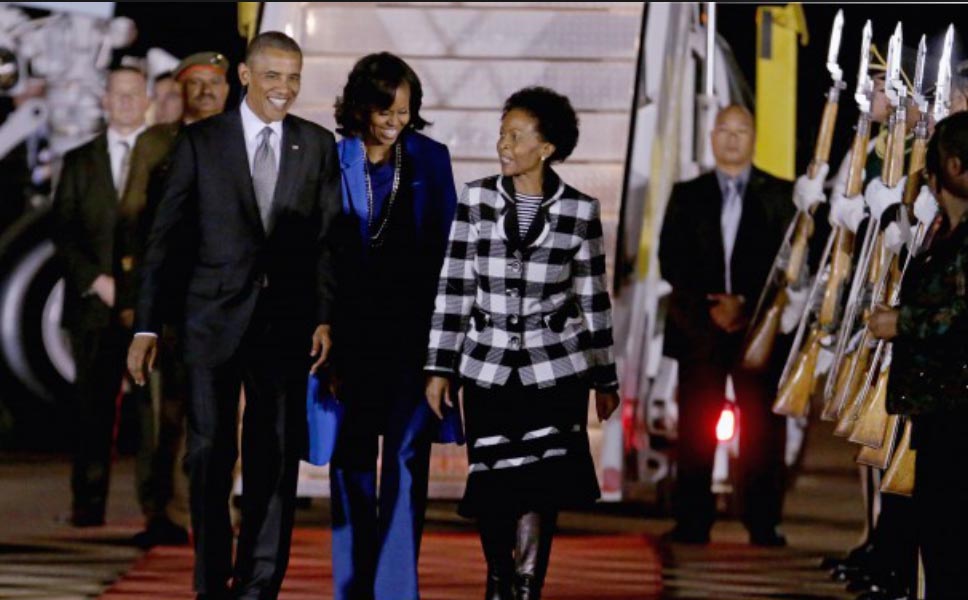
Obama upon his arrival at Waterkloof Air Force Base, with wife Michelle and Maite Nkoana-Mashabane, the SA foreign minister

US President Barack Obama told Africa’s youth Saturday that the future of the continent was in their hands and urged them to use Nelson Mandela as a model for political leadership.

Obama got a rowdy welcome as he used a town hall style meeting in South Africa to announce a new fellowship that will initially take 500 young African leaders to the United States every year for academic and leadership training.

As Obama spoke at a university in the sprawling township of Soweto where opposition to apartheid sprung into life, police nearby fired stun grenades to disperse hundreds of people critical of his anti-terror policies.

The US leader, on the second leg of an African tour, spoke at a University of Johannesburg not far from the simple homes in Soweto where Mandela, now 94 and in a critical condition in hospital, spent several years of his life.

“The future of this continent is in your hands,” Obama said.

He urged young people in Soweto and those watching the town hall meeting in Kenya, Nigeria and Uganda to take inspiration from Mandela’s refusal to be cowed by 27 years in jail.

“Think about 27 years in prison. Think about hardships and the struggles and being away from family and friends,” Obama said.

“There were dark moments that tested his faith in humanity, but he refused to give up.

“In your lives there will be times to test your faith.”

Obama was greeted with wild enthusiasm by the crowd in Soweto, who sang South African protest songs before he arrived and chanted his “Yes We Can” campaign slogan when he took the stage.

However, protesters set fire to US flags and portraits of Obama and at least three bangs from stun grenades were heard as armed police tried to move demonstrators away from the university.

“The message is clear. We want him to honour the promises he made when he became president, including things like the closing of Guantanamo Bay,” 30-year-old Firoz Osman told AFP. – AFP

‘Obama is supporting a British policy of genocide throughout Africa’

obamaafricaPresident Obama’s trip to Africa is little more than a public relations stunt to a continent desperate for his help, says Lawrence K. Freeman, editor of Executive Intelligence Review magazine.

Freeman believes not much is going to be accomplished. The purpose of the trip is not to help the African people to develop these African nations. He says it is a very calculated, glorified public relations tour to three countries and most people in Africa are going to realize, and do realize already, that the US is doing nothing to help their continent. “And what they do know is that the overthrow of Colonel Gaddafi, led by Obama and NATO, has been a catastrophe for north and West Africa in supporting various elements that have now allowed the destabilization of many of these countries, especially with the arms and the flow of Tuaregs and terrorists coming out of Libya. South Africans are not pleased or happy with President Obama and he’s going to offer absolutely nothing except maybe entice private sector companies to make a few investments. But this is really pathetic in terms of what Africa needs.”

Freeman says there is this silly notion in the US that somehow China is an American competitor in Africa. “But in fact what China has done over the last recent period, five to ten years, is invest massively and construct all types of infrastructure projects throughout many African countries totaling tens of billions of dollars per year. So the US had to stop doing that 40 years ago. The US does not build infrastructure. The US does not provide government-backed investment in the kinds of projects that are necessary for the people of Africa. We’ve done nothing, for example, to develop water management in the African Sahel. We’ve done nothing to develop the Arab culture capability of these regions and therefore you have the spread of terrorism, the spread of insurgency because you have these alienated youth who see no future because their economies are dying. In fact Obama’s done less than George Bush and less than Bill Clinton even though he’s called the Son of Africa. So he has a record of failure and in fact he’s been supporting destabilization, such as the overthrow of Gaddafi, which has actually worsened conditions throughout Africa.”

Obama is not really concerned about the continent, Freeman believes. “In 2009 he spent less than 24 hours and made one speech in Ghana. Here he’s visiting three countries – Senegal, South Africa, and Tanzania – and avoiding going to other countries such as Nigeria, such as Mali, many other countries that are in the spotlight right now. He doesn’t have anything to offer them, the United States – the transatlantic community of Europe and the United States, the financial system, is collapsing. We see this throughout Europe and the United States, dying economically, politically, and culturally. We have no vision, we have no future. Obama cares nothing about the welfare of the South African people as he cares nothing about the welfare of the people of the United States. In fact he’s supporting a British policy of genocide throughout Africa by allowing destabilization and by allowing hunger and shortages of food and medicine to kill Africans in large numbers, and this is something that could be corrected and changed if we had a policy to do that.”- RT

Obama: ‘Moral imperative’ to feed Africa

Obama on the tired old theme of African hunger

President Barack Obama, wrapping up the first leg of an African tour, said on Friday Washington had a “moral imperative” to help the world’s poorest continent feed itself and he then left for South Africa hoping to see ailing Nelson Mandela.

White House officials hope Obama’s three-nation tour of Africa – his first substantial visit to the continent since taking office in 2009 – will compensate for what some view as years of neglect by America’s first black president.

Before departing Senegal after a two-day stay, Obama met farmers and local entrepreneurs to discuss new technologies helping to raise agricultural output in West Africa, one of the world’s most under-developed and drought-prone regions.

Standing in front of the agricultural displays at an event hosted by “Feed the Future”, the U.S. government’s global hunger initiative, Obama said his administration was making food security a top priority of its development agenda.

“This is a moral imperative. I believe that Africa is rising and wants to partner with us: not be dependent but be self sufficient,” he told reporters. “Far too many Africans endure the daily injustice of poverty and chronic hunger.

“When people ask what’s happening to their taxpayer dollars in foreign aid, I want people to know this money’s not being wasted. It’s helping feed families.”

But the health of Mandela, the 94-year-old former South African president and anti-apartheid hero clinging to life in a Pretoria hospital, dominated Obama’s day even before he arrived in Johannesburg.

Trade unionists, student activists and Communist Party members protesting against American foreign policy gathered on Friday a few blocks from the hospital where Mandela is being treated for a lung infection.

Like Mandela, Obama has received the Nobel Peace Prize and both men were the first black presidents of their nations.

Air Force One departed Senegal’s coastal capital Dakar just before 1100 GMT (0700 AM ET) and was due to arrive in South Africa around eight hours later. On Friday evening, Obama has no public events scheduled and could go to the hospital then.

He is scheduled to visit Robben Island, where Mandela spent years in prison under South Africa’s former white minority regime, later during his trip. Obama’s last stop on his tour will be Tanzania in East Africa.

Food security, along with anti-corruption measures and trade opportunities for U.S. companies, are topics the White House wants to highlight on Obama’s eight-day tour.

Food security and public aid are two of the issues the Obama team believes are success stories. USAID head Raj Shah told reporters that Africa had seen a steady increase in resources under Obama’s administration despite a tough budget environment. – Reuters

Obama to honour slaves in Senegal

Barack ObamaAmerica’s first black president Barack Obama will acknowledge the historic stain of slavery and honour Senegal’s democratic resilience in an unstable region Thursday, at the start of an African tour.

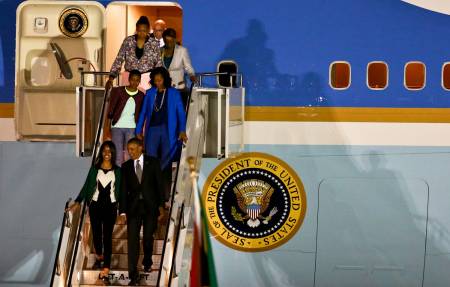
Obama stepped off Air Force One into the African night late Wednesday in Dakar to launch a three-nation trip designed to fulfil neglected expectations for his presidency on a continent where he has deep ancestral roots.

But his itinerary, which also takes in South Africa and Tanzania, threatens to be disrupted as life apparently ebbs from Nelson Mandela, the anti-apartheid icon who is gravely ill in a Pretoria hospital.

Should Mandela die before Obama lands in South Africa on Friday, aides may be forced to tear up plans to visit Johannesburg and Cape Town. As it stands, the ex-South African president’s plight is already overshadowing Obama’s trip.

On Thursday, Obama will begin his day with talks and a press conference with Senegal President Macky Sall. Then he will discuss the importance of the rule of law at Senegal’s Supreme Court.

A ‘full circle’ moment then beckons as Obama, the son of a Kenyan, and his wife Michelle, the descendent of slaves, will pay a visit to Goree Island, a memorial to Africans swept up in the Atlantic slave trade.

Obama will journey by ferry to the island’s Slave House museum, off the Senegal coast, which epitomises a dark period of American and African history resonating on both sides of the Atlantic to this day.

“There’s this link between Obama, an American originating from Africa through his father, and his wife, an African-American originating from Africa through her ancestors,” said House of Slaves curator Eloi Coly.

“I think with all these ingredients gathered together, this visit by the Obamas should be very special.”

White House spokesman Jay Carney said that the visit would be an important moment for Obama.

“A visit like this by an American President, any American President, is powerful,” he told reporters.

“I think that will be the case when President Obama visits and I’m sure particularly so, given that he is African American.”

US officials are keen to highlight democracy, in Muslim majority Senegal, on the first leg of a visit focusing on francophone west Africa, the tip of the continent in South Africa, and the democratic west in Tanzania.

Obama will also likely bring up the situation in neighbouring Mali, before a UN peacekeeping force starts operations in a country where Islamists and radicals have exploited a power vacuum.

The US president’s arrival in Africa came at a delicate time as the world prepared to say a farewell to Mandela.

Napilisi Mandela, an elder in Mandela’s clan, told AFP that the former South African president was on life support, and South African President Jacob Zuma called off a scheduled trip to Mozambique.

Obama and Mandela met in 2005, when the former South African president was in Washington, and Obama was a newly elected senator, and the two have spoken several times since by telephone.

But the long awaited prospect of a public appearance between the first black presidents of South Africa and the United States is now impossible.

Obama claims a spiritual connection to Africa, but a crush of international crises in his first term thwarted his hopes to travel extensively in the continent. He did manage a short trip to Ghana in 2009.

His tour is designed to highlight Africa’s emerging economic potential and growing middle class, as well as youth and health programs, and to emphasise US engagement in a region benefiting from a wave of Chinese investment.

“We are not too late,” said Carney, pointing out that although Obama had been kept away, Vice President Joe Biden visited Africa in the first term, and there were also wide ranging diplomatic efforts by the administration on the continent.

But there has been disappointment in Africa, after Obama’s 2008 election caused euphoria and an expectation that he would put Africa policy at the top of his agenda.

There is one glaring missing stop on Obama’s itinerary: Kenya.

Officials said that the indictment of Kenyan President Uhuru Kenyatta at the International Criminal Court in The Hague, over previous election violence, made it politically impossible for Obama to stop by on this tour. – AFP

Senegalese go into hiding for Obama visit

africaobamaOrdinary Senegalese are drawing lessons from the past and leaving nothing to chance so that they avoid “foreseeable” embarrassing circumstances during President Barack Obama’s visit, which commences on June 26.

Enduring long hours in traffic jams while waiting for high profile visitors to pass through, being unable to hawk their wares freely in the streets and being virtually “held prisoner in one’s house” are some of the embarrassments they recall from the 1998 visit of former American president Bill Clinton.

Many businesses particularly in downtown Dakar and its peripheral districts have already started recording low sales due to this anticipation. “We’ve virtually been closed for a week now,” says Doudou Keita, a garment seller in Guelle Tapé, a few kilometres from the city centre.

Mbaye Ndiaye, an economist formerly employed by the Trade ministry, says the visit will cause losses of several million dollars, especially to the informal sector “who will take months to recover”.

“While the Americans are capable of making our country a better place, Obama is also capable of making our small businesses in Dakar poorer,” argues Ndeye Diop, a doughnut and coffee seller in a conversation with her colleague.

Assuredly, Ndeye’s colleague Bintou Diagne retorted in English with a native accent “Yessi, e can!” It was a play on Obama’s 2008 campaign slogan: ‘Yes we can.’

These “unforeseeable” embarrassments have led thousands of Dakar city dwellers whose neighbourhoods are being “bunkered” to return to their villages until Obama – nicknamed “the big cat” – goes away.

Barack (which means ‘shack’ in Wolof) “should have lodged in a shack to show solidarity with the majority shack dwellers here”, leading comedian “Kutia” insistently jokes on television about Obama, who he calls the “White House rent payer”.

Pickpockets and prostitutes

Since the announcement of the date of his arrival, the thousands of street beggars in Dakar have visibly disappeared and gone underground.

The same thing has happened to the noisy hawkers on the streets of the capital, most of whom were mistakenly picked up by police during a clean-up against pickpockets classified by security agents as “persons with the propensity to cause embarrassment”.

This category also includes both licensed and unlicensed prostitutes who made good profits during visits by less high profile statesmen whose delegations frantically sought out their services.

But for Obama’s visit, they are among those bearing the heaviest brunt of the tour, which has been extended from 48 to 72 hours beginning this Wednesday.

“No matter…some of us can still harvest from Obama’s field”, says Aisha Konaté, a sex worker with nearly two decades of experience and who boasts of having contacts capable of roping in “high profile” clients to her private abode

For a week now, the national television “RTS” has been clocking Obama’s upcoming visit with the Senegalese and American flags displayed on the top left corner of TV screens, and the inscription “D-Day 3 days to go,” or whichever days are pending.

The youthful face of Obama has for two weeks been very visible on a billboard on one of the tallest buildings along the Place de l’independence main square in Dakar.

And elsewhere, especially at the heavily secured Leopold Sedar Senghor International airport, several giant Senegelase and American flags are flapping high in the sky around photographs of the two heads of state. – africareview.com

Streets in Pretoria being cordoned off for Obama visit

Several streets in the Pretoria were closed off on Tuesday in preparation for the visit of US President Barack Obama, the Tshwane metro police said.

Spokesman Superintendent, Isaac Mahamba said several streets in central Pretoria were currently closed off as a dry run for security measures for the coming visit by president Barack Obama.

Mahamba was unable to confirm which streets would be affected by the security drill due to security reasons, but according to reports Pretorius and Beatrix Streets were currently closed off. Motorists were advised to use alternative routes on Tuesday.

President Barack Obama is reportedly due to arrive in South Africa with his family on 28 June for his first substantive visit to Africa since he took office.

It is currently still unknown if President Barack Obama will make a visit to the ailing former president Nelson Mandela that is being treated at the Medi-clinic Heart Hospital.

Reports indicated that the Obama family are due to meet with President Jacob Zuma in Pretoria on 29 June before travelling to Soweto and then to Cape Town on Sunday. – looklocal


Bush follows Obama to Africa

dubyafricaIt’s not often that Africa sees a visiting American president, much less two. But as President Obama travels across the continent next week, so will his predecessor, George W. Bush.

Mr. Bush, who made fighting AIDS in Africa a top goal of his administration, will take a trip there — his third since leaving office — as part of a program to combat cervical cancer. He will leave late next week for Zambia, where he will help refurbish a clinic, and then head to Tanzania, where his wife, Laura Bush, is organizing a forum for African first ladies.

Mr. Bush will overlap briefly on July 2 with Mr. Obama in Tanzania, the last stop on the current president’s itinerary after Senegal and South Africa. There are no plans for the two to see each other, but Michelle Obama has agreed to attend the first ladies’ forum with Mrs. Bush in Dar es Salaam, Tanzania’s largest city, to promote women’s education, health and economic empowerment.

“It’s coincidental that we have two American presidents on the continent at the same time – in the same country at the same time – but it’s indicative of a continued commitment, which is great news,” said Hannah Abney, communications director for the George W. Bush Presidential Center. “It wasn’t planned. It really was coincidental. But we’re really excited about it.”

Africa was a personal priority for Mr. Bush during his presidency, overshadowed by Iraq, terrorism and other issues but one of the few areas where he drew praise across party lines. His Millennium Challenge program steered billions of dollars in development aid to countries that committed to reform. His President’s Emergency Plan for AIDS Relief, or Pepfar, directed lifesaving drugs and other care to millions with H.I.V. and was called the largest humanitarian health effort ever undertaken by any country.

As a result, Mr. Bush remains more popular in Africa than at home, and he has taken pride in his efforts there. He devoted a substantial part of his newly opened presidential museum, outside Dallas at Southern Methodist University, to an exhibit about Pepfar. And global health has been a top focus of the former president’s public policy institute.

Teaming up with Pepfar, the United Nations and pharmaceutical companies, Mr. Bush helped form Pink Ribbon Red Ribbon, which is devoted to curbing cervical cancer and breast cancer. It started in Zambia in 2011 and expanded to Botswana in 2012.

Last year, Mr. and Mrs. Bush helped refurbish a clinic in Kabwe, Zambia, where nearly 30,000 women have been treated since, according to his presidential center. They will help renovate and reopen another clinic on July 1, this time in Livingstone, Zambia; a team of four Southern Methodist University students left Friday to work on the reconstruction.

Mr. Bush’s interest in Africa coincides with that of his own predecessor, Bill Clinton, who has spent much of his own time since office on programs to provide help there. “It was a critical part of his administration,” Ms. Abney said of Mr. Bush. “It’s also something he and Mrs. Bush feel personally about. They feel a commitment to the people there.” – NYT

Tax havens cost Africa tens of billions: Kofi Annan

taxhavensTax havens used by major international firms are depriving impoverished African states of tens of billions of dollars each year, former UN secretary general Kofi Annan said.

Annan told a Security Council meeting on natural resources and conflict that tax avoidance and “murky” deals result in a loss of state revenue that fuels the wars over natural resources that have bedeviled Africa for decades.

“When foreign investors make extensive use of offshore companies, shell companies and tax havens, they weaken disclosure standards and undermine the efforts of reformers in Africa to promote transparency,” Annan said.

The former UN leader said the Africa Progress Report panel, which he chairs, had found “anonymous shell companies” were used in five deals that cost the Democratic Republic of the Congo nearly $1.4 billion from 2010 to 2012.

That sum is almost double the impoverished but resource-rich country’s annual budget for health and education.

Annan added that Africa loses more money each year through a Africa Progress Report panel technique, known as trade mispricing, than it receives in international development assistance.

More than $30 billion a year is sent to Africa each year in development aid by Western countries. Trade mispricing is where companies quote artificially low prices to deceive tax authorities.

Annan praised a vow by Group of Eight leaders at a summit this week to crack down on tax avoidance.

He called for international rules to insure the payment of taxes, “rules that limit the use of shell companies and other tools that contribute to secret, murky and exploitative deals.”

Annan said this could “help prevent the conditions that lead to armed competition for the spoils of natural wealth.”

He also said the Security Council could “play an important role in ending the plunder of minerals and other natural resources that perpetuate violent conflict” by taking tougher action against trade in conflict-linked resources.

The meeting was organized by Britain, which is Security Council president for June and had hoped the talks would result in a statement on conflict and natural resources.

But diplomats, speaking on condition of anonymity, said this was blocked by Russia.

Without naming any country, Britain’s UN ambassador Mark Lyall Grant expressed “disappointment” at the failure to agree a joint statement.

He said certain members had objected, saying that the issue of natural resources and conflict falls outside of the council’s mandate.

“This is clearly not true,” he said.

“There are a significant number of countries on the council’s agenda in which the weak management and illegal exploitation of natural resources has played a role in triggering, prolonging or escalating a conflict.” – SAPA/AFP

Cell phones lead to higher levels of violence throughout Africa

MandelacellMuch research and media attention has been devoted to exploring rapidly emerging African countries in recent years. In addition to extraordinarily high GDP growth rates, many African countries have seen their middle classes grow substantially and demand goods and services that were formerly available only to individuals in more developed countries. Cell phone use in Africa has increased substantially in recent years; its nearly 649 million mobile users in 2011 made it the second-largest market for mobile phones in the world after Asia.

Furthermore, the continent has the fastest-growing cell phone market in the world, maintaining an annual growth rate of almost 20% since 2007. This has substantially contributed to economic development within the continent as a result of various innovations and improvements, from mobile banking to faster communications between merchants and customers, as the World Bank notes. In Kenya, the success of the mobile banking system M-pesa has opened the door for a multitude of mobile phone tech startups, prompting some to refer to the country as the “Silicon Savannah.” (It should be noted, however, that mobile phone technology in Africa frequently does not afford robust Internet access, with all its innovation potential.)

The benefits of mobile technology in other regions are widely hailed. The availability of cell phones and use of social media is often credited with playing a key role in the Arab Spring, which toppled dictatorships in Egypt and Tunisia, and sparked protest movements throughout the Middle East and North Africa. In Mozambique, cell phones have been shown to improve voter education and political participation, while in Namibia cell phone usage has allowed citizens to hold their government officials more accountable and reduce corruption. Although much research has been done on the rise of technology in the developing world and its positive dimensions for politics, very little research has been done regarding possible negative externalities of increased communications capacity, such as improving the organizational abilities of violent groups to incite more conflict.

A 2013 paper from Duke University and the German Institute of Global and Area Studies published in the American Political Science Review, “Technology and Collective Action: The Effect of Cell Phone Coverage and Political Violence in Africa,” examines the impact that cell phones have had on violent conflict on the continent. The authors, Jan H. Pierskalla and Florian M. Hollenbach, utilize conflict data from the UCDP Georeferenced Event Data Set, which includes data on organized violence from 1989 to 2010, and data on cell phone coverage from the GSM Association, a global association of mobile phone service providers. The authors use various statistical techniques to account for economic, social and geographical factors related to conflict and to determine whether there is indeed an association between cell phone coverage and violent conflict in the context of Africa.

Key findings include:

– Even when confounding variables such as income, inequality, ethnic fractionalization, geography are accounted for, increases in cell phone coverage are associated with higher levels of violence throughout Africa.
– When evaluated on an individual country level, the impact of cell phone coverage on conflict is also significant within each country.
– Greater cell phone coverage leads to more conflict in “areas with structural conditions that favor violence” than those where the conditions do not favor violence; it “enables groups to overcome their collective action and coordination problems more easily, which translates to more organized conflict events.”
– The authors conclude that “cell phones lead to a boost in the capacity of rebels to communicate and monitor in-group behavior, thus increasing in-group cooperation. Furthermore, cell phones allow for coordination of insurgent activity across geographically distant locations.”

“We do not believe,” the researchers caution, “that the spread of cell phone technology has an overall negative effect on the African continent. The increase in violence induced by better communication might represent a short-term technological shock, while the positive effects of better communication networks on growth and political behavior may mitigate root causes of conflict in the long run.” The authors suggest that more research must be done to determine how communication technology, such as cell phones, impacts various forms of collective action, whether violent or non-violent, in Africa. They also note that prior research on the connection between cell phone capacity and violence — namely, the 2012 working paper “Is the Phone Mightier than the Sword? Cell Phones and Insurgent Violence in Iraq” — observed the opposite effect: Mobile technology was associated with decreased insurgent violence in Iraq.

Related research: The World Bank’s 2012 report “eTransform Africa: The Transformational Use of Information and Communication Technologies in Africa” examines a wide variety of areas, including agriculture, health, education and governance. The report discusses the implications of Africa’s so-called “mobile decade.” – journalistresource.org