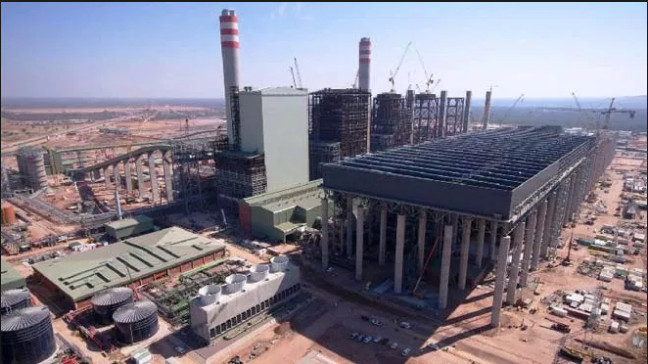
The Special Investigating Unit is probing 11 contractors for stealing a staggering R139bn during the building of Eskom’s Medupi, Kusile and Ingula power plants.
And insiders say the total cost of Eskom looting could reach about R500bn, dating back to 2005.
SIU spokesperson Nazreen Pandor said the unit was probing the theft of R170bn from Eskom — R139bn of which is directly related to contractors working on the power plants.
She said that after an “intensive scoping exercise” the unit had prioritised, among other things, investigating “the performance of, and payment made to the value of more than R139bn to 11 identified contractors appointed by Eskom in respect of the Medupi, Kusile and/or Ingula station”.
This makes up a massive chunk of the R334bn spent on building the plants — and suggests that public enterprises minister Pravin Gordhan’s estimate last year that about R100bn was lost to state capture was way below the mark.
Rolling blackouts last year had South Africans firing up candles, flashlights and generators after crisis-plagued Eskom Holdings SOC Ltd., which provides most of the country’s electricity, failed to meet demand. The power crunch has since eased thanks to fewer unplanned plant breakdowns and the use of diesel-powered generators to augment supply. But Eskom’s problems run far deeper than temporary shortfalls. The state-owned utility is mired in debt and isn’t selling enough power to cover all its costs, leaving it scrambling for money to replace aging plants. Now South Africa is weighing a plan to split Eskom into three entities in the hope of reviving its fortunes.
1. What caused the power shortages?
Theoretically Eskom should be able to generate about 47,000 megawatts of power, but output slipped to as low as 26,000 megawatts last year when several of its plants were being serviced or broke down. Less than three quarters of installed capacity has been available this year, in part because a lack of money forced the utility to cut back on maintenance and repairs. It also lacks key technical skills needed to carry out the work, despite having a bloated workforce. Plants that produce more than half the utility’s power are at, or nearing, their ideal retirement age.
2. How did this happen?
South Africa was able to produced more electricity than it needed when white-minority rule ended in 1994, but the government didn’t foresee how sharply demand would spike as the economy expanded and previously neglected black areas were connected to the grid. Eskom announced a series of multi-billion dollar investments after the government awoke to the severity of the problem in the mid-2000s, but the projects came too late and took too long to build. The first wide-scale outages occurred in late 2005. The Medupi and Kusile coal-fired plants, which were supposed to add almost 9,600 megawatts to the grid and be fully operational in 2015, are still years away from completion. Their projected costs have more than doubled to 292.5 billion rand ($21.5 billion).
3. Where was management?
The utility went through repeated board and management changes during the almost nine years Jacob Zuma was South Africa’s president. Investigations by lawmakers and the nation’s graft ombudsman alleged that the upheaval was part of an orchestrated attempt by Zuma’s allies to raid Eskom’s coffers with his tacit consent. Accusations that the utility was looted are now being investigated by a judicial commission. Zuma and his allies deny wrongdoing. Eskom’s board and management were replaced in January 2018, the month after Cyril Ramaphosa succeeded Zuma as head of the ruling party, the African National Congress. Since then, there’s been a concerted effort to stamp out graft, and a number of senior executives and staff have left the company. Ramaphosa was named president in February 2018, after the ANC forced Zuma to step down.
4. How precarious is Eskom’s financial position?
Very. By its own admission, it’s in a “death spiral.” It is saddled with 419 billion rand worth of debt that it’s battling to service, and it anticipates showing a loss of about 20 billion rand for the year ending in March. Sales volumes are at a decade low and continue to fall as the economy stagnates. Increasing numbers of businesses and middle-class consumers have moved off the grid as the price of renewable energy drops. Meanwhile, near-bankrupt municipalities are falling behind in in paying their bills as many customers in impoverished townships default on their debts or steal power through illegal connections.
Tortuous public sector wage negotiations are underway, as another deadlock has been reached which could mean a damaging strike.
As Mugwena Maluleke, convenor of the Cosatu public sector unions has warned: “If the negotiations reach a breaking point, they will severely affect the public in what will follow”.
After seven months of talks, the dispute over future wage increases and benefits for some 1.3 million civil servants is now in conciliation.
The government, as the employer, has until Monday to table revised proposals. These seem likely to include a pay deal that will take account of increases in the rate of inflation beyond the present estimate of 4.8%.
Meanwhile workers have been on strike at Medupi power station in Limpopo for nearly six weeks, Eskom said on Wednesday.
Those wanting to go back to work have been intimidated from doing so, the power utility said in a statement.
“The striking employees belonging to contractors on the Medupi Power Station Project have not heeded the call to return to work since the unprotected industrial action that took place on March 25, 2015, despite a court interdict as well as ultimatums issued in this regard…
“Violence and intimidation was experienced in the accommodation areas where these employees reside as well as en-route to the project site. This has resulted in employees that want to return to work, being prevented or intimidated from doing so.”
The police was keeping a close eye on the situation but it remained “tense”, News24 reported.
Labour unrest has been plaguing Medupi, a dry-cooled coal-fired power station meant to alleviate South Africa’s under pressure power grid.
Executive director of the Free Market Foundation, Leon Louw says the return of nuclear power run by the current government will be a ‘catastrophe’.
“This government has shown conclusively that it is unable to manage electricity … Nuclear will make the disasters of Medupi and Kusile seem small,” he told The Citizen newspaper.
Louw says he is not principally opposed to nuclear and sees it as a safe and reliable option. However, he’s concerned about nuclear energy investment remaining in government hands.
He has also cautioned that it could also be wide open to kickbacks.
“The only way we can have nuclear is to let private investors risk their own money for which we are not responsible. That’s happening worldwide. Pouring government money into it is irresponsible.
“Taxpayers will end up paying. We are sitting with a dinosaur model, what I’d call an ‘energy policy for Neanderthals’,” said Louw.
Estimates for the programme’s costs are around R1 trillion, with output ambitions indicating three nuclear plants will have to be built.
Louw’s other concern is that nuclear will take far too long to build. He estimates seven years, but in South Africa’s labour climate it could take much longer.
In his address to Parliament earlier this month, President Jacob Zuma said nuclear had the possibility of generating well over 9000MW.
Allegations of massive fraud related to Eskom’s ill-starred Medupi and Kusile power station projects have begun to emerge from the collapse of First Strut, the Mail & Guardian reported.
Central to the claims is steel fabrication company Cosira, which construction group First Strut bought in November 2012 from the Da Silva group in a deal funded with a R385-million bond issue.
Cosira was subcontracted by prime contractor Alstom to supply and construct the turbine halls at Medupi and was a joint venture partner for the turbine hall desulpherisation plant at Kusile.
Medupi has been dogged by delays and concern that key tenders may have favoured the business interests of the ANC – which, through Chancellor House, has an interest in boiler supplier Hitachi.
First Strut, which trades as First Tech, applied to put Cosira into business rescue on June 13 this year.
Six days later, First Strut’s gay chairperson and financial director, Jeff Wiggill, was found shot dead next to his Bentley in Protea Glen, Johannesburg.
His murder precipitated the collapse of First Strut and indications are emerging that Wiggill presided over what is – separate to the Cosira transaction – shaping up to be the largest corporate fraud and loan default in South African history.
First Strut director Andris Bertulis applied to liquidate Cosira. In his affidavit, Bertulis alleged that since taking control of the company First Tech had uncovered significant misrepresentation of its assets.
“As an illustration, a deeper look into one of the applicant’s projects, the Medupi project, revealed that the loss there was not the original R27-million … but rather a current projected loss of roughly R140-million.
“What’s coming out of that is the huge amounts of debt. I mean, they are talking in the region of R3.5-billion.”
The Bertulis affidavit alleges that lawyers engaged by First Strut analysed Cosira’s books during April 2013 and, on that basis, revised the company’s value down from a claimed positive R183-million to a total negative of R323-million.
Da Silva group chief executive John da Silva denied any wrongdoing. He said they had not been given an opportunity to respond to Bertulis’s claims.
“You’ve got to understand one thing: initially, when that affidavit came out … the rest of the [First Strut] group was still intact and Mr Bertulis was going around looking for any financial issue that the group had on Cosira.
Da Silva referred further queries to his lawyer.
Eskom declined to comment, referring all queries to Alstom.
A spokesperson for Alstom declined to answer detailed questions, but issued a statement noting: “Alstom did not purchase raw steel from Cosira, but a supply and construction service, for which Alstom paid a composite fee based on market-related pricing. Cosira has delivered all the steel and materials it was contracted to supply to the Medupi site. In light of recent developments, Alstom as the main contractor … has stepped in wherever possible to ensure timely completion of the deliverables and mitigate any material impact on the projects. Further questions should be directed to Cosira.”
An investigation has raised questions about the pricing of steel for the Eskom contract and the artificial insertion of middlemen between steel fabricators and steel suppliers such as Macsteel and Trident.
The M&G has established that, in March 2009, coinciding with the Eskom contracts, Cosira set up a shelf company called Copper Moon Trading 653, with two directors: Monique Fisher and Molemo Kgomo.
Fisher was until then the personal assistant to one of the senior Cosira executives. Kgomo was married to Cosira director Molefe Kgomo.
The announcement by national utility Eskom that the first unit of its disaster-prone 4,764MW Medupi coal power plant is now unlikely to be commissioned until the latter half of 2014 means South Africa could face 700MW gap in its 2014 electricity supply balance.
The plant’s first unit was initially expected to begin operating in April 2012. Eskom is blaming its contractors; consumers in South Africa and the region will again be concerned that they could lose out if power has to be rationed in Africa’s largest economy.
South Africa traditionally produced a power surplus and exported to its neighbours, but the balance started to swing from surplus into deficit in the mid 2000s and in 2008, the country suffered dramatic blackouts that underlined the under-invested electricity supply industry’s capacity to damage the economy.
The government and industry have few doubts about the extent of the problem. Public enterprises minister Malusi Nkanyezi Gigaba pulled no punches in April when he stressed the government’s commitment to bringing the first 800MW of power from Medupi Unit 6 of online by end-year.
Gigaba told reporters that “failure to meet these deadlines will result in tough penalties being imposed on any party responsible for such delay”.
Barely three months later it seems the minister and Eskom have admitted defeat, while project costs have spiralled – to over $14bn.
The innocuously titled Eskom Update on its New Build Programme delivered another blow to South Africa at a time when fears about declining mining output – an industry in which electricity can account for as much as 32% of total costs – and poor macroeconomic performance are weighing on investors’ minds.
In its update Eskom said the December target for commissioning Unit 6 was “unlikely to be met”. A “more realistic” target was H2 2014. However, full commissioning was still expected in 2017.
This is a View article from the African Energy newsletter, a respected source of independent analysis on the continent’s energy industries produced by Cross-border Information, a business intelligence company with a long established research focus on the politics, energy and financial sector trends of Africa and the Middle East.
This website uses cookies to improve your experience. We'll assume you're ok with this, but you can opt-out if you wish. Cookie settingsACCEPT
Privacy & Cookies Policy
Privacy Overview
This website uses cookies to improve your experience while you navigate through the website. Out of these cookies, the cookies that are categorized as necessary are stored on your browser as they are essential for the working of basic functionalities of the website. We also use third-party cookies that help us analyze and understand how you use this website. These cookies will be stored in your browser only with your consent. You also have the option to opt-out of these cookies. But opting out of some of these cookies may have an effect on your browsing experience.
Necessary cookies are absolutely essential for the website to function properly. This category only includes cookies that ensures basic functionalities and security features of the website. These cookies do not store any personal information.
Any cookies that may not be particularly necessary for the website to function and is used specifically to collect user personal data via analytics, ads, other embedded contents are termed as non-necessary cookies. It is mandatory to procure user consent prior to running these cookies on your website.