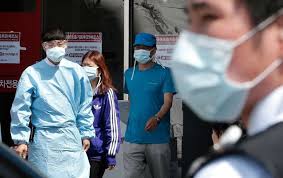
South Korea fails to contain MERS

Hong Kong issued a red alert and advised against traveling to South Korea, where an epidemic of Middle East Respiratory Syndrome (MERS) is gaining pace. The virus is spreading despite attempts to contain the outbreak.

In Korea, the number of infected people passed 100 this week, reaching 122 on Thursday. Tenth patient died from the disease, health officials said on Thursday. Most of the victims are elderly patients with other health problems unrelated to the virus. Over 3,250 people remain in quarantine.

Two people in Hong Kong who traveled to South Korea recently are being tested for possible MERS contagion, the authorities said on Thursday. Previously 31 people were tested negative in Hong Kong.

Earlier a man tested positive for the disease in China after coming from S. Korea, and a man in Taiwan was taken to hospital with symptoms consistent with MERS.

South Korean authorities are trying to stop the spread of the virus by closing schools and canceling public events. Neighbors in the region are scaling down tourist travel to South Korea, with Hong Kong alone scrapping 600 tours to the MERS-hit country.

Macau issued an advisory against traveling to South Korea.

MERS most likely spread to South Korea from Saudi Arabia, where the virus was first identified in 2012. At least 448 deaths are attributed to it, most of them in the Middle East, according to the World Health Organization numbers. The Korean outbreak is the largest so far outside the Middle East.

The virus is of the same coronavirus family that caused a massive epidemic in China in 2003 from severe acute respiratory syndrome (SARS). So far there is no vaccine for MERS.

Formaldehyde in water allegedly causing ebola-like symptoms

A man in Schieffelin, Liberia, has been arrested for attempting to put formaldehyde into a well used by the community.

Reports say around 10 a.m., he approached the well with powder in a bottle. Mobbed by the community, he confessed that he had been paid to put formaldeyde into the well, and that he was not the only one. He reportedly told community dwellers, “We are many.” There are are agents in Harbel, Dolostown, Cotton Tree and other communities around the ountry, he said.

State radio, ELBC, reports that least 10 people in the Dolostown community have died after drinking water from poisoned wells.
The man also alleged that some water companies, particularly those bagging mineral water to sell, are also involved. The poison, he said, produces Ebola-like symptoms and subsequently kills people.

The Observer had previously been informed that people dressed as nurses were going into communities with ‘Ebola Vaccines’. Once injected, it reportedly produces Ebola-like symptoms and sends victims into a coma. Shortly thereafter, victims expire. Communities are now reportedly chasing vaccine peddlers out of their communities. After 10 children reportedly died from the ‘vaccine’ in Bensonville, the peddlers were reportedly chased out of the community upon their next visit.

It is possible that the ‘vaccine’ is/was composed of the same formaldehyde-water mixture. This publication has received reports from families whose loved ones’ organs were missing upon return of the bodies to the families. Families suspect an organ trafficking operation is capitalizing on the outbreak of the Ebola virus in Liberia.

The district’s representative condemned the act as barbaric, but called upon Liberians not to doubt the existence of the Ebola virus in the country.

An investigation is ongoing.

Source: The Observer

Ebola outbreak due to ‘moral bankruptcy’ of Big Pharma

Britain’s leading public health doctor today blames the failure to find a vaccine against the Ebola virus on the “moral bankruptcy” of the pharmaceutical industry to invest in a disease because it has so far only affected people in Africa – despite hundreds of deaths.

Professor John Ashton, the president of the UK Faculty of Public Health, says the West needs to treat the deadly virus as if it were taking hold in the wealthiest parts of London rather than just Sierra Leone, Guinea and Liberia.

Writing in The Independent on Sunday, Professor Ashton compares the international response to Ebola to that of Aids, which was killing people in Africa for years before treatments were developed once it had spread to the US and UK in the 1980s.

He writes: “In both cases [Aids and Ebola], it seems that the involvement of powerless minority groups has contributed to a tardiness of response and a failure to mobilise an adequately resourced international medical response.

“In the case of Aids, it took years for proper research funding to be put in place and it was only when so-called ‘innocent’ groups were involved (women and children, haemophiliac patients and straight men) that the media, politicians, scientific community and funding bodies stood up and took notice.”

Source: The Independent

US to test Ebola vaccine on people

The U.S. government will begin testing on people an experimental Ebola vaccine as early as September, after seeing positive results from tests on primates, according to media reports on Thursday.

The National Institutes of Health’s infectious disease unit is working with the U.S. Food and Drug Administration to put the vaccine into trial as quickly as possible, according to CNN and USA Today. The director of that unit could not be reached for comment.

Source: Reuters