RIP Nelson Mandela

Nelson Mandela Muntz, the main bully in The Simpsons.

By Brian Goldfarb.

Ben Cohen has written a most perceptive remembrance of Nelson Mandela on 5 December, the day he died, in The Algemeiner. Before quoting some of that, I’d like to add my own memories of Mandela.

Early on, Cohen remembers where he was when Mandela walked free from prison. Well, we watched it on television at home, and then listened on the radio. I remember being astounded when the radio commentator expressed surprise, not to say astonishment, when Mandela got out of his car and walked out of the prison gates.

I am old enough to have been a student with a poster remembering the Sharpeville Massacre (those reading this aged less than 30 may need to Google that) on my wall, as well as other anti-apartheid posters thereon. Indeed, the Sharpeville massacre was the final straw in creating my own personal boycott of South African goods (from then – in 1960, two years before I became a university student – until 1991, when Mandela was released from prison), and I can remember when Mandela and his comrades were sentenced to jail for “treason”. Just imagine it, being called a traitor for demanding equal treatment, indeed freedom, for your people: difficult for those under 40, perhaps even for those under 50 (sorry, I’m trying not to be a reverse ageist here, but you have to have been there, in the 60s and 70s to understand this): we saw it unfold and wondered at the stupidity of the Afrikaaner South Africans – not difficult, they did appear to have a problem in coming to terms with the modern world.

I remember thinking, when the apartheid regime (the real one: the one at the tip of the African continent) sentenced him to life imprisonment that maybe, just maybe, they had avoided the obvious risk of creating a martyr. It turned out that that they had, instead, created the only avenue of escape from the corner they were painting themselves into, even it did take 27 painful years to become a reality.

I also remember Steve Biko, effectively beaten to death, who might otherwise have been one of the contenders for the succession to Mandela as President. And I also remember that other far right whites killed another likely (and potentially great) successor to Mandela: Chris Hani, leaving only, sadly, mediocre people to succeed Mandela.

But I also remember that many of Mandela’s comrades were Jews: I remember Joe Slovo, who survived to become Housing Minister in the Rainbow Nation, before succumbing to cancer; I remember Ruth First, his wife, assassinated by BOSS (the South African Bureau of State Security) with a parcel bomb when she had been exiled to Mozambique; I remember Benjamin Pogrund, anti-apartheid fighter who, having made aliyah, now rejects the equation of Israel=apartheid; and I remember Arthur Goldreich, of whom Cohen says:

“[Mandela] recalls that he learned about guerilla warfare not from Fidel Castro, but from Arthur Goldreich, a South African Jew who fought with the Palmach during Israel’s War of Independence.” Further, Mandela “relates the anecdote that the only airline willing to fly his friend, Walter Sisulu, to Europe without a passport was Israel’s own El Al.”

Of course, many of these Jews were Stalinists (such as Joe Slovo and the viciously anti-Israel Ronnie Kasrils). To understand their position (if it’s possible to do that), I would remind readers of the book by Colin Shindler “Israel & The Left“, mentioned in my report on London’s Jewish Book Week, 2012, on this blog.

On the other hand, there are those non-Stalinists Jews, such as Albie Sachs, who lost an arm and an eye to the struggle, and the Jewish lawyers who took Mandela on as an articled clerk, when this just wasn’t done. This enabled Mandela to complete his qualifications and become an accredited lawyer of the South African system. Just as we all know that there are anti-Zionist Jews (would we condemn all Haredi Jews just because of Naturei Kartura? I hope not), similarly, we shouldn’t condemn all anti-apartheid South African Jews because of those who were and are anti-Zionist (and by implication, cast doubts on Mandela’s own philo-semitism and support for Israel).

Furthermore, for anyone who still wants to believe that Mandela was an anti-Zionist, Cohen goes on to say (re Mandela autobiography) that

“the ultimate smoking gun — the equation of Israel’s democracy with apartheid — doesn’t exist.”

There is more. Cohen goes on to note that:

“Mandela once wrote that Jews, in his experience, were far more sensitive about race because of their own history. Now, it is absolutely true that there are parallels between the oppression suffered by South African blacks under racist white rulers, and Jews living under hostile non-Jewish rulers. The notorious Group Areas Act, which restricted black residency rights, brings to mind the enforced separation of Jews into the “Pale of Settlement” by the Russian Empress Catherine in 1791. Many of the other apartheid regulations, like the ban on sexual relationships between whites and blacks, carried echoes of the Nazi Nuremburg Laws of 1935.”

Indeed, whatever their political orientation, Jews are noted for their respect for human rights, both for themselves and their fellow Jews and, just as importantly, for others, having their own flouted so often. Why else create Israel as parliamentary democracy?

All this culminates in Cohen noting that:

“Mandela’s diagnosis was that Africans should be the sovereigns of their own destiny. Similarly, the founders of Zionism wanted nothing less for the Jews.”

That is, Nelson Mandela was not only did not oppose Zionism and the idea of self-determination for Jews (i.e., a state of their own), he also recognised that South African Jews had played a great part in the fight for equality in South Africa, out of a conviction that, as the American Declaration of Independence has it, “All [people] are created equal”.

Source: Blog

NATO acting out a deliberate charade in Europe

foolsjohnstoneby Diana Johnstone.

NATO leaders are currently acting out a deliberate charade in Europe, designed to reconstruct an Iron Curtain between Russia and the West.

With astonishing unanimity, NATO leaders feign surprise at events they planned months in advance. Events that they deliberately triggered are being misrepresented as sudden, astonishing, unjustified “Russian aggression”. The United States and the European Union undertook an aggressive provocation in Ukraine that they knew would force Russia to react defensively, one way or another.

They could not be sure exactly how Russian president Vladimir Putin would react when he saw that the United States was manipulating political conflict in Ukraine to install a pro-Western government intent on joining NATO. This was not a mere matter of a “sphere of influence” in Russia’s “near abroad”, but a matter of life and death to the Russian Navy, as well as a grave national security threat on Russia’s border.

A trap was thereby set for Putin. He was damned if he did, and damned if he didn’t. He could under-react, and betray Russia’s basic national interests, allowing NATO to advance its hostile forces to an ideal attack position.

Or he could over-react, by sending Russian forces to invade Ukraine. The West was ready for this, prepared to scream that Putin was “the new Hitler”, poised to overrun poor, helpless Europe, which could only be saved (again) by the generous Americans.

In reality, the Russian defensive move was a very reasonable middle course. Thanks to the fact that the overwhelming majority of Crimeans felt Russian, having been Russian citizens until Khrushchev frivolously bestowed the territory on Ukraine in 1954, a peaceful democratic solution was found. Crimeans voted for their return to Russia in a referendum which was perfectly legal according to international law, although in violation of the Ukrainian constitution, which was by then in tatters having just been violated by the overthrow of the country’s duly elected president, Victor Yanukovych, facilitated by violent militias. The change of status of Crimea was achieved without bloodshed, by the ballot box.

Nevertheless, the cries of indignation from the West were every bit as hysterically hostile as if Putin had overreacted and subjected Ukraine to a U.S.-style bombing campaign, or invaded the country outright – which they may have expected him to do.

U.S. Secretary of State John Kerry led the chorus of self-righteous indignation, accusing Russia of the sort of thing his own government is in the habit of doing. “You just don’t invade another country on phony pretext in order to assert your interests. This is an act of aggression that is completely trumped up in terms of its pretext”, Kerry pontificated. “It’s really 19th century behavior in the 21st century”. Instead of laughing at this hypocrisy, U.S. media, politicians and punditry zealously took up the theme of Putin’s unacceptable expansionist aggression. The Europeans followed with a weak, obedient echo.

It Was All Planned at Yalta

In September 2013, one of Ukraine’s richest oligarchs, Viktor Pinchuk, paid for an elite strategic conference on Ukraine’s future that was held in the same Palace in Yalta, Crimea, where Roosevelt, Stalin and Churchill met to decide the future of Europe in 1945. The Economist, one of the elite media reporting on what it called a “display of fierce diplomacy”, stated that: “The future of Ukraine, a country of 48m people, and of Europe was being decided in real time.” The participants included Bill and Hillary Clinton, former CIA head General David Petraeus, former U.S. Treasury secretary Lawrence Summers, former World Bank head Robert Zoellick, Swedish foreign minister Carl Bildt, Shimon Peres, Tony Blair, Gerhard Schröder, Dominique Strauss-Kahn, Mario Monti, Lithuanian president Dalia Grybauskaite, and Poland’s influential foreign minister Radek Sikorski. Both President Viktor Yanukovych, deposed five months later, and his recently elected successor Petro Poroshenko were present. Former U.S. energy secretary Bill Richardson was there to talk about the shale-gas revolution which the United States hopes to use to weaken Russia by substituting fracking for Russia’s natural gas reserves. The center of discussion was the “Deep and Comprehensive Free Trade Agreement” (DCFTA) between Ukraine and the European Union, and the prospect of Ukraine’s integration with the West. The general tone was euphoria over the prospect of breaking Ukraine’s ties with Russia in favor of the West.

Conspiracy against Russia? Not at all. Unlike Bilderberg, the proceedings were not secret. Facing a dozen or so American VIPs and a large sampling of the European political elite was a Putin adviser named Sergei Glazyev, who made Russia’s position perfectly clear.

Glazyev injected a note of political and economic realism into the conference. Forbes reported at the time on the “stark difference” between the Russian and Western views “not over the advisability of Ukraine’s integration with the EU but over its likely impact.” In contrast to Western euphoria, the Russian view was based on “very specific and pointed economic criticisms” about the Trade Agreement’s impact on Ukraine’s economy, noting that Ukraine was running an enormous foreign accounts deficit, funded with foreign borrowing, and that the resulting substantial increase in Western imports could only swell the deficit. Ukraine “will either default on its debts or require a sizable bailout”.

The Forbes reporter concluded that “the Russian position is far closer to the truth than the happy talk coming from Brussels and Kiev.”

As for the political impact, Glazyev pointed out that the Russian-speaking minority in Eastern Ukraine might move to split the country in protest against cutting ties with Russia, and that Russia would be legally entitled to support them, according to The Times of London.

In short, while planning to incorporate Ukraine into the Western sphere, Western leaders were perfectly aware that this move would entail serious problems with Russian-speaking Ukrainians, and with Russia itself. Rather than seeking to work out a compromise, Western leaders decided to forge ahead and to blame Russia for whatever would go wrong. What went wrong first was that Yanukovych got cold feet faced with the economic collapse implied by the Trade Agreement with the European Union. He postponed signing, hoping for a better deal. Since none of this was explained clearly to the Ukrainian public, outraged protests ensued, which were rapidly exploited by the United States… against Russia.

Ukraine as Bridge…Or Achilles Heel

Ukraine, a term meaning borderland, is a country without clearly fixed historical borders that has been stretched too far to the East and too far to the West. The Soviet Union was responsible for this, but the Soviet Union no longer exists, and the result is a country without a unified identity and which emerges as a problem for itself and for its neighbors.

It was extended too far East, incorporating territory that might as well have been Russian, as part of a general policy to distinguish the USSR from the Tsarist empire, enlarging Ukraine at the expense of its Russian component and demonstrating that the Soviet Union was really a union among equal socialist republics. So long as the whole Soviet Union was run by the Communist leadership, these borders didn’t matter too much.

It was extended too far West at the end of World War II. The victorious Soviet Union extended Ukraine’s border to include Western regions, dominated by the city variously named Lviv, Lwow, Lemberg or Lvov, depending on whether it belonged to Lithuania, Poland, the Hapsburg Empire or the USSR, a region which was a hotbed of anti-Russian sentiments. This was no doubt conceived as a defensive move, to neutralize hostile elements, but it created the fundamentally divided nation that today constitutes the perfect troubled waters for hostile fishing.

The Forbes report cited above pointed out that: “For most of the past five years, Ukraine was basically playing a double game, telling the EU that it was interested in signing the DCFTA while telling the Russians that it was interested in joining the customs union.” Either Yanukovych could not make up his mind, or was trying to squeeze the best deal out of both sides, or was seeking the highest bidder. In any case, he was never “Moscow’s man”, and his downfall owes a lot no doubt to his own role in playing both ends against the middle. His was a dangerous game of pitting greater powers against each other.

It is safe to say that what was needed was something that so far seems totally lacking in Ukraine: a leadership that recognizes the divided nature of the country and works diplomatically to find a solution that satisfies both the local populations and their historic ties with the Catholic West and with Russia. In short, Ukraine could be a bridge between East and West – and this, incidentally, has been precisely the Russian position. The Russian position has not been to split Ukraine, much less to conquer it, but to facilitate the country’s role as bridge. This would involve a degree of federalism, of local government, which so far is entirely lacking in the country, with local governors selected not by election but by the central government in Kiev. A federal Ukraine could both develop relations with the EU and maintain its vital (and profitable) economic relations with Russia.

But this arrangement calls for Western readiness to cooperate with Russia. The United States has plainly vetoed this possibility, preferring to exploit the crisis to brand Russia “the enemy”.

Plan A and Plan B

U.S. policy, already evident at the September 2013 Yalta meeting, was carried out on the ground by Victoria Nuland, former advisor to Dick Cheney, deputy ambassador to NATO, spokeswoman for Hillary Clinton, wife of neocon theorist Robert Kagan. Her leading role in the Ukraine events proves that the neo-con influence in the State Department, established under Bush II, was retained by Obama, whose only visible contribution to foreign policy change has been the presence of a man of African descent in the presidency, calculated to impress the world with U.S. multicultural virtue. Like most other recent presidents, Obama is there as a temporary salesman for policies made and executed by others.

As Victoria Nuland boasted in Washington, since the dissolution of the Soviet Union in 1991, the United States has spent five billion dollars to gain political influence in Ukraine (this is called “promoting democracy”). This investment is not “for oil”, or for any immediate economic advantage. The primary motives are geopolitical, because Ukraine is Russia’s Achilles’ heel, the territory with the greatest potential for causing trouble to Russia.

What called public attention to Victoria Nuland’s role in the Ukrainian crisis was her use of a naughty word, when she told the U.S. ambassador, “Fuck the EU”. But the fuss over her bad language veiled her bad intentions. The issue was who should take power away from the elected president Viktor Yanukovych. German Chancellor Angela Merkel’s party has been promoting former boxer Vitaly Klitschko as its candidate. Nuland’s rude rebuff signified that the United States, not Germany or the EU, was to choose the next leader, and that was not Klitschko but “Yats”. And indeed it was Yats, Arseniy Yatsenyuk , a second-string US-sponsored technocrat known for his enthusiasm for IMF austerity policies and NATO membership, who got the job. This put a U.S. sponsored government, enforced in the streets by fascist militia with little electoral clout but plenty of armed meanness, in a position to manage the May 25 elections, from which the Russophone East was largely excluded.

Plan A for the Victoria Nuland putsch was probably to install, rapidly, a government in Kiev that would join NATO, thus formally setting the stage for the United States to take possession of Russia’s indispensable Black Sea naval base at Sebastopol in Crimea. Reincorporating Crimea into Russia was Putin’s necessary defensive move to prevent this.

But the Nuland gambit was in fact a win-win ploy. If Russia failed to defend itself, it risked losing its entire southern fleet – a total national disaster. On the other hand, if Russia reacted, as was most likely, the US thereby won a political victory that was perhaps its main objective. Putin’s totally defensive move is portrayed by the Western mainstream media, echoing political leaders, as unprovoked “Russian expansionism”, which the propaganda machine compares to Hitler grabbing Czechoslovakia and Poland.

Thus a blatant Western provocation, using Ukrainian political confusion against a fundamentally defensive Russia, has astonishingly succeeded in producing a total change in the artificial Zeitgeist produced by Western mass media. Suddenly, we are told that the “freedom-loving West” is faced with the threat of “aggressive Russian expansionism”. Some forty years ago, Soviet leaders gave away the store under the illusion that peaceful renunciation on their part could lead to a friendly partnership with the West, and especially with the United States. But those in the United States who never wanted to end the Cold War are having their revenge. Never mind “communism”; if, instead of advocating the dictatorship of the proletariat, Russia’s current leader is simply old-fashioned in certain ways, Western media can fabricate a monster out of that. The United States needs an enemy to save the world from.

The Protection Racket Returns

But first of all, the United States needs Russia as an enemy in order to “save Europe”, which is another way to say, in order to continue to dominate Europe. Washington policy-makers seemed to be worried that Obama’s swing to Asia and neglect of Europe might weaken U.S. control of its NATO allies. The May 25 European Parliament elections revealed a large measure of disaffection with the European Union. This disaffection, notably in France, is linked to a growing realization that the EU, far from being a potential alternative to the United States, is in reality a mechanism that locks European countries into U.S.-defined globalization, economic decline and U.S. foreign policy, wars and all.

Ukraine is not the only entity that has been overextended. So has the EU. With 28 members of diverse language, culture, history and mentality, the EU is unable to agree on any foreign policy other than the one Washington imposes. The extension of the EU to former Eastern European satellites has totally broken whatever deep consensus might have been possible among the countries of the original Economic Community: France, Germany, Italy and the Benelux states. Poland and the Baltic States see EU membership as useful, but their hearts are in America – where many of their most influential leaders have been educated and trained. Washington is able to exploit the anti-communist, anti-Russian and even pro-Nazi nostalgia of northeastern Europe to raise the false cry of “the Russians are coming!” in order to obstruct the growing economic partnership between the old EU, notably Germany, and Russia.
le-grand-echiquier-2Russia is no threat. But to vociferous Russophobes in the Baltic States, Western Ukraine and Poland, the very existence of Russia is a threat. Encouraged by the United States and NATO, this endemic hostility is the political basis for the new “iron curtain” meant to achieve the aim spelled out in 1997 by Zbigniew Brzezinski in The Grand Chessboard: keeping the Eurasian continent divided in order to perpetuate U.S. world hegemony. The old Cold War served that purpose, cementing U.S. military presence and political influence in Western Europe. A new Cold War can prevent U.S. influence from being diluted by good relations between Western Europe and Russia.

Obama has come to Europe ostentatiously promising to “protect” Europe by basing more troops in regions as close as possible to Russia, while at the same time ordering Russia to withdraw its own troops, on its own territory, still farther away from troubled Ukraine. This appears designed to humiliate Putin and deprive him of political support at home, at a time when protests are rising in Eastern Ukraine against the Russian leader for abandoning them to killers sent from Kiev.

To tighten the U.S. grip on Europe, the United States is using the artificial crisis to demand that its indebted allies spend more on “defense”, notably by purchasing U.S. weapons systems. Although the U.S. is still far from being able to meet Europe’s energy needs from the new U.S. fracking boom, this prospect is being hailed as a substitute for Russia’s natural gas sales – stigmatized as a “way of exercising political pressure”, something of which hypothetic U.S. energy sales are presumed to be innocent. Pressure is being brought against Bulgaria and even Serbia to block construction of the South Stream pipeline that would bring Russian gas into the Balkans and southern Europe.

From D-Day to Dooms Day

Today, June 6, the seventieth anniversary of the D-Day landing is being played in Normandy as a gigantic celebration of American domination, with Obama heading an all-star cast of European leaders. The last of the aged surviving soldiers and aviators present are like the ghosts of a more innocent age when the United States was only at the start of its new career as world master. They were real, but the rest is a charade. French television is awash with the tears of young villagers in Normandy who have been taught that the United States is some sort of Guardian Angel, which sent its boys to die on the shores of Normandy out of pure love for France. This idealized image of the past is implicitly projected on the future. In seventy years, the Cold War, a dominant propaganda narrative and above all Hollywood have convinced the French, and most of the West, that D-Day was the turning point that won World War II and saved Europe from Nazi Germany.

Vladimir Putin came to the celebration, and has been elaborately shunned by Obama, self-appointed arbiter of Virtue. The Russians are paying tribute to the D-Day operation which liberated France from Nazi occupation, but they – and historians – know what most of the West has forgotten: that the Wehrmacht was decisively defeated not by the Normandy landing, but by the Red Army. If the vast bulk of German forces had not been pinned down fighting a losing war on the Eastern front, nobody would celebrate D-Day as it is being celebrated today.

Putin is widely credited as being “the best chess player”, who won the first round of the Ukrainian crisis. He has no doubt done the best he could, faced with the crisis foisted on him. But the U.S. has whole ranks of pawns which Putin does not have. And this is not only a chess game, but chess combined with poker combined with Russian roulette. The United States is ready to take risks that the more prudent Russian leaders prefer to avoid… as long as possible.

Perhaps the most extraordinary aspect of the current charade is the servility of the “old” Europeans. Apparently abandoning all Europe’s accumulated wisdom, drawn from its wars and tragedies, and even oblivious to their own best interests, today’s European leaders seem ready to follow their American protectors to another D-Day … D for Doom.

Can the presence of a peace-seeking Russian leader in Normandy make a difference? All it would take would be for mass media to tell the truth, and for Europe to produce reasonably wise and courageous leaders, for the whole fake war machine to lose its luster, and for truth to begin to dawn. A peaceful Europe is still possible, but for how long?

Diana Johnstone is the author of Fools’ Crusade: Yugoslavia, NATO, and Western Delusions.

Source: Counterpunch

Two killers probably tortured German employer

Erich Poll
Erich Poll

Two Cape Town coloured men have been convicted for murdering their German employer, then throwing his body down the mountainside.

Erich Poll, 46, was strangled at his business premises in Woodstock, not far from the Old Biscuit Mill, on April 9 last year.

Judge Gamble said it was probable that they had become “greedy”, forcing Poll to give them his banking pin numbers. “He (Poll) had to be threatened and probably tortured,” he said.

While he was originally from Cologne in Germany, he lived and co-owned a wood and metal furniture design business in Cape Town.

Judge Pat Gamble on Monday found Victor Jacobs and Neville Martin guilty of Poll’s murder in the Western Cape High Court, saying there was “overwhelming” evidence that they were the killers.

Poll was strangled. He was robbed of his bakkie, iPhone, iPad and R16 000.

According to Judge Gamble’s findings, there was little doubt that Poll was murdered in the factory, probably in his office. He had been killed that morning and his body had been thrown down the mountainside at the Du Toit’s Kloof Pass six to eight hours later.

Judge Gamble said both Jacobs and Martin had been at the factory that day.

If the incident had been the work of one or more “outsiders”, he said, they would have seen what was happening and hastened to Poll’s assistance.

He found that the two had acted together in beating up, handcuffing and strangling Poll. The court was unable to say whether the killing was premeditated as it was uncertain whether the pair had gone to work that day with the intention to kill their employer.

Source: IOL

Angler shot dead trying to rescue friend

strandfonteinA fellow angler was shot dead in front of a friend while coming to his rescue during a horrific attempted robbery on Strandfontein beach.

Alvin Allies, from Northpine, was killed instantly after being hit by a bullet in the pancreas on Sunday morning, his friend Pieter Terblanche told the Cape Times on Monday.

“He came to help me. He was running in the line of fire to come to my rescue. He could have run away but died because he wanted to help his friend,” Terblanche said.

He said he had worked with Allies since 2011 and the latter had used that specific spot, which he referred to as the Guntry, for more than 20 years.

The ordeal, at about 4am near a tidal pool, began when two “young criminals” approached Terblanche and Allies asking for petrol.

Terblanche said he referred the men to the offices of the National Sea Rescue Institute (NSRI) but they returned minutes later, this time wanting cigarettes.

They then left again.

When they returned yet again, one of the men confronted Terblanche with a firearm while Allies went to remove the last of their fishing rods from the water.

“The second chap came with a knife and wanted to stab me but I pulled his buddy in front of me and he stabbed him. We continued to wrestle and a lot of shots went off, but they missed me,” Terblanche said.

“My friend came back from the water and knocked the other guy with the fishing rod. As (Allies) was coming to assist me he was hit by a bullet. He was running in the line of fire.”

Allies is survived by his wife, children, mother and a brother, Terblanche said.

“It is hard on them (the Allies family). It is hard on all of us, his friends and the other fishermen,” he said.

The two men fled after Allies was hit. Terblanche, who had dislocated his shoulder during the altercation, ran to the NSRI’s rescue base for help. Terblanche alleged that the police took a while to get there because they had to walk to the scene as there were no proper vehicles to drive on the beach.

“Something must be done to ensure safety on our beaches. Idiotic criminals like these can just do whatever they please,” he said.

“These places are used by a lot of people and the government must do something.”

Source: IOL

Marine Le Pen: EU indifferent to suffering in eastern Ukraine

france-le-penThe leader of the Front National party Marine Le Pen talks to Sophie Shevardnadze on RT.

SS: Obama said the security of America’s European allies is sacrosanct, promising to boost U.S. military deployments and exercises around Europe. Does Europe need this kind of support?

MP: To defend ourselves against whom? […] To defend ourselves against whom? Well, you know that we are for leaving NATO, for France leaving NATO, we have a Gaullian vision of what international politics must be like, we are for developing our relations with Russia, without breaking ties with the United States. We believe that France must maintain its relations with all of the world’s great nations, and we do not want to be imposed with a way of seeing things by anybody. We aspire to have the freedom to determine the quality and the level of our international relations. But… to defend ourselves against whom? When we asked this question to a French politician, his answer was “China”. It almost makes you laugh. We can clearly see that, as a matter of fact, this is an opportunity for the United States to carry out military integration, and maybe tomorrow, economic integration, to extend the scope of its influence. The free-trade agreement that the United States want to sign at any price is really just another way to tie the European Union, in a quasi-definitive way, to the United States. This is, once again, a loss of independence, not to mention the catastrophic consequences that this free-trade agreement would have for us in terms of agriculture, industry, defence, etc. So this is much more a geopolitical treaty than a purely commercial or economic treaty.

S: The G7 condemned Russia for the situation in Ukraine, vowed more sanctions…Why are Western leaders calling on Russia and President Putin to end the violence, and not the government in Kiev, the newly-elected president they’ve been meeting with?

MP: That’s a good question. Because we are at the culmination of a Cold War that has been fought against Russia by the United States, to which the European capitals have completely submitted on an international level. It’s as simple as that, and a shame as well. And I would like to seize this opportunity to express my compassion and my sadness and my disgust to see these civil victims in the East of Ukraine, who are dying surrounded by the general indifference of the European political world and media. It is a real scandal which is happening on our doorstep, and you are right to say that from the moment Ukraine has a legitimate government, it is the government which must take responsibility. But for this, we would need to demand that the Ukrainian government dismantle and disarm the reigning militia, which would most likely embarrass a number of people.

SS: The elections in Ukraine were quick to be accepted by the major powers in the West – despite the civil war that’s going on in the country and the fact that there was no vote in the country’s rebellious East. At the same time, the elections in Syria, were branded illegitimate even before they were held. Why?

MP: Yes, but this has been happening for years! I mean, such and such decides who is on the good side and who is on the bad side. And this can change at any moment. The good guys of today will be the bad guys of tomorrow, and maybe the bad guys of today will become good tomorrow, if Washington decides that it is to their advantage to make them good. It is a shame, since there is a substantial amount of mistakes that have been made at an international level under Washington’s influence, especially in Syria. We were the only ones among the French political parties to oppose intervention in Syria, the first and only ones who, from the beginning, said that we were arming Islamic fundamentalists, who would, if they did win, implement a reign of terror like they did in Libya. This was, once again, because of us. We helped them come to power. This is the American method, the international American method: they defend their interests, or they think that they are defending them, since sometimes they make serious mistakes. What is terrible is that European countries no longer have a say in things. There are no more sovereign nations in Europe that can be the voice of reason for peaceful settlement of conflicts, the voice of balance between different interests of different nations.

SS: You’ve said the EU is responsible for the situation in Ukraine – did it ever know what it was getting into?

MP: By definition, it is not up to me to defend the competency of these bodies. To not know this would be tragic – such geopolitical ignorance seems astounding to me. Nevertheless, the result is there – the European Union did not play the role that it could have played, and it contributed to aggravating the situation. What is really a shame is that countries like France no longer have a diplomatic voice – because here is a conflict in which France, if it had kept a strong political voice, a balancing voice like the one I want it to recover, it could totally manage to overcome these difficulties. The diplomacy of the European Union is a catastrophe, and not only in Ukraine – each time the European Union participates on the global stage, it is usually either to create a problem or to aggravate it.

SS: A little while back there was talk about the new rising superpower – the European Union. These elections showed that the bloc is far from being a universally approved, superstate. Will Europe never unite now?

MP: Europe is not at stake; it is the European Union that is at stake. Europe exists, and it consists of nations whose wealth lies in their uniqueness, their sovereignty, their freedom, their democracy. So, I am for a Europe of nations – I wish that tomorrow we can constitute a Europe that could expand, but to countries that have preserved their sovereignty and that would work together on cooperative projects. This is what works, and this is what I want to implement, but in order to do this, we have to deconstruct this European Union.

Source: RT

Eugene Goostman fools humans

Eugene Goostman
Eugene Goostman

A programme that convinced humans that it was a 13-year-old boy has become the first computer ever to pass the Turing Test. The test — which requires that computers are indistinguishable from humans — is considered a landmark in the development of artificial intelligence, but academics have warned that the technology could be used for cybercrime.

Computing pioneer Alan Turing said that a computer could be understood to be thinking if it passed the test, which requires that a computer dupes 30 per cent of human interrogators in five-minute text conversations.

Eugene Goostman, a computer programme made by a team based in Russia, succeeded in a test conducted at the Royal Society in London. It convinced 33 per cent of the judges that it was human, said academics at the University of Reading, which organised the test.

It is thought to be the first computer to pass the iconic test. Though other programmes have claimed successes, those included set topics or questions in advance.

A version of the computer programme, which was created in 2001, is hosted online for anyone talk to. (“I feel about beating the turing test in quite convenient way. Nothing original,” said Goostman, when asked how he felt after his success.)

The computer programme claims to be a 13-year-old boy from Odessa in Ukraine.

“Our main idea was that he can claim that he knows anything, but his age also makes it perfectly reasonable that he doesn’t know everything,” said Vladimir Veselov, one of the creators of the programme. “We spent a lot of time developing a character with a believable personality.”

The programme’s success is likely to prompt some concerns about the future of computing, said Kevin Warwick, a visiting professor at the University of Reading and deputy vice-chancellor for research at Coventry University.

“Having a computer that can trick a human into thinking that someone, or even something, is a person we trust is a wake-up call to cybercrime.

“The Turing Test is a vital tool for combatting that threat. It is important to understand more fully how online, real-time communication of this type can influence an individual human in such a way that they are fooled into believing something is true… when in fact it is not.”

Source: The Independent

Illegal immigrants pour into US

illegalsIn recent weeks, a tide of young, unaccompanied minors crossing the Texas border illegally has pushed the US immigration system to its breaking point. Unable to cope with the volume of children crossing the border without their parents, immigration authorities have had to find emergency solutions, such as housing thousands in a San Antonio Air Force base, a California Navy base, and a makeshift detention center in Nogales, Ariz.

The Associated Press reported that the Nogales warehouse was running out of supplies.

The Obama administration has linked the trend to unrest in Central American countries, but Republican critics say an executive action that the president took in 2012 is to blame, calling the situation “an administration-made disaster.”

President Obama delayed rolling out new deportation reforms in late May partly because did didn’t want to further anger Republicans who accuse him of unconstitutionally bypassing Congress to set immigration policy. Now, if he proceeds, he will have to fend off fresh claims that the very policies he has set have pushed the country into crisis.

At issue is Mr. Obama’s Deferred Action for Childhood Arrivals (DACA), which in 2012 allowed some undocumented immigrants who came to America as minors to defer deportation for two years. Last week, the administration announced guidelines for how these immigrants could defer deportation for a further two years.

DACA would not apply to anyone coming across the border today. Only undocumented immigrants who were brought to the US as minors before June 15, 2007, are eligible. But to Republican critics, DACA created the opportunity for misinformation and confusion.

“Word has gotten out around the world about President Obama’s lax immigration enforcement policies and it has encouraged more individuals to come to the United States illegally,” said Rep. Bob Goodlatte (R) of Virginia, a key broker in immigration reform efforts on Capitol Hill, in a statement last week.

The numbers are stark.

During the decade preceding fiscal year 2012, the federal government agency tasked with caring for unaccompanied minors who cross the border illegally dealt with an average of 7,000 to 8,000 cases a year, according to a Department of Health and Human Services fact sheet. In fiscal year 2011, the number was 6,560.

The following year, however, the number jumped to 13,625. This fiscal year, which ends Sept. 30, 2014, federal officials are estimating that the number could be 80,000, according to an internal memo cited by The New York Times.

Source: DC Decoder

‘Freemasons planted seeds of Apartheid’

masoniclodgeOn the grounds of Parliament, close to Tuynhuys in the heart of Cape Town, the Lodge De Goede Hoop is hidden behind a parking lot filled with expensive ministerial cars.

It is an old, white, plastered building, writes City Press.

Only the Freemason symbol on the window and the Star of David above the large wooden doors show that this is not just another ­parliamentary building.

There are many conspiracy theories, ­alleged links with murders, and those who ­believe the Freemasons “planted the seeds” of Apartheid.

The building was inaugurated as the first masonic temple in South Africa in 1803 and is still used daily by its members.

This week, City Press took a tour of the ­temple with the newly appointed Grand Master of the SA Freemasons, Geoff ­Edwards.

On a table in the foyer are a square and a pair of compasses – well-known masonic symbols. On the wall is an engraved list of the names of former masters and the wall beside the front door is adorned with a framed ­photograph of Watty Watson, former ­DA chief whip and retiring Grand Master.

“People say we’re on parliamentary grounds, but that’s not true. Actually, Parliament is on our grounds,” he says.

The first Freemason lodge was formed in Cape Town in 1772 and the temple was built about 30 years later.

The Cape government of the time and the Freemasons were so intertwined that the Cape Parliament used the masonic banquet hall as a venue from 1854 to 1884 until the old House of Assembly was completed.

Others say that from the organisation’s ­inception in the 14th century, it has been the ­secret hand that is quietly ruling the world.

Not true, according to Edwards, taking us into the meditation chamber with its sinister statue of a dead man with a dagger, a book and an hourglass, and the words “know thyself”.

Two artificial human skulls add a chilling edge to the room. “People say the Freemasons have ruled the world over the centuries, but the truth is ­that many rulers were simply ­masons,” he says.

“Like many other organisations, we have been attacked aggressively in the past. During World War 2, Hitler tried to wipe out the ­Freemasons.

The most fascinating room in the Lodge De Goede Hoop is undoubtedly the middle chamber. With only two small windows letting in a sliver of light, the room is dark even in the ­middle of the day. Here, ceremonies are held at night in the pitch dark to remind members just how fleeting their lives are.

The organisation is open to all races, but does not accept women as members. There are female lodges in some parts of the world, but they are not recognised by the Freemasons’ constitution.

“In our lodge we have members of ­Parliament from three different political ­parties and they all get on tremendously well together,” he boasts.

Source: City Press

European Central Bank cuts interest rates to below zero

The European Central Bank

The European Central Bank cut interest rates to record lows on Thursday, imposing negative rates on its overnight depositors to cajole banks into lending more and to fight off the risk of Japan-like deflation.

The cut, the first time the ECB has deployed a negative deposit rate which effectively charges banks to deposit overnight, was a response to a slowdown in inflation far below the ECB’s target and to weak euro zone lending.

That is a combination that risks dragging the bloc into an economic quagmire.

The ECB lowered the deposit rate to -0.1 percent, meaning it will effectively charge banks for holding their money overnight. It cut its main refinancing rate to 0.15 percent, and the marginal lending rate – or emergency borrowing rate – to 0.40 percent.

Markets sent the euro EUR= to a four-month low of $1.3575 after the news.

“Further monetary policy measures to enhance the functioning of the monetary policy transmission mechanism will be communicated in a press release to be published at 3.30 p.m. CET today,” the ECB said in a statement.

Investors first turn their attention to ECB President Mario Draghi’s 1230 GMT news conference at which he is widely expected to present other measures to complement the rate move.

“This is a baby rate cut – a tweak to the policy stance,” said RBS economist Richard Barwell, adding that Draghi needed to announce a bundle of measures to avoid disappointing markets.

Economists polled by Reuters had expected the ECB to cut the refinancing rate to 0.10 percent from 0.25 percent and the deposit rate to -0.10 percent from zero, as well as launching a refinancing operation aimed at funding firms.

Reuters reported last month that the ECB was preparing a package of policy options for this week’s meeting, including the rate cuts and targeted measures with a view to boosting lending to small- and mid-sized firms (SMEs).

“I think expectations are very high,” Barwell added. “To exceed them, I think he (Draghi) is going to have to talk up the prospect of asset purchases in the near future.”

Just hours before the ECB policy decision, a Bank of Japan policymaker sounded a warning, saying the euro zone should not take lightly the potential danger of slipping into a Japan-style deflationary period.

In an April 24 speech, Draghi set out three broad scenarios for ECB policy action and included the possibility of a broad-based asset-purchase program in the event of a worsening of the medium-term inflation outlook.

Such a program is unlikely for now, however, even though euro zone annual inflation unexpectedly slowed to 0.5 percent last month, figures published earlier this week showed. The ECB targets inflation of close to but below 2 percent.

Draghi will present updated inflation and growth projections from ECB staff at his news conference. In March, the forecasts showed it would take 2-1/2 years for inflation to get near the ECB’s target. A weaker outlook will support robust ECB action.

QE ON THE SHELF

The ECB is widely expected to accompany the rate cuts with other measures such as offering banks cheap, long-term funding – a so-called LTRO – on condition that they use this financing to further lending to companies.

Euro zone inflation has been stuck in what Draghi has called “the danger zone” below 1 percent since October, mainly because of weaker commodity and food prices, but also because of wage and other adjustments in euro zone crisis countries.

The stronger euro exchange rate exacerbates these dynamics.

At the same time, record low interest rates are still not feeding through evenly to companies across the currency bloc. Companies in Portugal, for example, are paying on average 5.4 percent on loans compared with 2.2 percent in Finland or France.

This particularly affects smaller companies, which rely strongly on bank funding and make up the bulk of the economy.

Another possibility is the for ECB to extend its provision of unlimited access to central bank funding beyond July 2015.

U.S.-style quantitative easing (QE) – money printing to buy assets – is likely to remain someway off, however, as it is the last weapon at the ECB’s disposal and the barriers to using it are high for the hawkish contingent on the Governing Council.

“We expect the big QE-bazooka to remain in the closet,” said ING economist Carsten Brzeski. – Reuters

8 suspects arrested for stealing roadside metal crash barriers in KZN

Metal crash barriers found on the premises
Metal crash barriers found on the premises in Chatsworth

The KZN Police Integrated Vehicle Task Team arrest eight suspects for the theft of metal crash barriers. Whilst on duty last night at approximately 23:00, the team spotted a group “conducting road work” on Himalaya Road, Merebank. On further inspection it was found that the men were removing the guard rails. After further investigation the team proceeded to a scrap metal dealership in Chatsworth. Hundreds of guard rails were found on the premises. The dealer had paid the suspects over R100 000-00 for the metal. According the municipal officials the replacement value of the crash barriers is over R1 million. Detectives are investigating a case of theft.

The Provincial Commissioner, Lieutenant General Mmamonnye Ngobeni applauded the members for their vigilance which led to the arrest of the suspects. “These guard rails play a vital role on our roads in cases where vehicles are involved in an accident and we will not tolerate the theft of these guard rails. We will also be investigating whether these men are linked to other similar thefts in the greater Durban area,” she said. – Kwazulu-Natal Police Media Service

Big business running a guest worker racket

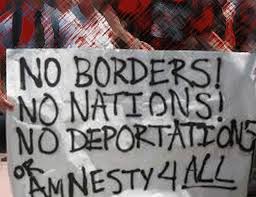
nobordersTom Donohue, U.S. Chamber of Commerce president, just hurled a challenge to Republicans. If they don’t pass amnesty for illegal aliens, they “shouldn’t bother to run a candidate in 2016.”

Somebody probably told him that outrageous statement was a gaffe, which means the inconvenient revelation of an embarrassing viewpoint, so Donohue tried to pass off his threat as a joke. But it isn’t funny; Donohue’s big-business members want us to import more low-paid workers and they want them now, suggesting that this fall’s lame-duck session of Congress would be a good time to implement this racket.

And it is a racket. It’s a carefully planned, well-financed scheme to use false arguments to import foreign workers who will keep wages depressed for American college graduates.

Every time the amnesty issue comes up, and we remind the advocates that it will severely disadvantage low-paid and entry-level American workers by swamping the market with a flood of immigrants to compete for their jobs and depress wages, business leaders offer a compromise. They argue that at least we must accept guest workers on H-1B visas because U.S. STEM (science, technology, engineering and math) graduates are in short supply.

We are even told we should welcome them because the foreign STEM graduates are the best and the brightest. That’s false and also insulting. In the age of political correctness, American STEM graduates should be invited to cry discrimination and demand apologies.

As Obama was hopping around in May from one high-dollar Democratic fundraiser to another, he used his famous pen of the Imperial Presidency to create a new category of guest workers for which he has no statutory authority. He will unilaterally allow the spouses of H1-B visa holders to take U.S. jobs.

Senator Jeff Sessions (R-AL), who is the best friend of American workers, says that Obama’s proposal to create 100,000 more guest worker permits for the spouses of H-1B holders is a plan that will keep 100,000 Americans from finding jobs.

The United States already has more than twice as many workers with STEM degrees as there are STEM jobs. The Economic Policy Institute, the RAND Corporation, the Urban Institute and the National Research Council have all found no evidence that STEM workers are in short supply.

There are more than 5,000,000 native-born Americans with STEM degrees working in non-STEM occupations, and an additional 1.2 million STEM graduates who are unemployed. There is absolutely no STEM worker shortage.

Senator Sessions organized a gathering of real experts on this issue. He included professors who obviously have studied Economics 101 and learned that the law of supply and demand results in wages going up if there is a shortage and down if there is an oversupply.

Rutgers University public policy professor Hal Salzman said that current wages in the high-tech and information technology industries do not indicate that there is any shortage because wages are not going up. In fact, wages are the same as they were when Bill Clinton was president, so Salzman asked, “If there is in fact a shortage, why don’t wages go up?”

Michael Teitelbaum, senior research associate at Harvard Law School and author of a new book on scientific talent, said the high-tech industry has gotten years of a “free ride” from the media about an issue which is really non-debatable because there is no evidence of shortages of scientists and engineers.

Many scholarly studies have refuted the widespread propaganda that there is a shortage of American STEM graduates. Norm Matloff, professor of computer science at the University of California Davis, asked, was there “a problem to begin with?”

Facebook’s Mark Zuckerberg has spent millions on expensive campaigns to get more H-1B visas. Bill Gates is another big advocate of bringing in more guest workers.

Big businesses favor H-1B visa workers because they are cheaper; corporations can pay them less than American engineers. In addition, they are similar to indentured workers because their employers hold their work permits and can prevent the H-1B workers from quitting to take a better job from another employer.
Big corporations not only pay H-1B workers less when they are hired, but use them to replace Americans over age 35 who expect promotions. H-1Bs have destroyed the opportunity of American STEM workers to move up and provide for their families.

The high-tech industries continue to cry about skilled labor shortages, yet they provide no evidence and their statements have been debunked by scholars. But they repeat them and the pro-amnesty media continue to give them coverage.

Source: Breitbart

The American Dream is dead

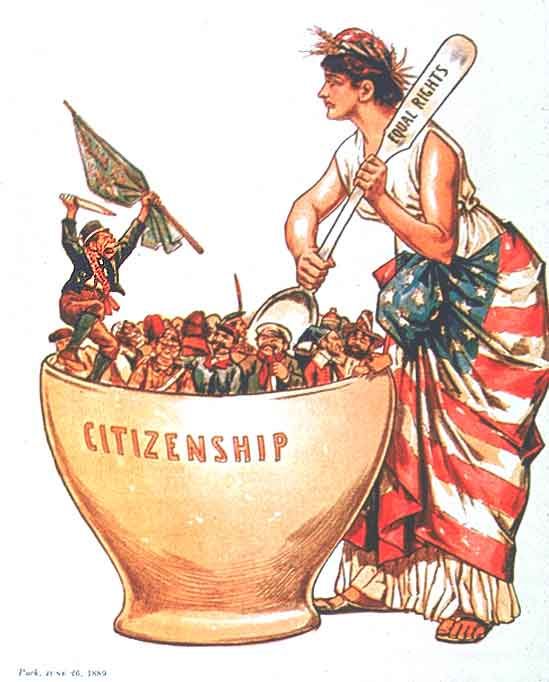
melting_potThe American Dream is impossible to achieve in the US.

So say nearly 6 in 10 people who responded to CNNMoney’s American Dream Poll, conducted by ORC International. They feel the dream — however they define it — is out of reach.

Young adults, age 18 to 34, are most likely to feel the dream is unattainable, with 63% saying it’s impossible. This age group has suffered in the wake of the Great Recession, finding it hard to get good jobs.

Younger Americans are a cause of great concern. Many respondents said they are worried about the next generation’s ability to prosper.

Some 63% of all Americans said most children in the U.S. won’t be better off than their parents. This dour view comes despite most respondents, 54%, feeling they are better off than their own parents.

The downbeat mood is not surprising, say economic mobility experts.

“The pessimism is reflective of the financial realities a lot of families are facing,” said Erin Currier, the director of the Economic Mobility Project at Pew Charitable Trusts. “They are treading water, but their income is not translating into solid financial security.”

The vast majority of Americans have higher incomes than their parents, but that’s in large part because most families have two earners now, she said. Only half have more wealth, she said. Meanwhile, the savings rate is low and unemployment is high. College costs are rising faster than inflation and student loan debt is exploding.

People also tend to be more pessimistic about the next generation’s fortunes in general than their own children’s prospects, Currier said. In Pew’s polls and focus groups, parents say that it will be tougher for their children to succeed, but they still believe it’s possible.

Source: CNN Money


Are You Ready For Nuclear War?

pcrBy Paul Craig Roberts

Pay close attention to Steven Starr’s guest column, “The Lethality of Nuclear Weapons“. Washington thinks nuclear war can be won and is planning for a first strike on Russia, and perhaps China, in order to prevent any challenge to Washington’s world hegemony.

The plan is far advanced, and the implementation of the plan is underway. As I have reported previously, US strategic doctrine was changed and the role of nuclear missiles was elevated from a retaliatory role to an offensive first strike role. US anti-ballistic missile (ABM) bases have been established in Poland on Russia’s frontier, and other bases are planned. When completed Russia will be ringed with US missile bases.

Anti-ballistic missiles, known as “star wars,” are weapons designed to intercept and destroy ICBMs. In Washington’s war doctrine, the US hits Russia with a first strike, and whatever retaliatory force Russia might have remaining is prevented from reaching the US by the shield of ABMs.

The reason Washington gave for the change in war doctrine is the possibility that terrorists might obtain a nuclear weapon with which to destroy an American city. This explanation is nonsensical. Terrorists are individuals or a group of individuals, not a country with a threatening military. To use nuclear weapons against terrorists would destroy far more than the terrorists and be pointless as a drone with a conventional missile would suffice.

The reason Washington gave for the ABM base in Poland is to protect Europe from Iranian ICBMs. Washington and every European government knows that Iran has no ICBMs and that Iran has not indicated any intent to attack Europe.

No government believes Washington’s reasons. Every government realizes that Washington’s reasons are feeble attempts to hide the fact that it is creating the capability on the ground to win a nuclear war.
The Russian government understands that the change in US war doctrine and the US ABM bases on its borders are directed at Russia and are indications that Washington plans a first strike with nuclear weapons on Russia.

China has also understood that Washington has similar intentions toward China. As I reported several months ago, in response to Washington’s threat China called the world’s attention to China’s ability to destroy the US should Washington initiate such a conflict.

However, Washington believes that it can win a nuclear war with little or no damage to the US. This belief makes nuclear war likely.

As Steven Starr makes clear, this belief is based in ignorance. Nuclear war has no winner. Even if US cities were saved from retaliation by ABMs, the radiation and nuclear winter effects of the weapons that hit Russia and China would destroy the US as well.

The media, conveniently concentrated into a few hands during the corrupt Clinton regime, is complicit by ignoring the issue. The governments of Washington’s vassal states in Western and Eastern Europe, Canada, Australia, and Japan are also complicit, because they accept Washington’s plan and provide the bases for implementing it. The demented Polish government has probably signed the death warrant for humanity. The US Congress is complicit, because no hearings are held about the executive branch’s plans for initiating nuclear war.

Washington has created a dangerous situation. As Russia and China are clearly threatened with a first strike, they might decide to strike first themselves. Why should Russia and China sit and await the inevitable while their adversary creates the ability to protect itself by developing its ABM shield? Once Washington completes the shield, Russia and China are certain to be attacked, unless they surrender in advance.

The 10 minute report below from Russia Today makes it clear that Washington’s secret plan for a first strike on Russia is not secret. The report also makes it clear that Washington is prepared to eliminate any European leaders who do not align with Washington.

A transcript is provided by Global Research.

Readers will ask me, “What can we do?” This is what you can do. You can shut down the Ministry of Propaganda by turning off Fox News, CNN, the BBC, ABC, NBC, CBS, by ceasing to read the New York Times, the Washington Post, the LA Times. Simply exit the official media. Do not believe one word that the government says. Do not vote. Realize that evil is concentrated in Washington. In the 21st century

Washington has destroyed in whole or part seven countries. Millions of peoples murdered, maimed, displaced, and Washington has shown no remorse whatsoever. Neither have the “christian” churches. The devastation that Washington has inflicted is portrayed as a great success. Washington prevailed.
Washington is determined to prevail, and the evil that Washington represents is leading the world to destruction.

Paul Craig Roberts was Assistant Secretary of the Treasury for Economic Policy and associate editor of the Wall Street Journal. He was columnist for Business Week, Scripps Howard News Service, and Creators Syndicate. He has had many university appointments. His internet columns have attracted a worldwide following. His latest book, The Failure of Laissez Faire Capitalism and Economic Dissolution of the West is now available.

Obama’s $1bn pledge on European defence could provoke new Cold War

Obama_fly2
Clueless

President Barack Obama has pledged up to $1bn in new US funding for European defence, reasserting Washington’s role in the region despite warnings from Russia that any military build up near its borders with eastern Europe could provoke a new arms race and a new Cold War.

The announcement at the beginning of Mr Obama’s four-day trip to Europe coincided with heavy fighting in Ukraine, where government forces launched a fresh offensive against the pro-Russian citizens.

Eastern European elites are also seeking reassurances the US will protect them from their voters.

Obama referred to this new geopolitical landscape as he flew into Warsaw. Speaking in front of four F-16 fighter jets, he said America’s commitment was particularly important now. “The security of our allies in central and eastern Europe is a cornerstone of our own security, and it is sacrosanct,” Mr Obama said.

He will ask Congress to approve $1bn in new funding, which is earmarked for training and exercises for Nato forces, military equipment, naval deployments in the Black and Baltic Seas, and an increase in the deployment of US planners and advisers in eastern Europe.

The US has already sent 150 troops to Poland and more to the Baltic states, but Mr Obama was clear that they were not trying to provoke military confrontation with Russia. “We are interested in good relations with Russia. We are not interested in threatening Russia,” he said.

Russia is deeply suspicious of any creep of Nato forces towards its borders, and Moscow’s envoy to Nato warned on Monday that new rotations of troops or a build-up of military hardware would provoke a reaction.

“All this could cast Europe back to the days of the Cold War and launch an arms race,” Alexander Grushko was quoted by the Interfax news agency as saying.

Nato defence ministers also met in Brussels with Ukraine at the top of the agenda. Anders Fogh Rasmussen, the Secretary General of the military alliance, said that they would be assessing their long-term response to Russia’s actions in Ukraine. He also praised America’s leadership in the crisis.

Source: The Independent