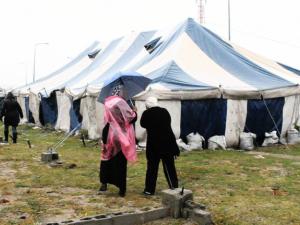
Town mobilizes to halt Aryan enclave

leithIn a tree-fringed grassy lot with a lone picnic bench in the tiny North Dakota farming town of Leith, Craig Cobb sees the perfect venue for a white power music festival.

Across a gravel intersection between two abandoned buildings, he envisions a park, perhaps with a swimming pool, dedicated to a neo-Nazi and white supremacist activist. He pictures the town decorated with fluttering flags and banners bearing the swastika, the symbol of Nazism.

“They would have to be approved by the town council, of course,” Cobb said, gazing out over Leith’s sparse downtown from his overgrown, weed-infested front yard.

Cobb, 61, a self-described white supremacist, has purchased about a dozen lots in the community about 60 miles southwest of Bismarck. Over the past year he has invited fellow white supremacists to move there and help him to transform the town of 16 people into a white enclave. No one has come.

Still, the community is mobilizing to fight out of fear that Cobb could succeed, and the mayor has vowed to do whatever it takes to ensure Cobb’s dream remains just that.

Last week, while news of Cobb’s plan was being splashed across the front pages of The Bismarck Tribune and The Forum, about two dozen people, mostly residents of Leith and concerned friends from neighboring towns, showed up for an impromptu meeting in nearby Carson.

“We all share kind of the same concerns that people living in the community of Leith have, just the unknown,” said Kathy Hoff, who lives just south of the town and attended the meeting.

Cobb spends his days in his ramshackle two-story home with no running water, posting online comments advocating for white supremacists to join his settlement.

“I only need 17 people,” he said with a chuckle. “You have to have a majority to win an election. If we get 22 we’ve got a landslide.”

Cobb’s neighbors across a back alley are Sherrill Harper, who is white, and her husband Bobby, who is black. Bobby Harper, a 52-year-old welder, said he has spoken to Cobb only once, and that Cobb’s plans don’t bother him much.

“The most extreme thing you can do is hate another man because of the color of his skin, (but) I don’t think we should get too excited,” he said. “I believe right will prevail.”

Officials are considering enforcing health codes and ordinances relating to the upkeep of Cobb’s run-down property. A proposal to disband Leith’s government and turn over control to the county is even on the table.

“He would still own his property,” said Mayor Ryan Schock, a 38-year-old farmer and lifelong Leith resident. “But … he can’t control the city if there’s no city government.”

No decisions have been made, but the six-member town council that usually convenes once a month might call a special meeting to discuss the matter soon, Schock said.

Ryan Lenz, a writer with the Alabama-based civil rights nonprofit Southern Poverty Law Center, said his organization has long tracked Cobb, who is wanted in Canada for willfully promoting hatred in Vancouver in 2010 via a blog.

“It’s a pipe dream for white nationalists to have an entire area in which their neighbors are Aryan,” Lenz said.

That’s hard to achieve, Lenz said, but Cobb has made strides because he has gobbled up land _ even transferring some to Tom Metzger, a former grand wizard of the Ku Klux Klan and founder of the White Aryan Resistance.

That doesn’t mean he’s any closer to enacting his plan. Metzger said he likes Cobb but that declared plans for white enclaves never work and that he will not be joining Cobb in Leith.

“I think it’s better just to have people move in quietly, have a job, operate a regular daily life and get along with their neighbors,” he said. “I wouldn’t go into a town pushing my weight around.”

Cobb, a native of Missouri, fled prosecution in Canada and chased the promise of high-paying jobs in the booming western North Dakota oil fields. He said he was fired from a job because of a dispute with a co-worker and that he lost a job with a Fargo-based paving company after media coverage of his settlement plans.

Canadian authorities have not approached the U.S. to extradite Cobb. Cpl. Normandie Levas of the Royal Canadian Mounted Police said the white supremacist can’t be extradited because the charge against him in Canada doesn’t exist under U.S. law.

Deputy North Dakota Attorney General Tom Trenbeath said authorities are aware of Cobb, and the Grant County Sheriff’s Office has increased patrols in the area. But Cobb hasn’t broken any laws there, and Schock acknowledges that he has a right to live in Leith, no matter his views.

Cobb’s comments and writings indicate he believes in a superior white race, distrusts both Jews and Christians, and questions the intelligence of women. He declines to talk about his upbringing and gives no indication as to why he adopted his supremacist platform.

In an interview outside his house, he was calm, cheerful and even jovial, making comments that raised questions about whether he believes his plan could succeed, or if he’s just seeking publicity.

“If I’m the only one in Leith forever, white consciousness has already been raised,” he said. – breitbart.com

British Parliament vote against Syrian attack

David Cameron
David Cameron

The British vote against military strikes in Syria is a tough blow to Prime Minister David Cameron’s domestic political fortunes.

Since taking office in 2010, he has on numerous occasions been undercut not just from opposition parties, but also from elements within both his own Conservative Party and the Liberal Democrats, the junior member of the UK’s governing coalition.

That was the combination that once again hurt Cameron late Thursday. The government lost a vote—by a tally of 285 to 272—that would have supported in principle military intervention in Syria. Members of all major parties—including his own Tories—opposed the measure.

Mr. Cameron said it is clear that the British Parliament, reflecting the view of the British people, doesn’t want to see the UK get involved in military action and “the government will act accordingly.”

The outcome marks a significant moment in British politics—it is highly unusual for a prime minister to be defeated on foreign policy and raises the prospect of whether the UK’s role on the world stage going forward.

It is also a rare setback for Anglo-American relations that will spur questions about the so-called “special relationship” between the two nations. In recent decades, the UK. has rarely if ever parted ways with the US on such a significant strategic issue.

While the government doesn’t require parliamentary approval to take military action, it would now be politically difficult to do so. A further parliamentary vote had been due to take place early next week on whether the UK should be directly involved in that action. A spokesman for the prime minister confirmed that the UK now won’t take part in the Syrian action.

The outcome of the UK. vote could make it more difficult for President Barack Obama and other Western allies—already weary from years of difficult military intervention in the Middle East—to convince their own publics of the need for intervention in Syria.

The defense secretary, Philip Hammond, said America “will be disappointed that Britain won’t be involved.” Mr. Hammond, speaking in an interview with BBC, said he still expected other countries to continue to look at a response.

The setback also raises questions about Cameron’s authority. The prime minister, who wasn’t required to hold a parliamentary vote but chose to, had personally laid out his case at length to parliament earlier in the day about why military action was needed and why it would be justified, citing humanitarian grounds and the need to prevent the use of chemical weapons in the future.

US officials said Mr. Obama is prepared to act in coming days without Britain. They added that unlike U.S. involvement in the 2011 military operations in Libya, the options being considered in Syria are on a smaller scale and wouldn’t require a coalition to be effective.

Britain’s about turn leaves France as the last European country still considering conducting air attacks on the Assad regime. French officials have said the country’s military had prepared plans for possible action in Syria but repeated on Thursday that no final decision had been made yet.

The French government can engage force overseas without prior Parliamentary approval.


Education Department ditches competence test for markers

Angie cancels competency tests
Angie ditches competence tests for matric markers

Not all those marking this year’s matric exam papers will have sat a test to demonstrate their competence, according to Basic Education Minister Angie Motshekga.

“Not all the provincial education departments will implement the competency test for markers in 2013, as initially planned,” she said in a written reply to a parliamentary question, tabled on Tuesday.

The reason was she had not yet approved a policy on administration of such a test, due to the need for further consultation with one of the teacher unions that had opposed the writing of the competency test.

Her reply does not name the union, but later refers to it as the country’s “major” teacher union. The largest teacher union in South Africa, with 240 000 members, is the South African Democratic Teachers’ Union (Sadtu).

Motshekga said she would meet the union to address their concerns and finalise the policy.

“However, given that most of the [provincial education departments] are at an advanced stage of appointing their markers for the 2013 National Senior Certificate examination, the official implementation of the competency test will be scheduled for 2014,” she said. – Sapa

‘We can’t just fire crooked cops’

National Police Commissioner General Riah Phiyega

National Police Commissioner Riah Phiyega said on Tuesday that police officers with criminal records could not simply be fired.

According to an IOL report, Phiyega made the comments to the Western Cape legislature after being quizzed about an audit that found that nearly 1500 officers had criminal records. None of the officers in question had yet been dismissed.

“The non-disclosure of a criminal record in most organisations would result in a summary dismissal. Why is it not the case with the SA Police Service?” asked Mark Wiley, the chairperson of the standing committee on community safety.

Phiyega replied that it wasn’t quite that simple.

“You’ll agree with me that we are like most organisations. In terms of our agreement with labour and other people, we will use all the labour laws that are at hand to ensure we respect the rights of everybody,” she said.

Wiley said it was important that the SAPS be cleaned up.

“Okay, I think you’re being very soft on them. The many organisations I know, it’s a straight walk,” said Wiley. – iafrica.com

Zuma warns West that bombing won’t solve Syrian crisis

Syrian child
Syrian child

South African President Jacob Zuma hit out at what it called “dangerous rhetoric” concerning possible strikes against Syria and warned any military action must have United Nations backing.

“We are concerned by the rhetoric pointing to the possibility of a military intervention,” said Zuma while condemning “the chemical weapons attack” in Damascus.

“South Africa does not believe that bombing the already suffering people and crumbling infrastructure of Syria, will contribute to a sustainable solution.”

“Military intervention will serve no other purpose than hurting the possibility of a speedy diplomatic solution to the conflict.”

South Africa, the continent’s largest economy and a G20 member, has largely opposed non-UN Western military intervention since becoming a fully democratic state in 1994, with the fall of apartheid.

“Any attack on Syria without the UN Security Council authorisation would constitute a grave violation of international law and dangerously undermine international order,” Zuma said.

South Africa has long sought a seat on the United Nations Security Council, but has irked Western powers with its stance on Zimbabwe and Libya — where it backed authoritarian rulers’ bids to remain in power.

In recent years South Africa has moved to deepen ties with China and Russia, long-time supporters of the ruling ANC during the anti-apartheid struggle.

Zuma was speaking during a meeting with his counterpart from Sao Tome and Principe, Manuel Pinto da Costa. – Sapa/AFP

Walter Sisulu University bankrupt

WalterSisuluUniversity2The embattled Walter Sisulu University (WSU) remains technically and commercially bankrupt, higher education director general Gwebs Qonde said.

Staff are demanding an eight to 10 percent salary hike.

Qonde said that for the university to break even it could only afford to pay staff, including lecturers, a 4.25 percent salary increase.

An assessor, appointed in June 2011, had found that the university was bankrupt and battled to meet payroll commitments.

“In addition, the institution had been operating on a council-approved deficit for about five years and illegally used earmarked grants provided for infrastructure improvement to pay salaries.”

A criminal investigation into these matters was underway, though Qonde could not provide details.

After the appointment of an administrator in October 2011, substantial progress had been made to put systems in place to ensure the long-term viability of the university.

“By June 2013, the administrator reported that financial stability had been achieved in the short-term with all creditors paid, staff salaries secured, backlogs cleared, and a break-even budget tabled for 2013,” Qonde said.

“The administrator, within the first year, has managed to clear the bank overdraft of the university, improve and implement internal control systems, and reduce student debt from R271 million to R40m.”

A turnaround plan was submitted to the department to fix the governance, human resources, and infrastructure failures.

The plan revealed how the WSU paid its staff more than most other universities in the country.

“The national payroll norm for universities is currently between 55 percent and 62 percent [of operational income],” Qonde said.

The WSU paid its staff 75 percent of its operational income, which included money from student fees, grants, and donations.

The department had had to pump R858m into the university to keep it up and running.

The breakdown of money given to the university was as follows:

  • R310m to address historic student debt;
  • R64.2m for teaching and learning technology;
  • R14.4m for technical expertise;
  • R48m to fund the bonuses of personnel in 2012; and
  • R421m for infrastructure.

“It should be noted that the 2013 break-even budget takes into account the 4.24 percent salary increase offered and any amount above this will result in cash flow problems and significant budget deficits going forward.”

Qonde said he had met the parties concerned in early August, but was unable to reach a settlement.

“The unions do not appear to grasp the gravity of their demands and the potentially disastrous consequences of their continued action.”

Qonde defended the administrator’s decision to shut down all WSU campuses and send students home.

“The risk to safety of students and prolonged nature of the strike has resulted in the university taking the decision to vacate the residences and send students home for a short term,” he said.

The decision has already led to protests by students who clashed with police on Wednesday.

At least a dozen students were injured during the scuffles. – Sapa

‘Dad rapes girl (7) in church tent’

Hosanna Ministries Church tent

A 47-year-old Cape Town coloured man was arrested for allegedly raping his daughter in a church tent, according to a report on Thursday.

The Mitchells Plain man, who was an employee of the church, and his friend allegedly raped his seven-year-old child in the tent at the Hosanna Ministries Church in New Woodlands.

“The Mitchells Plain Family violence, Child protection and Sexual offences unit is investigating an alleged rape of a minor,” said police spokesperson Captain FC van Wyk.

“The alleged rape occurred in New Woodlands. A 47-year-old man was arrested and the accused appeared in the Mitchells Plain Magistrate Court on August 16,” said Van Wyk.

According to IOL, the girl’s mother was thought to be drunk when the incident took place.

The mother denied this, and said that her husband was innocent.

“I know nothing about this because she told me nothing,” she said, according to The Daily Voice.

“I was on my way home from work when people in the street told me my husband was assaulted because he touched my daughter.

“I can’t believe my husband would do something like that because I will not allow it. He is not that kind of man,” she said.

Four black rhino poachers shot dead

More valuable tha a pale male
More valuable than a pale male

Four suspected rhino poachers were shot dead in the Kruger National Park at the weekend.

Rangers in the park made contact with a group of six suspected rhino horn poachers on Saturday, SanParks spokesman Ike Phaahla said on Monday.

“A shoot-out ensued between the suspected poachers and the rangers; three of the alleged poachers were killed and the other three were arrested,” said Phaahla.

Phaahla said two rifles, ammunition and rhino poaching equipment were recovered.

Another suspected rhino horn poacher was shot and killed by rangers in Crocodile Bridge in Mpumalanga on Saturday.

Limpopo police spokesman Brigadier Hangwani Mulaudzi said police also arrested four suspected rhino poachers on Sunday at Hoedspruit.

“Police found the alleged poachers in possession of a hunting rifle, firearm silencer and ammunition,” said Hangwani.

The four men aged between 33 and 46 will appear in the Phalaborwa Magistrate’s Court on Tuesday on charges of illegal possession of a firearm and ammunition and charges under the National Environmental Biodiversity Act which includes conspiracy to poach rhino.

The court date for the first three arrested was not available. – Sapa

Taxi for 13 carries 37 kids

taxischoolAn Eastern Cape taxi driver was arrested on Wednesday for transporting 37 school children in a Toyota Quantum.

The Times newspaper reported that the taxi — which was licensed to carry 13 passengers — was impounded by police in East London.

The 25-year-old driver was charged with reckless driving, negligence and overloading, said police.

“We keep emphasising to parents that the safety of their children is very important,” police spokesperson Captain Mluleki Mbi told the newspaper.

“It is important for them to know the vehicle and about their children’s safety all the time.” – iafrica.com

BRICS agree on structure of bank

bricsbankThe BRICS bloc of large emerging economies have agreed on the capital structure for a proposed development bank that aims to reduce their reliance on Western financial institutions, the Wall Street Journal reported.

Officials from Brazil, China, India, Russia and South Africa agreed to set up the bank with a total capital of $50 billion, shared equally among them, it quoted an unnamed senior Indian government official as saying.

The decision was made at a meeting in New Delhi in the first week of August, the newspaper said. The move would likely end disagreements over the funding and management of the bank as China had earlier proposed total bank capital of $100 billion and sought a bigger share, it said.

The bank would support the financing needs in emerging and developing nations for roads, modern-day port facilities, and reliable power and rail services.

Officials have previously said the BRICS aimed to inject an initial $50 billion into the bank, but there was disagreement over whether each state should contribute $10 billion or if contributions should vary by the size of their economies.

China’s economy is about 20 times the size of South Africa’s and four times as big as Russia’s or India’s. Other key issues, such as proposals within the group to offer a stake to developed nations, needed further discussion, the Indian official said. The group is considering offering a stake of 40-45% to non-BRICS nations, the official added.

That would help the bank get a higher credit rating and enable it to raise cheaper funds from the market, the newspaper said. The bloc has yet to make a decision on where the bank would be located, the official added.

Those issues are likely to be discussed when finance ministers from the group meet on the side-lines of the annual meetings of the World Bank and International Monetary Fund in Washington in October, the official added.

The five countries represent a fifth of global GDP but have struggled to find common ground that would convert their economic weight into joint political clout. – Reuters

Armed robbers shoot two, hijack pair

crime-gunA gang of armed robbers hit the Oriental City market in Bruma on Wednesday morning, firing shots and wounding two shop owners who were rushed to hospital.

The thieves made off with an undisclosed sum of money.


Shortly after 9am a gang of 12 robbers stormed a shop in the flea market. They ordered the shop owners – two brothers – to hand over all their money.


According to police spokesman Constable Thabo Malatji, the robbers shot the shopowners and fled in a white Mercedes-Benz Vito.

“As they drove out, they collided against a silver BMW. They jumped out of the Vito and hijacked two vehicles, a white Toyota Avanza and a silver Peugeot,” Malatji said. – The Star

Fighting rages outside Goma

militia_in_eastFresh fighting raged Thursday outside the flashpoint city of Goma in eastern Democratic Republic of Congo, the M23 rebels and regular army said, blaming each other for the new hostilities.

An army officer said rebels had attacked government-held positions on Wednesday night 20 kilometres (12 miles) north of the capital of North Kivu province, sparking clashes with heavy weaponry that continued into Thursday.


The territory, near the villages of Mutaho and Kibati, has been in government hands since mid-July, he said, speaking on condition of anonymity.


M23 intelligence officer Modeste Bahati confirmed the renewed fighting but blamed the army for starting it by attacking rebel positions around Kibati.


“Our forces are holding their positions,” he told AFP.


The rebels accused the army of wanting to “broaden” an offensive against them.


“The absurd war relaunched by the Congolese government appears to be an outburst of anger after the failure of military-style diplomacy in these past weeks,” the movement’s spokesman Amani Kabasha said in a statement.


Kabasha accused the army of breaching “recent recommendations by the UN Security Council, the International Conference on the Great Lakes Region, and the SADC (Southern African Development Community) for the resumption of peace talks.”


Both sides said they were not yet able to say how many people had been killed or wounded.


The rebellion by the M23, a movement launched by Tutsi ex-soldiers who mutinied from the army in April 2012, is the latest insurgency to ravage the vast central African country’s mineral-rich but conflict-torn east.

The rebels, estimated to number about 1000, have been active in North Kivu province since May 2012. Founded by members of a previous rebel group integrated into the military under a 2009 peace deal, they left the army because they accused the government of failing to abide by the terms of the agreement.

The M23 occupied Goma – a city of about one million people and the hub around which most of the fighting has revolved for 10 days in November 2012 before withdrawing under international pressure.

The latest bout of fighting, which erupted in mid-July and has flared up periodically ever since, ended an almost two-month truce reached in May when UN chief Ban Ki-moon visited the region. – Sapa/AFP


Al Qaeda from Benghazi attack trains Jihadists for Syrian rebels

alqaedaU.S. intelligence agencies earlier this month uncovered new evidence that al Qaeda-linked terrorists in Benghazi are training foreign jihadists to fight with Syria’s Islamist rebels, according to U.S. officials.

Ansar al-Sharia, the al Qaeda-affiliated militia that U.S. officials say orchestrated the Sept. 11 attacks on the U.S. diplomatic compound and a CIA facility in Benghazi, is running several training camps for jihadists in Benghazi and nearby Darnah, another port city further east, said officials who discussed some details of the camps on condition of anonymity.

The officials said the terror training camps have been in operation since at least May and are part of a network that funnels foreign fighters to Syrian rebel groups, including the Al-Nusra Front, the most organized of the Islamist rebel groups fighting the Bashar al-Assad regime in Damascus.

The officials said the jihadist training is a clear indication that Ansar al-Sharia continues to conduct terrorist activities and is linked to jihadists in both Syria and North Africa.

Disclosure of the terror training camps also bolsters earlier intelligence assessments that Libya, following the death of Muammar Qaddafi, is now a focal point for al Qaeda terrorist activity in North Africa.

Information about the terrorist training camps in northeastern Libya was uncovered after the arrest of several jihadists near the port city of Darnah in early August.

Other information about the camps appeared online at jihadist social media outlets around the same time.

Two men identified as Tunisians disclosed the existence of the training camps in Benghazi after they were interrogated by a local militia group in northern Libya.

At the time of their arrest, the Tunisians stated that they were trained in small arms use and were on their way to join Syria rebels by traveling first to Benghazi, then Istanbul, and over land across Turkey and into northern Syria.

According to the officials, the Tunisians were arrested Aug. 3. Inside their car, the militia found six passports, an AK-47 assault rifle, and foreign currency. A total of four people traveling in the car, including two Libyans, clashed with guards at a security checkpoint at the time of the arrest.

One of the men said he was an associate of Ansar al-Sharia’s leader Sufian Ben Qumu, an al Qaeda terrorist released from the U.S. prison in Guantanamo Bay, Cuba, in 2007.

Details of the number of jihadist training camps and jihadists was not disclosed, but the officials said there are several training camps.

The Ansar al-Sharia Brigade in Benghazi was formed in early 2012 from several Islamist militias that fought during the 2011 revolution that ousted Libyan leader Muammar Qaddafi. The group was forced to relocate its operating bases based on local opposition to the group’s role in attacks on the U.S. diplomatic compound.

Ansar al-Sharia is engaged in overt charitable activities and armed patrols in Benghazi, in addition to the covert terrorist training. The group has sought to play down its role in jihadist activities to avoid both the Libyan government and international scrutiny.

Ansar al-Sharia in Darnah was founded by former members of the terrorist Salim Martyrs Brigade and operates a base west of Darnah.

Libyan officials told Britain’s Arabic language newspaper Al Sharq al Awsat earlier this month that some type of covert U.S. military action was taken against al Qaeda bases in Darnah. However, Pentagon spokesmen said they had no information about such attack that reportedly took place Aug. 11.

U.S. intelligence agencies believe Libya has produced more jihadist rebels for the Syrian conflict than any other outside nation. Some 20 percent of foreign jihadists in Syria came from Libya and that several hundred are currently in the country.

Over 100 Libyans were reported killed in Syrian fighting for such rebel groups as Al-Nusra Front, the Islamic State in Iraq and the Levant, Umma Brigade, Muhajirin Brigade, and Ahrar al-Sham, an Al-Nusra offshoot.

The jihadist training highlights the danger that Libya is becoming a breeding ground for al Qaeda terrorists. Officials said the weak central government in Tripoli has allowed Islamist militias to flourish, including in Benghazi and Darnah where the two factions Ansar al-Sharia groups operate.

The Ansar al-Sharia Brigade was blamed by U.S. officials for carrying out the deadly Benghazi terrorist attack Sept. 11.

The Obama administration sought to cover up the terrorist attack in the weeks before the presidential election by initially claiming the action was the result of a spontaneous demonstration triggered by an anti-Islamic Internet video.

Four Americans were killed in the attack, including U.S. Ambassador to Libya Christopher Stevens.

A Pentagon report from August 2012 published by the Library of Congress stated that al Qaeda senior leaders and the group al Qaeda in the Islamic Maghreb (AQIM) “have sought to take advantage of the Libyan Revolution to recruit militants and to reinforce their operational capabilities in an attempt to create a safe haven and possibly to extend their area of operations to Libya.”

The report said al Qaeda is developing a “clandestine network” in Libya that could be used in the future to destabilize the government and offer logistical support for al Qaeda activities in the region.

The report said that AQIM has formed sleeper cells that “are probably connected to an al Qaeda underground network in Libya, likely as a way, primarily, to secure the supply of arms for its ongoing jihadist operations in Algeria and the Sahel.”

“The al Qaeda clandestine network is currently in an expansion phase, running training camps and media campaigns on social-media platforms, such as Facebook and YouTube,” the report said. “However it will likely continue to mask its presence under the umbrella of the Libyan Salafist movement, with which it shares a radical ideology and a general intent to implement sharia in Libya and elsewhere.”

To avoid attacks, Ansar al-Sharia in Libya “could be the new face of al Qaeda in Libya despite its leader’s denial.” – Washington Free Beacon

Protesters go on rampage in Randfontein

randfonteinPolice have dispersed a crowd of protesters who have gone on the rampage in Randfontein, west of Johannesburg.

The residents of Mohlakeng extension five are demanding services from the municipality.

Earlier residents barricaded roads with burning tires and stones, however calm has now been restored.

The council, the claim, has not provided them with electricity, water and sanitation because of a legal dispute over the sale of land.

More than 1 000 home owners have bought stands in the area since 2006.

But the Randfontein municipality says homes were built on the land without permission. – eNCA