A letter from South Africa

Afrikaans monument

Partial view of the Afrikaans language monument at Paarl, Western Cape


Dear PRAAG member/supporter abroad,

Thank you very much for your support so far for the cause of saving South Africa’s white and Afrikaner people from extinction. I must apologise for not having communicated with you regularly in the past, but we have been, as always, busy with our increasingly bitter struggle here.

We have also revamped this, our English-language website. Apart from publishing South African news, together with our own media releases and newsletters, we shall also be carrying global news stories of interest on that site. Please visit it regularly as we shall be updating it on a daily basis.

Our Afrikaans-language site for South Africa is also being renewed and has become a major South African news portal in its own right. We publish approximately 20 stories and columns per day and also have a very lively comments section.

Increasingly, the mainstream media in South Africa and globally are suppressing the bad news coming out of this country. For example, our president Jacob Zuma sang a song in public during the ANC’s centenary celebrations on 8 January 2012 in Bloemfontein in which he called for the shooting of Boers and whites. It included the phrases: “They are cowards, they will run, the cabinet will shoot them.” Although broadcast live on television to the whole country, it took some time for people to realise that he was actually calling for the mass killing of whites and farmers, as the song was sung in Zulu.

However, none of the mainstream media made much of this, which actually constituted an international crime due to South Africa being a signatory to various international conventions that prohibit any form of incitement to genocide or violence against another ethnic or racial group.

Many crimes committed against whites are not reflected in police statistics. I personally interviewed a gallery owner in Pretoria who was held up at gunpoint by three blacks in her home who continuously threatened to kill and rape her. She was badly assaulted and had to be hospitalised afterwards. However, when she reported the crime to the local police station, the black officers on duty refused to accept it as she had mentioned the fact that her attackers had used the words: “We are going to kill you, you white bitch.” Due to the racial nature of the attack, the police refused to accept her affidavit.

We are currently setting up support groups all over the country that will collect information which we could then publish on our website. One of our technicians is busy training people in video technology to make it possible to gather evidence and also post videos on YouTube on the ongoing violence in South Africa, as well as efforts to counter it. We have some retired policemen and detectives who are prepared to investigate crimes without remuneration, but we have to pay their transport costs.

No-one knows how many whites have been killed by blacks in South Africa since 1994 when the ANC took over. It could be 30 000, or 50 000, or even as high as 100 000. Such statistics are a closely guarded secret. However, together with another organisation, we lodged an official request last month with the South African Police Service for crime statistics broken down by race or population group. We are anxiously awaiting the results. If not forthcoming, we will be forced to seek a court order to obtain them.

A high-ranking member of the Dutch Freedom Party (PVV), Martin Bosma, recently visited South Africa. According to him, “Afrikaners are the canary in the coal mine for the whole of the Western world. You will be the first Western nation to die out since the start of the European Renaissance.”

The attack on us is multifaceted: racial violence, anti-white legislation and discrimination, as well as efforts to undermine our educational system, our culture, language and our very identity. At the beginning of this year, a high school in Fochville, a town west of Johannesburg, was targeted with a group of black children bused in by the provincial government. This was the last remaining public school of quality in that whole area, with parents driving their children 100 kilometres per day there and back. The provincial education department is being run by a white communist who is adamant that all schools “must be the same” whether they are majority-white or majority-black. According to talk in the education department, the officials want to capitalise on “white flight” by driving all white children out of public or state schools, forcing them into private and home schooling which many cannot afford.

In 2003 when it was announced that the name of our capital, Pretoria, would be changed to the African name of “Tshwane”, PRAAG was the first organisation to protest that act of cultural vandalism. We organised a protest march right into the heart of the black inner city, with myself walking side by side with the very popular Afrikaner singer Steve Hofmeyr. Since then we have not given up the fight and many court cases and petitions later, it was announced last week that the name of the city would not be changed after all. However, it was announced at the same time that twenty-seven street names would be changed from those of the city’s founders to black and communist names. Even “Church Street” would not be spared as it is apparently offensive. One of the streets would be named after terrorist Solomon Mahlangu who had killed some white civilians in the late 1970’s.

As the South African crisis deepens, more and more people are waking up to the fact that the current system is unjust, corrupt and violent. Those who can afford it, are emigrating. But many cannot leave, either for financial reasons or because the other Western countries would not accept them. On the other hand: why should we leave and simply abandon our country and all our assets to a corrupt African government appointed over us by the United States, Britain, Sweden and other Western powers?

We must claim at least part of South Africa for ourselves! To this end, we are building our current network of activists, not only in this country, but all over the world.

We are very much encouraged by the groundswell of conservative support for us in the United States, the Low Countries, Australia, Northern Italy and many other countries. Protests and demonstrations are being planned in several major Western cities this year and we welcome those.

I want to invite you to join us in this struggle, which currently affects us, the canary in the coal mine, the most. But ultimately it engages us all, because multiculturalism is just communism or extreme egalitarianism in disguise. The Cold War may be over, but the assault upon our Western and Christian values have never been greater.

Let us hope that the movement which we are building to save our beleagured nation on the southern tip of Africa will not only benefit us, but will mobilise thousands more all over Europe and North America to stave off the kind of nightmare which we are already living through, every day.

I shall soon be sending you information on our Pro-Afrikaans support groups or simply “buzz groups” which we are currently forming. They offer an exciting way of meeting like-minded people and participating in the movement to save this nation.

Soon, on 6 April 2012, it will be 360 years since three Dutch ships first threw anchor in Cape Town’s Table Bay. Of course, that founding moment is today derided as “the coming of the hated white colonialist”.

But we who love our culture and civilisation know otherwise.

Regards,

Dan Roodt
Director, PRAAG (Pro-Afrikaner Action Group)
PRAAG calls for civil disobedience after passing of language bill

For more than two hundred years the Afrikaans language has been attacked and marginalised in South Africa, either by the British colonial authorities or by the ANC regime. During the days of National Party rule, English was allowed to retain its role as sole public language and Afrikaans was subjected to censorship.

PRAAG (the Pro-Afrikaans Action Group) therefore rejects the notion that Afrikaans could ever be classified with English as a “previously advantaged language”. Commenting in Johannesburg, Dr. Dan Roodt, the leader of PRAAG said: “No language has been more subject to state repression and marginalisation than Afrikaans. The new language bill simply represents a continuation of British imperialism and colonialism, with the genocidal ANC regime intent upon killing Afrikaans and a large number of its speakers.”

Roodt has called upon the international community to “take note of the dire situation in South Africa, with the ANC regime inviting ethnic conflict through its policy of cultural and linguistic imperialism, as well as attacks upon Afrikaans schools, place names, museums and libraries.”

PRAAG will join in court applications with other Afrikaans organisations to stop the illegal and totalitarian measures being taken against Afrikaans. However, it has also called for civil disobedience to the “sushi-devouring, corrupt, Milnerist satraps whose tyrannical rule over South Africa already represents a crime against humanity. Afrikaners especially should not pay toll fees, taxes or make any contribution to sustain these Idi Amin-like clowns who are dreaming of being British lords calling us donkeys for speaking Afrikaans.”

However, the pro-Afrikaans body has welcomed the “clarity” brought by the ANC’s new language law. “If final evidence had been needed that the unitary state of South Africa was doomed, this is it,” said Roodt. “The only logical way out is self-determination for Afrikaners, as soon as possible. There is currently a reawakening of our noble Afrikaner spirit that has sustained us in the struggle against imperialism for so long. We prevailed against the British Empire and will likewise survive the Nguni Empire in its venality, ugliness and arrogance.”

ANC must take land, Mantashe tells Young Communists

The ANC cannot be a liberation movement if it does not tackle the issue of land reform, ANC secretary general Gwede Mantashe said on Thursday.

“The land question is at the centre of the struggle. If we raise it in the ANC some are irritated. It can’t be a liberation movement that refuses to deal with the land question,” he said.

Mantashe, who is also the chairman of the SA Communist Party, was speaking at a Young Communist League meeting at the University of Witwatersrand in Johannesburg.

He said land could not just be claimed without compensation, as unskilled workers would not be able to successfully care for their land.

“When the people were dispossessed, they were also de-skilled. Land distribution must go together with a support mechanism for emerging farmers.”

He said historians needed to focus on the indigenous people of South Africa.

“The first war in the country [with colonialists] left what they call the ‘Khoisan Genocide’,” he said.

“This left [the Khoi and San] believing they are extinct, and they say now that they are the ‘coloured’ people. They are the first indigenous people in Africa… they are a part of the African identity.”

He said subsequent wars forced the Basuto nation into the mountains as a means of defence.

“We need to see history through the eyes of the lion. We cannot allow hunters to write the history of lions.”

He was talking in reference to the claim made by Freedom Front Plus leader Pieter Mulder in Parliament on Wednesday.

Mulder suggested that black “Bantu-speaking” people had no historical claim to 40 percent of the country. “Africans in particular never in the past lived in the whole of South Africa,” Mulder claimed during debate in the National Assembly on last week’s state-of-the-nation address.

Mantashe said the ANC and SACP were both fighting different sides of the same “monster”.

“We are fighting the monster at the same time. The ANC is fighting against racial exploitation and the SACP against economic exploitation.”

He said both parties needed to clear themselves of members with “negative tendencies”.

“It is like taking a mouse to a cheese factory, it will eat itself to death. We need to fight these tendencies wherever they are… things like corruption and the use of money to balance forces in conferences, or singing songs that are decisive.

“The ANC needs to reinforce that the only thing that is yours is your salary,” he said

South African Mineworkers Union issues communist-style call for nationalisation

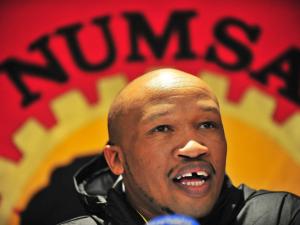
Irvin Jim
Irvin Jim

Yesterday NUMSA, the National Mineworkers Union of South Africa, issued a document replete with Marxist references to the class struggle, calling for the nationalisation of mines in South Africa. It based its policy position on two fundamental ANC documents: the Freedom Charter and the Morogoro Conference of 1969 when the ANC was still firmly tied to the old Soviet Union.

Here follows the whole statement by NUMSA:

White domination persists in South Africa – Irvin Jim

Irvin Jim
08 February 2012

NUMSA GS says without nationalisation black people doomed to remain at bottom of society

Press Statement on the Nationalisation Report of the ANC

“In our country – more than in any other part of the oppressed world – it is inconceivable for liberation to have meaning without a return of the wealth of the land to the people as a whole. It is therefore a fundamental feature of our strategy that victory must embrace more than formal political democracy. To allow the existing economic forces to retain their interests intact is to feed the root of racial supremacy and does not represent even the shadow of liberation.” (Morogoro Conference of the ANC, meeting at Morogoro, Tanzania, 25 April – 1 May 1969)

The National Union of Metal Workers of South Africa (NUMSA) is extremely disturbed and dismayed by the statements made by two ANC Ministers in the Mining Indaba during the course of this week, in Cape Town.

Numsa as part of a Cosatu delegation in the ANC Economic Transformation Committee (ETC) did have the opportunity to see the Nationalisation Report last week but we were not given copies as the Report was embargoed.

We were advised that the Report would be tabled in the ANC NEC and the NEC was to define the process on how the Report was to be circulated in the branches of the ANC and to components of the Alliance for debate in preparing for the coming ANC National Policy Conference.

WE find it very disturbing that the Report has been unofficially released to the media before the structures of the ANC and its Alliance could see it.

We further find it quite unfortunate that two ANC ministers have found it fit to use the Report in support of their private views against nationalisation of mines and other strategic economic sectors. As we show below, the ANC NGC in 2010 was unanimous in support of the nationalisation of mines and other strategic economic assets in the country.

Numsa takes the view that both Minister Susan Shabangu and Trevor Manuel have acted completely without any ANC mandate in deciding to speak for the ANC government and for the ANC and the Alliance that there will be no nationalization of mines and key strategic sectors in the economy. Their unilateral pronouncement goes completely against the ANC’s position which says – it is the ANC who leads government and not government leading the ANC. Numsa therefore reject with contempt their cheap manipulation of our democratic processes in the movement.

We have also noted that in the recent past right-wing global rating agencies have been doing the same in threatening our movement should nationalisation take place. These seek to make sure that there is no fundamental change in the vested Apartheid white monopoly economic interests, thus guaranteeing that black people in general and Africans in particular remain at the bottom of South Africa’s economy and society and detained forever in poverty, unemployment and inequality.

Below we restate in our view, the current and historic position of the ANC and its Alliance on this extremely important matter of nationalisation of mines and strategic economic assets of the country. 

A. Nationalisation and ANC Policy

1. The basic revolutionary socio-economic programme of the ANC is the Freedom. The core tenet of the Freedom Charter states that:

“The national wealth of our country, the heritage of South Africans, shall be restored to the people; The mineral wealth beneath the soil, the Banks and monopoly industry shall be transferred to the ownership of the people as a whole; All other industry and trade shall be controlled to assist the well-being of the people; All people shall have equal rights to trade where they choose, to manufacture and to enter all trades, crafts and professions.”

In this regard we fail to understand the constant refrain that nationalisation is the ANC policy because in our understanding the representatives of our people who gathered in Kliptown in 1955 adopted this policy position of the ANC.

2. The restoration of the wealth of the country to the people is, has been, and will always be, at the heart of the struggle to liberate all South Africans, today and tomorrow. 

3. The transferring to the ownership of the people as a whole of the mineral wealth beneath the soil, the banks and monopoly industry is the basic foundation and only basis upon which lasting peace and a common nationhood can be created in South Africa.

4. To reinforce these fundamentals of the liberation struggle, the ANC at its Morogoro Conference further stated that:

“In our country – more than in any other part of the oppressed world – it is inconceivable for liberation to have meaning without a return of the wealth of the land to the people as a whole. It is therefore a fundamental feature of our strategy that victory must embrace more than formal political democracy. To allow the existing economic forces to retain their interests intact is to feed the root of racial supremacy and does not represent even the shadow of liberation.”

5. The roots of South African racial supremacy would be well nourished if the existing economic forces were to be allowed to retain their interests intact. This is a very self-evident truth. In South Africa, real poverty is black and African, and wealth is white and European.

6. In the 2010 ANC National General Council – the policy forum of the ANC – the Economic Transformation Commission reported thus:

“There was greater consensus in the commission on the nationalisation of mines and other strategic sectors of the economy. The NGC therefore mandated the NEC to ensure further work be done, including research, study tours and discussions, and to report to the Policy Conference for decision at National Conference in 2012.”

7. We have quoted the documents above to show the centrality, the revolutionary significance, of the unchanging core demand of the liberation struggle in South Africa – to return the basic wealth of the country to the people as a whole.

8. All ANC Policy and other documents have always faithfully reiterated this demand. The demand to return the wealth of the country to the people as a whole, including by transferring this wealth into the hands of the people (nationalisation) is a central and defining feature of the ANC. To deviate from this is un-ANC.

B. Revisionism, distortion and vulgarisation of the main strategic objective of the struggle for liberation in South Africa

1. The restoration of the basic wealth of the country to the people was, and still is, the essence, the reason, the strategic objective, of the struggle for liberation in South Africa. Only this could end racial supremacy and Colonialism of a Special Type (CST). Only this could guarantee peace, equality and restore the dignity of all the people of South Africa.

2. It is now clear that long before the 1994 democratic breakthrough, elements of English, Afrikaner and African elites had begun to work very hard to dilute the essence of the struggle for liberation in South Africa, by peddling a version of freedom and democracy that would allow the essential existing economic forces to retain their interests intact. Thus the new South Africa after 1994 was handed down a constitution offering democratic freedoms but in essence made private property sacred in a country in which the majority had no property – to be more precise, the country’s constitution fails to address the land stolen from our people through the 1913 Land Act!

3. Since 1994, we have seen a progressive watering down, weakening and erosion of the essential and basic revolutionary demand of the liberation struggle – the returning of the wealth of the land into the hands of the people as a whole.

4. A very dangerous revisionist tendency is one that simply re-interprets the demand in narrow legalistic and technical terms, and thus attempts to convince us that some of the reforms (charters, taxation, and BBBEE) the ANC government has put in place since 1994 amount to “transferring the wealth of the land into the hands of the people”.

5. A further equally dangerous tendency is simply to vulgarise and distort the core revolutionary demand of the liberation struggle – the demand to transfer all the major wealth of the country into the hands of the people, thus restoring the country to all its people – by simply reducing it to the question of the nationalisation of mines, and even this is further mired in financial and technical obstacles!

6. The core revolutionary demand of the freedom struggle in South Africa is very clear: The national wealth of our country, the heritage of South Africans, shall be restored to the people! It is all the “national wealth” and not just the mines, which must be restored to the people. All other industries must be subordinated to the imperative to develop the people and provide for them. This distortion seeks to diminish and conceal the other wealth which must equally be restored and transferred to the people as a whole.

7. Implicit in the demand is not just the revolutionary need to uproot racial supremacy and restore the dignity of all our people, but also a very strong anti-imperialist demand.

8. A most vulgar postulation is one that simply says after 1994, we are all free to share in the country’s wealth, and it is now each person for themselves and all the government has to do is make the country business friendly. Thus all over the country we find business and enterprise promotion NGOs and sometimes these are assisted by monopoly industries.

C. The persistence of white monopoly capitalism in South Africa, post 1994

1. Anyone with the barest minimum of knowledge about the state of the South African economy and society, 17 years after “democracy” will not fail to notice the persistence of white domination of the economy and society, notwithstanding the small sprinkling of black and African capitalists.

2. The South African economy continues to be dominated by the Minerals/Energy/Finance Complex which is largely white owned. The white population continue to in fact grow their domination of social and cultural life of the country.

3. Poverty and unemployment are largely black, and African, with African females and youths faring the worst.

4. South Africa has become the most unequal place on Earth today. At the bottom, of course are black and African people, and at the top, are white people. The facts to illustrate this are there for all to see.

5. Black and African people are condemned to inferior public sector education and health facilities, while the white population enjoys first world schools, hospitals and shopping malls. Of course the trick today is that there is no Group Areas Act and you are simply told to get on with it as an individual and make your money and you will join the white population!

6. As a result of the lamentable failure to radically restore the basic wealth of the country to the people as a whole, 11 percent of the South African School system accounts for more than 70 percent of Matric passes.

7. An average white male in South African earns anything above R19 000, 00 per month while a black male earns just about R2 400, 00!

8. Ultimately of course, the life expectance of a white person in South Africa today stands at about 70 years, while that of a black person is at 48 years – some 22 years less!

D. The struggle continues, and it is a class struggle!

1. At Numsa we are not surprised that the 2010 ANC NGC Resolutions which clearly indicated that there was consensus on nationalisation are being manipulated and shoved into the dustbin.

2. At Numsa we are not surprised that rather than investigate what the most appropriate forms of nationalisation of mines and other strategic sectors of the economic would be, the ANC Report has done everything to confirm that nationalisation of the mines would be a “disaster” for South Africa. Knowing the dominance of white monopoly capital in general and white mining and financial capital in particular, our political and social life post 1994 we did not expect anything less than this distortion of the ANC NGC Resolutions.

3. Further, we at Numsa do not think that the struggle to restore the wealth of the country to the people as a whole will ever be won via research teams and Conference Resolutions. As a working class, and industrial working class formation our experience teaches us that capital concedes nothing without a fight!

4. Thus we are not surprised that elements deployed by the ANC in government to implement ANC policies have been very busy trying to assure capitalists that government in South Africa does not belong to the ANC and that it is not government policy to nationalise! Those ANC deployees who advocated the neo liberal macro economic framework in 1996 continues to champion a failed and discredited neo liberal policy framework which stands in direct opposition to the ANC’s progressive and revolutionary agenda as contained in the Freedom Charter.

5. The people who voted this government into office suddenly do not exist. This is as it should be, as the dominant class in this country is that of white monopoly capitalists!

6. At Numsa we must serve notice to the people of this country: the black and African working class are fast losing patience at the pace at which their conditions of extreme poverty are being dealt with.

7. The success and sustainability of the 1994 democratic breakthrough in this country rests on the extent and speed of restoration of the wealth of the country to the people as a whole, including transferring the national wealth to the people. Anything less than this is a recipe for disaster.

8. At Numsa we will continue to mobilise the working class and to demand in the revolutionary alliance for the speedy implementation of the entirety of the Freedom Charter.

9. In the ANC Policy Conference Numsa will demand for the restoration of the basic wealth of the country to all the people as a whole.

10. In the National Conference of the ANC this year Numsa will demand the transferring – nationalisation – of the mines and other strategic economic sectors into the hands of the people as a whole. This is what we understand the struggle for liberation, democracy and equality in South Africa to be all about. Anything short of this is a betrayal of all our 100 years of struggle and sacrifice against racist white monopoly capitalism.

Statement issued by Irvin Jim, NUMSA general secretary, February 8 2012