Scientists have found that London has the highest concentration of cocaine in its sewage system, closely followed by Amsterdam, according to test results from 50 European cities.
The EU’s drug monitoring body has determined that the average daily concentration of cocaine in London’s sewer system was 737mg per 1,000 people in 2014.
Measuring the concentration of drugs in waste water helps scientists monitor the level of illicit drug use in major metropolitan cities.
For instance, the amount of cocaine in London’s waste water drastically rises on Fridays and Sundays and falls back down on Sundays and Mondays, while in Amsterdam, consumption rises later in the weekend, peaking on Sunday.
Wastewater analysis is a “rapidly developing scientific discipline with the potential for monitoring real-time population-level trends in illicit drug use,” the European Monitoring Centre for Drugs and Drug Addiction (EMCDDA) said in its research.
The study also shows that Amsterdam’s sewers have much greater concentrations of cannabis, and London has the fourth highest daily concentration of ecstasy.
At the same time, drugs like cannabis, methamphetamine, and amphetamine were not found in London’s waste water.
Oslo in Norway and Dresden in Germany had the highest levels of methamphetamine in their sewage.
According to recent statistics, there were 2,995 drug related deaths in 2013 (involving both legal and illegal drugs), according to the UK Office of National Statistics’. This is up from 2012, when there were 2,597.
“Hamas, Hamas, Jews to the gas,” sang a section of the home supporters of FC Utrecht towards the fans visiting from Amsterdam, a city historic in part for its Jewish community. “My father was in the commandos, my mother was in the SS, together they burned Jews, because Jews burn the best!”
The chant was caught on video and quickly circulated among Dutch media. FC Utrecht issued an apology as Jewish organizations demanded action by soccer authorities.
Anti-Semitism in European soccer appears to be getting worse. According to Kick It Out, a British organization originally devoted to combating racism, anti-Semitic incidents are up in the English Premier League. A Kick It Out study released last month revealed that there were 59 reported instances of anti-Semitism during the first half of this season. That was more than during the entire previous season. Anti-Semitism made up a third of the total instances of abuse, and was second in frequency only to racism.
One of this season’s worst episodes came when fans of the London club West Ham were caught on camera chanting “I’ve got a foreskin, how about you? F—— Jew” on their way to play Tottenham Hotspur, a team with a historically strong Jewish following.
Other recent incidents have included fans — and in several instances players — making Nazi-like salutes.
In a recent game between Bosnia and Austria. Bosnian fans took to the streets of Vienna in what was originally a pro-Palestine demonstration, but eventually disintegrated into chants of “Kill, kill the Jews” — also caught on video.
But Ronny Naftaniel, Chairman of the Dutch Jewish Humanitarian Fund, sought to draw a line between the chants — as insulting as they are — and anti-Semitism. Whether it’s West Ham vs. Tottenham or Utrecht vs. Ajax Amsterdam, he said such insults have more to do with local rivalries than true bigotry.
“It’s indeed very shocking what happened at the game between FC Utrecht and Ajax,” he said. “It’s something that happens twice or three times a year during games. And it looks as if no one is able to fight it. Of course, it has some deeper roots which go back to the fact that Ajax supporters, they expose themselves as Jews. They walk with flags with the Star of David and they call themselves ‘The Jews.’ So the problem is that then their adversaries act as if Ajax are the Jews and come up with the most insulting slogans.”
“For us Jews, we are disgusted,” he said. “But those people who do those slogans are not Nazis. They are not most of them fundamentalists whatsoever. They are supporters, hard core supporters, of those clubs.
“If these were hard core anti-Semites, it would be easier to combat it,” he said. “But it’s part of the football culture, and that is very tough to fight against.”
Supporters of the local team, ADO Den Haag, used to chant “Hamas, Hamas, Jews to the gas” whenever Ajax came to town, Naftaniel said. They even made a sickening sound, as if gas were slowly leaking into the stadium.
Support for the anti-Islamic Freedom Party (PVV) of Dutch politician Geert Wilders has jumped to its highest level in more than a year after the Islamist militant attacks in Paris.
Wilders, known for his cool rhetoric, said after the Paris bloodshed that the West was “at war” with Islam, drawing a rebuke from Dutch Prime Minister Mark Rutte on Sunday.
If elections were held now, his party would be the single largest in the Netherlands, with 31 seats in the 150-member parliament, more than twice as many as it won in the last elections, according to a Sunday poll.
The governing Liberal and Labour parties, damaged by persistent sluggish growth, would have just 28 seats between them, compared to the 79 they held after the 2012 elections.
The Freedom Party was polling 30 seats just prior to the Jan. 7-9 Paris attacks, in which 17 people including journalists and policemen were killed by three Islamist gunmen who were later shot dead by French special forces.
Wilders this week called in an interview for measures against Islam: “If we don’t do anything, it will happen here,” he was quoted by the newspaper Het Parool as saying.
More than 80 percent of respondents to the De Hond poll said people who left the Netherlands to wage jihad (holy war) in Syria should lose their Dutch citizenship and those returning from fighting in Syria or Iraq should face lengthy jail terms.
The attack on the French satirical newspaper Charlie Hebdo had particular resonance in the Netherlands. In 2004, Dutch filmmaker Theo van Gogh, known for making anti-Islam remarks that were designed to offend, was stabbed to death by an Islamic radical as he cycled down an Amsterdam street.
Wilders, who has described Islam as a “lie” and the prophet Muhammad as a “criminal”, has lived in hiding and under 24-hour armed guard since van Gogh’s murder.
He is currently facing prosecution over remarks he made at an election rally last year, when he appeared to call for “fewer Moroccans” in the city of The Hague, and later referred in a television interview to “Moroccan scum”.
Several Jewish schools in Amsterdam’s Buitenveldert district are being guarded by military police officers and have been for the past month, the Parool said on Thursday.
Four police officers in full uniform are on duty at the entrance of the orthodox Cheider school, while Maimonides and Rosj Pina have similar protection, the paper says. The street also has a mobile police post which has fitted with cameras.
The protection is at the instigation of the mayor, council officials and justice ministry, the paper says.
‘We do not want to sow panic and there have not been any concrete threats,’ one officer told the paper. ‘The guards are a consequence of developments in society. They are part of the policy of discouragement.
The Dimitrovs are the first nuisance neighbours to be moved forcibly to police-supervised accommodation as crowded Amsterdam steps up measures against anti-social behaviour.
Eberhard van der Laan, Amsterdam’s mayor, admitted that the removal of the family was a draconian measure but insisted that bullying and violent behaviour had left him with no choice.
“The family has been causing problems for years and has a history of vandalism, noise nuisance and threatening behaviour,” he said.
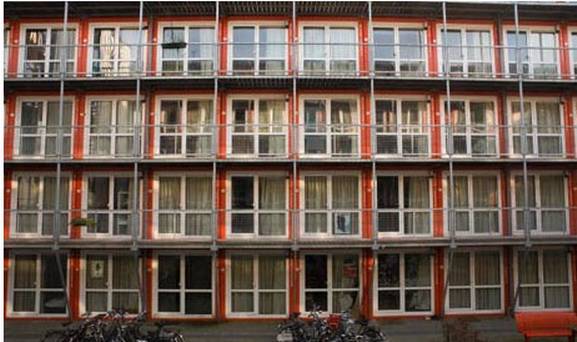
The eight members of the gypsy family have compared their container homes, numbers 48a and 48b, to a concentration camp and accused Amsterdam council of “pure racism”.
Francois Lonis, an ex-boyfriend of one of the Dimitrov daughters who still lives with the family, criticised Mr van der Laan for commemorating the Holocaust while “discriminating” against Roma. “The mayor talks about Auschwitz but sends us to this place,” he said.
“Where is my mother-in-law supposed to do the shopping. Our television does not fit inside.”
The housing camps have been nicknamed “scum villages” because their establishment follows a 2011 proposal from Geert Wilders, the leader of a populist Dutch right-wing party, for special units to deal with persistent troublemakers.
“Repeat offenders should be forcibly removed from their neighbourhood and sent to a village for scum,” he argued at the time. – Daily Telegraph
Amsterdam residents with a record of harassing their neighbors will be exiled, the city’s mayor announced. After being forced out, they will live under police supervision in special container housing units with only basic amenities.
Authorities in the Dutch capital have formed a task force to identify the worst offenders behind the 13,000 complaints of antisocial behavior the city receives annually, Amsterdam-based daily Het Parool reported.
Those charged who defy a compulsory six-month course in the camps will face eviction and homelessness. Amsterdam Mayor Eberhard van der Laan has allocated an estimated 1.3 million euro to the project, which he argued will protect law-abiding residents from being forced to move by unruly neighbors.
The camp dwellers will supposedly be motivated to change their behavior after they return to the city, authorities said.
“The aim is not to reward people who behave badly with a new five-room home with a south-facing garden. This is supposed to be a deterrent,” a mayoral spokesperson said.
Some have dubbed the camps ‘tuigdorpen’ – ‘scum villages’ – over their similarity to the rhetoric of right-wing anti-immigrant politician Geert Wilders, leader of the Party for Freedom. Last year, Wilders said that “repeat offenders should be forcibly removed from their neighborhood and sent to a village for scum.”
The controversial proposal sparked widespread debate, with the term becoming the Netherlands’ ‘word of the year’ in a poll conducted by Van Dale, the leading national dictionary.
The new policy will come into effect in January. There are several small-scale trial projects of a similar nature already underway in the Netherlands, including a location near Amsterdam where 10 shipping container homes have been set up for persistent offenders.
The world has an extensive record of communities evicting those seen as misfits: Jewish ghettos in Europe, Bantustans for blacks in apartheid South Africa and the Soviet Union’s unofficial ‘rule of 101 km,’ which banned criminals, dissidents and work-dodgers from living closer than 100 kilometers from large cities.
The Netherlands is no exception – troublemakers in the 19th century were exiled to live in special villages in Drenthe and Overijssel outside Amsterdam. – RT
Van Gogh's 'Starry Night' in the Museum of Modern Art in New York, however
The operation began moments after the Van Gogh Museum in Amsterdam closed Sunday evening. Men removed alarm tags from behind some of Vincent Van Gogh’s greatest masterpieces, including “Sunflowers,” “Irises” and the famously crooked “Bedroom,” and quickly pulled the paintings down from the museum’s walls.
Fortunately, they were not thieves carrying out an epic heist, but curators preparing the works for transport to a temporary location across town where they will be on display for the next seven months while the museum is closed for renovations.
In all, 75 pieces – the cream of the biggest collection of Vincent Van Gogh’s work – are moving to The Hermitage, an Amsterdam dependency of the Russian state museum.
Watching the lifeblood of his museum disappear, Director Axel Ruger said he wasn’t nervous about the possibility the paintings could be damaged or stolen before they return next year.
“We do this all the time” when individual paintings go on loan to another museum, he said. But never on this scale, he conceded.
“I cannot really say much about the (security) measures that are being taken, because you will understand that we need to keep those confidential in order to safeguard the security of the transport,” he said.
Standing near a blank space on the wall where Van Gogh’s final work, the 1890 painting “Wheatfield with Crows,” had hung just minutes earlier, Curator Leo Jansen described in brief the treatment the paintings would undergo.
After being loaded onto felt-covered trolleys, they would be taken to a workshop to be wrapped in protective insulation and packed into hard-shell carrying cases called “turtles” that are resistant to both physical shocks and temperature changes.
The cases have been assigned code numbers rather than bearing the paintings’ individual names.
About an hour later, the first shipment was loaded onto a yellow van and then driven away under police escort. The route each shipment followed was kept secret until the last moment.
The operation continued like clockwork through Sunday night and into the day Monday in order to get the paintings on display again as soon as possible: the Van Gogh Museum is Amsterdam’s most popular, attracting 1.6 million visitors in 2011 – eclipsing both the Rembrandt-rich Rijksmuseum and the Anne Frank House museum.
[ad 1]
The exhibit at The Hermitage opens Saturday and runs through mid-April, with the Van Gogh Museum to reopen on April 25, 2013.
The closure of the Van Gogh Museum was timed in part to coincide with the reopening next door of the lesser-known Stedelijk, or city museum, which houses works by Dutch Modernists Piet Mondriaan and Gerrit Rietveld, as well as Pablo Picasso, Marcel Duchamp, Henri Matisse and many others.
Dubbed “the bathtub” by local press, the most notable new feature of the renovated Stedelijk is a white roof with an overhang that stretches so far from the side of the building it looks like it might simply break off.
Architects say it is structurally sound, made possible thanks to a stronger-than-steel composite material. – AP
This website uses cookies to improve your experience. We'll assume you're ok with this, but you can opt-out if you wish. Cookie settingsACCEPT
Privacy & Cookies Policy
Privacy Overview
This website uses cookies to improve your experience while you navigate through the website. Out of these cookies, the cookies that are categorized as necessary are stored on your browser as they are essential for the working of basic functionalities of the website. We also use third-party cookies that help us analyze and understand how you use this website. These cookies will be stored in your browser only with your consent. You also have the option to opt-out of these cookies. But opting out of some of these cookies may have an effect on your browsing experience.
Necessary cookies are absolutely essential for the website to function properly. This category only includes cookies that ensures basic functionalities and security features of the website. These cookies do not store any personal information.
Any cookies that may not be particularly necessary for the website to function and is used specifically to collect user personal data via analytics, ads, other embedded contents are termed as non-necessary cookies. It is mandatory to procure user consent prior to running these cookies on your website.